


TL;DR:
- Verify that your chosen interstate mover is authorized by FMCSA and holds valid insurance before signing any agreements. Starting your planning at least eight weeks ahead gives you the best chance to secure reliable service, get accurate bids, and declutter effectively. Always review and sign only complete, accurate documentation to ensure legal protection and prevent move-related issues.
TL;DR: Book an FMCSA-authorized interstate mover, get a written estimate, and start your timeline well in advance. Your single next action: look up any mover’s USDOT and MC numbers on the FMCSA SAFER portal and confirm “Authorized for HHG” before you sign anything.

This interstate moving checklist for 2026 covers everything from the first budget conversation to your first week in the new state, with FMCSA-verified steps at every stage.
High-priority tasks to complete right now:
- Verify USDOT and MC numbers on SAFER and confirm “Authorized for HHG” status
- Request multiple written estimates from licensed carriers (in-home or virtual survey preferred)
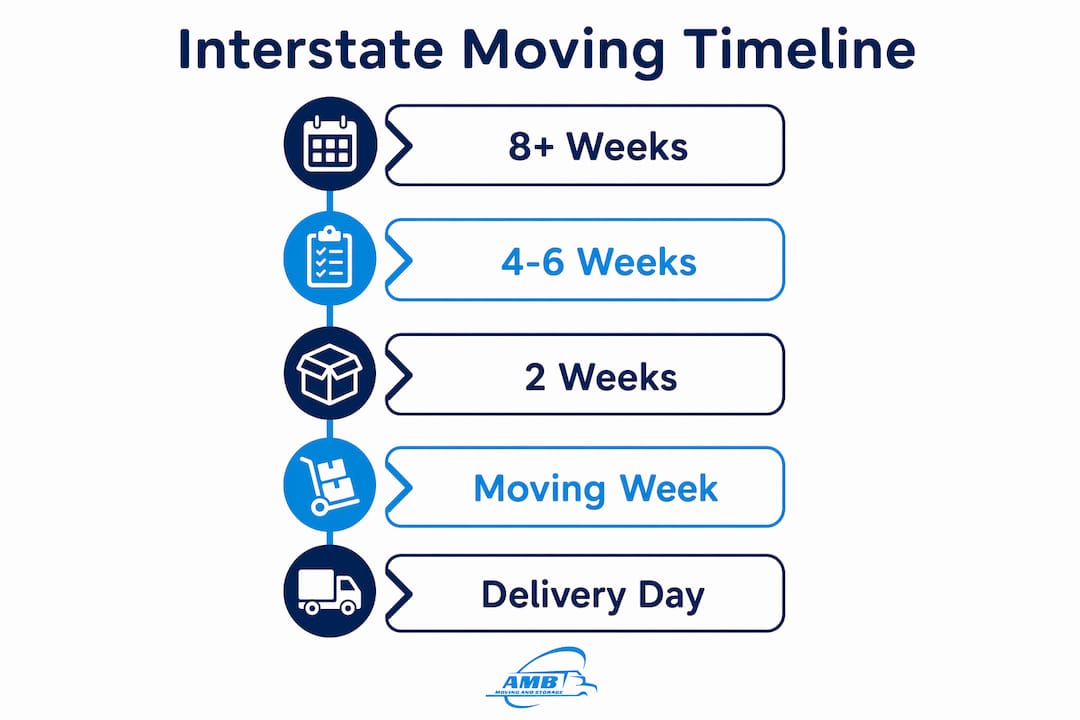
- Set your move date and build an 8-week countdown calendar
- Start a room-by-room inventory with photos of high-value items
- Gather key documents: lease or closing paperwork, insurance policies, medical records
- Confirm valuation options (full-value protection vs. released value) before signing
- Schedule utility disconnection and reconnection dates at both addresses
- Begin decluttering: anything you donate or sell reduces your shipment weight and your bill
- Notify your employer’s HR department and your children’s schools of the move date
- Set up USPS mail forwarding at least two weeks before moving day
Pro Tip: Never let a mover load your truck before you have a signed bill of lading in your hand. A carrier that pressures you to sign a blank or incomplete document is the single clearest warning sign of a hostage-load situation, where your belongings are held until you pay far above the estimate.
Table of Contents
- What should you do 8+ weeks before your interstate move?
- How do you vet and choose an interstate moving company?
- What should you do 4–6 weeks before moving day?
- What confirmations do you need two weeks before moving?
- What should you do during moving week and on move-out day?
- What happens at delivery and how do you settle in?
- How are interstate moving costs calculated?
- What do insurance and valuation options actually cover?
- How do you handle cars, pets, plants, and other special items?
- How do you recognize moving scams and red flags?
- FMCSA verification checklist and 2026 cost benchmarks
- Key Takeaways
- AMB’s perspective on what most families get wrong
- Ready to move? Get a quote from AMB Moving & Storage
- Official links and useful resources
What should you do 8+ weeks before your interstate move?
Starting your state-to-state moving plan at least eight weeks out is not just good advice. It is the difference between locking in a preferred move date and scrambling for whatever truck is available. Peak moving season runs May through September, and carriers in popular corridors book out fast.
Why the timeline matters for cost: Interstate moving costs are calculated primarily on shipment weight and distance. The earlier you get written estimates, the more time you have to compare them accurately and reduce weight through decluttering before the mover’s scale determines your final bill.
Budget line items to estimate at this stage:
- Linehaul charge (weight in pounds × miles traveled, carrier’s rate per pound-mile)
- Packing labor and materials (full-service vs. self-pack vs. partial)
- Accessorial fees: stair carries, long carries, elevator fees, shuttle service
- Storage-in-transit if your delivery window does not align with your new home’s availability
- Vehicle transport (open or enclosed carrier)
- Deposit amount and refund terms
Choosing your service level shapes everything downstream. Full-service packing means the mover handles every box; partial packing means you do the easy rooms and they handle fragile items; a DIY container means you load and they drive. Full service costs more upfront but reduces your personal labor and, critically, gives the carrier more liability exposure for damage they cause during packing.
Action steps for weeks 8–12:
- Walk every room and build a written inventory (item, room, approximate size/weight, photo)
- Pull together relocation documents: employment letter, school enrollment forms, lease or purchase agreement, insurance cards
- Request a minimum of three in-home or virtual surveys from licensed carriers. Phone quotes alone are unreliable for any shipment over 1,000 pounds, and federal practice treats a walkthrough-based inventory as the standard for accurate written estimates
- Compare estimates line by line, not just the bottom number
- Confirm whether each estimate is binding or non-binding before you proceed
How do you vet and choose an interstate moving company?
The single most effective step you can take is to verify USDOT and MC numbers on SAFER and confirm “Authorized for HHG” status before you book. That one check, according to FMCSA consumer guidance, prevents the majority of common interstate move failures.
Step-by-step SAFER verification
- Go to the FMCSA SAFER Company Snapshot and enter the mover’s USDOT number or company name.
- Confirm “Operating Status” reads “AUTHORIZED” — not “NOT AUTHORIZED” or “OUT OF SERVICE.”
- Check “Authorized for HHG” (household goods) is listed as “Yes.”
- Review the insurance filing section: carriers must carry at least $750,000 BIPD for household goods, plus cargo coverage of at least $5,000 per vehicle and $10,000 per occurrence.
- Note the date of the most recent insurance filing to confirm coverage is current.
- Search the mover’s USDOT and MC numbers in the FMCSA National Consumer Complaint Database to review complaint history for the past 36 months.
Carrier vs. broker: why the distinction matters
Many families hire what they think is a carrier and discover on move day that a broker booked a different company to do the actual work. A broker arranges transportation but does not move your goods. Under federal rules, brokers must hold a surety bond and disclose their role in writing. A USDOT number alone is not enough: the company must also hold an MC number specifically authorized for household goods transport. If SAFER shows only freight authority, not HHG authority, that company cannot legally move your belongings across state lines.
Binding vs. non-binding estimates
A binding estimate locks the price. You pay exactly what the estimate says, regardless of actual weight, as long as you do not add items or services after signing. A non-binding estimate is an approximation. The final charge is based on actual weight, and federal regulations limit what you must pay at delivery to a moderate amount above the written estimate; any charges above that are billed separately and paid later. That protection is real, but it still allows a meaningful gap between estimate and final bill if the survey was inaccurate.
For a non-binding estimate, insist on a physical or virtual in-home survey. A quote given over the phone with no walkthrough is not a reliable basis for an interstate move.
Required documents at pickup
- Bill of lading: The legal contract between you and the carrier. The driver must hand you a copy before or at the time of loading. Do not let loading begin without it.
- Written estimate: Must be signed and dated by both parties.
- Inventory list: A numbered list of every item loaded, with condition noted.
- Order for service: Authorizes the carrier to perform the move under the agreed terms.
If any of these documents are blank, incomplete, or inconsistent with what you agreed to, do not sign. Under 49 CFR Part 375, movers are required to provide written estimates and a bill of lading for every interstate household goods shipment.
Pro Tip: During the survey, record a video walkthrough of every room and narrate the high-value items. If a claim arises later, that video establishes pre-move condition far more convincingly than a written inventory alone.
What should you do 4–6 weeks before moving day?
Four to six weeks out is when planning shifts to execution. By now your mover is booked and your estimate is signed. This window is for locking in every supporting service and getting serious about packing.
Packing checklist for this phase:
- Start with rooms you use least: guest rooms, storage areas, seasonal closets
- Label every box on the top and at least one side: room, contents, and handling notes (“fragile,” “this side up”)
- Build a “first night” box per person: toiletries, a change of clothes, phone chargers, medications, and any documents you will need immediately
- Photograph the contents of boxes holding electronics, art, or collectibles before sealing
- Use best packing practices for long-distance moves: double-wall boxes for heavy items, cell packs for dishes, wardrobe boxes for hanging clothes
- Color-code boxes by room so movers can place them correctly at the destination without asking
Building your inventory: Create a spreadsheet or use a moving app with these fields: item name, room of origin, approximate weight or cubic-foot estimate, photo reference number, and declared value for insurance purposes. This document becomes your evidence base if anything is damaged or missing at delivery.
Special-service planning:
- Vehicle transport: Book an open or enclosed carrier at least four weeks out. Confirm the pickup and delivery windows in writing and get the carrier’s USDOT number.
- Pets: If flying, book airline-approved carriers and vet health certificates now. Most airlines require a certificate issued within 10 days of travel, so schedule the vet appointment accordingly.
- Appliances: Dishwashers, washing machines, and refrigerators need professional disconnection. Schedule a plumber or appliance tech at least two weeks before loading day.
- Plants: Check your destination state’s agricultural quarantine rules before you pack a single pot. Several states restrict or prohibit certain plants from entering.
Pro Tip: Before you pack a single box, walk through every room with a “sell or donate” mindset. Every 500 pounds you remove from your shipment can meaningfully reduce your linehaul charge on a non-binding estimate. A weekend estate sale or a few Facebook Marketplace listings can pay for your packing materials.
What confirmations do you need two weeks before moving?
Two weeks out is entirely about confirmations and paperwork. Nothing should be left to assumption at this stage.
Two-week confirmation checklist:
- Re-confirm pickup date, time window, and delivery window with your carrier in writing
- Verify your valuation selection is documented on the bill of lading (full-value protection or released value at 60 cents per pound)
- Confirm all accessorial fees are itemized on your estimate: stair carries, long carries, shuttle service, storage-in-transit
- Review the pickup inventory list and flag any items added since the original survey
- Schedule utility disconnection at your current address for the day after loading
- Schedule utility connection at your new address for the day before or day of delivery
- Submit a USPS change-of-address form (available at usps.com) with a start date matching your move date
- Notify your bank, credit card issuers, and investment accounts of your new address
- Update your auto and homeowner’s or renter’s insurance with the new address and confirm coverage during transit
- Contact your children’s current school to request records transfer and enrollment paperwork for the new district
- Schedule medical and dental records transfers with every provider
Timeline callouts for specific services:
- Vehicle shipping: Confirm pickup window and delivery estimate with your auto transport carrier. Photograph the vehicle thoroughly before handoff.
- Pet airline reservations: If you have not booked yet, do it now. Cabin space for pets is limited and fills quickly on popular routes.
- Medical records: Some providers require 5–10 business days to process transfer requests. Start this now, not the week of the move.
For families navigating this process, the interstate moving step-by-step guide for families 2026 covers the paperwork sequence in more detail.
What should you do during moving week and on move-out day?
Moving week is about verification, presence, and documentation. The decisions you make during loading have direct consequences at delivery.
Move-week checklist:
- Confirm the mover’s arrival time 48 hours in advance
- Prepare cash or a certified check for any balance due at pickup (carriers may require payment before loading begins)
- Charge all devices and back up any computers or external drives
- Disassemble furniture that requires it and set aside hardware in labeled bags taped to the piece
- Clear pathways through every room and protect floors and doorframes if the mover does not supply padding
Move-day checklist:
- Be present for the entire loading process. Do not leave the property.
- Walk through each room with the crew lead before loading begins and point out fragile or high-value items
- Photograph the condition of furniture, appliances, and walls before they are moved
- Watch the inventory list as it is created. Every item gets a numbered sticker; confirm the number and condition notation match what you see.
- Do not sign the bill of lading until you have read every line. Confirm the pickup and delivery dates, the estimate type, and the payment terms.
- Conduct a final walkthrough of every room, closet, cabinet, attic, and garage after the truck is loaded
Sample inventory fields to track during loading: item number, description, room, condition code (from the carrier’s standard scale), and your own condition note or photo reference.
Pro Tip: For non-binding estimates, you have the right to request weigh tickets at pickup and again at delivery. Insist on them. If the actual weight comes in significantly higher than the survey estimate, that gap tells you the survey was inaccurate — and it gives you grounds to question the final charge. At delivery, federal regulations limit what you are required to pay to a moderate amount above the written estimate; any charges above that must be billed separately.
What happens at delivery and how do you settle in?
Inspect before you sign. That is the rule at delivery, and it protects every claim you might need to file.
Delivery inspection checklist:
- Walk through the truck with the driver before any item is brought inside
- Check each item against the numbered inventory list as it comes off the truck
- Note any visible damage on the inventory sheet before signing. Write “subject to further inspection” if you cannot fully check everything before the driver needs to leave.
- Photograph every damaged item immediately, including the packaging
- For non-binding estimates, request the weigh tickets and confirm the final weight matches what was communicated
Delivery windows: Consolidated interstate moves typically carry a delivery window of 2 to 21 days, with most actual deliveries landing somewhere in the middle of that range. Expedited or exclusive-use service shortens the window but costs more. Confirm your window in writing before moving day.
Filing a claim:
- Notify the carrier in writing within 9 months of delivery for loss or damage claims.
- Attach photos, the inventory sheet with damage notations, and repair or replacement estimates.
- Keep copies of every communication.
- If the carrier does not respond or denies a valid claim, file a complaint with the FMCSA National Consumer Complaint Database.
- All interstate carriers are required to offer arbitration as a dispute resolution option.
Post-move priority list:
- Update your driver’s license and vehicle registration at the new state’s DMV (most states require this within 30–60 days of establishing residency)
- Register to vote at your new address at vote.gov
- Transfer medical, dental, and school records if not already done
- Confirm USPS mail forwarding is active
- Locate the nearest urgent care, hospital, and pharmacy
- Introduce yourself to neighbors and find your local community resources: library card, parks, community center
How are interstate moving costs calculated?
Costs are driven primarily by weight and distance. Accessorial charges and valuation choices create most of the surprise fees that families encounter at delivery.
Core cost components:
- Linehaul: The base charge, calculated from shipment weight (in pounds) multiplied by the distance (in miles) at the carrier’s rate per pound-mile
- Fuel surcharge: A percentage added to the linehaul, adjusted periodically
- Packing labor and materials: Charged per hour or per box, depending on the carrier
- Stair carry / long carry: Fees apply when movers must carry items beyond a standard distance from the truck or up multiple flights
- Shuttle service: If a full-size moving truck cannot access your street or building, a smaller shuttle vehicle is used at an additional charge
- Storage-in-transit: Short-term warehousing when pickup and delivery dates do not align; charged per day or per month
- Vehicle transport: Separate from the household goods shipment; priced by distance and vehicle type
- Full-value protection: An additional charge for declared-value coverage above the default released-value rate
Sample cost comparison checklist (use this when reviewing estimates side by side):
- Is the estimate binding or non-binding?
- What is the estimated shipment weight and how was it determined (survey vs. phone)?
- Are packing materials itemized separately?
- Which accessorial fees are included and which are “if applicable”?
- What is the storage-in-transit rate and minimum period?
- What valuation option is included, and what does it cost to upgrade?
- What is the delivery window and is expedited service available?
For 2026 benchmark ranges by route, Ambmovingservices publishes the 2026 Interstate Moving Cost Report, which provides route-based cost bands and explains the variance drivers that push a move toward the high or low end of the range.
| Cost Component | What Drives It | Watch For |
|---|---|---|
| Linehaul | Weight × distance × rate | Survey accuracy; weigh tickets |
| Fuel surcharge | Distance and current fuel index | Confirm rate at booking |
| Packing labor | Hours or per-box rate | Full-service vs. partial packing |
| Accessorials | Building access, stairs, shuttle | Ask for itemized list upfront |
| Storage-in-transit | Days in warehouse | Minimum period and daily rate |
| Valuation | Coverage level chosen | Default is 60 cents/lb released value |
Pro Tip: To get a true apples-to-apples comparison between carriers, ask each one to quote the same service level: same estimated weight, same valuation option, same accessorials. A quote that looks $800 cheaper may simply exclude full-value protection or assume ground-floor access when you live on the third floor.
What do insurance and valuation options actually cover?
Carrier valuation and third-party insurance are not the same thing. The bill of lading tells you which one applies to your shipment.
The two standard valuation options under federal rules:
- Released value (Option 2 / Waiver of Full Value Protection): The default if you do not choose otherwise. Liability is limited to 60 cents per pound per article. A 50-pound flat-screen television damaged beyond repair pays out $30. No additional charge for this option, but the coverage is minimal.
- Full-value protection (Option 1): The carrier is liable for the replacement value or repair cost of damaged or lost items, subject to any deductible you select. This option costs more and the rate varies by carrier and declared value.
Documents needed to support a claim:
- Signed inventory sheet with damage notations made at delivery
- Photographs of damaged items and their packaging
- Repair estimates or replacement receipts
- Original purchase receipts or appraisals for high-value items
- All written communications with the carrier about the claim
Interstate carriers must show cargo coverage of at least $5,000 per vehicle and $10,000 per occurrence on their SAFER snapshot. For high-value items, antiques, or art, that minimum is often insufficient. A supplemental third-party policy from a specialty insurer fills the gap.
If a carrier denies a valid claim or fails to respond within the required timeframe, file a complaint through the FMCSA’s consumer complaint process. All interstate carriers are federally required to participate in an arbitration program, which gives you a binding dispute resolution path without going to court.
How do you handle cars, pets, plants, and other special items?
Each category has its own rules and its own failure mode if you skip the prep.
Cars: Use a licensed auto transport carrier with its own USDOT number. Open transport is standard and costs less; enclosed transport protects the vehicle from road debris and weather. Before handoff, photograph every panel, wheel, and the interior. Remove all personal items from the car — most carriers prohibit them and will not cover damage to anything left inside.
Pets: Book early. Airline cabin space for pets is limited, and many breeds are restricted from cargo holds. Your vet must issue a health certificate within 10 days of travel for most airlines and for crossing certain state lines. Keep vaccination records, rabies certificates, and the vet’s contact information in your carry-on.
Plants: Several states, including California, Arizona, and Florida, have agricultural quarantine rules that restrict or prohibit certain plants from entering. Check your destination state’s department of agriculture website before you pack a single pot. Most interstate movers will not transport plants at all, which means you are driving them yourself or leaving them behind.
Appliances: Washing machines need the drum secured with shipping bolts (most manufacturers include them; check the manual). Refrigerators should be defrosted and dried 24 hours before loading. Gas appliances require a licensed technician to disconnect. Schedule these appointments before loading day, not the morning of.
Antiques and high-value items:
- Get a written appraisal from a certified appraiser before the move
- Photograph every angle and document any existing wear or damage
- Discuss custom crating with your mover; standard moving blankets are not adequate for fragile antiques
- Declare the item’s value on the bill of lading and confirm it is covered under full-value protection
Pro Tip: For art, antiques, jewelry, and collectibles, keep a digital folder with the appraisal, purchase receipt, and pre-move photos stored in cloud storage. If a claim arises, you can share that folder with the carrier and your insurer immediately, without hunting through boxes.
How do you recognize moving scams and red flags?
Certain behaviors and paperwork gaps reliably predict higher risk. Walk away when you see them.
Red flags to watch for:
- Refusal to provide USDOT or MC numbers, or numbers that do not match SAFER records
- Demands for a large cash deposit before any service is performed
- A quote that is dramatically lower than every other estimate you received
- Refusal to conduct an in-home or virtual survey before quoting
- No written estimate offered, or pressure to sign a blank or incomplete document
- Insurance that does not appear on the SAFER snapshot
- A company name or address that does not match SAFER registration
- Rented trucks with no company markings on moving day
FMCSA guidance states: “You should avoid brokers and movers that are not registered with FMCSA or refuse to perform a physical survey of your household goods.” Operating as an interstate household-goods carrier without proper registration is a federal violation under 49 U.S.C. §13902 and can trigger civil penalties and out-of-service orders. If a mover refuses to show USDOT/MC numbers or appears “NOT AUTHORIZED” on SAFER, do not book and do not pay a deposit.
If you suspect fraud or unlawful behavior:
- Stop the transaction immediately and do not pay any additional funds.
- Document everything: save all emails, texts, contracts, and receipts.
- File a complaint at the FMCSA National Consumer Complaint Database.
- Contact your state attorney general’s consumer protection office.
- If goods are being held hostage, contact local law enforcement and FMCSA simultaneously.
- Small-claims court is an option for disputes under your state’s dollar threshold, typically $5,000–$10,000.
For a detailed walkthrough of the FMCSA verification process, including how to read a SAFER snapshot and what each field means, that guide covers the full lookup sequence step by step.
FMCSA verification checklist and 2026 cost benchmarks
Use these FMCSA verification steps before you book any carrier. USDOT and MC confirmation, “Authorized for HHG” status, current insurance filings, and no out-of-service flags are the four non-negotiable checks.
| SAFER Field | What to Confirm | Why It Matters |
|---|---|---|
| Operating Status | “AUTHORIZED” | Carrier is legally permitted to operate |
| Authorized for HHG | “Yes” | Carrier can legally transport household goods interstate |
| BIPD Insurance | At least $750,000 on file | Minimum required under FMCSA regulations |
| Cargo Insurance | At least $10,000 per occurrence | Minimum cargo coverage for HHG carriers |
| Out-of-Service Flag | None present | Active flags indicate safety or compliance violations |
| MC Number | Matches what the company provided | Confirms identity and prevents impersonation |
2026 cost benchmarks from Ambmovingservices: The 2026 Interstate Moving Cost Report shows that typical three-bedroom interstate moves fall into distinguishable cost bands depending on distance and service level. Route variance, not just mileage, drives most of the price differential: a move between two dense metro areas with elevator access costs materially less than the same mileage between rural origins and destinations with limited truck access. Accepting a quote well below the benchmark range for your route is one of the clearest indicators of a low-ball bid that may become a hostage-load situation at delivery.
Statistic callout: According to Ambmovingservices’s route-data analysis, the variance between the low and high end of cost bands for the same three-bedroom move is driven primarily by access conditions, service level, and seasonality, not just distance. Families who use route-based benchmarks to evaluate quotes are better positioned to identify outlier bids before signing.
Key Takeaways
A successful interstate move in 2026 requires FMCSA-verified carrier selection, a written binding or non-binding estimate with full-value protection, and a documented 8-week timeline that starts with decluttering and ends with a signed bill of lading in your hand at pickup.
| Point | Details |
|---|---|
| Start 8 weeks out | Book your carrier and request written estimates early; peak-season availability fills fast. |
| Verify on SAFER first | Confirm USDOT, MC, “Authorized for HHG,” and current insurance before paying any deposit. |
| Know the 110% rule | Non-binding estimates cap your delivery payment at a value moderately above the written estimate; amounts above that are billed later. |
| Document everything | Photograph high-value items before loading and note any damage on the inventory sheet at delivery before signing. |
| Ambmovingservices for your move | Ambmovingservices is a licensed, insured nationwide mover with 2026 route-based cost benchmarks and a free quote process. |
AMB’s perspective on what most families get wrong
Most families treat mover selection as a price comparison. They collect three quotes, pick the middle one, and assume the process is done. The paperwork is where moves actually succeed or fail, and most people do not read it until something goes wrong.
The bill of lading is the contract. Not the estimate, not the sales call, not the confirmation email. The bill of lading. If the pickup date, delivery window, valuation option, or payment terms on that document do not match what you agreed to verbally, you have no legal basis to dispute the discrepancy later. The FMCSA’s framework gives consumers real protections, but those protections only activate when the paperwork is correct and in your possession.
The other thing families consistently underestimate is the weight of their shipment. A three-bedroom home that “feels light” because the furniture is older often weighs more than expected once every closet, cabinet, and garage shelf is counted. That gap between estimated and actual weight is where non-binding estimates create the most friction. The 110% rule limits what you pay at delivery, but it does not eliminate the surprise. A pre-move declutter and an accurate in-home survey are the two most effective ways to close that gap before it becomes a problem.
Ambmovingservices handles interstate and long-distance moves nationwide, with FMCSA-compliant documentation at every stage. For families who want the paperwork to be right the first time, that matters more than the quote.
Ready to move? Get a quote from AMB Moving & Storage
Ambmovingservices takes the guesswork out of long-distance moving by pairing FMCSA-licensed service with transparent, route-based pricing from the 2026 Interstate Moving Cost Report. You get a written estimate based on an actual survey, not a phone guess, along with full-value protection options, professional packing, vehicle transport, and secure storage-in-transit when your delivery window needs flexibility.
Services available for your interstate move:
- Full-service and partial packing with professional materials
- Licensed, insured interstate and cross-country transport
- Vehicle transport coordination (open and enclosed carriers)
- Short- and long-term storage-in-transit
- Expedited and exclusive-use delivery options for time-sensitive moves
Every move is backed by FMCSA-compliant documentation: written estimate, bill of lading, and inventory list issued at pickup. To schedule an in-home or virtual survey and get your written estimate, request a quote today.
Official links and useful resources
Bookmark these before you request your first quote.
- FMCSA SAFER Company Snapshot: Look up any mover’s USDOT and MC numbers, operating status, HHG authorization, and insurance filings. Use this before signing anything.
- FMCSA National Consumer Complaint Database (NCCDB): Search complaint history by USDOT or MC number. Covers the past 36 months of complaints and dispositions.
- Your Rights and Responsibilities When You Move (FMCSA handbook): The federal consumer rights booklet your mover is required to give you. Read it before your survey appointment.
- Protect Your Move (FMCSA consumer guidance): FMCSA’s main consumer hub for interstate moving, including red-flag guidance and enforcement information.
- USPS Change of Address: Submit your mail forwarding request at least two weeks before moving day.
- Vote.gov: Register to vote at your new address after you arrive in the new state.
- How to verify a moving company license: Step-by-step SAFER lookup guide from Ambmovingservices.
- Federal regulations for movers: Plain-language breakdown of the federal rules that govern your interstate move.
- 2026 Interstate Moving Cost Report: Route-based cost benchmarks from Ambmovingservices to help you evaluate quotes realistically.
- AMB Moving Services quote page: Schedule your in-home or virtual survey and get a written estimate.
This article is general information for planning purposes. For legal, regulatory, or claim-specific questions, consult the FMCSA directly or a qualified consumer protection professional for your specific situation.