

TL;DR:
- Verifying an interstate mover’s federal registration is essential to avoid costly scams and ensure legal compliance. Using tools like LIVIEW and SAFER, consumers can confirm a company’s registration, insurance, safety record, and operating authority before signing any contract. Combining federal database checks with consumer reviews and safety data helps families make informed, confident moving decisions.
Hiring an interstate mover without verifying their federal registration is one of the most expensive mistakes families make during a long-distance move. The FMCSA moving company search, powered by tools like the FMCSA’s LIVIEW portal and SAFER Company Snapshot, gives you direct access to a carrier’s registration status, insurance coverage, safety record, and complaint history. These are official federal databases, and most people never use them. This guide walks you through every step so you can verify any mover before you sign a contract, protect your belongings, and avoid the fraud that costs consumers millions of dollars every year.
Key Takeaways
| Point | Details |
|---|---|
| FMCSA registration is required | Every legitimate interstate mover must hold a USDOT number and active FMCSA operating authority. |
| Two tools, two purposes | Use LIVIEW to check registration and insurance status; use SAFER for safety ratings and crash data. |
| Movers and brokers differ legally | Brokers coordinate moves but must use only FMCSA-registered carriers, which changes your rights as a consumer. |
| The 110% rule protects you | Federal law caps moving charges at 110% of a non-binding estimate, and exceeding that is a federal violation. |
| Cross-check everything | Combining FMCSA data with verified moving company reviews gives you the most reliable picture of a carrier. |
How FMCSA moving company search works
The Federal Motor Carrier Safety Administration, commonly known as FMCSA, is the federal agency that regulates commercial vehicle safety in the United States, including all interstate household goods movers. When you hear the phrase “FMCSA moving company search,” what you are actually doing is querying one or more of FMCSA’s public databases to verify a carrier’s legal standing before they touch your belongings.
Interstate moving companies must hold a USDOT number and be registered with FMCSA, while brokers must also be registered and are legally required to use only FMCSA-registered movers for any interstate moving services they coordinate. This distinction matters far more than most people realize.
Here is what FMCSA registration actually covers:
- Active operating authority confirms the carrier is legally permitted to transport household goods across state lines
- USDOT number is a unique federal identifier assigned to every regulated carrier and is the single most useful piece of information for any search
- Insurance verification confirms the mover carries the minimum liability coverage required by federal law
- Broker vs. mover status defines the legal relationship between you and the company coordinating or performing your move
The most common misconception is that a company with a professional website and positive online presence is automatically registered. It is not. Anyone can build a website and call themselves a moving company. FMCSA distinguishes between movers who own trucks and employ drivers and brokers who arrange moves through third-party carriers. If you hire a broker thinking they are a mover, you may end up with an unknown subcontractor handling your household goods with no direct accountability to you.
Knowing whether a company is a mover or broker is the most important early verification step, since their legal responsibilities and consumer protections differ significantly.
Step-by-step FMCSA carrier verification
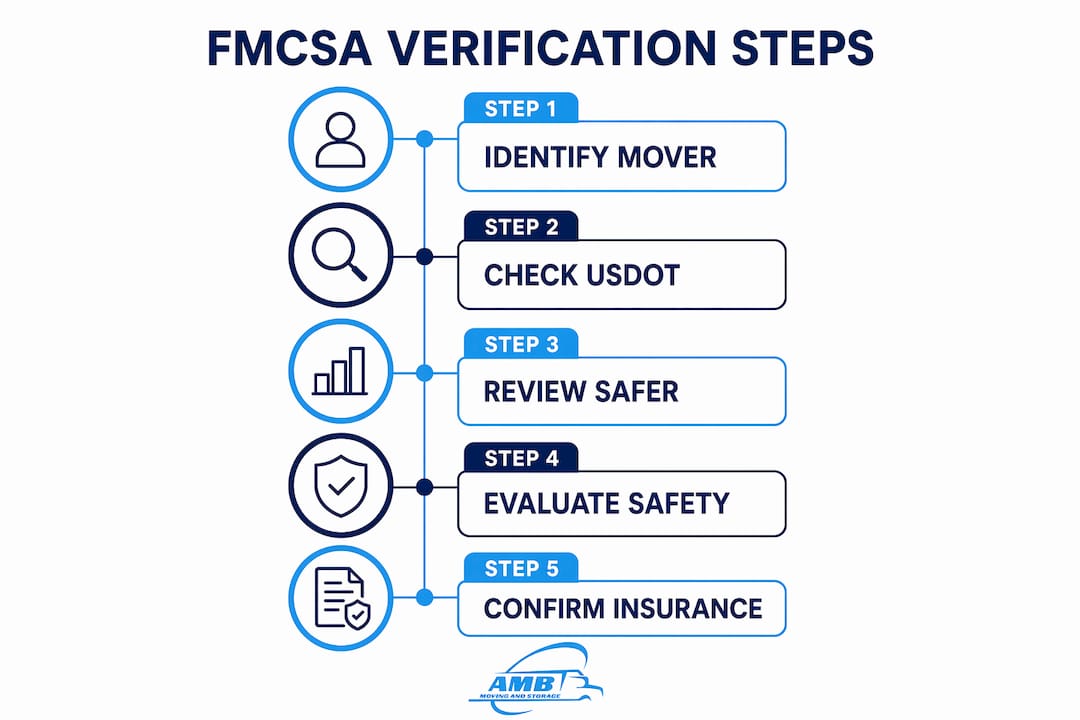
The process is straightforward once you know which tools to use and in what order. Here is exactly how to verify any mover before committing to a contract.
-
Collect the mover’s USDOT number. Ask any mover you are considering for their USDOT number before any conversation about pricing. Legitimate FMCSA-licensed movers will provide it immediately. If a company hesitates or says they do not have one, stop there.
-
Run the LIVIEW carrier query. Go to the FMCSA LIVIEW portal and enter the USDOT number, docket number, or company name along with state to narrow results. This database confirms current registration and insurance status. If you search by company name only, always select a state to avoid matching unrelated companies with similar names.
-
Run the SAFER Company Snapshot. The SAFER snapshot provides a free, one-carrier-at-a-time record that includes company size, safety rating, roadside inspection summaries, out-of-service rates, and crash data. You can search by USDOT number, MC/MX number, or company name.
-
Match the legal entity name. Cross-check the legal entity name shown in FMCSA records against the name on your contract or estimate. This step prevents what is called “verification drift,” where you accidentally confirm a different company with a similar name.
-
Check operating authority for household goods. Active registration is not enough. The carrier’s operating authority must specifically cover household goods transportation. A carrier authorized only for general freight is not legally cleared to move your personal belongings interstate.
-
Review safety and inspection data. Confirm the inspection data from the SAFER portal to check the out-of-service rate compared to the national average. A significantly higher-than-average out-of-service rate signals maintenance problems or driver compliance issues.
Pro Tip: When searching by name in LIVIEW, avoid using a wildcard () as the first character. According to FMCSA’s own search guidance, wildcard-first searches change the matching behavior and take significantly longer to return results. Use the state filter and enter the company’s exact legal name first.*
| FMCSA Tool | What It Shows | Best Used For |
|---|---|---|
| LIVIEW Carrier Query | Registration status, insurance, broker vs. mover classification | First-pass verification before getting quotes |
| SAFER Company Snapshot | Safety rating, crash data, roadside inspections, operating authority | Deeper due diligence after initial registration check |
| National Consumer Complaint Database | Filed complaints against specific carriers | Identifying patterns of consumer abuse or fraud |
Evaluating safety data and moving company reviews
Confirming that a mover is registered is the floor, not the ceiling. Once you have verified basic registration, the next layer of due diligence involves safety performance data and moving company reviews that go beyond star ratings.
Checking beyond authorization, including inspection and crash data, helps you assess the actual reliability of a carrier in the field. A company with active authority and a clean registration record can still have a poor safety history. Look for these specific signals in SAFER data:
- Out-of-service rate: Compare the carrier’s rate to the national average. For vehicles, anything above 20% is a meaningful warning sign. For drivers, anything above 6% warrants closer scrutiny.
- Crash indicator: FMCSA flags carriers with crash data significantly worse than their peer group. This does not mean the carrier caused every crash, but it reflects overall risk.
- Safety rating: Carriers rated “Unsatisfactory” are legally prohibited from operating. “Conditional” ratings require investigation into the specific violations cited.
For moving company reviews, treat no single platform as authoritative. Instead, look for patterns across multiple sources. A mover with 4.8 stars on one platform but a pattern of complaints about hidden fees, delivered damaged goods, or refused refunds across the FMCSA complaint database and other review sites tells a more honest story than any single score.
The FMCSA complaint database, specifically the National Consumer Complaint Database, is separate from the SAFER portal and tracks consumer-filed complaints. You can search it by company name or USDOT number. Watch for recurring complaint categories: hostage load situations (where belongings are held until extra payment is made), large and unexplained price increases after pickup, and misrepresentation of services.
Pro Tip: Treat the FMCSA SAFER database as your foundation, not your finish line. Combine safety, insurance, and operating authority checks with reading complaint records and cross-checking reviews for the most complete picture of any mover you are considering.
| Verification Source | What It Confirms | Limitation |
|---|---|---|
| FMCSA LIVIEW | Registration, insurance, authority type | Does not show performance or complaints |
| SAFER Snapshot | Safety record, crash data, inspection history | Lags real-time by 30-60 days |
| NCCD Complaints | Consumer-filed complaints against carriers | FMCSA does not resolve individual disputes |
| Online reviews | Customer experience and service quality | Can be manipulated; check for patterns |
Protecting yourself from moving scams and disputes
Even with thorough FMCSA verification, problems can arise during the actual move. Knowing your federal rights gives you real leverage if a situation turns bad.
The most critical protection is the federal 110% rule. Under federal moving company regulations, a carrier cannot charge more than 110% of a non-binding estimate at delivery. If they demand more, you have the legal right to pay the 110% cap and receive your belongings. Any excess beyond that must be billed and collected within 30 days after delivery.
Watch for these red flags before and during your move:
- The company name on the truck or paperwork does not match the name on your contract
- No physical address is provided, or the address leads to a vacant lot or residential property
- The mover demands a large cash deposit before pickup, particularly over 20% of the total estimate
- You receive a quote over the phone without any in-home or virtual survey of your belongings
- The company cannot or will not provide their USDOT number when asked directly
If a dispute does occur, documentation is your most powerful tool. Keep copies of your original estimate, the bill of lading, any written communications, and photos of your belongings before loading. If a carrier holds your goods hostage or demands payment beyond the 110% cap, file a detailed FMCSA complaint immediately, including the USDOT number, the original estimate amount, the amount demanded, and the dates involved.
Filing an FMCSA complaint does not instantly recover your belongings, but it builds an enforcement case that can result in the carrier’s operating authority being suspended or revoked. For immediate recovery, you may need to contact a local attorney or law enforcement alongside the FMCSA complaint.
For added protection, ask your mover specific questions about their binding vs. non-binding estimate options. A binding estimate locks your price regardless of actual weight, which eliminates the 110% dispute scenario entirely.
Quick-reference guide to FMCSA search tools
Here is a consolidated reference for every tool and resource you need when performing carrier verification or filing a complaint.
| Resource | URL | Primary Function |
|---|---|---|
| FMCSA LIVIEW Carrier Query | li-public.fmcsa.dot.gov/LIVIEW | Registration and insurance lookup |
| SAFER Company Snapshot | saferfmcsa.com | Safety rating, inspection data, crash history |
| National Consumer Complaint Database | nccdb.fmcsa.dot.gov | File or search consumer complaints |
| FMCSA Protect Your Move | fmcsa.dot.gov/protect-your-move | General consumer education and moving checklist |
| FMCSA Phone Hotline | 1-888-368-7238 | Report safety violations or emergencies |
The LIVIEW portal is your first stop for every new mover you consider. The SAFER snapshot is where you go deeper. The National Consumer Complaint Database is where disputes get documented for federal enforcement. Use all three together, not as standalone checks.
For families preparing a cross-country relocation, the nationwide moving checklist from Ambmovingservices organizes these verification steps alongside every other preparation task you need to complete before moving day.
My honest take on FMCSA verification
I have watched families spend weeks comparing prices and reading online reviews, then skip the 15-minute FMCSA check that would have saved them everything. It happens more than people want to admit. The combination of moving stress and the assumption that a company with a polished website must be legitimate leads people to skip the one step that actually has federal data behind it.
What I’ve found in practice is that families who run the LIVIEW and SAFER checks early, before getting deeply invested in a price quote, make far better decisions. They catch brokers misrepresenting themselves as direct movers. They spot carriers with suspended authority who are still actively marketing services. They find the mismatch between the charming sales rep and the actual third-party carrier that will show up to load their furniture.
My take: do not treat FMCSA tools as a last resort you use after something feels wrong. Use them before you get emotionally or financially committed to a mover. And do not over-rely on safety ratings alone. A carrier with an “Unrated” status on SAFER is not necessarily unsafe. It may simply be newer or carry light loads. Cross-checking official records with real consumer complaints and conversation with the company gives you something no database alone can provide: judgment.
— AMB
Move with confidence through AMB Moving Services
At Ambmovingservices, FMCSA compliance is not a checkbox. It is the foundation every move is built on. As a registered interstate carrier with active operating authority for household goods, Ambmovingservices operates transparently under federal moving company regulations, so you can verify every credential before you commit. Whether you are planning a long-distance relocation across the country or a state-to-state move for your family, our team provides written estimates, full licensing documentation, and a moving coordinator to guide you through every stage. Check our credentials yourself using the tools in this guide. Then request your free quote at ambmovingservices.com/quote and experience what a properly registered, federally compliant interstate mover actually looks like in practice.
FAQ
What is an FMCSA moving company search?
An FMCSA moving company search is the process of querying federal databases, primarily LIVIEW and SAFER, to verify a carrier’s registration status, insurance coverage, operating authority, and safety record before hiring them for an interstate move.
How do I find a mover’s USDOT number?
Ask the moving company directly or look for it on their website, contract, or estimate paperwork. Legitimate FMCSA-licensed movers are required to display their USDOT number on marketing materials and vehicles.
What does the SAFER Company Snapshot show?
The SAFER snapshot shows a carrier’s company identification, safety rating, roadside inspection out-of-service summary, crash data, and operating authority status, all available free of charge by searching USDOT or MC number.
What is the 110% rule for moving companies?
Federal regulations limit what a mover can charge at delivery to no more than 110% of a non-binding estimate. Any amount above that cannot be collected at delivery and must be billed separately within 30 days.
How do I file a complaint against a moving company?
Submit a detailed complaint through FMCSA’s National Consumer Complaint Database at nccdb.fmcsa.dot.gov. Include the carrier’s USDOT number, your original estimate, the amount charged, and dates. You can also call the FMCSA hotline at 1-888-368-7238.