
Storage access hours are the times your gate code or key works. At most gated self-storage facilities that means roughly 6 AM to 10 PM, though the exact window changes by location, and round-the-clock access exists only at some properties. Office hours are a separate, usually shorter schedule. If you are storing belongings during an interstate move, the difference between the two can decide whether your truck unloads on schedule or sits at a locked gate.
This guide explains how access hours work, why they vary, what 24/7 access does and does not give you, and how to build a long-distance moving timeline around them.
TL;DR
- Access hours (gate open) and office hours (staff on site) are different schedules. Check both for the exact location.
- A window of about 6 AM to 10 PM is common, and 24/7 access is usually an optional feature at select properties, not a default.
- Late-night access does not mean help is available. Lock cutting, paperwork and billing questions wait for office hours.
- Living or sleeping in a unit is prohibited, and facilities watch for it.
- On a cross-country move, schedule loading and unloading inside gate hours, and confirm that trucks, not just people, may enter.
Table of Contents
- Access hours, office hours and service hours: three different things
- Why access hours vary so much
- What 24/7 access really means
- Can you stay overnight in a storage unit?
- Why gate hours matter more on a long-distance move
- Choosing a facility: access hours versus location
- A timeline built around gate hours
- Packing and organizing the unit for easy access
- Our perspective: treat the gate schedule as part of the move plan
- What storage and related fees can cost
- Plan your move with a nationwide moving company
- Plan around the gate, not just the truck
- FAQ
- Sources
Access hours, office hours and service hours: three different things
People often assume that a facility that is “open” is open for everything. In practice, operators run up to three schedules.
| Schedule | What it controls | Typical pattern |
|---|---|---|
| Gate (access) hours | When your code or key opens the gate and the building doors | Early morning to late evening, often about 6 AM to 10 PM |
| Office hours | When a person can rent units, take payments, cut a lock or solve a dispute | Standard business hours, often shorter, and closed on some days |
| Service hours | When support lines, on-site help or loading assistance exist | Varies by operator and may be limited to office hours |
These ranges are typical, not guaranteed. A facility might list gate hours of 6 AM to 10 PM every day, office hours of 9 AM to 5:30 PM on weekdays, shorter Saturday hours and a closed office on Sunday. Always read the posted hours for your specific address, because two sites owned by the same company can differ.
The practical rule: if you need a person, plan for office hours. If you only need to drop off or pick up boxes, gate hours are what matter.
Why access hours vary so much
There is no national standard. Several forces shape the schedule at any one facility.
Security and liability. Gates that close overnight reduce after-hours traffic, and operators have a legal and insurance interest in knowing who is on the property. Inside Self Storage notes that an operator who ignores a tenant sleeping in a unit could be held liable for injuries to people or property resulting from that conduct.
Local zoning and neighbors. A facility next to homes may face conditions on noise and vehicle traffic late at night or early in the morning. Facilities in commercial or industrial zones often have more freedom. A UK-focused explainer on access hours describes planning conditions as one driver of the variation, and the same logic applies to municipal approvals in US cities.
Staffing and technology. Automated gates, keypads and mobile-app entry make longer access practical without extra staff. Older sites with manual gates tend to keep tighter schedules.
Property type. Indoor, climate-controlled buildings often follow the building’s door hours, while drive-up units may have their own gate windows.
What 24/7 access really means
Industry coverage of anytime access points out that most gated operators have limited hours, though many now let customers come and go around the clock. When it is offered, it is usually a feature of a particular property, sometimes with a monthly fee, and sometimes switched on or off through your online account.
Before you pay for it, check four details:
- Is it available at this exact location? A company’s brand page may advertise 24/7 access while only some sites support it.
- Does it include vehicles? Some facilities allow walk-in entry overnight but restrict vehicle movement after dark to limit noise and security risks. If you are unloading a truck, a pedestrian-only window will not help.
- Is there an extra charge? Ask whether it is bundled with the unit or billed separately.
- Is staff help available? It almost never is. Even with 24/7 gate access, nobody is guaranteed to answer the office phone at 3 AM.
For most families, the extended 6 AM to 10 PM window is enough. True overnight access matters mainly for people working shifts, small businesses restocking inventory or anyone with a very tight delivery schedule.
Can you stay overnight in a storage unit?
No. Storage units are not legal residences. State law addresses this directly in some places: for example, Montana’s statute on self-storage use prohibits an operator from knowingly permitting a leased space to be used for residential purposes. Rental agreements across the industry carry similar clauses, and units lack ventilation, plumbing and safe exits for habitation.
Operators also watch for it. Access logs, cameras and walk-through patrols make irregular daily visits and long stays easy to spot. Inside Self Storage describes how operators handle tenants who overstay. Consequences can include restricted gate hours, a required appointment for entry or lease termination, depending on the facility and the lease. If you are between homes during a move, plan a short-term rental or a hotel, not your unit.
Why gate hours matter more on a long-distance move
On a local move, a missed gate window costs you an evening. On an interstate or cross-country move, it can cost a day of truck time, a hotel night and a delivery date.
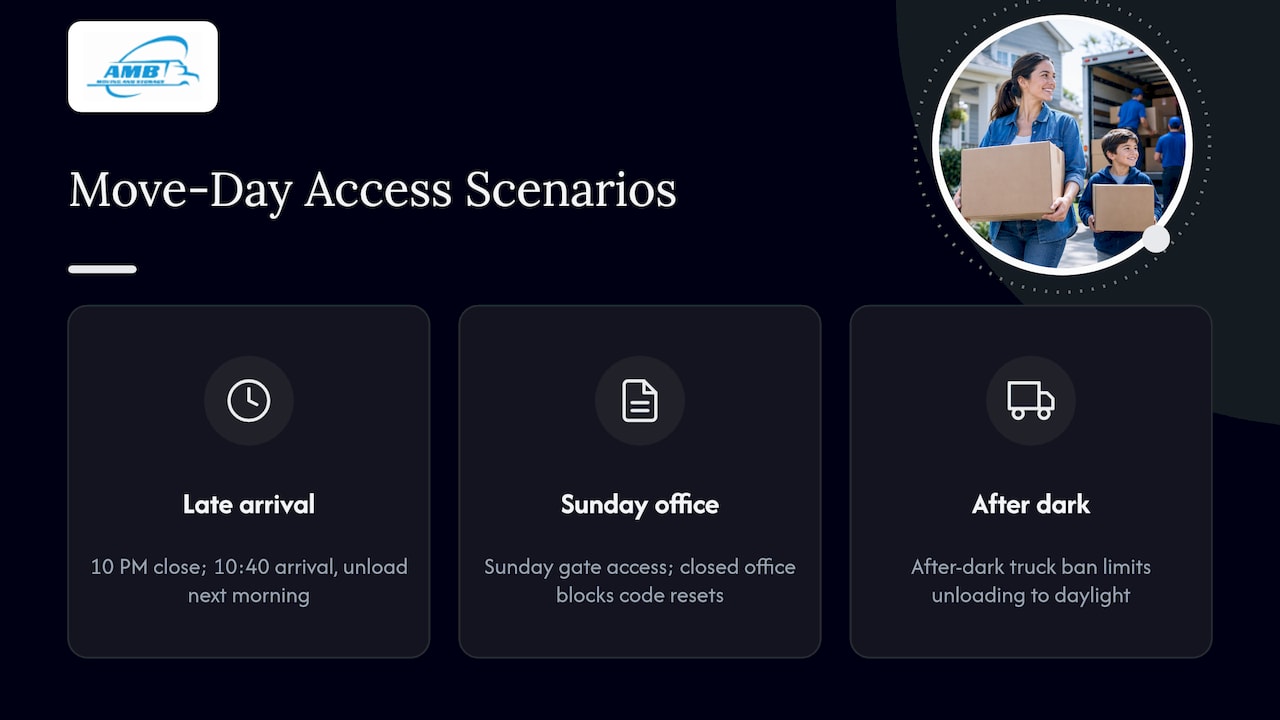
Here are three real scenarios we see in long-distance planning.
The late arrival. A truck leaves a family’s old home in the morning and spends two days on the road. The driver reaches the destination city at 10:40 PM, and the storage gate closed at 10:00 PM. Unloading moves to the next morning, and the crew, the driver and the family all lose time. Building a buffer into the delivery window prevents this.
The Sunday drop. A facility has gate access seven days a week but the office is closed on Sunday. A tenant who needs a lock cut or a gate code reset on Sunday has no one to ask. Anything that needs paperwork should be done on a weekday before move day.
The vehicle restriction. Gate hours run until 10 PM, but trucks are not allowed on the property after dark. The crew can only unload during daylight, which shortens the real window by several hours in winter.
If your storage is part of a larger relocation, a long-distance moving plan should list the storage hours next to the pickup date, the delivery spread and the contact numbers for each stop.
Choosing a facility: access hours versus location
It is tempting to pick the unit with the longest hours. For movers, distance and route often matter more. A 24/7 facility far from your route or your new home can be less convenient than a standard-hours facility along your main transit path or near where you will live. Ask yourself:
- Where will I be in the next 30 to 90 days, and how far is the facility from there?
- Will I be visiting the unit myself, or will movers deliver the contents at a set date?
- If my truck arrives late, is there a flexible after-hours option or an appointment system?
- Do I need climate control for furniture, electronics or documents?
For a deeper look at how storage fits into a relocation, see our guides to temporary storage for long-distance moves and moving storage solutions for long-distance relocations.
A timeline built around gate hours
Use this sequence to keep storage from becoming the bottleneck in your move.
- 60 to 30 days out: Get the posted gate hours, office hours and vehicle rules in writing or from the facility’s account page. Note holiday schedules.
- 30 days out: Decide whether you need extended or 24/7 access, and confirm it can be added to your specific unit. Request your moving cost estimates so storage fees are included in the budget.
- 2 weeks out: Complete any paperwork, insurance proof or lock questions during office hours. Pick a lock that you can remove yourself.
- 1 week out: Confirm the truck’s size and whether it fits the driveway, gate and loading area. Share the facility’s hours with your mover.
- Move day minus 1: Re-check weather and traffic. Plan for the truck to arrive at least two hours before the gate closes.
- Move day: Load the unit in the back-to-front order you will want to retrieve things. Keep an access aisle and a labeled box of essentials near the door.
If your truck must park overnight on a multi-day trip, our guide to truck overnight parking on US moves covers permits and planning.
Packing and organizing the unit for easy access
Gate hours are only useful if you can find things once you are inside. Pack storage the way you want to unpack it: heavy items at the bottom and back, frequently needed items near the door, boxes labeled on two sides and an inventory list on your phone. Freestanding shelving in the unit keeps boxes off the floor and makes aisles reachable. For ideas on using vertical space, this guide to maximizing storeroom space with shelving shows layouts that adapt well to a storage unit.
Our storage solutions checklist for long-distance moves walks through labeling, inventory and what not to store.
Our perspective: treat the gate schedule as part of the move plan
At AMB Moving & Storage Inc., we plan interstate and cross-country moves for families and businesses, and the pattern is consistent. Delays rarely come from the big things. They come from small mismatches: a delivery window that ends after the gate closes, an office that is closed when paperwork is needed, a truck too large for the property.
Our approach is structured planning. We write the pickup date, the delivery spread, the storage hours and the contacts for each stop into one timeline, and we ask customers to confirm the facility details early rather than on move day. Clear communication with the crew and the facility is what keeps a licensed, insured long-distance move on schedule. If storage is part of your relocation, tell us when you request your quote, so the plan accounts for it from the start.
— AMB
What storage and related fees can cost
Access hours are one variable. Cost is another, and fees add up when a move includes storage. The prices below are the ones published in our moving cost guide and on our packing services page.
| Item | Published price |
|---|---|
| Storage services | From $0.50 per cubic foot |
| Professional packing | $1–$2 per cubic foot |
| Specialty item handling (pianos, safes) | From $200 |
| Elevator or stair fees | From $75 |
| Long carry charges | From $75 |
A long carry or a flight of stairs at the destination can matter as much as the truck mileage. Final totals depend on the shipment, the route and the services you choose, so use these as a starting point for moving cost estimates and request a quote for your own move.
Plan your move with a nationwide moving company
If you are comparing interstate movers or cross country movers, ask each one how they handle storage timing, delivery windows and facility rules. We are a licensed and insured nationwide moving company handling interstate and state-to-state moves, with packing, secure storage and specialty moves available as part of the same plan.
Ready to plan your move? Request your free moving quote and tell us your dates, your route and whether you need storage. We will build the timeline around it.
Plan around the gate, not just the truck
Storage access hours are simple once you separate them from office hours. Confirm the gate window, the vehicle rules and the office schedule for your specific location. Pay for 24/7 access only if your move truly needs it. Never count on staff help outside office hours, and leave a buffer so a late truck does not meet a closed gate. A move that is timed around those few facts is cheaper, calmer and faster.
FAQ
What are typical storage access hours?
Many gated facilities offer gate access from about 6 AM to 10 PM, while office hours are shorter. The schedule varies by location, so check the posted hours for your facility. Some sites have shorter or longer windows.
Can I access my storage unit 24/7?
Only if your facility offers it. It is usually a feature at select properties and may carry an extra fee. Confirm whether it covers vehicles as well as foot traffic, and remember that staff are generally not available overnight.
Can I sleep in my storage unit for one night?
No. Residential use is prohibited by rental agreements and by some state laws, such as Montana’s self-storage statute. Facilities monitor access logs and cameras, and violations can lead to restricted access or lease termination.
What should I do if my truck will arrive after the gate closes?
Call the facility during office hours before move day and ask about options. Some offer appointments or extended access. If not, schedule the delivery earlier or plan to unload the next morning, and tell your mover so the crew is booked accordingly.
Does AMB offer storage as part of an interstate move?
Yes. We offer secure short- and long-term storage as part of a move package, with published storage pricing from $0.50 per cubic foot. Request a quote and we will confirm the details for your route.
Sources
- Inside Self Storage: The Ongoing Problem of Loitering and Habitation in Self-Storage
- Montana Code 70-6-603: Self-storage use, prohibition on residential or other unlawful purposes
- Modern Storage Media: Anytime Access
- GetBrent: Storage Access Hours, Why They Vary So Much