

TL;DR:
- Verifying a moving company’s license is essential to prevent fraud and ensure proper authorization, especially for interstate moves. Consumers should check the FMCSA SAFER database to confirm active household-goods authority, valid insurance, and a current operating status of the carrier, not just the USDOT number alone. For local moves, verification should be through state agencies, and red flags include name mismatches, broker impersonation, or inactive statuses, which warrant avoidance and reporting.
Verifying a moving company’s license is the single most effective step you can take to protect your household goods and avoid moving fraud. The formal industry term for this process is “carrier authorization verification,” and it applies to both federal and state-level licensing checks. Every year, consumers lose thousands of dollars to unlicensed or fraudulent movers who collect deposits and disappear, or hold belongings hostage for inflated fees. This guide walks you through exactly how to confirm a mover’s legitimacy using the Federal Motor Carrier Safety Administration (FMCSA) SAFER database, state agency tools, and insurance records before you sign a single contract.
How to verify moving company license: federal requirements explained
Interstate movers must be registered with FMCSA, hold a USDOT number, and maintain active household-goods operating authority to legally transport your belongings across state lines. These are not optional credentials. They are federal mandates, and a mover missing any one of them cannot legally perform your move.
Here is what each credential means in practice:
- USDOT Number: A unique identifier assigned by the U.S. Department of Transportation. Every interstate carrier must display this on their trucks and contracts.
- MC Number (Motor Carrier Number): Issued by FMCSA, this number specifically authorizes a carrier to operate for hire in interstate commerce.
- Household Goods (HHG) Authority: A specific authorization confirming the carrier is approved to move residential household goods. A USDOT number without HHG authority does not cover your furniture and personal property.
- Operating Status: Must read “AUTHORIZED” and “ACTIVE.” Any other status means the mover cannot legally operate.
The distinction between movers and brokers matters here. Brokers must register with FMCSA but cannot physically perform your move. They arrange transportation through third-party carriers. Consumers often book what they believe is a mover, only to discover a broker handed their job to an unlicensed carrier. Always confirm you are dealing with an authorized carrier, not a broker acting as one.
Pro Tip: Ask any company you contact whether they are a carrier or a broker before requesting a quote. A legitimate carrier will answer immediately and provide their USDOT number without hesitation.
How to use the FMCSA SAFER database step by step
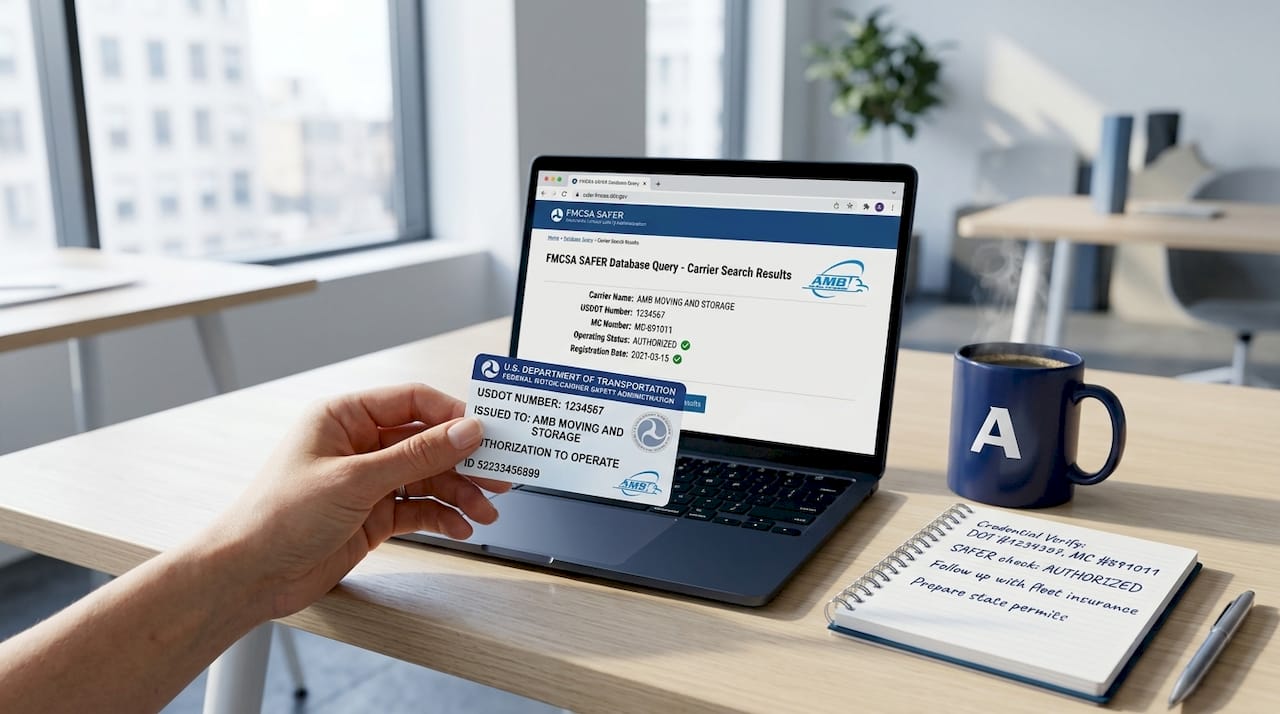
The FMCSA’s Licensing & Insurance Carrier Search tool is the definitive resource for licensed movers verification at the federal level. It is free, publicly accessible, and takes under five minutes to use.
Follow these steps:
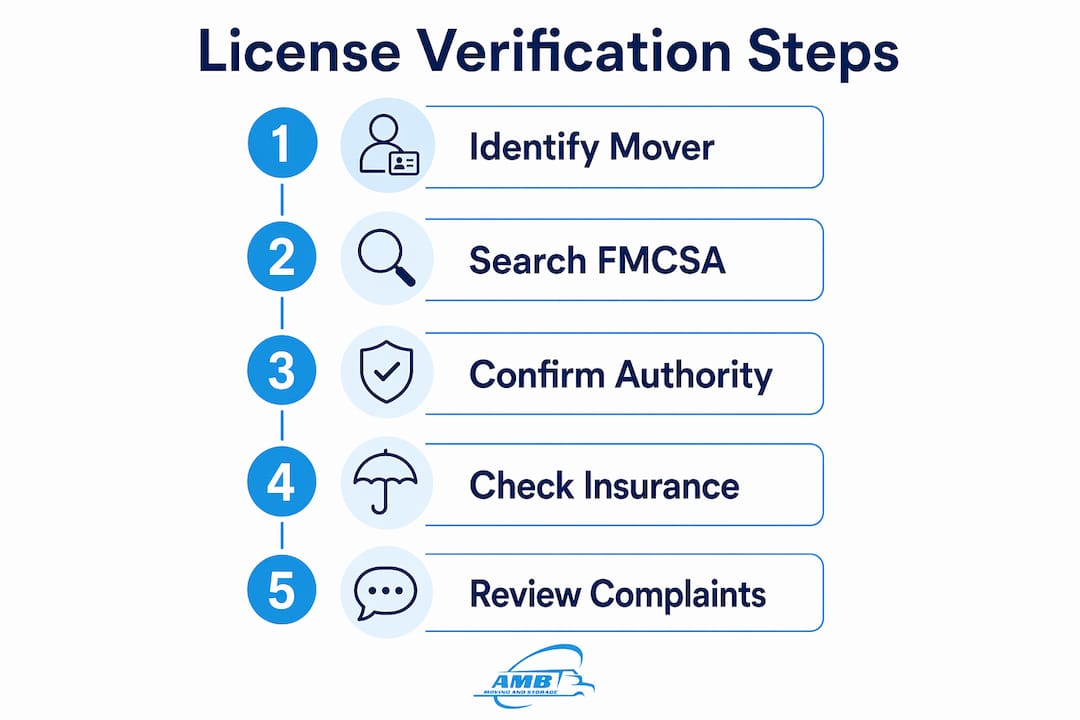
- Locate the company’s USDOT number. Find it on their website, estimate paperwork, or the side of their truck. If a company refuses to provide this number, stop the conversation.
- Go to the FMCSA SAFER search tool at safer.fmcsa.dot.gov or use the Licensing & Insurance Carrier Search linked above.
- Search by USDOT number, legal name, or DBA name. The tool supports wildcard searches, which helps when you are unsure of the exact legal name.
- Review the operating authority status. The fields you need to read are “Operating Status” and “Authority Status.” Operating status must read “AUTHORIZED” and authority status must read “ACTIVE.” If you see “OUT OF SERVICE,” “NOT AUTHORIZED,” or “INACTIVE,” do not book that company.
- Confirm household-goods authority. Look specifically for HHG authority in the carrier’s record. A USDOT number alone is not enough. Many consumers mistakenly believe a USDOT number alone confirms full authorization, but HHG authority is the field that actually covers residential moves.
- Check insurance filings. The SAFER record shows BIPD (Bodily Injury and Property Damage) and cargo insurance. Confirm both are active and on file.
- Match the company name exactly. The USDOT number must match the legal name and DBA name the company gave you. A mismatch is a serious red flag and a common tactic used by fraudulent shell companies.
- Review safety scores and complaint history. FMCSA SAFER also displays safety BASIC scores and out-of-service rates. A company with multiple recent violations or a high out-of-service rate warrants serious scrutiny.
Here is a quick reference for reading key SAFER fields:
| SAFER Field | What to Look For | Red Flag |
|---|---|---|
| Operating Status | AUTHORIZED | NOT AUTHORIZED or OUT OF SERVICE |
| Authority Status | ACTIVE | INACTIVE or REVOKED |
| HHG Authority | Granted | Not granted or pending |
| Insurance (BIPD) | On file and active | Not on file |
| Cargo Insurance | On file and active | Not on file |
| Company Name Match | Matches exactly | Any name discrepancy |
“If the FMCSA record is missing, unauthorized, or inactive, consumers should avoid booking that mover entirely. Case reports document fraudulent movers operating without valid USDOT registration, causing costly and stressful outcomes for families.” — FMCSA consumer protection guidance
Pro Tip: Request a Certificate of Insurance (COI) directly from the mover and confirm insurance details match what is on file in the FMCSA record. A legitimate company will provide this without delay.
How to check moving company credentials for local or intrastate moves
Local and intrastate movers operate entirely within one state, which means FMCSA registration does not apply to them. Instead, local movers are regulated by state agencies, and the verification process varies significantly depending on where you live.
Key state agencies to know:
- California: Bureau of Household Goods and Services (BHGS). California requires all intrastate movers to hold a Cal T license, which you can verify through the BHGS online license lookup.
- Texas: Texas DMV Motor Carrier Division. Texas movers must register with TxDMV and carry state-mandated insurance.
- Florida: Florida Department of Agriculture and Consumer Services (FDACS). Florida requires intrastate movers to hold a valid mover registration number.
For any state not listed above, search “[your state] moving company license lookup” or contact your state’s Department of Transportation or Public Utilities Commission. Most states maintain public license databases you can search by company name or license number.
What to check in state records mirrors the federal process: confirm the license is current and not expired, verify insurance coverage is active, and review any consumer complaints filed against the company. State consumer protection offices and the Better Business Bureau (BBB) are also useful for checking complaint history at the local level.
One important note: if your move crosses a state line, even by a few miles, FMCSA federal registration applies. A mover who only holds a state license cannot legally perform an interstate move. This is a common gray area that unlicensed movers exploit, particularly in border cities like Kansas City, Memphis, or the Washington D.C. metro area.
Pro Tip: For moves that start in one state and end in another, use the interstate moving guide to confirm which federal requirements apply, even if the distance seems short.
Common red flags when verifying moving company licenses
The most dangerous verification mistake is assuming a USDOT number alone confirms full authorization. A USDOT number only proves a company registered with the federal system. It does not confirm active HHG authority, valid insurance, or an authorized operating status.
Watch for these specific warning signs:
- Name mismatches: The company name on the FMCSA record does not match the name on the estimate or website. Fraudulent movers frequently operate under similar-sounding names to confuse consumers.
- Broker posing as a carrier: The company cannot confirm whether they are a carrier or a broker, or they deflect the question. Consumers often overlook this distinction until after a problem occurs.
- No physical address: A legitimate moving company has a verifiable street address, not just a P.O. box or a vague city reference.
- Expired or inactive status: Any operating status other than “AUTHORIZED” and “ACTIVE” in the FMCSA record means no legal authority to move your goods.
- Refusal to provide documentation: A licensed mover will provide their USDOT number, MC number, and a COI without hesitation. Resistance is a clear signal.
- No consumer protection literature: FMCSA requires registered movers to provide the “Your Rights and Responsibilities When You Move” brochure. If a company has never heard of it, they are likely not compliant.
If you encounter a mover with any of these red flags, report them to the FMCSA at 1-888-368-7238 or file a complaint at protectyourmove.gov. You can also contact your state attorney general’s office for intrastate violations.
Checking a mover’s reputation through the BBB, Google Reviews, and the FMCSA complaint database adds another layer of confidence. No single source tells the whole story, but cross-referencing three or more sources makes it very difficult for a fraudulent company to hide.
Key takeaways
Verifying a moving company’s license requires checking FMCSA SAFER for active HHG authority, confirming insurance filings, and using state agency tools for local moves.
| Point | Details |
|---|---|
| Federal verification tool | Use FMCSA SAFER to confirm USDOT number, HHG authority, and active operating status. |
| USDOT is not enough | A USDOT number alone does not confirm full authorization. HHG authority must also be active. |
| Broker vs. carrier distinction | Brokers cannot perform moves. Always confirm you are booking an authorized carrier. |
| State-level verification | Local movers are regulated by state agencies like California BHGS, Texas DMV, or Florida FDACS. |
| Insurance confirmation | Request a COI and cross-check it against FMCSA insurance filings before signing any contract. |
What we have learned from years of watching consumers get this wrong
At Ambmovingservices, we talk to families every week who did some version of verification but missed the one field that mattered. They found a USDOT number, felt reassured, and stopped there. They never checked whether the operating status was active. They never confirmed HHG authority. They never asked whether the company was a carrier or a broker.
The uncomfortable truth is that fraudulent movers count on consumers stopping at the first sign of legitimacy. A USDOT number is easy to display. It costs nothing to register and then let authorization lapse. The FMCSA SAFER database is the tool that exposes the difference, but only if you know which fields to read.
We have also seen families get burned by attractive pricing from companies that turned out to be brokers. The broker collected a deposit, assigned the job to an unvetted carrier, and the family had no recourse when things went wrong. The movers vs. brokers distinction is not a technicality. It determines who is legally responsible for your belongings.
My advice: treat verification like a checklist, not a feeling. Run the SAFER search. Confirm every field in the table above. Request the COI. Ask directly whether the company is a carrier or a broker. If anything does not match, walk away. There are plenty of fully licensed, compliant movers available, and none of them will make you work hard to confirm their credentials.
— AMB
Move with confidence using Ambmovingservices
Ambmovingservices is fully registered with FMCSA, holds active household-goods operating authority, and complies with all federal licensing and insurance requirements for long-distance moving and interstate relocations. Every client receives transparent documentation, including USDOT and MC numbers, insurance certificates, and the federally required consumer protection brochure. If you are planning a state-to-state move and want to work with a mover whose credentials you can verify in under five minutes, request a free quote today. Our team is ready to walk you through our licensing, answer your questions, and give you a clear, binding estimate with no surprises.
FAQ
What is the fastest way to verify a moving company’s license?
Search the company’s USDOT number in the FMCSA SAFER database at safer.fmcsa.dot.gov. Confirm the operating status reads “AUTHORIZED,” authority status reads “ACTIVE,” and household-goods authority is granted.
Does a USDOT number mean a mover is fully licensed?
No. A USDOT number confirms federal registration but does not confirm active operating authority or household-goods authorization. You must check all three fields in the FMCSA SAFER record to validate a mover’s full compliance.
How do I verify a local moving company that only operates within one state?
Local intrastate movers are regulated by state agencies, not FMCSA. Check with your state’s Department of Transportation, Public Utilities Commission, or a state-specific agency like California’s Bureau of Household Goods and Services or Texas DMV Motor Carrier Division.
What is the difference between a moving broker and a moving carrier?
A carrier physically performs your move and must hold active FMCSA operating authority. A broker arranges transportation through third-party carriers but cannot perform the move itself. Always confirm which type of company you are booking before signing a contract.
What should I do if a mover’s FMCSA record shows inactive or unauthorized status?
Do not book that company. Report the mover to FMCSA at 1-888-368-7238 or file a complaint at protectyourmove.gov. An inactive or unauthorized status means the company has no legal authority to transport your household goods across state lines.