
TL;DR:
- Federal regulations enforced by the FMCSA govern interstate household moves, ensuring transparency and consumer protections across state lines. These rules mandate proper registration, written estimates, bills of lading, insurance, and the 110% payment cap to prevent fraud and surprise charges. Consumers should verify mover credentials, carefully review contracts, and utilize the FMCSA resources to enforce their rights during interstate relocations.
Federal regulations for movers are rules enforced by the Federal Motor Carrier Safety Administration (FMCSA), a division of the U.S. Department of Transportation, that govern every licensed interstate household-goods move in the United States. These rules cover mover registration, written estimates, billing limits, consumer rights, and enforcement penalties. If you are planning a long-distance or interstate move, understanding these protections is the single most effective way to avoid fraud, surprise charges, and disputes on moving day.
What are the key federal regulations movers must comply with?
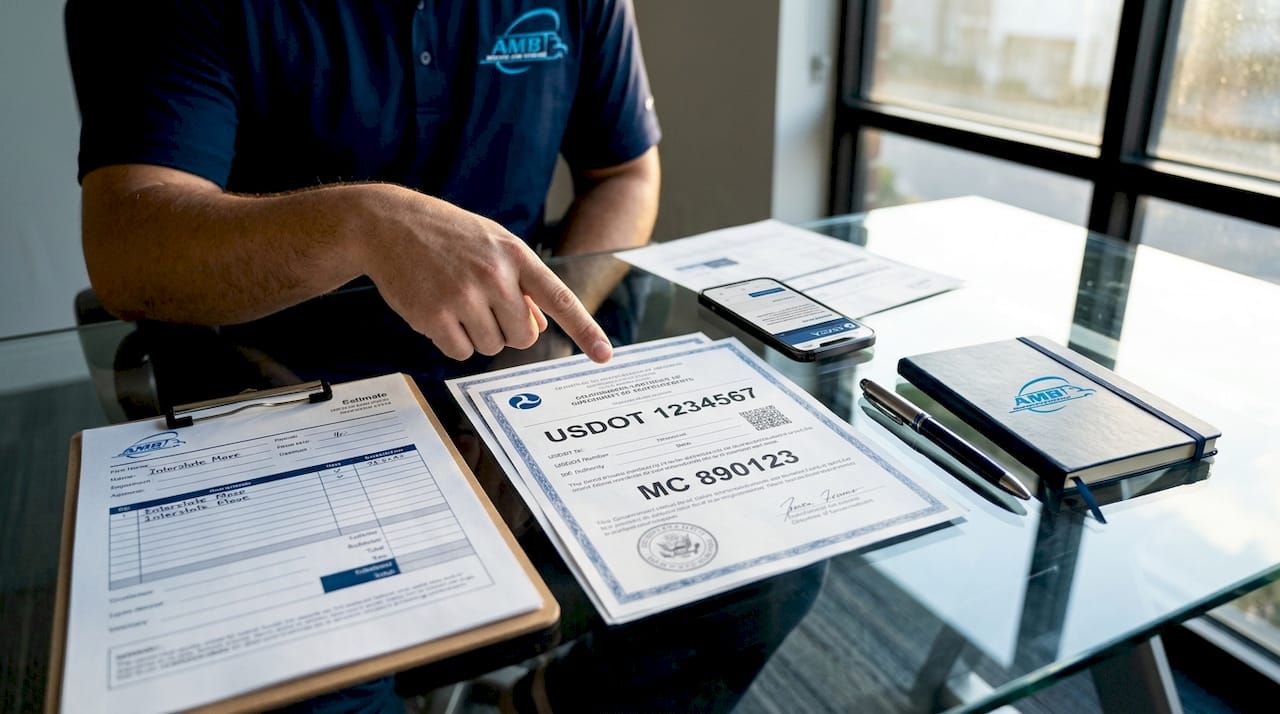
Interstate moving companies must register with FMCSA and obtain both a USDOT number and Motor Carrier (MC) authority before legally transporting household goods across state lines. This registration is mandatory regardless of how frequently a company operates. Beyond registration, FMCSA requires movers to maintain tariffs listing all rates and charges, carry minimum insurance coverage, and provide consumers with the official handbook Your Rights and Responsibilities When You Move before any contract is signed.
The core compliance requirements every interstate mover must meet include:
- USDOT and MC number registration with FMCSA, including a process agent for each state of operation and biennial MCS-150 reporting to maintain operating authority
- Written estimates provided before the move, designated as either binding or non-binding under 49 CFR Part 375
- Bill of Lading (BOL) issued before loading, which serves as the legally binding contract for the move
- Tariff maintenance with all rates publicly available to consumers on request
- Minimum liability insurance meeting FMCSA thresholds for cargo and public liability
| Requirement | Federal Standard |
|---|---|
| Registration | USDOT number + MC authority required |
| Estimate type | Binding or non-binding, in writing, before move |
| Contract document | Bill of Lading issued before loading |
| Insurance | Minimum cargo and liability coverage required |
| Consumer handbook | Must be provided before signing any contract |
Pro Tip: Verify any mover’s USDOT and MC numbers using FMCSA’s SAFER system at safer.fmcsa.dot.gov before signing anything. A legitimate mover will never hesitate to share these numbers.
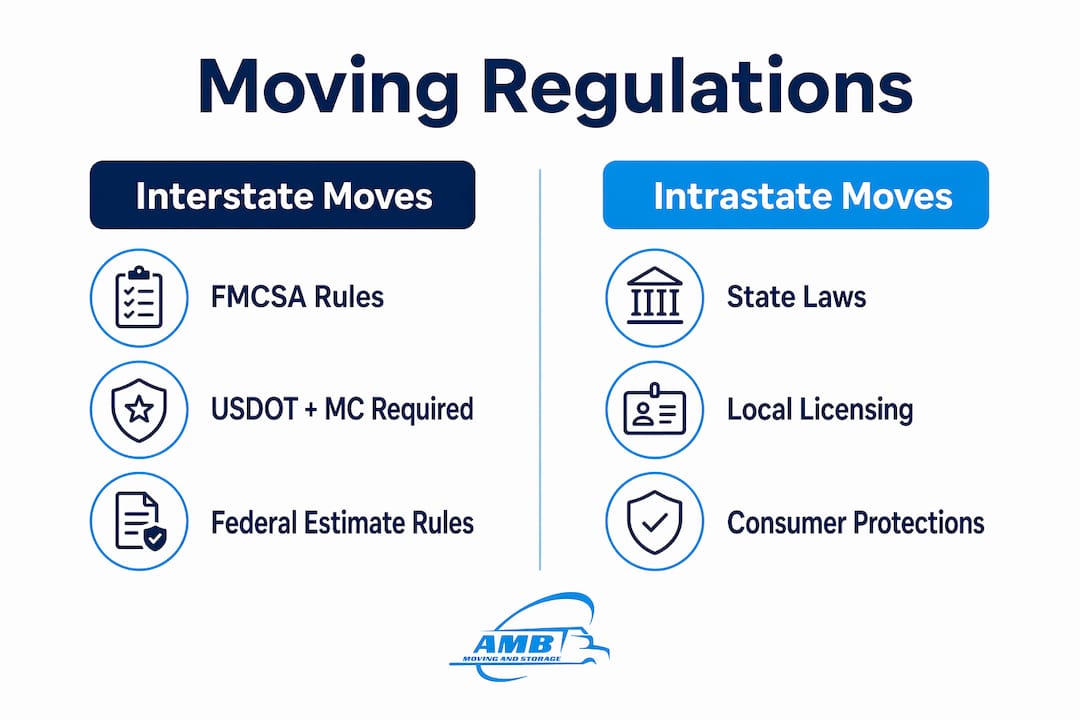
One distinction that surprises many consumers: federal FMCSA rules apply only to moves that cross state lines. A move entirely within one state falls under that state’s own regulatory framework, which varies significantly.
How do federal estimate and billing rules protect you?
The most misunderstood area of moving company regulations involves estimates and final billing. A binding estimate locks in the total price regardless of actual weight or time, provided the shipment and services do not change. A non-binding estimate is the mover’s best projection of cost, and the final charge is calculated from the actual weight of your shipment and the services performed.
The critical consumer protection here is the 110% payment cap under 49 CFR §375.407. On a non-binding estimate, a mover may require you to pay no more than 110% of the estimated charges at delivery. Any amount above that must be invoiced and is not due until 30 days after delivery. This rule exists specifically to prevent movers from leveraging surprise bills at delivery to extract payment before releasing your belongings.
Here is how the billing process works under federal moving laws:
- Receive a written estimate before the move, clearly labeled as binding or non-binding
- Confirm the estimate type on your Bill of Lading before the crew begins loading. The BOL estimate type determines which payment rules apply at delivery
- Request a reweigh if you believe the final weight is inaccurate. Consumers have the right to a reweigh before final charges are calculated, and if the second weight is lower, the lower figure must be used for billing under 49 CFR Part 375 Subpart H
- At delivery, pay only up to 110% of a non-binding estimate. Paying more is not required and may actually weaken your legal position in a dispute
- Dispute any remaining balance within 30 days using written documentation of your estimate, BOL, and weight tickets
“Consumers need to confirm estimate type on the Bill of Lading carefully, as final price protections hinge on this designation.” — FMCSA consumer guidance
Pro Tip: Ask your mover to show you the weight ticket from the origin weigh-in. Federal rules require movers to weigh the loaded truck and provide you with that documentation before demanding final payment.
What enforcement mechanisms exist under federal moving regulations?
FMCSA monitors compliance through audits, complaint investigations, and civil penalty proceedings. The agency’s enforcement authority is substantial. Under 49 U.S.C. 14915, movers who refuse to release a shipment after a consumer has tendered lawful payment face civil penalties, suspension of operating authority, and in serious cases, criminal charges. This statute directly targets the practice known as a “hostage load,” where a mover holds belongings until a consumer pays inflated charges above what federal rules allow.
Consumers who encounter violations have a clear path to report them:
- File a complaint with FMCSA’s National Consumer Complaint Database at nccdb.fmcsa.dot.gov. FMCSA builds enforcement cases from complaint patterns, even when it cannot resolve individual claims immediately
- Contact the FMCSA Protect Your Move program for guidance, checklists, and direct reporting tools
- Document everything in writing. Written demands referencing your BOL, estimate, and the 110% cap create a paper trail that supports both FMCSA complaints and civil claims
- Contact your state attorney general if the mover also violates state consumer protection laws
The FMCSA’s consumer complaint resources include a “File a Moving Fraud Complaint” option and a “Ready to Move” checklist designed to prevent problems before they start. Proactive use of these tools is far more effective than relying on dispute resolution after a problem occurs.
How do federal and state moving regulations differ?
Federal FMCSA rules apply exclusively to interstate moves, meaning any move where goods cross a state line. The moment a move stays entirely within one state, it falls outside FMCSA jurisdiction and into the hands of state regulators. This distinction matters because state rules vary widely in their consumer protections and licensing requirements.
| Move Type | Governing Authority | Key Requirement |
|---|---|---|
| Interstate (crosses state lines) | FMCSA / U.S. DOT | USDOT number, MC authority, federal estimate rules |
| Intrastate (within one state) | State agency | Varies by state; separate license often required |
| California intrastate | California Public Utilities Commission | CAL-T number required; strict estimate rules |
| Texas intrastate | Texas Department of Motor Vehicles | TxDMV mover registration required |
| New York intrastate | New York State Department of Transportation | NYDOT registration and tariff filing required |
| Florida intrastate | Florida Department of Agriculture | IM license required; written estimate mandatory |
States like California, Texas, New York, and Florida have licensing bodies and consumer protection rules that are as detailed as federal standards, and in some cases stricter. A mover operating legally under FMCSA for interstate work still needs separate state authorization to handle intrastate jobs in those states.
Pro Tip: Always verify a mover’s credentials with both FMCSA’s SAFER system and your state’s transportation or consumer protection agency. A mover licensed only at the federal level may not be authorized to handle a local or in-state portion of your relocation.
What practical steps protect you when hiring interstate movers?
Understanding federal moving laws is only useful if you act on them before signing anything. The FMCSA consumer handbook Your Rights and Responsibilities When You Move is a free, detailed guide that covers every stage of the process. Read it before you contact a single mover.
Follow these steps to protect yourself on every interstate move:
- Verify registration before any conversation. Look up the mover’s USDOT and MC numbers in FMCSA’s SAFER system. No valid numbers means no legal authority to move you across state lines. Use this step-by-step verification guide to confirm credentials quickly.
- Get estimates from at least three movers and confirm in writing whether each is binding or non-binding. Review this long-distance estimate guide to understand what each type means for your final bill.
- Read your Bill of Lading before the crew loads a single box. Confirm the estimate type, pickup and delivery dates, and all listed charges. Errors on the BOL are far easier to correct before loading than after.
- Keep copies of every document. Your written estimate, BOL, weight tickets, and any written communications form your complete legal record if a dispute arises.
- Know your delivery-day rights. On a non-binding estimate, you are legally required to pay no more than 110% of the estimate at delivery. If a mover demands more, state the 110% rule in writing and tender only that amount.
- If a mover holds your belongings, contact FMCSA immediately, file a complaint in the National Consumer Complaint Database, and consult an attorney. Federal law under 49 U.S.C. 14915 gives you strong legal standing in these situations.
Pro Tip: Use the FMCSA “Ready to Move” checklist as a moving-day reference, not just a pre-move tool. Having it on hand during loading and delivery gives you immediate access to the rules if a dispute starts.
Key takeaways
Federal regulations for movers give consumers legally enforceable rights on every interstate move, but those rights only protect you if you verify credentials, read your contract, and act on the 110% cap at delivery.
| Point | Details |
|---|---|
| FMCSA governs interstate moves | Every mover crossing state lines must hold a USDOT number and MC authority. |
| Estimate type determines billing rules | Binding estimates lock in price; non-binding estimates cap delivery-day payment at 110% of the estimate. |
| Bill of Lading is your legal contract | Read and confirm the BOL before loading; errors are nearly impossible to correct afterward. |
| Reweigh rights protect against overcharging | Request a reweigh before final charges; the lower weight must be used for billing. |
| Complaints trigger enforcement | Filing with FMCSA’s National Consumer Complaint Database builds enforcement cases against fraudulent movers. |
What experience with federal moving rules actually teaches you
After years of working in interstate relocation, the pattern I see most often is this: consumers who get burned by moving fraud almost always had the right to prevent it. The 110% cap, the reweigh right, the Bill of Lading review. These are not obscure legal technicalities. They are practical tools that federal law put directly in your hands.
The mistake most families make is treating the estimate as the contract. It is not. The Bill of Lading is the contract, and the estimate type written on that document determines every financial protection you have at delivery. I have seen consumers pay thousands of dollars more than they owed simply because they did not confirm that one field before the truck left their driveway.
The FMCSA’s Protect Your Move resources are genuinely useful, not bureaucratic filler. The consumer handbook answers questions most people do not think to ask until it is too late. My honest advice: download it, read the estimate and delivery sections before you sign anything, and use the SAFER system to verify every mover you consider. Federal regulations put real power in consumer hands. The only way to lose that power is to not use it.
— AMB
Move with a federally compliant, transparent interstate mover
Ambmovingservices operates as a fully registered interstate mover with an active USDOT number and MC authority, compliant with all FMCSA requirements. Every move begins with a written estimate clearly designated as binding or non-binding, followed by a complete Bill of Lading reviewed with you before loading begins. There are no surprise charges at delivery and no hostage-load tactics. Whether you are planning a long-distance move across two states or a cross-country relocation, Ambmovingservices provides the documentation, transparency, and consumer protections federal law requires. Get a free moving quote today and start your interstate move with a company that treats compliance as a baseline, not a selling point.
FAQ
What federal agency regulates interstate moving companies?
The Federal Motor Carrier Safety Administration (FMCSA), part of the U.S. Department of Transportation, regulates all interstate household-goods movers. FMCSA enforces licensing, estimate rules, billing limits, and consumer protections under 49 CFR Part 375.
What is the 110% rule for interstate moves?
Under 49 CFR §375.407, on a non-binding estimate, a mover may require payment of no more than 110% of the estimated charges at delivery. Any balance above that amount must be invoiced and is not due for 30 days after delivery.
How do I verify that a moving company is federally licensed?
Use FMCSA’s SAFER system at safer.fmcsa.dot.gov to search a mover’s USDOT or MC number. A legitimate interstate mover will have active registration, valid insurance filings, and no record of revoked authority.
What should I do if a mover holds my belongings hostage?
Tender payment of 110% of your non-binding estimate in writing, document the refusal, and immediately file a complaint with FMCSA’s National Consumer Complaint Database. Under 49 U.S.C. 14915, movers who refuse to release goods after lawful payment face civil penalties and potential criminal charges.
Do federal moving regulations apply to moves within one state?
No. FMCSA rules apply only to moves that cross state lines. Intrastate moves are regulated by individual state agencies, and requirements vary significantly. States like California, Texas, New York, and Florida each have separate licensing and consumer protection rules for in-state movers.