

Most HOAs and condo associations let you move in or out only on set days and hours, in a reserved slot, with a signed agreement, a fee or deposit, and often a certificate of insurance from your movers. The details differ from one community to the next, so the written rules from your property manager decide your schedule. If you are planning a long-distance or interstate move, you have two sets of rules to satisfy: one at the origin and one at the destination.
This guide covers what associations can require, what real buildings ask for, how freight elevator reservations work, and what to do if a rule is unclear or a violation is claimed.
TL;DR
- Get the current written move-in and move-out rules from management at both addresses before you pick a date.
- Expect advance notice, a reserved window, a non-refundable fee, a refundable deposit and a certificate of insurance naming the association.
- Freight elevators and loading docks are normally the required route for furniture, appliances and bulky boxes.
- Unscheduled or overrunning moves can bring fines, usually after notice and a chance for a hearing.
- Send your mover the rules, the reservation confirmation and the insurance wording early, so the crew arrives ready.
Table of Contents
- What an HOA or Condo Association Can Require for a Move
- Rules to Check Before You Schedule a Move
- Elevator and Loading Dock Reservations: What Buildings Actually Ask For
- Freight Elevator Rules on Move Day
- Insurance, Deposits and Damage Responsibility
- What Happens If You Break a Move Rule
- Moving Long Distance Into or Out of an HOA Community
- Perspective
- Plan Your Move Around the Rules With AMB
- Your Next Steps
- FAQ
- Sources
What an HOA or Condo Association Can Require for a Move
Associations can set rules on advance notice, moving windows, truck access, equipment use, fees and deposits, damage protection and indemnification. A law firm that advises community associations describes these as the standard elements of a written move-in and move-out policy. The same source says fees should be reasonable, disclosed in the governing documents or policies, and applied evenly to everyone.
Where the authority comes from matters. An association’s power to enforce a rule, and the remedies it has, depend on the community’s bylaws and CC&Rs and must comply with state and federal law, according to Nolo’s legal guide to HOA enforcement. So a rule printed on a one-page flyer is not the whole story. Ask management where the rule is written: the declaration, the rules and regulations, or a board-adopted move policy.
A few practical points follow:
- Rules differ by community. A single-family subdivision with an HOA may care mostly about truck parking and street blocking. A high-rise condo will care about elevators, lobbies and hallway protection.
- Rules can change. Always ask for the current version rather than relying on what the seller, landlord or a neighbor remembers.
- Move rules may tie into sales and leases. Inspections, transfer disclosures, tenant screening and the move date can be linked, so the same office may need to sign off on several things at once.
Rules to Check Before You Schedule a Move
When you ask for the rules, you want a complete picture. A moving company’s planning guide for condo moves suggests checking permitted days and hours, notice deadlines, the required entrance, elevator reservations, floor protection, insurance wording, fees, parking, elevator dimensions, debris disposal and late-move consequences. Turn that into a checklist:
- Move days and hours. Some communities allow moves seven days a week; others block Sundays and holidays.
- Notice deadline. How many business days ahead must you reserve?
- Entrance and route. Which door, dock or elevator must the crew use?
- Truck parking. Where may the truck park, for how long, and is a loading zone or valet involved?
- Paperwork. Is there a move-in agreement, an elevator use form or a contractor registration?
- Fees and deposits. What is non-refundable, what is refundable, and when is each due?
- Insurance. Who must be named on the certificate, and how many days before the move is it due?
- Protection. Which pads, floor coverings and wall guards are required?
- Debris. Where do boxes, pallets and packing paper go?
- Overrun policy. What happens if loading runs past your slot?
If you want to prepare the unit itself, our guide to protecting floors when moving covers materials and mover-grade steps that line up with most building requirements.
Elevator and Loading Dock Reservations: What Buildings Actually Ask For
Published building policies show how much the details vary. The examples below come from the associations’ own documents. Treat them as illustrations of what you may meet, not as rules for your building.
| Community | Reservation and timing | Fees and deposit | Other terms |
|---|---|---|---|
| Axis HOA Docs | Reserve seven business days before the move; moves 8:00 a.m. to 5:00 p.m., Monday to Sunday, except listed holidays | $120 non-refundable fee and $300 deposit five business days before | Certificate of insurance at least two days before; an unscheduled move may bring a $500 fine after notice and a hearing |
| River Place North | Weekdays 9:00 a.m. to 6:00 p.m., weekends 10:00 a.m. to 6:00 p.m.; three-hour maximum | $50 non-refundable fee and $200 refundable deposit; one-time large-appliance transport has no fee but still needs the deposit | Use freight elevator #3 and the loading dock |
| Skyline Plaza | First come, first served; 7:00 a.m. to 1:00 p.m. or 1:00 p.m. to 7:00 p.m. slots, Monday to Saturday | Not covered here | No Sunday or holiday moves |
Note how different the notice periods, slot lengths and money involved are. A three-hour cap, as at River Place North, is tight for a full two-bedroom load. A half-day slot, as at Skyline Plaza, is more forgiving but may start or end at hours that affect your truck’s schedule.
What the reservation form asks for
Expect to give your name and unit, whether you are an owner or tenant, a phone number, the purpose (move-in, move-out or delivery), and the date and time window. One condo elevator reservation agreement lists exactly those items. Have your mover’s name and contact details ready too, since some buildings want them on the form.
Freight Elevator Rules on Move Day
The freight elevator is normally the required route for furniture, appliances, oversized boxes and other bulky items. River Place North defines large items to include furniture, mattresses, major appliances, oversized boxes, anything over 3 feet in width or depth, and anything over 75 pounds, per its freight elevator guidelines. The same guidelines say to check dimensions and weight, check in with the concierge, and use a different elevator only with concierge authorization.

Some buildings go further. Place One’s policy requires the freight elevator and loading dock for moves and major deliveries, prohibits passenger elevators and the lobby, and reserves slots first come, first served using a completed form, fee and deposit.
On the day itself, a good plan looks like this:
- Measure first. Check the freight elevator’s interior dimensions against your largest pieces, such as a sofa, wardrobe or headboard.
- Use the padded elevator. Buildings commonly designate one. Keep the crew out of the others.
- Protect floors and keep halls clear. Houston Empire’s move-in and move-out acknowledgment asks users to protect floors, keep hallways clear and finish by 4:30 p.m.
- Check in. The same document requires the moving company’s supervisor to sign in, and says damage to walls, hallways, garage gates or elevators may be charged to the owner or lessee against or beyond the deposit.
- Stage efficiently. Pack and tape boxes before the elevator slot begins, so the clock runs only on carrying. Our guide to loading and unloading a moving truck explains how crews sequence a load.
If your building charges for stairs, elevators or long carries, you can see how such charges are typically priced in our moving cost guide. Our published figures start at $75 for elevator and stair fees and $75 for long carry charges.
Insurance, Deposits and Damage Responsibility
Many associations want proof that the movers are insured before they will approve a reservation. One condo’s FAQ states that approval requires a signed Elevator Use Agreement and a certificate of insurance naming both the association and its management company as additional insured. Request the exact wording from management, then pass it to your mover without edits. Insurance wording errors are among the most common reasons a reservation gets held up, and our page on what buildings require in a mover’s certificate of insurance walks through the typical lines.
Deposits are the other piece. Associations hold them against damage and cleanup, and refund them after a post-move inspection. Separate from the building’s deposit, your moving company may also ask for money upfront. Our overview of moving deposit rules explains what is normal. For coverage of your belongings during the move, see what moving insurance is and how it protects your items and our guide to homeowners insurance and moving.
What Happens If You Break a Move Rule
Consequences depend on the governing documents, but the pattern is consistent. An association may pursue fines, suspend common-facility privileges, sue, seek attorneys’ fees or costs, or place a lien when its documents and state law allow, and the documents commonly require written notice and time to cure, as Nolo explains.
Real policies show the practical side:
- Axis HOA Docs states that an unscheduled move may result in a $500 fine after notice and a hearing.
- Skyline Plaza treats exceeding the assigned slot, or failing to return the elevator to regular use by 7:00 p.m., as a house-rule violation.
- Nine Mile Ranch’s 2026 rules let an owner request a hearing within seven days of notice, with fines stayed until the hearing outcome.
If a requirement is unclear or disputed
Start with the manager or general manager, in writing, and keep the reply. One community’s enforcement procedure allows staff to escalate unclear cases to a manager or general manager and, where needed, involve the committee, board or association counsel. It also says staff may send a friendly reminder or ask for a correction first, though informal resolution is not required before formal notice and a hearing opportunity. In other words, answer notices promptly and use any hearing right you have. If a fine or lien is at stake, a real estate attorney licensed in your state is the right person to read your documents.
Moving Long Distance Into or Out of an HOA Community
On an interstate move, the HOA rules sit on top of a bigger logistics puzzle. Your truck may be a full-size tractor-trailer, your pickup and delivery windows may be tied to a route across several states, and you may not be on site to sort things out in person. That is why timing the paperwork matters more than on a local move.
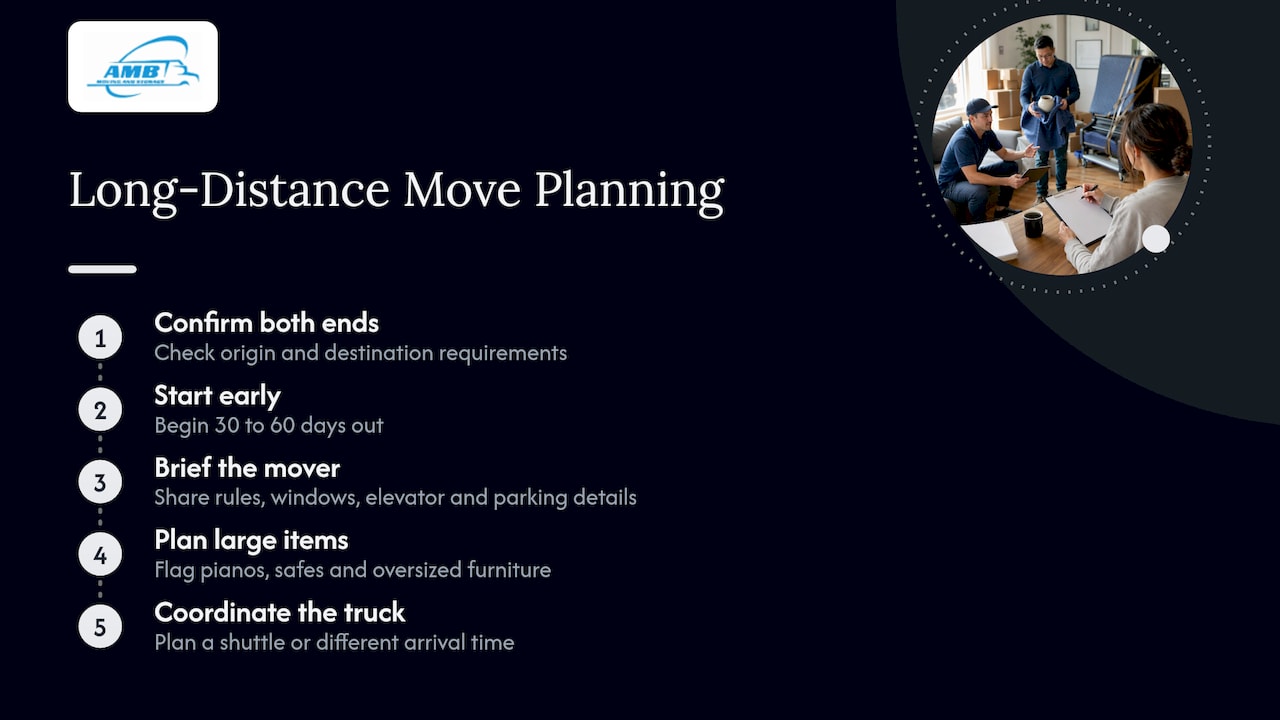
Work both ends. Confirm requirements at the origin and destination buildings. A move-out slot of three hours in one city and a half-day slot at the destination call for different crew planning.
Start 30 to 60 days out. Notice deadlines of a week or more, insurance certificates due days ahead and slots that go first come, first served all reward early requests. This matches the usual window for booking a long-distance move.
Brief the mover. Send your mover the association’s written rules, both move windows, elevator reservations, insurance wording, parking instructions, unit and floor information, inventory and photos of large items. That is the list one moving company recommends providing before the move.
Plan for big items. Pianos, safes and oversized furniture are the pieces most likely to hit a freight elevator or doorway limit. Tell your mover early so the crew brings the right equipment and extra time.
Mind the truck. If trucks may park only in a loading zone for a limited time, or not at all on the street, your mover may need to plan a shuttle or a different arrival time.
For a wider view of the process, read our interstate moving step-by-step guide for families, and for items a crew will decline, see the checklist of items movers won’t move. Understanding your rights and responsibilities and how regulated moving contracts work helps you coordinate with the building as well.
Perspective
Here is how we look at HOA and condo moves. The building’s rules are not an obstacle to work around. They are the schedule your whole move runs on. When we plan a long-distance or interstate relocation, we want the written rules, the reservation confirmation and the insurance wording in hand before a truck is dispatched.
That is the heart of structured planning for us. A crew that knows the elevator slot, the loading route and the sign-in procedure in advance can concentrate on careful handling instead of improvising at the curb. Our approach is designed around licensed, insured, federally compliant service, clear communication and reliable scheduling, and building paperwork is where those commitments show up in practice.
Our advice to families: ask for the rules early, share them with your mover in one package, and keep every confirmation. Done that way, a strict building is just another set of logistics to plan.
AMB
Plan Your Move Around the Rules With AMB
If your destination or origin has an HOA or condo association, we can plan the move with those requirements in mind. We handle long-distance moving, interstate moves and nationwide moving for homeowners and families, with packing from $1 to $2 per cubic foot and storage from $0.50 per cubic foot if your dates do not line up. Packing details are on our packing services page.
Tell us the building rules and your timeline, and we will build moving cost estimates around them. Request your free quote here.
Your Next Steps
Here is the short path from rulebook to move day:
- Email management at both addresses and request the current written move policy.
- Reserve the elevator or loading dock as soon as your dates are firm.
- Pay the required fee and deposit and sign the agreement.
- Send the certificate of insurance wording to your mover and confirm it was delivered on time.
- Share the rules, reservations, inventory and photos of large items with your crew.
- Pre-pack, protect the floors and be on site for check-in and the post-move inspection.
With that done, interstate movers and cross country movers can arrive knowing exactly what the building expects, and you can focus on the move itself.
FAQ
How far in advance should I reserve an elevator for a move?
It depends on the building. Axis HOA Docs requires a reservation seven business days before the move, while other buildings schedule slots first come, first served. Ask for the deadline when you request the rules, and reserve as soon as your date is confirmed.
What are typical condo move requirements?
Common requirements include a reserved window, a signed move or elevator agreement, a non-refundable fee, a refundable deposit, a certificate of insurance naming the association, and use of the freight elevator or loading dock. Floor and wall protection and a sign-in by the mover’s supervisor are also frequent. Your management office has the exact list.
Can an HOA fine me for moving without notice?
If the governing documents authorize it, yes. Axis HOA Docs, for example, states that an unscheduled move may result in a $500 fine after notice and a hearing. Documents commonly require written notice and time to cure first, so respond to any notice quickly.
Do I need to follow the rules at both the old and new building?
Yes. Each building or community sets its own move policy, so confirm requirements at the origin and the destination. Different slot lengths, notice deadlines and insurance wording can affect how your mover schedules the crew and truck.
What should I send my moving company about the HOA rules?
Send the association’s written rules, both move windows, elevator reservations, insurance wording, parking instructions, unit and floor details, your inventory and photos of large items. Doing this before moving day gives the crew time to plan equipment, staffing and truck access.
Sources
- Move-In and Move-Out Policies for Community Associations
- Will the HOA Enforce Community Rules and Regulations Against You
- How to Plan a Condo Move Around HOA Rules
- Axis HOA Docs: Move-In/Move-Out and Delivery
- River Place North Freight Elevator and Loading Dock Reservation Guidelines
- Skyline Plaza Move-In/Move-Out Procedures
- Elevator Reservation Agreement
- Place One Freight Elevator Use
- Houston Empire Move In/Out Acknowledgment and Elevator Reservation
- 588 Condos FAQ
- Nine Mile Ranch Enforcement Rules and Fine Schedule
- Brambleton Enforcement Procedures