


TL;DR:
- Interstate moving involves relocating household goods across state lines within the U.S., regulated by federal laws enforced by the FMCSA. Proper classification, documentation, and verification of licensed movers protect consumers from overcharges and fraud, with costs based on weight and distance. Ensuring compliance and understanding consumer protections like the 110% rule are essential for a smooth, legal long-distance move.
Interstate moving is the relocation of household goods across state lines within the United States and is subject to federal consumer-protection regulations enforceable by the Federal Motor Carrier Safety Administration (FMCSA) under 49 CFR Part 375. Unlike local or intrastate moves, crossing a state boundary triggers a specific set of legal requirements that govern your mover’s licensing, the documents they must provide, and the pricing structures they can use. For individuals and families planning a long-distance relocation, understanding these rules before you sign anything is the difference between a protected move and an expensive dispute.
What is interstate moving and how is it legally defined?
Interstate moving is defined by federal law as the transportation of household goods between a state and any place outside that state, including moves that cross state lines even briefly. The governing authority is the FMCSA, which enforces 49 CFR Part 375 and mandates specific consumer protections the moment your shipment crosses a state boundary. This is not a technicality. It is the legal threshold that determines which rules apply to your entire move.

Every company performing interstate moves must hold a USDOT number and active operating authority issued by the FMCSA. Without both, a mover is operating illegally on your shipment. The FMCSA’s SAFER database allows you to verify mover credentials in under two minutes by entering the company’s USDOT number.
Federal consumer protections under FMCSA apply exclusively to interstate moves. This means the paperwork requirements, estimate rules, and dispute resolution processes described throughout this article do not automatically apply to moves that stay within one state. The classification of your move is therefore one of the first things to confirm in writing.
Key facts about the federal definition:
- A move from New York to New Jersey is interstate regardless of distance.
- A move from Los Angeles to San Francisco stays intrastate because it remains within California.
- Some moves that originate and end in the same state may still qualify as interstate if the route crosses state boundaries, requiring federal paperwork and protections.
- FMCSA registration and operating authority are non-negotiable requirements for any company performing interstate transportation.
Pro Tip: Ask your mover to confirm the move classification in writing before signing any contract. Misclassification can strip you of federal consumer protections and complicate any billing disputes.
How does interstate moving differ from intrastate and local moves?
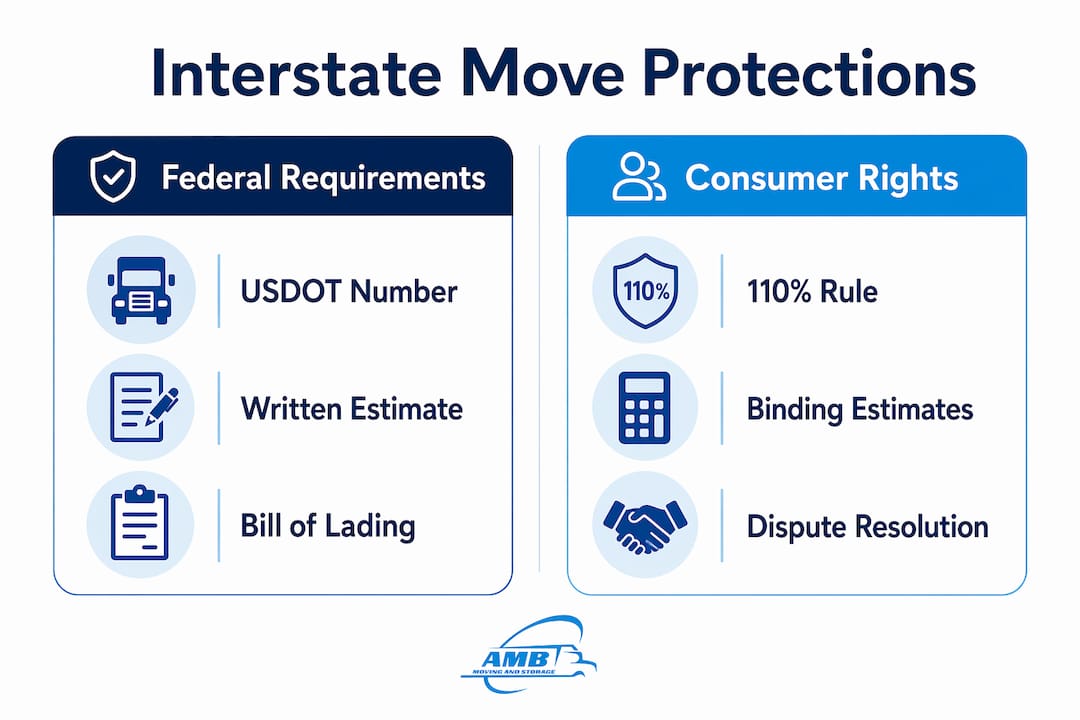
The distinction between interstate, intrastate, and local moves affects your legal rights, the paperwork you receive, and how your bill is calculated. Interstate and intrastate moves are regulated differently: interstate moves fall under FMCSA federal rules, while intrastate moves are governed by the regulations of the individual state where the move occurs. This matters because state regulations vary widely in their consumer protections, and some states offer far fewer safeguards than federal law provides.
An intrastate move can cover hundreds of miles and still not trigger federal protections. A family moving from Dallas to El Paso, a distance of over 600 miles, remains under Texas state jurisdiction because both cities are within Texas. By contrast, a family moving from Kansas City, Missouri, to Kansas City, Kansas, a distance of roughly five miles, is making a federally regulated interstate move. Distance is not the deciding factor. State lines are.
Local moves are typically short-distance relocations within a metropolitan area, usually billed by the hour rather than by weight and distance. They carry the lightest regulatory burden and the fewest required documents.
| Move type | Jurisdiction | Pricing model | Key documents required |
|---|---|---|---|
| Interstate | FMCSA (federal) | Weight and distance | Estimate, bill of lading, inventory, rights pamphlet |
| Intrastate | State agency | Varies by state | State-specific requirements |
| Local | State or municipal | Hourly rate | Basic contract |
The practical implication is clear. If you want the full protection of federal law, including binding estimate rules, the 110% cap on non-binding estimates, and mandatory dispute resolution, your move must cross a state line and your mover must be federally registered.
What documents and consumer protections apply to interstate moves?
FMCSA requires every interstate mover to furnish four core documents before and during your move: a written estimate, an order for service, a bill of lading, and a detailed inventory of your shipment. A fifth item, the “Your Rights and Responsibilities When You Move” pamphlet, must also be provided before the estimate is given. If a mover skips any of these, that is a red flag worth acting on immediately.
Here is what each document does and why it matters:
- Written estimate. This is your cost projection and must be provided in one of three forms: binding (a fixed price), non-binding (an approximation subject to adjustment), or binding-not-to-exceed (a ceiling price that can only go lower). Each type carries different financial implications.
- Order for service. This authorizes the mover to perform the move and confirms the agreed services, pickup and delivery dates, and pricing basis. It is your pre-move contract.
- Bill of lading. The bill of lading is the legal contract for the move and must detail both addresses, the pricing basis, inventory, valuation coverage, and the delivery window. Verify that it matches your written estimate exactly before signing.
- Inventory list. This itemizes every piece being moved and notes the condition of each item. It is your primary evidence in any damage or loss claim.
The most consumer-friendly protection in federal law is the 110% rule. On a non-binding estimate, a carrier cannot collect more than 110% of the estimated cost at delivery. Any charges above that threshold must be deferred and billed within 30 days. This rule prevents movers from holding your belongings hostage for inflated payments at the door.
Pro Tip: Read the bill of lading line by line against your written estimate before the truck leaves. Any discrepancy between the two documents should be resolved before your goods are loaded, not after they arrive.
How to plan and prepare for an interstate move
Planning an interstate move requires a realistic timeline and a structured approach to mover selection. Most professional interstate movers recommend booking at least six to eight weeks in advance for peak season moves between May and September. Booking late in this window often limits your choice of movers and reduces your negotiating position on price.
Verifying your mover’s credentials is the single most important step before signing anything. The FMCSA SAFER website allows you to confirm a company’s USDOT number, active operating authority, and insurance status in real time. A company without active authority is not legally permitted to transport your household goods across state lines, regardless of how professional their website looks.
When comparing quotes, focus on these factors:
- Estimate type. A binding-not-to-exceed estimate offers the most financial predictability. Avoid movers who only offer verbal or non-binding estimates without explaining the 110% rule.
- Valuation coverage. Federal law requires movers to offer two options: released value protection (minimal, at no charge) and full value protection (covers repair or replacement at current market value). Released value protection covers only $0.60 per pound per article, which is inadequate for electronics or antiques.
- Accessorial charges. Fees for long carries, elevator use, stair carries, and shuttle service can add hundreds of dollars to your final bill. Ask for these to be itemized in writing.
- Delivery window. Interstate moves rarely deliver on a single fixed date. Understand the spread of dates in your contract and plan temporary housing or storage accordingly.
Moving fraud is a documented problem in the interstate moving industry. The most common scheme involves a low-ball estimate followed by inflated charges at delivery. Checking a mover’s complaint history on the FMCSA website and reading verified reviews on platforms like the Better Business Bureau reduces this risk significantly.
What costs and pricing structures apply to interstate moving?
Interstate moving costs are calculated using a weight-and-distance model called linehaul pricing. Rates typically range from $0.50 to $1.20 per pound per mile depending on shipment size, route, and season. That range means a 7,500-pound household moving 1,000 miles could cost anywhere from $3,750 to $9,000 in linehaul charges alone, before any additional fees are applied. Understanding this model helps you evaluate whether a quote is competitive or suspiciously low.
Additional charges that commonly appear on interstate invoices include:
- Fuel surcharges, which fluctuate with diesel prices and are typically a percentage of the linehaul rate.
- Packing and unpacking labor, billed per hour or per box depending on the mover.
- Storage-in-transit fees if your destination is not ready on the delivery date.
- Accessorial service fees for stairs, long carries, or specialty items like pianos and safes.
| Move size | Estimated weight | 500-mile move | 1,500-mile move |
|---|---|---|---|
| 1-bedroom apartment | 2,500 lbs | $625 to $1,500 | $1,875 to $4,500 |
| 3-bedroom home | 7,500 lbs | $1,875 to $4,500 | $5,625 to $13,500 |
| 5-bedroom home | 12,000 lbs | $3,000 to $7,200 | $9,000 to $21,600 |
Note: Figures represent linehaul estimates only. Accessorial fees, packing, and valuation coverage are additional.
Pro Tip: Request an in-home or virtual survey before accepting any quote. Estimates based on a phone conversation or a room count are almost always inaccurate and frequently lead to higher charges at delivery.
Key takeaways
Interstate moving is a federally regulated process that requires licensed movers, specific documentation, and consumer-protective pricing rules that do not apply to intrastate or local moves.
| Point | Details |
|---|---|
| Federal definition matters | Any move crossing a state line triggers FMCSA oversight and mandatory consumer protections. |
| Four required documents | Expect a written estimate, order for service, bill of lading, and inventory before your move begins. |
| The 110% rule protects you | On non-binding estimates, carriers cannot collect more than 110% of the quoted price at delivery. |
| Verify credentials first | Confirm your mover’s USDOT number and active FMCSA operating authority before signing any contract. |
| Pricing is weight and distance | Linehaul rates range from $0.50 to $1.20 per pound per mile, with accessorial fees added separately. |
What experience has taught us about interstate moves
After coordinating hundreds of interstate relocations across the country, the pattern we see most often is not logistical failure. It is documentation failure. Families arrive at their destination to find a bill that does not match the estimate they signed, or they discover their mover is not federally registered only after the truck has left.
The federal framework built around FMCSA is genuinely protective when consumers use it. The FMCSA consumer protection framework is designed not only to inform consumers but also to facilitate regulatory enforcement against moving fraud. That means every document you receive is also a compliance record. When something goes wrong, those documents are your leverage.
What most articles miss is the distinction between long-distance and interstate. A move can be interstate but short-distance, and vice versa. A five-mile move across a state line is federally regulated. A 700-mile move within Texas is not. Treating these as interchangeable concepts leads to real mistakes in mover selection and contract review.
Our advice is direct: classify your move correctly, get every promise in writing, and verify your mover’s FMCSA registration before you pay a deposit. These three steps eliminate the majority of problems we see. The consumer rights exist. Use them.
— AMB
Plan your interstate move with Ambmovingservices
Ambmovingservices specializes in licensed interstate moving with full FMCSA compliance, transparent written estimates, and experienced coordinators who manage every detail of your relocation from first contact to final delivery.
Whether you are moving a one-bedroom apartment across two states or relocating a five-bedroom home cross-country, Ambmovingservices provides binding-not-to-exceed estimates, full-value protection options, and access to secure storage when your timeline requires flexibility. Every move is backed by active USDOT registration and federal operating authority. For a customized quote based on your actual shipment weight and distance, request your estimate today and get a number you can plan around.
FAQ
What is interstate moving in simple terms?
Interstate moving is the process of relocating your household goods from one U.S. state to another. Any move that crosses a state line is classified as interstate and is regulated by the FMCSA under federal law.
What documents should I expect from an interstate mover?
Federal law requires interstate movers to provide a written estimate, an order for service, a bill of lading, a detailed inventory, and the “Your Rights and Responsibilities When You Move” pamphlet before your move begins.
How is the cost of an interstate move calculated?
Interstate moving costs are based on the weight of your shipment and the distance traveled, known as linehaul pricing. Rates range from $0.50 to $1.20 per pound per mile, with additional charges for packing, fuel, and accessorial services applied separately.
What is the 110% rule for interstate moves?
The 110% rule is a federal consumer protection that limits what a carrier can collect at delivery on a non-binding estimate to no more than 110% of the original quoted price. Any charges above that amount must be billed separately within 30 days.
How do I verify that an interstate mover is legitimate?
Check the mover’s USDOT number and active operating authority on the FMCSA SAFER website before signing any contract or paying a deposit. A company without active authority cannot legally transport your goods across state lines.