
Your homeowners policy does not move with you automatically, and it only partly protects your belongings on the truck. When you move, three separate layers of protection are in play: the policy on the home you are leaving, the new policy for the home you are buying, and the liability your mover carries for your goods. Each has gaps. This guide shows where they are and what to do about them, in order, so you are never uninsured on closing day or surprised by a damaged-goods claim.
TL;DR
- Your old policy does not transfer. You need a separate new policy that starts the day you close, and your insurer must actually write business in your new state.
- Homeowners coverage for items in transit is limited and subject to your deductible. Mover liability is not insurance, and the free default pays only $0.60 per pound per item.
- An empty house still needs coverage. Insurers commonly cut protection for homes vacant more than 30 days, so ask about a vacancy endorsement early.
- Start 60 days out: call your insurer, shop quotes, inventory valuables, and choose a valuation option in writing before the movers load.
Table of Contents
- Does homeowners insurance cover your move?
- Mover liability is not insurance
- Your insurance timeline for a long-distance move
- The vacancy trap when you move out first
- Buying, selling, renting: what changes
- How to estimate what your belongings are worth
- Our perspective: coverage decisions are made too late
- Special items: pianos, safes, art and electronics
- Where AMB fits in your move
- A short checklist to keep
- FAQ
- Sources
Does homeowners insurance cover your move?
Partly. A standard policy has four core parts: the dwelling, your personal property, liability, and additional living expenses. According to the Consumer Financial Protection Bureau, those are the essential areas of a typical policy, and flood damage usually needs its own separate policy.
Your personal property coverage often extends beyond the walls of your house, which is why people assume the truck is covered. The catch is in the details. Per FMCSA consumer guidance, coverage for possessions in transit is limited and sits under your policy’s deductible. High-value items such as artwork or jewelry often hit strict sub-limits, and you may need an inland marine policy or a personal property floater to cover their full appraised value.
A practical example: your policy has a $2,500 deductible and a mover drops a dresser and a TV box. If the combined loss is $1,800, your homeowners policy pays nothing, because the loss is below the deductible. That is one reason the mover’s own liability option matters so much.
Call your agent and ask four specific questions:
- Does my personal property coverage apply while goods are in a mover’s truck or in storage?
- What perils are covered in transit, and what is excluded?
- Which items have sub-limits (jewelry, art, collectibles, electronics)?
- Does my deductible apply to a transit loss?
Get the answers by email so you have them in writing.
Mover liability is not insurance
This is the part most families get wrong. Interstate movers are federally required to offer two liability options, and neither is a homeowners policy. FMCSA explains that the two choices are Released Value and Full Value Protection.
| Released Value | Full Value Protection | |
|---|---|---|
| Cost | Free | May involve a deductible or added fee |
| What it pays | Up to $0.60 per pound per item | Repair, replacement or cash value of lost or damaged items |
| Example | A 25-pound TV damaged in transit yields $15 | The item is repaired or replaced |
| Selection | In writing on the bill of lading, before the move | Same |
The FMCSA’s own example is stark: under Released Value, a 25-pound television that is destroyed returns $15. A flat-screen that cost $900 is not made whole by that math. The same page notes that claims for loss or damage must be filed in writing within 9 months of delivery.
Even Full Value Protection has limits. Items of extraordinary value, defined by FMCSA as worth more than $100 per pound, generally need to be listed in the shipping documents before the move. Think of a small piece of jewelry, a watch, or a valuable collectible. If your belongings exceed what the mover’s protection covers, a third-party policy is worth pricing. We break down that tradeoff in our guide to third-party moving insurance for interstate moves and explain the default option in Full Value Protection for U.S. interstate moves. For the broader picture, see moving insurance for interstate moves.
Your insurance timeline for a long-distance move
The sequence matters more than any single decision. Here is how a move typically plays out for a family buying a home in another state.
60 to 45 days out: call your current insurer
The NAIC advises contacting your insurer well in advance of a long-distance move and confirming that your company even operates in your new state. Not every carrier does. If it does not, you will need a new carrier anyway, so start shopping now. NAIC’s guidance on leaving home also notes that home age, roof condition and location influence premiums at the new address.
In the same call, ask about your move-in date, whether you own both homes for any overlap, and whether you will be eligible for a refund on the unused portion of the old premium.
45 to 21 days out: shop the new policy
Lenders require proof of insurance before funding a mortgage, but you choose the company. The CFPB says you have the right to shop around, recommends comparing quotes in writing, and advises giving your final selection to your loan officer at least three business days before closing. Do not leave this to the week of closing.
Budget realistically. Bankrate reports a national average of $2,470 per year, with huge state variation: a $300,000 dwelling policy ranges from $827 in Vermont to $6,274 in Louisiana, based on November 2025 data. Moving from a low-cost state to a coastal one can double or triple what you pay. Factor that into your relocation budget alongside moving cost estimates. Also ask about flood coverage if the new address is in a flood zone, since standard policies do not include it.
If you are buying in the Seattle area, a local brokerage that offers relocation planning for Seattle buyers can help you understand the neighborhood context that insurers price in.
21 to 7 days out: lock down the move itself
Choose your valuation option in writing with your mover. Photograph and list high-value items. Decide whether a floater or third-party policy is needed. Confirm in writing with your insurer what applies while goods are in transit.
Moving week and delivery
Inspect your goods as they come off the truck and note damage before the driver leaves. NAIC advises having the driver sign off on any damage. Keep the inventory and bill of lading in a folder you can reach, not in a box on the truck.
Closing day
The new policy must take effect the day you close. NAIC’s consumer guide to moving is blunt that an old policy does not carry over: you secure a separate new policy for the new home. Only cancel the old policy once you have confirmed the new one is in force and, if you are selling, once the sale has closed.
The vacancy trap when you move out first
Many interstate movers leave before their old house sells. That is where coverage quietly erodes. The Insurance Information Institute notes in its guidance on vacant homes that an empty house still needs coverage. Insurers commonly limit or discontinue coverage after a home has been unoccupied for more than 30 days without notice, and a standard policy may not respond to theft, vandalism or water damage in a vacant property.
If your house will sit on the market after the truck leaves:
- Tell your agent your move-out date and ask for a vacancy permit or endorsement before day 30.
- Keep utilities on so a burst pipe or failed sump pump does not become an uncovered loss.
- Arrange for someone to check the house regularly, and keep the lawn and mail handled so it does not look empty.
- Review your alarm and camera setup. A security system checklist for homeowners is a good way to audit what protects a property while no one lives there.
Buying, selling, renting: what changes
Selling and buying. You need coverage on the old home until closing and a new policy at the new one. The two policies may overlap for a few days. That is normal and usually cheap compared with a gap.
Renting at the new place first. Your homeowners policy on the old house does not cover a rental. Get renters insurance for the rental period. If you are keeping the old house as a rental, you need a landlord policy, not a standard owner-occupied one.
Using storage. Goods in a storage unit are a separate question. Ask both your insurer and the storage operator what is covered and at what limit. We cover how storage fits a move in our storage solutions family guide.
How to estimate what your belongings are worth
Most people underestimate. Walk the house with your phone and film every room, opening closets and drawers. Then build a simple spreadsheet with item, age, replacement cost and, for anything above a few hundred dollars, a serial number or receipt.
This inventory does three jobs. It tells you whether Released Value could ever be enough (it almost never is for a full household), it supports a claim if something is damaged, and it tells your insurer what limits you need. NAIC specifically advises taking inventory before you move so you know what is missing or damaged if something goes wrong.
A useful rule of thumb comes straight from the arithmetic: at $0.60 per pound, a 200-pound sofa is valued at $120 under Released Value. Price what the sofa would cost to replace and compare.
Packing quality also affects outcomes. Damage from poor packing is the most common point of dispute, which is why our guide to protecting belongings during a move and our note on custom crating to avoid Released Value payouts are worth reading before you decide what to pack yourself.

Our perspective: coverage decisions are made too late
At AMB Moving & Storage, we see the same pattern on long-distance and interstate jobs. Families spend weeks comparing truck sizes and dates, then reach the paperwork stage and sign the free valuation option because it costs nothing. The insurance question was never really asked.
Our advice is simple. Treat the valuation choice as a decision with a dollar amount attached, not a form. Read what each option pays, compare it with your inventory, and choose in writing before the crew loads. For most households with furniture, electronics and appliances, the free option is not a plan. We would rather you spend an afternoon on your inventory than discover the gap after delivery.
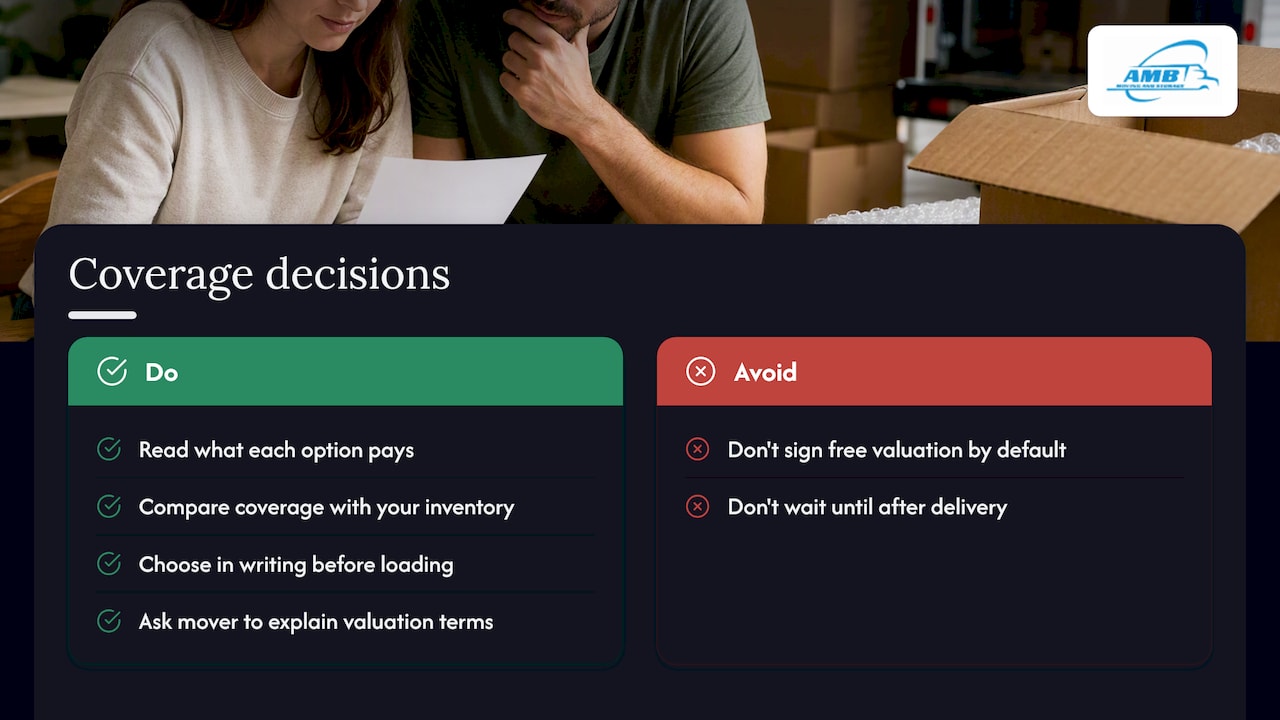
We also encourage customers to separate three things in their heads: your homeowners policy, your mover’s liability, and optional third-party coverage. When a customer asks us which one covers a damaged item, the honest answer begins with which paperwork they signed. Ask your mover to show you the valuation language on the bill of lading and explain it plainly. A professional carrier will.
If you are planning a cross-country move, our long-distance moving service is built around that kind of structured planning, with licensed and insured crews and clear communication from quote to delivery.
— AMB
Special items: pianos, safes, art and electronics
Some items need their own plan whatever your valuation choice:
- Pianos and safes. These require specialized equipment and add risk of damage to both the item and your floors. Our specialty item handling starts from $200 (one-off), as listed on our moving cost guide.
- Jewelry, cash, documents, medications. Carry these yourself. Do not put them on the truck.
- Art and collectibles. Get appraisals and ask your insurer about a floater, because sub-limits in a standard policy can fall short of appraised value.
- Electronics. Keep original boxes if you have them and photograph serial numbers.
Our items movers won’t move checklist lists what cannot go on the truck at all, which matters because uncovered items are also items that no one reimburses.
Where AMB fits in your move
We are a licensed and insured nationwide moving company handling long-distance, interstate and state-to-state relocations for families and businesses. We can walk you through valuation options before you book so the number on the bill of lading matches your inventory. Learn more about our interstate moving process and our nationwide moving services, or add professional packing, which we list at $1-2 per cubic foot (one-off), via our packing services. Storage starts from $0.50 per cubic foot (one-off) if closing dates and move-in dates do not line up.
Ready to compare numbers? Request your moving quote and tell us which valuation option you want priced.
A short checklist to keep
- Call your current insurer 60 days before the move and confirm they write policies in your new state.
- Get written quotes for the new home and give your choice to your loan officer at least three business days before closing.
- Confirm in writing what your homeowners policy covers in transit and what your deductible is.
- Choose Released Value or Full Value Protection on the bill of lading before loading, not after.
- List high-value items and price a floater or third-party policy if they exceed mover protection.
- Request a vacancy endorsement before day 30 if the old house sits empty.
- Inspect goods on delivery, note damage with the driver, and file any written claim within 9 months.
What matters most: no coverage gap at either address, and a valuation choice that fits what you own. Do those two things and the rest of the paperwork is routine.
FAQ
Does homeowners insurance cover my belongings while I move?
Only in a limited way. Coverage for possessions in transit is limited, applies only against certain perils, and is subject to your deductible. High-value items may hit sub-limits. Ask your agent for the specifics in writing before moving day.
Does my homeowners policy transfer to my new home?
No. You need a separate policy for the new home that takes effect the day you close. If you are moving to another state, confirm your current insurer writes policies there; if not, you will need a new carrier.
When should I cancel my old homeowners insurance?
Not until the new policy is confirmed and, if you are selling, the sale has closed. If the house will sit empty, ask for a vacancy endorsement before it has been unoccupied for 30 days, since insurers commonly restrict coverage after that point.
Is mover liability the same as moving insurance?
No. Mover liability is a federally required valuation option, not insurance. Released Value is free but pays only $0.60 per pound per item. Full Value Protection covers repair or replacement, though it may involve a deductible or fee.
How much is homeowners insurance after an interstate move?
It depends heavily on the state and the home. Bankrate puts the national average at $2,470 per year, with $300,000 dwelling policies ranging from $827 in Vermont to $6,274 in Louisiana. Get several written quotes before you commit to a purchase.
Sources
- Consumer Financial Protection Bureau: Shop for homeowners insurance
- FMCSA: Liability and protection for household goods moves
- NAIC: Leaving home, insurance considerations for a move
- NAIC: Moving places, changing spaces
- Bankrate: Home insurance rates by state