

A mover can ask you to pay something to hold your date, but a deposit is a term in your contract, not a right the law hands out in a set amount. For interstate moves, federal rules focus on written estimates, clear payment terms and what you owe at delivery. The safest move is to get the deposit, the refund terms and the accepted payment methods in writing before you pay anything.
This guide explains how deposits work for long distance moving, what federal rules actually cover, how a deposit relates to your final bill, and which requests should make you stop and ask questions.
TL;DR
- Interstate brokers must give you their policies on deposits, cancellations and refunds, so ask for them in writing before you book.
- At delivery on an interstate move you generally owe up to 110% of a non-binding estimate or 100% of a binding estimate, plus charges for services you requested.
- Movers must list the forms of payment they accept on the estimate, the order for service and the bill of lading.
- Any deposit should appear in the written contract with a refund and rescheduling clause. A verbal ask or a pressure deadline is a warning sign.
- Local and in-state moves follow state rules, so check your state’s regulator.
Table of Contents
- What a moving deposit is and why movers ask for one
- What federal rules say about deposits on interstate moves
- How the deposit connects to your estimate and final bill
- How much upfront is reasonable
- Cancellations, rescheduling and refunds
- Red flags in a deposit request
- A checklist to run before you pay
- Local and in-state moves follow state rules
- Our perspective on deposits
- What extras can add to the bill
- Work with a team that puts terms in writing
- A realistic scenario: a three-bedroom move across the country
- Conclusion
- FAQ
- Sources
What a moving deposit is and why movers ask for one
A moving deposit is a payment made at booking, before the crew loads anything. Movers use it to hold a date on the calendar, a truck and a crew. Without it, a customer could book three companies, pick one the week before and leave two crews idle.
That is the honest reason for a deposit. For a long-distance job, a mover plans a route, often combines your shipment with others, and turns away other customers for that date. A deposit shares a little of that risk with you.
A deposit is different from three things people confuse it with:
- The estimate. This is the mover’s calculation of what the move will cost.
- The final payment. This is what you pay when your goods arrive.
- Fees for extra services. Packing, storage and stairs are charged for what you ask for, not held in advance.
Keeping these apart makes it easier to read a contract. If a number on the page does not fit one of these categories, ask what it is for.
What federal rules say about deposits on interstate moves
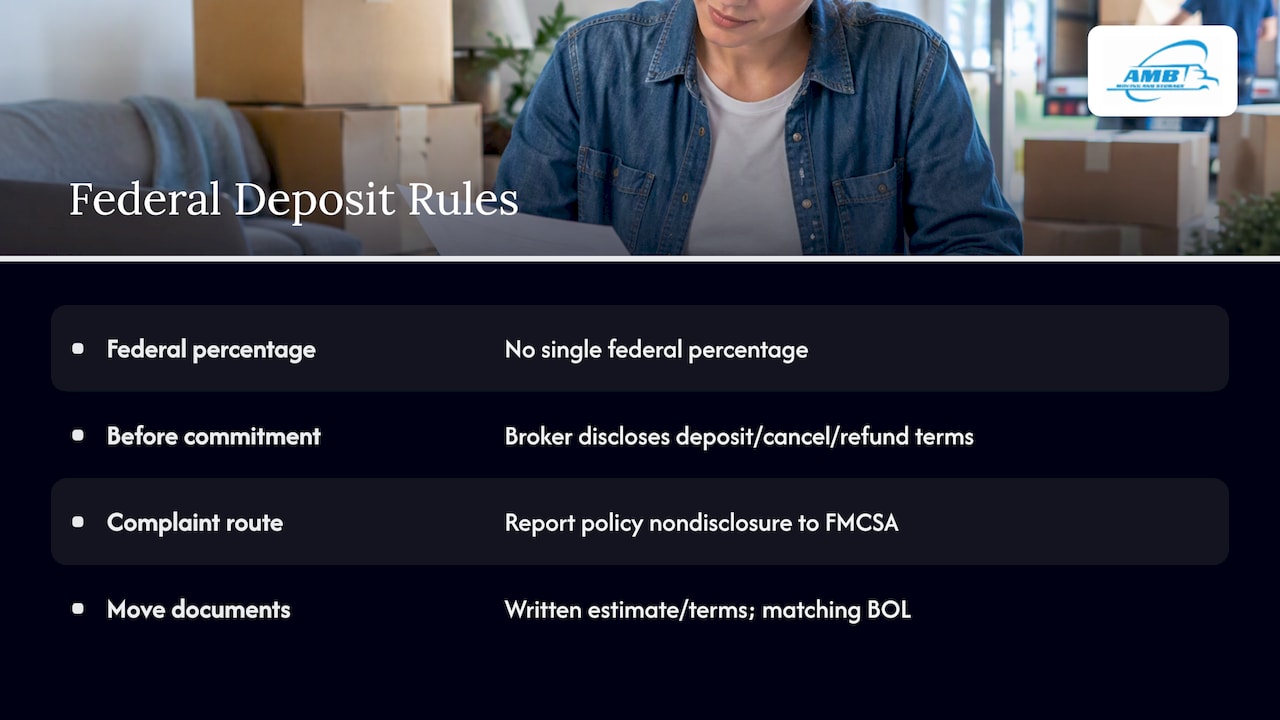
The Federal Motor Carrier Safety Administration (FMCSA) regulates household goods moves that cross state lines. Its rules are built around disclosure. For interstate or foreign moves, brokers must provide their policies concerning deposits, cancellations and refunds. That means you are entitled to see the terms before you commit.
The same logic applies to complaints. Consumers can file a complaint alleging that a broker did not disclose its cancellation, deposit or refunding policy. So the question “what happens to my deposit if I cancel?” is one you are entitled to have answered before you pay, not after.
What you will not find in the sources we reviewed is a single federal percentage that every interstate deposit must match. Articles online quote different caps, and they do not agree with each other. Treat any specific percentage you read as a claim to verify against the FMCSA’s own pages and your contract, not as a rule you can quote at a mover.
What you can rely on is the structure: a written estimate, written payment terms, and a bill of lading that matches them.
How the deposit connects to your estimate and final bill
Your deposit is a piece of the total, not an extra on top of it. Think of the money in three stages.
Stage 1: booking
You receive a written estimate and an order for service. If a deposit is required, it should be on those documents with the amount, the reason and the refund terms. Movers must also state acceptable forms of payment on the estimate, the order for service and the bill of lading. If someone asks you to pay by a method that is not on those documents, pause.
Stage 2: moving day
The crew loads, and the bill of lading records what was loaded and the terms. Check that it matches your estimate before you sign.
Stage 3: delivery
At delivery on an interstate move, you generally must pay 110% of a non-binding estimate or 100% of a binding estimate, plus charges for additional services you requested and for impracticable operations. Impracticable-operation charges due at delivery may not exceed 15% of all other charges due at delivery.
A worked example makes it concrete. Say your non-binding estimate is $6,000, and you paid a deposit of $600 at booking. The most you would generally owe at delivery is 110% of $6,000, which is $6,600, plus charges for extra services you asked for. Your deposit counts toward that total, so you would hand over the remainder, not the full $6,600 again. Confirm in your contract that the deposit is credited to the final bill. It should be.
With a binding estimate, the figure is fixed at 100% of the quoted price for the services listed. Our guide to a binding not-to-exceed estimate explains how that protects you from a bill that grows on delivery day. For a broader view of how quotes work, see our overview of moving estimate types.

How much upfront is reasonable
There is no number we can point to in federal rules that tells you the right deposit. What we can offer is a way to judge one.
A reasonable deposit has these traits:
- It is a modest share of the total, not a large majority of it.
- It is written in the contract with a reason, such as holding your date and crew.
- It states what is refundable and until when.
- It is credited to your final bill.
- It can be paid by a traceable method, such as a credit card.
A deposit that does not look like this deserves questions. If a company wants most of the total before loading anything, ask why. On a long-distance move the bulk of the cost is for transporting your goods, and that service has not happened yet.
Also compare the deposit to the risk. A small booking hold for a studio apartment move is a different conversation than a large payment for a four-bedroom house sent across the country. If the amount feels out of proportion, get a second written quote and compare the terms, not just the totals.
Cancellations, rescheduling and refunds
This is where deposits cause the most arguments. Moves slip: a closing date shifts, a lease starts later, a job offer changes. Your contract should answer these questions in plain words:
- Is the deposit refundable if you cancel, and up to what date?
- If you reschedule, does the deposit carry over to the new date?
- If the mover cancels or cannot provide the date, how fast is the deposit returned?
- Is any part kept as a fee, and what is the fee for?
- How must you give notice: by email, by phone, or through a form?
Keep a copy of every document and every message. If a mover does not disclose its deposit, cancellation or refund policy, that is a matter you can raise with the FMCSA through its eligible complaints process linked above.
The FMCSA also notes that enforcement action may occur if an interstate mover knowingly violates a contract, for example by failing to deliver goods at the agreed destination after you have paid the required amount. Paying what the contract requires, and no more, puts you in the strongest position.
Red flags in a deposit request
Most movers are honest, and a deposit is normal. These signs are not:
- No written estimate. A quote given only by phone or text, with a deposit demanded right away.
- Pressure. “This price disappears in an hour” is a sales tactic, not a moving cost.
- Odd payment methods. If the mover asks for cash only, a wire, or a peer-to-peer app, and that method is not listed on the estimate, ask why. Movers must list accepted forms of payment on their documents.
- Nothing in writing about refunds. Brokers must provide their deposit, cancellation and refund policies for interstate moves.
- A very low quote. An estimate far below every other quote often grows later through added charges.
- Unclear identity. You cannot tell whether you are dealing with the carrier who will move you or a broker who sells your job to someone else.
- Payment of the full amount before loading. Final payment on an interstate move is tied to delivery.
The last point matters most. If you are asked to pay your entire bill before your belongings are on the truck, you have lost your leverage if something goes wrong.
A checklist to run before you pay
Spend ten minutes on these steps before sending money:
- Get the estimate in writing, with the type clearly stated: binding, binding not-to-exceed or non-binding.
- Find the deposit line and read the amount, the purpose and the refund terms.
- Ask who your mover is. Is it the company that will load and drive, or a broker? Ask for the company’s name and USDOT number, and look it up with the FMCSA.
- Check accepted payment methods on the estimate and order for service.
- Pay by credit card when you can, since that gives you a record and often a dispute option. Your card issuer’s terms apply.
- Confirm the deposit is credited to your final bill.
- Read the cancellation and rescheduling clause and note the deadlines.
- Save everything: estimate, order for service, receipts and emails.
If you want a clearer picture of how the quote itself is built, our guide to what a moving estimate is walks through it line by line.
Local and in-state moves follow state rules
Federal rules apply to moves across state lines. A move that starts and ends in the same state generally falls under that state’s rules, and those differ. Some states license and regulate movers through a consumer-affairs, public utilities or transportation agency, and some do very little.
To find the rules that apply to you:
- Search for your state’s name plus “household goods mover regulation” and look for a government page.
- Ask the mover which license or permit it holds in your state, and check it with the regulator.
- Read the deposit and cancellation clause against what that state page says.
If your move is a state-to-state relocation, the federal framework above is the one that matters. If you are unsure whether your move counts as interstate, ask the mover and get the answer on the estimate.
Our perspective on deposits
We think a deposit should be easy to understand. It should be written down, tied to a specific estimate, and explained before anyone asks you to pay it.
Long-distance moving takes planning: dates, crews, routes and, often, storage between pickup and delivery. Customers are right to want clear terms, and a company worth hiring puts those terms on paper. That is how we aim to work: licensed and insured service, structured planning and clear communication, with the estimate type, the charges and the payment terms laid out before the move.
When you compare quotes, compare the paperwork as much as the totals. Ask each company the same questions about deposits, refunds, accepted payment methods and how extras are priced. The answers tell you how the move will go.
If you want our terms in front of you before you decide, request a quote and ask us to show you the deposit and refund terms in writing.
AMB
What extras can add to the bill
The deposit is only one piece of the cost. Charges for extra services show up on the estimate and are paid for what you request. Here are the starting points published on our moving cost guide:
| Charge | Published price |
|---|---|
| Professional packing | $1 to $2 per cubic foot |
| Storage services | From $0.50 per cubic foot |
| Specialty item handling (pianos, safes) | From $200 |
| Elevator or stair fees | From $75 |
| Long carry charges | From $75 |
These are the kinds of line items to look for when you compare moving cost estimates. If a quote lists a total with no breakdown, ask for the detail. A low headline number with extras added later is the most common reason a final bill surprises people.
For packing, see our professional packing services page for what is included.
Work with a team that puts terms in writing
If you are planning a long distance moving job, we handle residential and commercial relocations across state lines, including packing, storage and specialty items. Whether you need one of our interstate movers for a family home or a team for an office, we start with a written estimate so you can see the charges and the terms before you commit.
Learn how we handle long distance moving, explore our interstate moving service, or see how our nationwide moving company coverage works for cross country moves. Ready to compare? Request your quote and ask us for the deposit and refund terms in writing.
A realistic scenario: a three-bedroom move across the country
Consider a family moving a three-bedroom home from the Midwest to the Southeast in six weeks. They collect three written quotes from cross country movers.
- Quote A is a non-binding estimate with a modest booking deposit, clear refund terms and card payment accepted.
- Quote B is far cheaper, comes by text, and asks for a large deposit by a payment app within the hour.
- Quote C is a binding estimate with a written deposit clause and a request for the balance at delivery.
Quote B fails on every point in the checklist: no written estimate, pressure, and a payment method that is not on any document. The family compares A and C on the terms. They ask each company where the deposit goes on the final bill, what happens if closing moves by two weeks, and which payment forms are accepted. They pick the company that answers in writing.
The lesson is that the deposit is not the main cost, but it is the first test of how a company handles paperwork.
Conclusion
Moving deposit rules come down to disclosure and documentation. For interstate moves, you are entitled to see a mover’s deposit, cancellation and refund policies, to know the accepted forms of payment, and to pay the delivery amount set by the estimate type. Get the terms in writing, pay by a traceable method, confirm the deposit is credited to your bill, and walk away from pressure. When you are ready to compare, get your quote from us.
FAQ
Do interstate movers require a deposit?
Many do, to hold your date and crew, but it is a contract term, not a universal requirement. For interstate moves, brokers must provide their policies on deposits, cancellations and refunds. Ask for them in writing before you book.
How much is the final payment at delivery?
On an interstate move you generally owe up to 110% of a non-binding estimate or 100% of a binding estimate, plus charges for services you requested. Your deposit should be credited toward that total. Check the figures against your contract.
Can I get my moving deposit back if I cancel?
It depends on the refund terms in your contract, so read the cancellation clause before paying. It should say whether the deposit is refundable, until what date and whether any part is kept. If a broker never disclosed its policy, you can file a complaint with the FMCSA.
What payment methods can a mover ask for?
Movers must list their acceptable forms of payment on the estimate, the order for service and the bill of lading. If a request does not match those documents, ask why. A credit card gives you a record of the payment.
Do deposit rules differ for local moves?
Yes. Moves within one state follow that state’s rules, which vary. Check your state’s regulator, ask the mover which license it holds, and compare the deposit clause with what the state says.
Sources
- Brokers of Household Goods Transportation by Motor Vehicle, FMCSA Federal Register document
- Estimating Charges (Subpart D), FMCSA
- Eligible Complaints, FMCSA
- Frequently Asked Questions, FMCSA