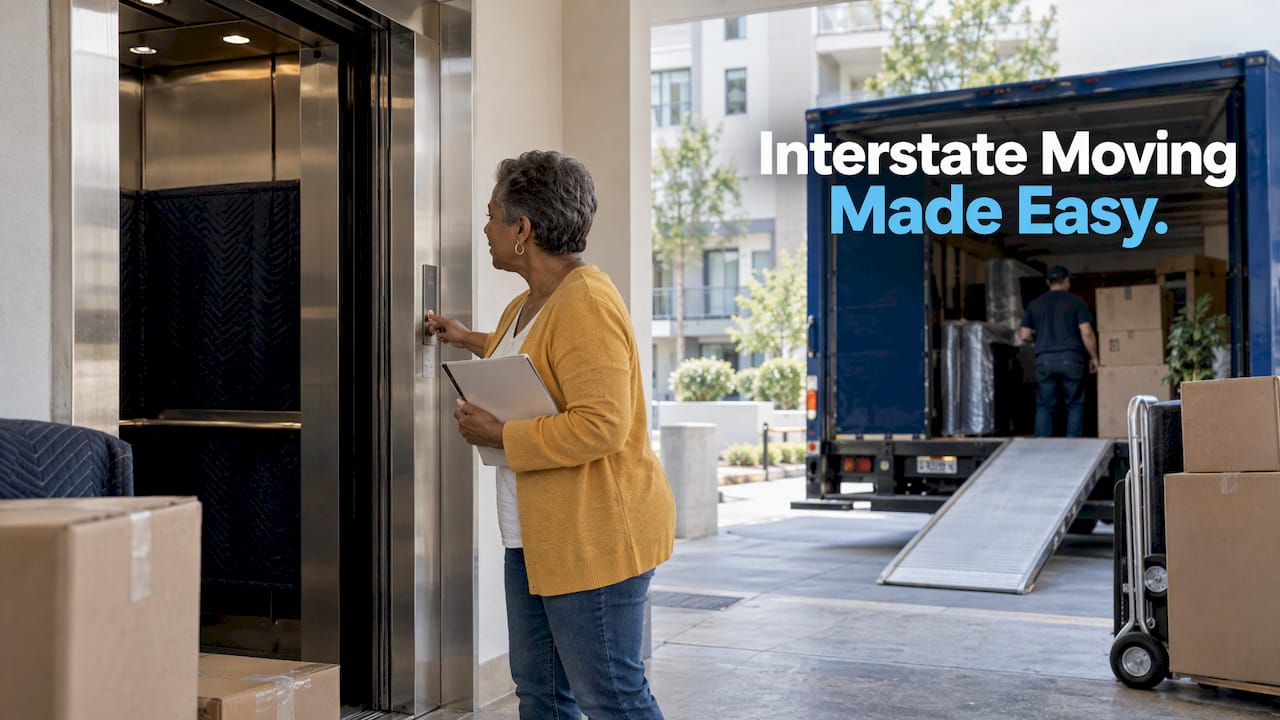


The best apartment move checklist is a countdown with three parts: what you do before you leave (notice, movers, packing, address changes), what you do on the way out (cleaning, final walkthrough, keys), and what you do on arrival (condition report, utilities, unpacking). Start eight weeks ahead if you are crossing state lines, four weeks ahead for a local move. The sections below put every task in order, with the dates, fees and rules that catch people out.
We are a licensed, insured long-distance mover, so we see what happens when an apartment move goes wrong: a missed notice window, a lost deposit, an elevator that was never reserved, a box that cannot be claimed because nobody listed what was in it. This checklist is built to prevent those.
TL;DR
- Read your lease first. It sets your notice deadline, cleaning rules and deposit terms, and it drives every other date.
- Get a written estimate from any interstate mover. A verbal number is not official under FMCSA guidance.
- Photograph both apartments: the one you leave and the one you enter. Those photos are your deposit protection.
- Submit your USPS change of address at least two weeks out, and only on the official site.
- Reserve elevators, loading docks and parking at both buildings before you book moving day.
Table of Contents
- Before You Pack: Set the Frame
- The Apartment Move Checklist by Timeline
- Move-Out Checklist: Get Your Deposit Back
- Packing Plan: DIY, Partial or Full
- Apartment-Specific Costs and Logistics
- Protect Your Belongings: Valuation Coverage
- Move-In Checklist: The First 24 Hours
- After the Move: Your First Week and Month
- Checklist Variations: Family, Senior and Student Moves
- Our Perspective: Why Apartment Moves Fail
- Moving Between States? Let Us Handle the Heavy Part
- FAQ
- Sources
Before You Pack: Set the Frame
Three decisions shape the rest of the checklist, and they are cheaper to make early.
Pick the move type. A move across town, a move to another state and a move across the country are different jobs. Local moves are often priced by the hour. Interstate moves are priced on the weight or volume of your belongings and the distance, and they are regulated federally. If your new apartment is in another state, you want a licensed interstate mover, not a truck rental and a few friends.
Pick the date by your lease, not your calendar. Most leases end on the last day of a month and require 30 to 60 days of written notice. Check yours. Some apartments charge a month-to-month premium or a lease-break fee if your dates do not line up. If your old lease ends before your new one begins, plan for a gap: a few nights of lodging or short-term storage.
Set a budget with a cushion. Moving costs are more than the truck. Count deposits, application and move-in fees, utility start-up charges, packing materials, building fees and tips. LegalClarity notes that landlords collect several payments between lease signing and move-in, and that mandatory move-in fees are often non-refundable, unlike the security deposit. Read those lines before you pay them.
The Apartment Move Checklist by Timeline
Eight to six weeks out
- Find and read both leases. Note the notice period, required cleaning, carpet or paint charges, and rules about moving hours.
- Give written notice to your landlord. Send it the way the lease says (certified mail, email, or a portal), and keep a copy with the date.
- Build a rough inventory. Walk room by room and write down what is moving. This number drives your estimate. Our guide to building a household inventory before your move shows a simple method.
- Start decluttering. Sell, donate or discard anything you would not pay to ship. On a long-distance move, you pay for weight and volume, so every unneeded item has a price.
- Request estimates. For an interstate move, ask for a written estimate based on a survey of your goods, in person or by video. Our page on virtual moving estimates explains how a video survey works.
- Verify any mover you consider. FMCSA says legitimate movers are registered with the agency for interstate work and will tell you plainly whether they are a mover or a broker, per its Your Rights and Responsibilities handbook.
Five to four weeks out
- Book your mover and confirm the date in writing. Peak season (late spring through summer) and the end and start of months fill up first.
- Reserve the elevator and loading zone at your current building and your new one. Many complexes require advance booking, a certificate of insurance, or a deposit for the elevator.
- Decide on packing. You can pack yourself, hire packing for everything, or hire it only for fragile and awkward items. More on this below.
- Collect supplies. Boxes in three sizes, packing paper, tape, markers, bags for hardware, and moving blankets if you are handling furniture yourself.
- Plan for gaps. If you need storage between leases, book it now.
- Start a folder (paper or digital) for the lease, estimate, contract, receipts and ID documents.
Three to two weeks out
- Submit your change of address. According to the USPS, you should submit the request at least two weeks before moving. The online request carries a $1.25 identity verification fee, and permanent moves have mail forwarded for up to 12 months. The same page warns about third-party sites that charge $40 or more and are not affiliated with USPS. USAGov also points you to the official USPS site.
- Update your address elsewhere: employer and payroll, banks and credit cards, insurance, your state driver’s license and vehicle registration, subscriptions, and your doctor and pharmacy.
- Schedule utilities. Set shutoff for the day after you leave and start service at the new place the day before you arrive: electric, gas, water if separate, internet, and trash if billed separately. Book internet installation early, since technician slots can run out.
- Start packing the rooms you use least: books, off-season clothes, decor, spare linens.
- Check what will not travel. Movers will not take certain items, such as flammables and perishables. Our list of items movers won’t move saves you a surprise on loading day.
- Schedule move-out cleaning or set aside the time to do it yourself.
The final week
- Confirm everything: mover arrival window, elevator, parking, and keys.
- Pack a first-night box (see the list below) and an “open first” bag for each person.
- Prepare appliances. Defrost and dry the freezer, and disconnect the washer and dryer. Our washer and dryer prep steps are worth a read for interstate moves.
- Photograph valuable furniture and electronics before they are wrapped, and note serial numbers.
- Pack valuables and documents yourself and carry them with you: passport, medications, jewelry, laptops, chargers, leases, the contract.
- Label everything by room and by contents, and mark boxes that must stay upright.
Moving day
- Be there from first load to last. Walk through with the crew lead and point out fragile items and anything going in your own car.
- Compare the inventory sheet to what is loaded before you sign. Do not sign blank or incomplete documents, FMCSA warns in its handbook.
- Check every room and closet after the truck is loaded, including the balcony, storage cage and garage.
- Take final photos of the empty apartment, then lock up and hand in keys as the lease directs.
- Keep your phone charged and your wallet handy. You will need both at delivery.
Move-Out Checklist: Get Your Deposit Back
A security deposit is usually the largest sum you can lose by being careless in the last week. The fight is almost always over condition, so the plan is to prove it.
- Request a pre-move-out inspection if your landlord offers one. Rules on this vary by state, so check your state’s tenant guidance or ask the landlord.
- Clean to the lease standard. Typical items are oven, refrigerator, bathroom fixtures, cabinets, floors, and window tracks. Remove everything, including items in the attic or storage cage.
- Patch nail holes only if the lease permits it. Some leases prefer you leave walls alone.
- Photograph and video every room after cleaning, with dated files. Include inside closets, under sinks, appliances and floors.
- Return all keys, fobs, remotes and parking passes, and get a receipt.
- Give a forwarding address in writing, since the landlord may mail the deposit or an itemized deduction notice there. Deposit return deadlines are set by state law, so look up yours.
If you are moving a long distance, do not leave the cleaning for after the truck leaves if you are driving away the same day. Book the cleaners for the morning after loading, or clean as rooms empty.
Packing Plan: DIY, Partial or Full
The right choice depends on distance, time and the value of what you own.
| Approach | Best for | Watch out for |
|---|---|---|
| Pack everything yourself | Local moves, small studios, tight budgets | Time; weak boxes; damage claims are harder |
| Pack most, hire pros for fragile and bulky items | One-bedroom to two-bedroom moves with dishes, art, TVs | Marking which boxes the crew packed |
| Full professional packing | Interstate moves, tight timelines, larger apartments | Cost, which scales with volume |
The FMCSA’s liability guidance adds a point many people miss: on long-distance moves, self-packed boxes can make a damage claim harder, because the mover cannot verify the condition of what was inside.
Our professional packing services are priced at $1 to $2 per cubic foot. Specialty items such as pianos and safes start from $200 on our moving cost guide. If you pack fragile items yourself, keep boxes manageable. Our guide to packing fragile items for long-distance moves explains the 45 lb ceiling and why it matters.
Packing tips that save time
- Pack one room at a time and finish each before starting the next.
- Keep heavy items (books) in small boxes and light items (linens) in large ones.
- Bag and tape furniture screws to the underside of the piece they belong to.
- Take a photo of the back of the TV and router before unplugging cables.
- Leave clothes in dresser drawers only if the mover allows it. Many do not for long-distance moves.
Apartment-Specific Costs and Logistics
Apartments add costs that a house move does not. Ask about them when you request your estimate, and read the written estimate for every accessorial charge.
- Stairs and elevators. Fees for carrying items up flights or using an elevator start from $75 with us. See our moving cost guide.
- Long carry. If the truck cannot park near the entrance and crews must carry items a long distance, a long carry charge applies, from $75 with us.
- Building rules. Many buildings limit move hours, require insurance certificates or ask you to pad the elevator. Get the rules in writing from the property manager.
- Parking. Reserve space or get a permit for the truck, particularly in dense cities where street parking is hard.
- Storage. If your new lease starts later than your move-out, storage starts from $0.50 per cubic foot with us. Our guide to storage security features lists what to check before booking.
The estimate matters most. FMCSA says verbal estimates are not official, and you should receive a written estimate based on a survey of your goods, one that spells out transportation, accessorial and advance charges. For route-level figures, see our breakdown of interstate moving costs.
Protect Your Belongings: Valuation Coverage
This is the part of an interstate apartment move that most people skip until something breaks. Under federal law, interstate movers must offer two liability options: Full Value Protection and Released Value. Full Value Protection is the default, and it covers replacement value for lost or damaged goods. Released Value is limited to 60 cents per pound per article, and you must choose it in writing.
In practice, a 10 lb flat-screen TV under Released Value would pay about $6. For a full explanation, read our article on Full Value Protection.
Two more practical points from the FMCSA page: strike out any language on a delivery receipt that releases the mover from liability, and remember that you have nine months after delivery to file a written claim for loss or damage. Note any damage on the delivery paperwork at the time, and photograph it.

Move-In Checklist: The First 24 Hours
You have the keys. Do these before the boxes pile up.
- Do a walkthrough before moving anything in. Open every door, window and closet. Test the locks, smoke detectors, outlets, faucets, toilets, shower, oven, burners, dishwasher, refrigerator, heat and air conditioning.
- Photograph existing damage with a date stamp: scuffs, stains, carpet wear, cracked tiles, broken blinds, appliance dings.
- Fill in the condition report and return a signed copy to the landlord in writing. LegalClarity describes move-in condition reports as the primary protection against deposit disputes, and says documenting existing damage right away is critical.
- Report problems in writing, by email so there is a timestamp. Ask for repairs and a date.
- Check the lease again for clauses on utility caps, pet fees, guest policies and renter’s insurance requirements.
- Confirm utilities and internet are on, and that the meter readings and accounts are in your name.
- Change the locks or ask what the policy is. Some landlords rekey between tenants. Ask, and get the answer in writing.
- Direct the crew room by room, with furniture placement first and boxes second.
- Check the delivery inventory against the list and note any damage on the paperwork before the crew leaves.
The first-night box
Pack it last and load it last, or take it in your car:
- Phone chargers, a power strip, a flashlight
- Toilet paper, hand soap, towels, shower curtain
- Sheets, a pillow, a blanket for each bed
- Basic tools: screwdriver, box cutter, tape, a hammer
- Paper plates, cups, utensils, coffee or tea, snacks and water
- Medications, toiletries, a change of clothes
- Trash bags and all-purpose cleaner
After the Move: Your First Week and Month
Much of what readers search for as a post-move checklist is paperwork. Do it while the memory is fresh.
- Confirm USPS forwarding is working, and watch the mail for a few weeks. Forwarding for a permanent move runs up to 12 months per the USPS.
- Update your address with the IRS if you are waiting on a refund. USAGov says refund checks go to your last known address, and can be returned to the IRS if you move without notifying it or the Postal Service.
- Register to vote and update your license in your new state, within the time your state requires.
- Update vehicle registration and insurance. Ask your insurer to update your renter’s policy to the new address.
- Find the essentials: pharmacy, grocery store, urgent care, and the fastest route to work.
- Inspect your belongings. Open boxes within days, not weeks, and note any damage against the inventory before the claim window shrinks.
- Keep your moving documents until your deposit is returned and any claim is settled.
- Break down boxes and recycle or list them for free locally.
Checklist Variations: Family, Senior and Student Moves
Family moves
Add school records and enrollment, pediatrician records, child care, and a plan for kids and pets on moving day. A family relocation checklist is mostly the same as this one, with more lead time. Our interstate moving guide for families goes deeper.
Senior moves and downsizing
Moving from a house into an apartment means the biggest job is deciding what to keep. Start with a floor plan of the new place, measure the large furniture, and sort belongings into keep, give to family, donate and sell. Begin three months out, not three weeks. Confirm the elevator and ground-floor access in the new building, and ask the mover about careful handling of heirlooms and medical equipment.
Student moves
Students usually move small volumes at the start and end of semesters, when demand peaks. Ship early, check what your residence or landlord allows, and take photos of the room at check-in and check-out. We handle student moves as part of our long-distance service.
Our Perspective: Why Apartment Moves Fail
We move people across state lines every week, and apartment moves fail for a few repeat reasons, almost none of them about the truck.
First, people treat the estimate as a rough idea. A written estimate from a survey of your goods is the only number you can hold a company to. We ask clients to take the inventory seriously, since a missed couch or a forgotten storage cage changes weight, volume and price.
Second, people forget the building. A 4th-floor walk-up with a long carry behaves very differently from a ground-floor unit with a loading dock. We want to hear about it on day one, so the quote reflects it.

Third, people skip coverage and documentation. We recommend you read your valuation options before signing, and photograph everything of value. A claim is only as strong as the record behind it.
Finally, people start late. Eight weeks gives you room for everything above. Two weeks gives you stress and fewer options.
— AMB
Moving Between States? Let Us Handle the Heavy Part
If your apartment move crosses state lines, our crews handle long-distance moving, interstate and state-to-state moves and nationwide relocations with packing and storage available as add-ons. We are licensed and insured. Tell us your dates, building details and inventory, and we will put a written estimate together. Request your moving quote.
FAQ
What should be on an apartment move checklist?
A complete checklist covers notice to your landlord, a written estimate and booked movers, an inventory, packing, address changes, utility transfers, move-out cleaning, photos of both apartments, and a post-move paperwork list. Put each task on a date counting back from moving day. Start eight weeks out for interstate moves.
When should I start packing for an apartment move?
Start three to four weeks before moving day with the items you use least, such as off-season clothes, books and decor. Leave kitchen items, toiletries and daily clothes until the last week. For large apartments or interstate moves, consider professional packing, which saves time and makes claims simpler.
What should I do first when I move into a new apartment?
Walk through before unloading, test the locks, appliances, water and outlets, and photograph any damage. Send the condition report to your landlord in writing. Then confirm that utilities and internet work and set up beds and the first-night box.
How do I make sure I get my security deposit back?
Read your lease cleaning rules, clean thoroughly, and photograph and video every room after cleaning. Return all keys and give a forwarding address in writing. Your move-in condition report is your proof of what damage existed before you arrived, and deposit return deadlines depend on your state’s law.
Is $5,000 enough to move out?
It depends on distance and what you bring. For a local studio, it can cover a deposit, first month’s rent and movers. For an interstate move, the mover’s estimate alone can use much of it, before deposits and fees. Get a written estimate first, then add rent, deposits, move-in fees, utilities and a buffer.
Sources
- USPS: Standard Forward Mail & Change of Address
- USAGov: How to change your address
- USAGov: Undelivered and unclaimed tax refund checks
- FMCSA: Liability & Protection
- FMCSA: Your Rights and Responsibilities When You Move
- LegalClarity: What Happens After You Sign a Lease for an Apartment?