


TL;DR:
- A regulated moving contract is a legally binding agreement governed by federal and state laws that protect consumers. Consumers should review all required documents, such as estimates and the Bill of Lading, to prevent unexpected charges and disputes. Verification of license details through official databases ensures compliance and protects against scams during interstate relocations.
A regulated moving contract is a legally enforceable agreement that defines the terms for transporting your household goods, protecting your rights under federal and state law. For any interstate move, the Federal Motor Carrier Safety Administration (FMCSA) mandates specific documents and disclosures before a mover can load a single box. Skipping a careful review of these documents is the single most common reason consumers face surprise charges, delayed deliveries, or worse. Understanding the role of a moving contract before signing puts you in control of your relocation from day one.
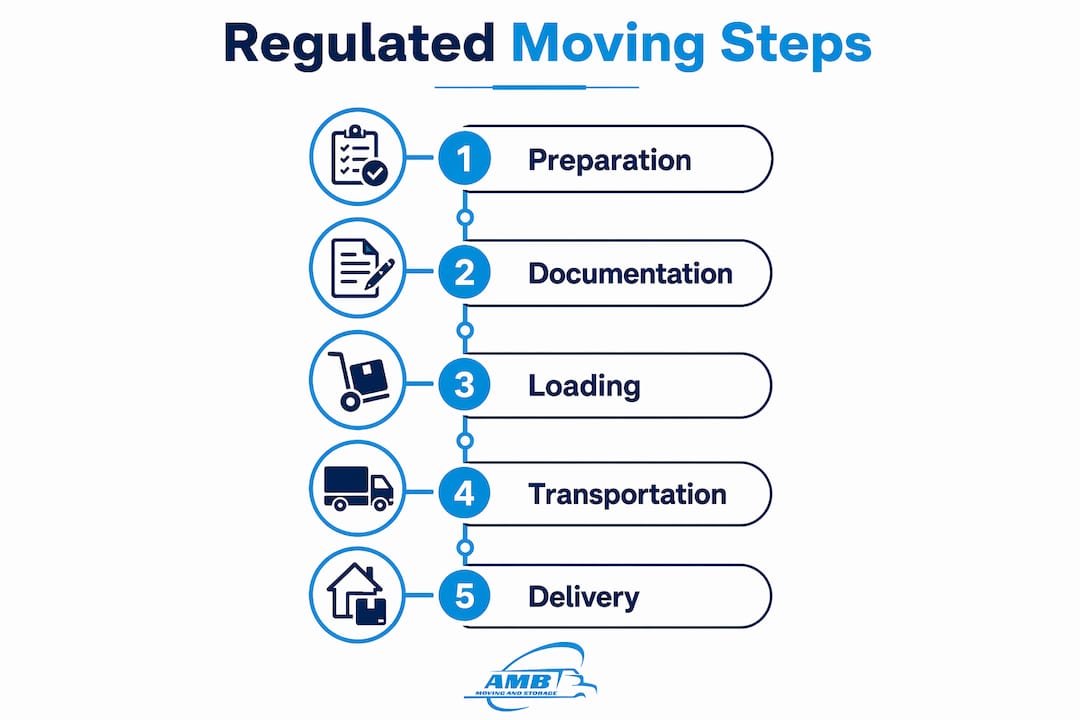
What federal and state regulations govern regulated moving contracts?
Interstate household goods moves fall under federal authority, specifically 49 CFR Part 375, which sets the minimum standards every licensed interstate mover must follow. This regulation covers required disclosures, estimate types, delivery windows, and dispute resolution procedures. The FMCSA enforces these rules and can penalize movers who violate them.
Interstate vs. intrastate rules differ significantly. An interstate move crosses state lines and triggers federal oversight. An intrastate move stays within one state and falls under that state’s transportation authority, which sets its own licensing, insurance, and contract requirements.
State regulations vary widely. California’s Bureau of Household Goods and Services, for example, requires movers to provide a written estimate and a separate consumer protection notice that federal rules do not mandate. Texas enforces its own tariff rules through the Texas Department of Motor Vehicles. These differences matter because a contract that satisfies federal standards may still be non-compliant under your state’s rules.
Key regulatory distinctions to understand:
- Interstate moves: Governed by FMCSA under 49 CFR Part 375; federal rules set the floor for all contract terms.
- Intrastate moves: Governed by individual state agencies; requirements vary by state and may exceed federal standards.
- Licensing: Interstate movers must hold a USDOT number and an MC (Motor Carrier) number issued by FMCSA.
- State licenses: Intrastate movers must hold a state-issued operating authority, separate from any federal registration.
- Consumer protections: Federal rules guarantee specific rights on interstate moves; state rules may add or modify those protections for in-state moves.
What are the required documents in a regulated moving contract?
Four federally required documents must be in your possession before the mover loads your goods on an interstate move: a written estimate, an Order for Service, a Bill of Lading, and a detailed inventory. You must also receive the FMCSA’s “Your Rights and Responsibilities When You Move” booklet. Each document serves a distinct legal function.
The three estimate types
- Binding estimate: A fixed price the mover cannot exceed, regardless of actual weight or time. This is the safest option for budget certainty.
- Non-binding estimate: An approximation of cost based on projected weight. The final charge can differ, though the 110% rule limits what the mover can demand at delivery.
- Binding-not-to-exceed estimate: The price can go down if actual weight is less than estimated, but it cannot go up. This type offers the best consumer protection of the three.
The Bill of Lading
The Bill of Lading is the actual legal contract created at the time of loading. If its terms differ from the written estimate, the Bill of Lading’s terms control. That single fact makes it the most important document in the entire transaction. Read it carefully before the truck leaves your driveway. Any discrepancy between the estimate and the Bill of Lading must be resolved before loading, not after delivery.
Inventory and rights booklet
The inventory lists every item loaded and its condition at pickup. A complete, signed inventory protects you if items arrive damaged or missing. The FMCSA rights booklet explains your legal protections, including how to file a claim and how arbitration works. Movers who fail to provide it are in violation of federal law.
Pro Tip: Photograph your inventory sheet next to the truck before it departs. This creates a timestamped record that is difficult to dispute if a claim arises later.
What are the red flags to watch for in moving contracts?
Seven primary red flags signal a risky or non-compliant moving contract. Recognizing them before signing can save you thousands of dollars and significant stress.
- Non-binding estimates with no written revision: If the mover adjusts the price verbally without issuing a revised written estimate, that change is not enforceable and may violate federal disclosure rules.
- Missing USDOT number: Written estimates must list the mover’s USDOT number and an itemized breakdown of charges. Any estimate that omits this information is non-compliant.
- Verbal-only quotes: A quote that exists only as a phone conversation or email summary is not a regulated estimate. It provides no legal protection.
- Excessive upfront cash deposits: Legitimate interstate movers do not require large cash deposits before the move. A demand for a deposit exceeding 20% of the estimated cost is a warning sign.
- Vague storage fee triggers: Contracts that allow the mover to place goods in storage and charge fees without clear written conditions expose you to open-ended costs.
- No itemized weight or volume calculation: Without a weight or cubic-foot breakdown, you cannot verify whether the final charge is accurate. Learn how weight vs. cubic-foot estimates affect your final bill.
- No arbitration disclosure: Federal rules require interstate movers to offer a neutral arbitration program for disputes under $10,000. A contract that omits this disclosure violates 49 CFR Part 375.
The hostage load is a federal violation. Under the 110% rule, a mover cannot demand more than 110% of a non-binding estimate at delivery as a condition of releasing your goods. Any excess charges must be deferred for at least 30 days. Holding your belongings until you pay above that threshold is a federal offense. State Attorneys General have authority to enforce this rule alongside FMCSA, giving consumers two enforcement channels.
Moving scams often start with a low verbal quote and escalate at delivery. Reviewing a guide on avoiding moving scams before you sign any contract is a practical first step.
How can you verify a moving contract before hiring a mover?
Verification is the step most consumers skip, and it is the step that prevents the most problems. Checking USDOT and MC numbers through the FMCSA’s online database confirms whether a mover is legally registered to operate across state lines. This search takes under two minutes and reveals the mover’s insurance status, complaint history, and operating authority.

Movers and brokers are not the same. A carrier physically transports your goods and holds direct liability. A broker arranges the move but does not transport goods, which can complicate claims if something goes wrong. Your contract must clearly state which type of company you are hiring.
Pro Tip: Use the FMCSA’s “Protect Your Move” portal at protectyourmove.gov to run a full background check on any mover before signing. It shows active complaints, safety ratings, and insurance certificates in one place.
A practical verification checklist before signing any moving agreement:
- Confirm the USDOT and MC numbers match the company name on the contract.
- Verify state-specific operating authority for intrastate moves through your state’s transportation agency.
- Confirm whether the company is a carrier or broker, and get it in writing.
- Review the contract for complete service terms: pickup window, delivery window, and all fee categories.
- Request a binding or binding-not-to-exceed estimate in writing before the move date.
- Reject any contract that lacks the FMCSA rights booklet or omits the arbitration disclosure.
- Use the FMCSA verification guide to cross-check credentials step by step.
| Verification step | What to check |
|---|---|
| USDOT number | Active status and insurance on FMCSA database |
| MC number | Operating authority for interstate moves |
| State license | State transportation agency for intrastate moves |
| Carrier vs. broker | Stated clearly in writing on the contract |
| Estimate type | Binding, non-binding, or binding-not-to-exceed |
| Arbitration clause | Neutral program disclosed per 49 CFR Part 375 |
If you are planning a long-distance relocation, the step-by-step interstate moving guide walks through each verification stage in detail. For budgeting across borders, a moving budget calculator can help you cross-reference estimated costs against itemized contract figures.
Key Takeaways
Regulated moving contracts are legally binding documents governed by FMCSA under 49 CFR Part 375, and reviewing every required document before loading is the single most effective way to protect yourself during an interstate relocation.
| Point | Details |
|---|---|
| Federal framework applies | Interstate moves fall under 49 CFR Part 375; FMCSA enforces all contract requirements. |
| Four documents are mandatory | Written estimate, Order for Service, Bill of Lading, and inventory must be in hand before loading. |
| Bill of Lading controls | If it conflicts with the estimate, the Bill of Lading’s terms are legally binding. |
| 110% rule limits charges | Movers cannot demand more than 110% of a non-binding estimate at delivery; excess must be deferred 30 days. |
| Verify before you sign | Check USDOT and MC numbers on the FMCSA database and confirm carrier vs. broker status in writing. |
What years of interstate moving work taught me about contract review
After working with clients across dozens of interstate relocations, the pattern is consistent: the moves that go wrong almost always involve a contract that was signed without a line-by-line review. Clients assume the estimate is the contract. It is not. The Bill of Lading is the contract, and by the time the truck arrives, most people are too focused on logistics to read it carefully.
The red flag I see most often is the vague storage clause. A contract that says “storage fees may apply” without specifying the trigger, the daily rate, and the release process is an open invitation for unexpected charges. I have seen clients receive bills for two weeks of storage they never agreed to, simply because the delivery window was missed and the mover exercised a clause buried in paragraph nine.
My honest advice: treat the contract review the same way you would treat reviewing a lease. Read every line. Ask the mover to explain any term you do not understand. If they cannot or will not, that tells you everything. Federal law gives you real protections on interstate moves. Use them. Verify credentials through FMCSA, request a binding estimate, and never accept a verbal revision to a written agreement.
— AMB
How Ambmovingservices handles compliant interstate contracts
Ambmovingservices operates as a fully licensed and insured nationwide moving company, registered with FMCSA and compliant with 49 CFR Part 375 on every interstate relocation. Every client receives a written binding estimate, a complete Order for Service, and a clear Bill of Lading before loading begins.
The team at Ambmovingservices reviews contract terms with clients directly, answers questions about estimate types and liability coverage, and provides the FMCSA rights booklet as standard practice. For long-distance moving across state lines, transparent documentation is not optional. It is how every move is handled. Get a personalized, no-obligation quote at ambmovingservices.com/quote/ and move with the confidence that every document is in order before the truck arrives.
FAQ
What is a regulated moving contract?
A regulated moving contract is a legally binding agreement between a consumer and a licensed mover that defines service terms, costs, and obligations under federal or state law. For interstate moves, FMCSA regulations under 49 CFR Part 375 set the minimum required content.
What documents must a mover provide before loading?
Federal law requires four documents before an interstate mover loads your goods: a written estimate, an Order for Service, a Bill of Lading, and a detailed inventory. The FMCSA “Your Rights and Responsibilities When You Move” booklet is also mandatory.
What is the 110% rule in moving contracts?
The 110% rule limits what a mover can demand at delivery on a non-binding estimate. The mover cannot require payment of more than 110% of the estimate as a condition of releasing your goods; any amount above that must be deferred for at least 30 days.
How do I verify a moving company’s license?
Check the mover’s USDOT and MC numbers through the FMCSA’s online database at protectyourmove.gov. For intrastate moves, verify the mover’s operating authority through your state’s transportation agency.
What is the difference between a carrier and a broker?
A carrier physically transports your goods and holds direct liability for the move. A broker arranges the move but does not transport goods, which can complicate the claims process if items are lost or damaged.