


TL;DR:
- Weight-based estimates are legally verifiable and commonly used for long-distance interstate moves, providing transparency and protection. Cubic-foot estimates determine costs based on volume and are primarily suitable for DIY truck or container rentals, but lack independent verification. Choosing a trusted mover with a detailed inventory list and a binding estimate minimizes surprises and ensures fair pricing.
Weight-based estimates calculate your moving cost from the total pounds your shipment weighs, while cubic-foot estimates base pricing on the total space your belongings occupy. These two methods, the primary pricing models used across the U.S. moving industry, produce very different quotes for the same household. For families planning long-distance moves, understanding which method applies to your move is the difference between a final bill that matches your quote and one that doesn’t. The Federal Motor Carrier Safety Administration (FMCSA) regulates interstate moves, and its rules favor weight-based pricing for verifiability. Ambmovingservices uses inventory-based binding estimates to give clients transparent, predictable costs from the start.
How do weight-based moving estimates work?
Weight-based estimates are the industry standard for professional long-distance and interstate moves in the United States. Your mover calculates an estimated weight during an in-home or virtual survey, then confirms the final weight at a certified scale before and after loading your shipment.
The legal framework here matters. Weight-based estimates are verifiable at certified weigh stations under USDOT and FMCSA regulations. That verifiability gives you an objective audit trail. If you believe the final weight is wrong, you can request a reweigh before delivery.
When movers cannot physically weigh items during the estimate, they apply a standard density conversion. The industry standard is 7 pounds per cubic foot for approximating shipment weight from volume. Estimates using 6 lbs/ft³ are considered optimistic and rarely reflect actual shipping weight. That gap matters when your final bill arrives.
Average room weights for planning
Use these figures as a starting point when reviewing your estimate:
- Studio or one-bedroom apartment: 1,500–3,000 lbs
- Two-bedroom home: 3,000–5,000 lbs
- Three-bedroom home: 5,000–7,000 lbs
- Four-bedroom home: 7,000–10,000 lbs
Each full-size room averages 1,000–1,500 pounds of household items. That figure helps you cross-check whether a mover’s estimate aligns with the number of rooms you’re moving.
Pro Tip: At delivery, ask your driver for the certified weight tickets from both the origin and destination weigh stations. You have the legal right to request these documents, and they are your strongest tool for disputing an inflated final charge.
How do cubic-foot estimates work and when do they apply?
Cubic-foot measurement, also called volume-based pricing, calculates the space your items occupy rather than how much they weigh. The formula is straightforward: length × width × height for each item, totaled across your entire shipment. Cubic-foot estimates are standard for DIY moves and truck or container capacity planning.

This method is most useful when you rent a moving truck or portable storage container. Knowing your total cubic footage tells you whether a 16-foot or 26-foot truck fits your load. It does not require a certified scale, which makes it faster to calculate but impossible to verify independently.
Common moving truck sizes by cubic feet
| Truck Size | Approximate Cubic Feet | Best For |
|---|---|---|
| 10-foot truck | 400 cu ft | Studio or 1-bedroom apartment |
| 15-foot truck | 700 cu ft | 1–2 bedroom apartment |
| 20-foot truck | 1,000 cu ft | 2–3 bedroom home |
| 26-foot truck | 1,700 cu ft | 3–4 bedroom home |
Volume-based pricing has one significant limitation for professional moves: no legal verification mechanism exists. A mover can estimate your cubic footage at 600 cu ft and charge accordingly, but you have no certified document to challenge that number the way you can challenge a weight ticket.
Pro Tip: When measuring bulky items like sectional sofas, armoires, or treadmills, measure the full outer dimensions including any protrusions. Underestimating a single large item by 10 cubic feet can shift your truck size category and add hundreds of dollars to your rental cost.
Weight-based vs cubic-foot estimates: which one should you choose?
The right method depends on your move type, your mover, and your tolerance for pricing uncertainty. Here is a direct comparison across the factors that matter most.
Side-by-side comparison
| Factor | Weight-Based | Cubic-Foot |
|---|---|---|
| Calculation method | Total shipment weight in pounds | Length × width × height of all items |
| Legal verifiability | Yes, certified weigh station tickets | No independent verification |
| Typical use case | Professional long-distance and interstate moves | DIY moves, truck rentals, container moves |
| Binding estimate compatibility | Strong, widely used | Limited, harder to enforce |
| Risk of surprise charges | Lower with binding estimate | Higher without verification |
| FMCSA regulated | Yes | No |
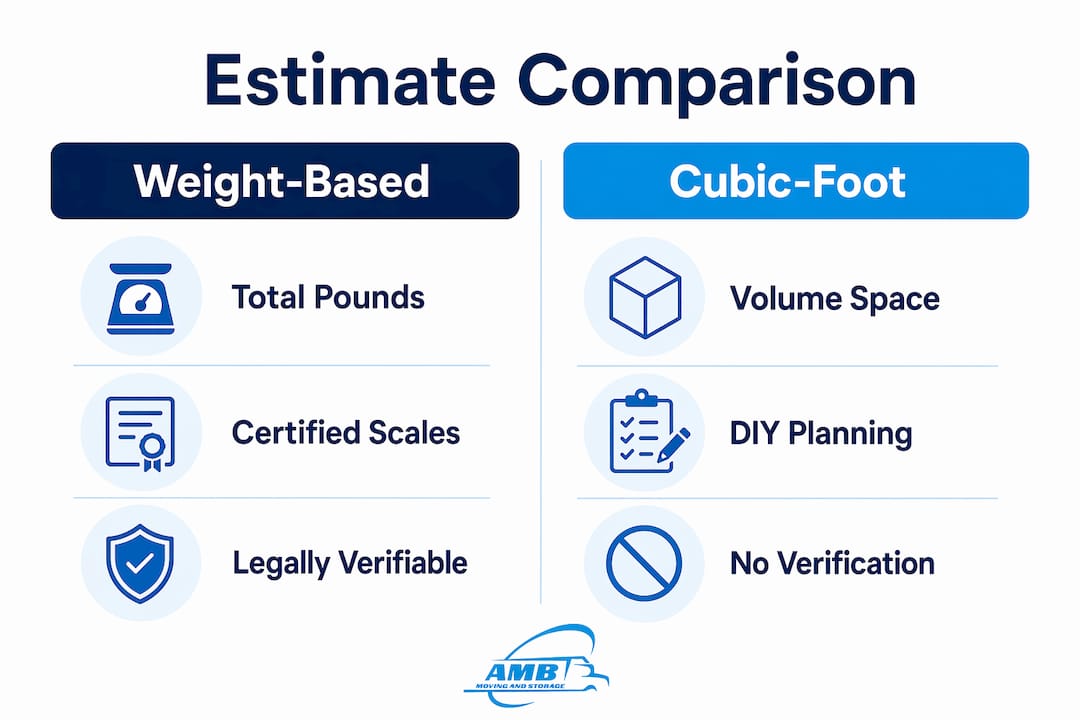
Weight-based estimates win on transparency for interstate moves. Cubic-foot estimates win on simplicity for DIY planning.
The biggest risk with volume-based pricing from a professional mover is the density factor trap. Movers using 6 lbs/ft³ instead of the standard 7 lbs/ft³ may offer a lower initial quote to win your business. The actual weight at the scale then exceeds the estimate, and you face a higher bill at delivery.
What to ask before signing any estimate
- What density factor does the mover use when converting volume to weight?
- Is this a binding or non-binding estimate?
- What surcharges apply beyond the base weight or volume charge?
- Can I see the weigh tickets before I pay the final balance?
Pro Tip: Ask every mover you interview whether their estimate is weight-based or cubic-foot-based, and whether it is binding. A mover who cannot answer both questions clearly is a mover worth avoiding.
What do FMCSA rules say about binding estimates?
The FMCSA defines two types of estimates for interstate moves: binding and non-binding. A binding estimate fixes your price to the agreed inventory list. A non-binding estimate is a good-faith projection that can change based on actual weight or volume at the scale.
Binding estimates require an accurate inventory list and protect you by fixing costs to the agreed items regardless of actual weight or volume. If the inventory list is precise, you avoid extra charges unless you add items after signing. That protection only holds if your inventory is complete and current.
Accurate, comprehensive inventory checklists are the most effective method to prevent post-move billing issues regardless of pricing model. An incomplete inventory almost guarantees unexpected charges. Review your list room by room before your estimator visits.
Common surcharges that appear on final bills
These charges apply independently from weight or cubic-foot calculations:
- Fuel surcharge: Applied as a percentage of the base rate, varies by fuel prices at move time.
- Stair carry fee: Charged per flight of stairs at origin or destination.
- Long-carry fee: Applied when movers must carry items more than 75 feet from the truck to your door.
- Elevator fee: Common in apartment buildings without freight elevator access.
- Shuttle fee: Charged when a large moving truck cannot access your street and a smaller vehicle is required.
Understanding these surcharges helps you anticipate final moving costs before signing. Ask for a written breakdown of every potential surcharge before you commit to any mover. For a full breakdown of how these fees affect your total, the Ambmovingservices moving cost guide covers each line item in detail.
Real-world examples for a typical 3-bedroom interstate move
A 3-bedroom home moving from Chicago to Dallas illustrates how the two methods diverge in practice. Using weight-based pricing, a mover surveys the home, estimates 6,500 lbs, and quotes $4,200 on a binding estimate. At the weigh station, the truck registers 6,720 lbs. Because the estimate is binding, the price does not change.
Using cubic-foot pricing for the same move, a mover estimates 900 cubic feet at $4.50 per cubic foot for a quote of $4,050. The truck loads to 1,050 cubic feet. Without a binding agreement tied to a verified measurement, the final bill climbs to $4,725. That $675 difference is a common outcome when volume estimates go unchecked.
Industry expert Ryan Carrigan advises focusing on mover credibility rather than estimate type. The measurement method matters less than whether your mover is licensed, insured, and committed to transparent pricing. Check FMCSA’s mover registration database before signing anything.
Checklist before your estimator arrives
- Walk every room and list every item, including items in closets, attics, and garages.
- Note any items you plan to sell, donate, or discard before the move.
- Flag specialty items: pianos, gun safes, large artwork, or antiques.
- Confirm access conditions at both addresses: stairs, elevators, parking restrictions.
- Ask whether the estimate will be binding or non-binding and get it in writing.
Consumers can dispute final charges by requesting certified weight tickets from the mover’s weigh stations. For interstate moving specifically, FMCSA rules give you the right to be present at the reweigh. Use that right if your final bill exceeds your binding estimate by any amount.
Key takeaways
The most reliable moving estimates combine a detailed household inventory with a binding agreement, regardless of whether pricing is weight-based or volume-based.
| Point | Details |
|---|---|
| Weight-based is legally verifiable | Certified weigh station tickets give you an objective record to dispute inflated charges. |
| Cubic-foot estimates suit DIY planning | Use volume calculations to select the right truck size, not to lock in a professional mover’s price. |
| Density factor affects your quote | The industry standard is 7 lbs/ft³; estimates using 6 lbs/ft³ often lead to higher final bills. |
| Binding estimates require complete inventories | An incomplete item list voids your price protection and opens the door to surprise charges. |
| Surcharges add cost beyond base pricing | Fuel, stair carry, and long-carry fees apply independently from weight or volume calculations. |
What i’ve learned after thousands of interstate moves
After working through thousands of long-distance relocations across the country, one pattern stands out clearly. Families who get burned by surprise charges almost never had a bad mover. They had an incomplete inventory.
Weight-based pricing is the right default for any professional interstate move. The FMCSA framework exists precisely because weight is objective and verifiable. Volume is not. A mover can estimate your cubic footage at 800 and load 1,000 without a single document to challenge them. That asymmetry favors the mover, not you.
The density factor issue is one I see underestimated constantly. When a quote looks unusually low, the first question I ask is what density factor the mover used. A quote built on 6 lbs/ft³ instead of the standard 7 lbs/ft³ is not a deal. It is a deferred charge waiting at the weigh station.
The insight from Ryan Carrigan rings true from experience: the measurement method is secondary to mover credibility. A trustworthy mover using cubic-foot pricing with a binding agreement will serve you better than a dishonest mover using weight-based pricing with a non-binding quote. But when all else is equal, weight-based binding estimates offer the strongest consumer protection for cross-country moves.
My honest advice: build your inventory list before you call a single mover. Walk every room with a notepad or a spreadsheet. That list is your contract. It is the document that makes a binding estimate actually binding.
— AMB
Get an accurate moving estimate from Ambmovingservices
Planning a long-distance or interstate move means you need numbers you can trust before moving day, not surprises at the door.
Ambmovingservices specializes in nationwide long-distance moves with binding, inventory-based estimates that reflect real weight and volume measurements. Every quote includes a full breakdown of base rates and applicable surcharges so you know exactly what you are paying before you sign. The team conducts thorough in-home or virtual surveys to build the accurate inventory list that makes binding price protection work. Whether you are moving a two-bedroom apartment or a five-bedroom home across state lines, Ambmovingservices delivers transparent pricing backed by FMCSA-compliant processes. Request your personalized moving quote today and move with confidence.
FAQ
What is the difference between weight-based and cubic-foot estimates?
Weight-based estimates price your move by the total pounds your shipment weighs, verified at a certified scale. Cubic-foot estimates price by the total volume your items occupy, calculated as length × width × height.
Which estimate type is better for long-distance moves?
Weight-based estimates are preferred for long-distance interstate moves because they are legally verifiable under FMCSA and USDOT regulations, giving you an objective basis to dispute charges.
What is a binding moving estimate?
A binding estimate fixes your price to an agreed inventory list, protecting you from cost increases even if actual weight or volume differs at delivery. It only holds if your inventory is complete and accurate.
How do i avoid surprise charges on my final moving bill?
Build a complete household inventory before your estimator visits, ask for a binding estimate in writing, and request certified weight tickets at delivery to verify the final charge.
What density factor should my mover use for estimates?
The industry standard density factor is 7 pounds per cubic foot. Estimates built on 6 lbs/ft³ are optimistic and often result in a higher final bill once your shipment reaches the weigh station.