

TL;DR:
- Hiring a licensed mover provides legal protections, insurance coverage, and consumer safeguards during long-distance relocations. Unlicensed movers pose significant financial and legal risks, often engaging in scams with no insurance or accountability. Verifying a mover’s licensing status through official FMCSA and state databases before booking is essential for a secure move.
Licensed movers are professional moving companies that meet strict federal and state regulatory requirements, while unlicensed movers operate without official authorization and expose you to serious financial and legal risks. The distinction between licensed vs unlicensed movers is not a technicality. It determines whether your belongings are protected, whether you have legal recourse if something goes wrong, and whether the company you hired will still answer the phone after your furniture is loaded on a truck.
For interstate moves, the Federal Motor Carrier Safety Administration (FMCSA) is the primary regulatory body. State transportation agencies govern intrastate moves. Both frameworks exist to protect consumers from fraud, property loss, and predatory pricing. Skipping the licensing check is one of the most expensive mistakes a mover can make.
What regulations define a licensed mover?
The regulatory standard for licensed moving companies depends on whether your move crosses state lines.
For interstate household goods moves, the FMCSA requires every carrier to hold a USDOT number and household goods moving authority. These two credentials confirm the company is registered with the federal government and authorized to transport your belongings across state lines. A company without both is operating illegally for interstate work.
Intrastate moves, meaning moves within a single state, fall under state jurisdiction. State licensing requirements vary significantly. California requires a permit from the Public Utilities Commission along with high insurance minimums. Texas requires certification through the Texas Department of Motor Vehicles. Florida has its own intrastate mover registration process. Before you hire anyone for a local move, check your state’s transportation agency website for the specific requirements in your area.
Movers vs. brokers: a critical distinction
Many consumers confuse moving brokers with moving carriers, and that confusion creates real risk. A mover, also called a carrier, assumes full transport responsibility for your goods from pickup to delivery. A broker arranges the move by connecting you with a carrier but does not transport anything itself.
Both movers and brokers must be registered with FMCSA for interstate moves, and brokers are required to use only FMCSA-registered carriers. The problem is that some brokers present themselves as movers, which obscures who is actually responsible for your shipment. Always confirm whether the company you are signing a contract with is the carrier or the broker, and get the carrier’s USDOT number in writing before moving day.
Key documents every licensed mover must provide
Licensed interstate movers are required to give you specific documentation before and during your move:
- Written binding or non-binding estimate before any work begins
- Order for service confirming the agreed terms
- Bill of lading, which is your legal contract and receipt for the shipment
- Your Rights and Responsibilities When You Move, a federal consumer protection booklet
- Proof of cargo and liability insurance coverage
Pro Tip: If a mover refuses to provide a written estimate or skips the bill of lading, treat it as a hard stop. These documents are legally required for interstate moves, and their absence signals an unlicensed or non-compliant operator.
What are the real risks of hiring unlicensed movers?
Unlicensed movers are directly associated with scam tactics including bait-and-switch pricing, hostage deliveries, and taking deposits before disappearing. These are not rare edge cases. They are documented patterns that the FMCSA and consumer protection agencies track every year.
Here is how the most common scams unfold:
- Bait-and-switch pricing. The company quotes a low price online or over the phone. On moving day, the crew loads your belongings, then presents a bill two or three times the original estimate. You pay or your furniture stays on the truck.
- Hostage delivery. The mover takes your goods to a warehouse and refuses to release them until you pay inflated fees not included in the original quote. This tactic is illegal under federal law but nearly impossible to resolve quickly when your belongings are already gone.
- Deposit and disappear. The company collects a large upfront deposit, then cancels last minute or simply stops responding. You lose the deposit and scramble to find a replacement mover.
- No insurance, no recourse. Unlicensed movers carry no required liability or cargo insurance. If your items are damaged, stolen, or lost, you have no insurance claim to file and no regulatory body to escalate to.
“Verifying licensing using FMCSA and state databases reduces the likelihood of encountering bait-and-switch pricing or hostage-load scams.” — FreightWaves
The legal difficulty compounds the financial loss. Without a licensed carrier on record, you cannot file a formal complaint with the FMCSA. Small claims court is an option, but recovering money from a fraudulent operation is rarely straightforward. The best protection is prevention. You can learn more about specific fraud patterns in this guide on avoiding moving scams.
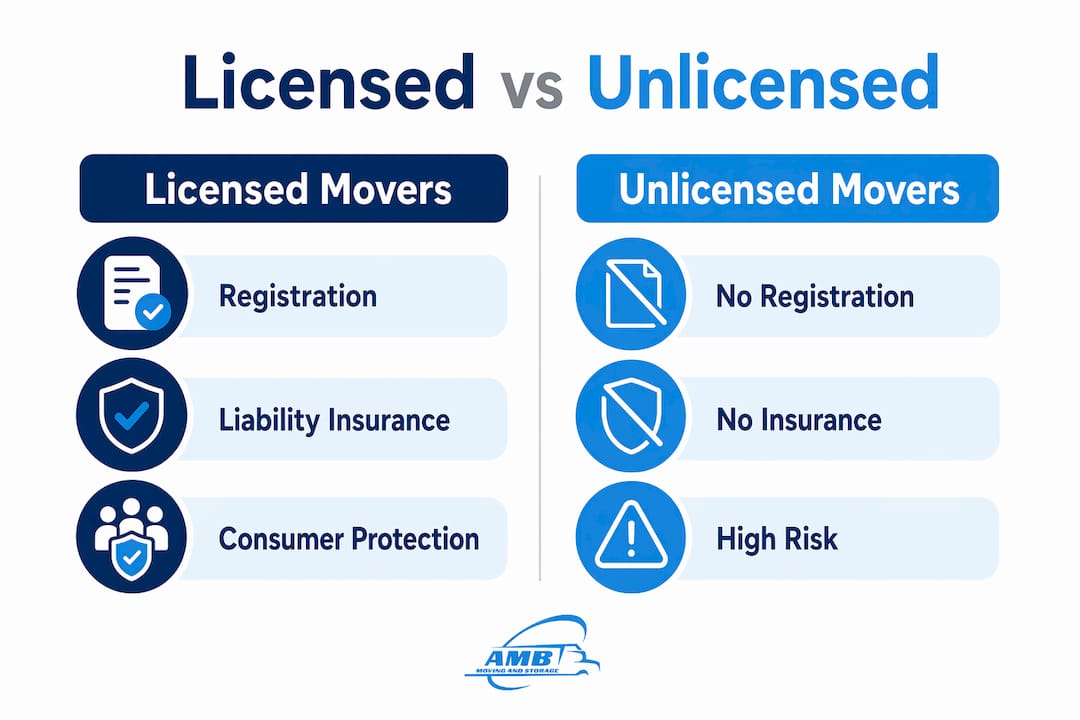
How do licensed movers protect you vs. unlicensed movers?
The gap between licensed and unlicensed movers is not just about paperwork. It translates directly into consumer protections, service quality, and financial accountability.
| Protection | Licensed Movers | Unlicensed Movers |
|---|---|---|
| Liability insurance | Required by law | Not required, rarely carried |
| Cargo insurance | Required by law | Not required, rarely carried |
| Written estimates | Legally mandated | Optional, often verbal only |
| Bill of lading | Required for every shipment | Not provided |
| Driver training | Required under federal standards | No standard |
| Vehicle inspections | Required under FMCSA rules | No standard |
| Complaint resolution | FMCSA and state agencies | No official process |
| Pricing transparency | Binding or non-binding estimate rules apply | No regulation |

Licensed movers must carry liability and cargo insurance, keep vehicles inspected, and employ trained drivers. These requirements exist because moving involves transporting high-value personal property across hundreds or thousands of miles. A single accident or theft without insurance coverage can cost you tens of thousands of dollars with no path to recovery.
The FMCSA consumer framework also gives you a formal dispute process if something goes wrong with a licensed interstate carrier. You can file complaints, access the carrier’s complaint history, and pursue claims through established channels. None of that exists with an unlicensed operator.
Pro Tip: Ask every mover for their USDOT number before the conversation goes any further. A licensed interstate carrier will give it to you immediately. Hesitation or deflection is a red flag worth acting on.
How do you verify if a mover is licensed?
Checking FMCSA and state records is the single most effective step you can take to protect yourself from unlicensed mover risks. The process takes less than five minutes and can save you thousands of dollars.
Step-by-step verification for interstate moves
Use the FMCSA’s online search tool at protectyourmove.gov or the FMCSA SAFER system to look up any carrier by USDOT number or company name. You can verify a mover’s FMCSA status and access their complaint history in the same search. Confirm the following before signing anything:
- The company holds an active USDOT number
- The company has household goods moving authority (not just general freight)
- The company’s operating status shows “Authorized”
- The name on the FMCSA record matches the name on your contract
That last point matters more than most people realize. The authorized carrier doing the transport must match FMCSA records and your contract exactly. A broker may be licensed, but if the carrier they assign to your move is not, your protections disappear. This is the “licensed on paper” problem that catches consumers off guard on long-distance moves.
For intrastate moves, visit your state’s transportation or public utilities commission website and search the company’s state license number. California, Texas, and Florida all maintain public databases. If your state does not have an online search tool, call the agency directly.
Questions to ask every mover before you book
Use this checklist when evaluating any moving company:
- What is your USDOT number, and are you a carrier or a broker?
- Can you provide proof of cargo and liability insurance?
- Will you provide a written binding estimate before moving day?
- Who will physically transport my goods, and what is their USDOT number?
- What is your claims process if items are damaged or lost?
A reputable company answers all five questions without hesitation. You can find a full step-by-step verification guide that walks through each check in detail. For a deeper look at the federal rules that govern your move, the Ambmovingservices resource on federal moving regulations covers what every consumer should know before signing a contract.
Key takeaways
Hiring a licensed mover is the single most reliable way to protect your belongings, your money, and your legal rights during any interstate or long-distance relocation.
| Point | Details |
|---|---|
| Licensed movers require federal registration | Interstate carriers must hold a USDOT number and FMCSA household goods authority before operating legally. |
| Unlicensed movers carry serious financial risk | Without insurance or regulatory oversight, you have no recourse for damaged, stolen, or held goods. |
| Brokers and carriers are not the same | Always confirm the actual carrier’s USDOT number, not just the broker’s registration status. |
| Verification takes five minutes | Use the FMCSA SAFER system or protectyourmove.gov to check any mover’s license and complaint history before booking. |
| State rules apply to local moves | Intrastate moves fall under state licensing, which varies by state and requires a separate verification step. |
What years of interstate moving experience taught me about licensing
Most people assume that if a company has a website, a phone number, and a Google listing, it must be legitimate. That assumption is wrong, and it costs consumers real money every year.
At Ambmovingservices, we have seen the aftermath of unlicensed mover situations more times than we would like. A family in Texas paid a $1,200 deposit to a company that had no USDOT number and no physical address. The company loaded their furniture and went silent. The family had no contract, no insurance claim, and no regulatory body to call. That is not an unusual story.
The term “licensed” also misleads people more than it should. A broker can be fully licensed with FMCSA and still hand your shipment to an unregistered carrier. The license on paper does not protect you if the truck pulling away from your driveway belongs to an unauthorized operator. The only protection that works is confirming the carrier’s USDOT number matches your contract and FMCSA records before a single box is loaded.
One more thing worth saying directly: price is not a reliable signal of legitimacy. Some unlicensed operators quote competitive rates specifically to attract customers who do not check credentials. A low quote from an unverified company is not a deal. It is a liability.
Trust the databases, not the sales pitch. Official records do not lie.
— AMB
Move with confidence using a fully licensed carrier
Ambmovingservices operates as a fully licensed and insured nationwide moving company, holding all required FMCSA registrations for interstate and long-distance moves across the United States. Every shipment moves under a verified USDOT number, a written binding estimate, and full cargo and liability insurance coverage. You get the documentation, the accountability, and the consumer protections that licensed carriers are required to provide. Whether you are relocating across two states or across the country, Ambmovingservices delivers the compliance and reliability your move deserves. Get a free quote today and move with the confidence that comes from hiring a carrier you can verify.
FAQ
What is the difference between a licensed and unlicensed mover?
A licensed mover holds required federal or state registrations, including a USDOT number for interstate moves, and carries mandatory insurance. An unlicensed mover operates without this authorization and offers no regulated consumer protections.
How do i check if a moving company is licensed?
Use the FMCSA SAFER system or protectyourmove.gov to search by USDOT number or company name. Confirm the carrier’s operating status shows “Authorized” and that their name matches your contract exactly.
Are moving brokers the same as licensed movers?
No. Brokers arrange moves but do not transport goods. Both must be FMCSA-registered for interstate moves, but the carrier physically handling your shipment must also hold its own household goods moving authority.
What happens if an unlicensed mover damages my belongings?
You have no insurance claim to file and no regulatory agency to contact. Unlicensed movers carry no required liability or cargo insurance, leaving you with limited options beyond small claims court.
What questions should i ask before hiring a mover?
Ask for the company’s USDOT number, confirm whether they are a carrier or broker, request proof of insurance, and ask for a written binding estimate. Any mover that hesitates on these questions warrants immediate scrutiny.