

TL;DR:
- Moving software connects you to services but offers no direct moving guarantees.
- Licensed carriers own trucks, employ trained crews, and hold federal insurance, ensuring accountability.
- Always verify a mover’s USDOT number to avoid scams and ensure legal accountability.
Planning an interstate move is one of the most stressful experiences a family can face, and the surge of moving apps and platforms has made the decision even harder. You might assume that booking through a sleek digital platform gives you control and saves money. But brokers risk double-brokering and non-refundable deposits between 10 and 20%, with complaint rates three times higher than licensed carriers. Knowing the real difference between moving software, brokers, and actual moving companies before you sign anything can save your household from serious financial and logistical pain.
Table of Contents
- Understanding moving software and real moving companies
- Comparing key features: Moving software vs. real moving companies
- What really matters: Credentials, authority, and your risk
- Which option is right for you? Deciding based on your priorities
- Our take: What most moving guides won’t tell you
- Ready to make your move stress-free?
- Frequently asked questions
Key Takeaways
| Point | Details |
|---|---|
| Always verify credentials | Check USDOT numbers to ensure your mover is fully licensed and insured for interstate moves. |
| Beware of brokers | Moving brokers have triple the complaint rate and often charge non-refundable deposits. |
| Direct carriers offer safety | Dealing with licensed carriers gives you more control, protection, and accountability. |
| Moving software is just a tool | Use software for research, but always hire a carrier who owns trucks and provides legal protection. |
Understanding moving software and real moving companies
Not every platform that helps you book a move is actually a moving company. This distinction matters more than most families realize, especially when you’re trusting someone with everything you own.
Moving software refers to apps and digital platforms that help you organize, compare, and schedule moving services. Think of them as sophisticated search and coordination tools. They don’t own trucks. They don’t employ movers. They connect you with third parties, and the quality of that connection varies wildly.
Moving brokers sit one step closer to the actual move, but they still don’t own transportation equipment or employ trained crews. A broker takes your booking, collects a deposit, and then sells your move to a carrier. That handoff is where things often go wrong.
Licensed moving carriers are the real deal. They own or lease trucks, employ trained moving crews, carry federally required insurance, and hold a valid USDOT number. When something breaks or a delivery is delayed, a licensed carrier is directly accountable.
Here’s where consumer confusion gets expensive. Many families book through what looks like a professional moving site, pay a deposit, and later discover that an unfamiliar company shows up on moving day because the booking was double-brokered to another carrier without their knowledge.
Before committing to any platform, check out moving software alternatives and review the full spectrum of types of moving services available to you. Understanding your options is the first step to avoiding costly surprises.
- Moving software: coordinates and compares, no direct service
- Moving brokers: middle layer between you and the actual carrier
- Licensed carriers: own trucks, employ crews, hold federal authority
- Software and brokers: no direct liability for your belongings
- Licensed carriers: legally and financially accountable for your move
Pro Tip: Every legitimate moving carrier has a USDOT number. Before you pay anything, search that number in the FMCSA SAFER database. If the listing shows the company as a broker rather than a carrier, they don’t own trucks and won’t be the ones showing up at your door.
Comparing key features: Moving software vs. real moving companies
With definitions clear, it’s critical to see how your actual experience changes depending on which solution you choose.
| Feature | Software or broker | Licensed carrier |
|---|---|---|
| Owns trucks | No | Yes |
| Direct liability | No | Yes |
| Trained crew | Not guaranteed | Yes |
| Complaint rate | 3x higher | Standard |
| Deposit policy | Often non-refundable | Typically flexible |
| Price guarantee | Rarely | Binding estimate available |
| Support responsiveness | Varies by platform | Direct contact |
| Federal insurance required | No | Yes |
Those numbers in the complaint column aren’t minor. Brokers carry triple the consumer complaint rate compared to direct carriers, largely because they have no control over the company actually handling your belongings once the handoff happens.
Before you even ask for a price, know what questions to ask moving companies so you can tell immediately whether you’re talking to a carrier or a broker. And when you’re ready to compare providers, this guide on choosing a moving company lays out exactly what to look for.
Key feature differences that affect your actual move experience:
- Insurance coverage: Carriers are federally required to offer Released Value and Full Value Protection. Brokers are not.
- Written estimates: Licensed carriers can provide binding or not-to-exceed estimates. Broker quotes often shift significantly at pickup.
- Scheduling control: With a carrier, you communicate directly. With a broker, you may not know who’s coming until the day before.
- Recourse when things go wrong: If a carrier damages your furniture, you file a claim with them. If a broker’s assigned company damages it, you may have zero recourse with the broker who took your money.
A quick reality check: A non-refundable deposit with a broker isn’t just an inconvenience. If the broker can’t find a carrier for your date, you could lose that money entirely with no move completed.
What really matters: Credentials, authority, and your risk
Once you know the main differences, the next most crucial concern is verifying you’re dealing with a legitimate, accountable mover.
The federal government requires all interstate movers to register with the Federal Motor Carrier Safety Administration (FMCSA). This is your primary protection as a consumer, and checking it takes about two minutes.
Steps to verify any moving company before you pay:
- Ask the company for their USDOT number before any payment or contract.
- Go to the FMCSA SAFER system (safer.fmcsa.dot.gov) and enter the number.
- Confirm the company is listed as an active carrier, not a broker.
- Check their safety rating and whether they have active operating authority.
- Look up their complaint history through the FMCSA consumer complaint database.
Always verify USDOT carrier authority before signing anything. This step alone eliminates the majority of moving scams.
For deeper guidance, the process for verifying moving company accreditation walks you through what legitimate documentation looks like. You can also follow this licensed interstate mover verification guide for a full step-by-step approach.
“When you’re moving across state lines, federal law governs the entire transaction. A carrier with proper authority isn’t just a preference. It’s the only party legally required to protect your belongings and honor their written estimate.”
Pro Tip: Red flags that signal a broker or unlicensed mover include vague business addresses (or no physical address at all), no written estimate offered before payment, and a website with no USDOT number listed. If a company refuses to give you their USDOT number, walk away. Real interstate moving carriers are transparent about their credentials.
Which option is right for you? Deciding based on your priorities
All these facts and risks lead to a clear decision point: which path aligns best with your family’s relocation needs and comfort level?
| Priority | Software or broker | Licensed carrier |
|---|---|---|
| Lowest upfront cost | May appear cheaper | Accurate total cost |
| Accountability | Limited | Full |
| Support when issues arise | Inconsistent | Direct |
| Safety of belongings | Variable | Federally regulated |
| Predictable scheduling | Not guaranteed | Confirmed |
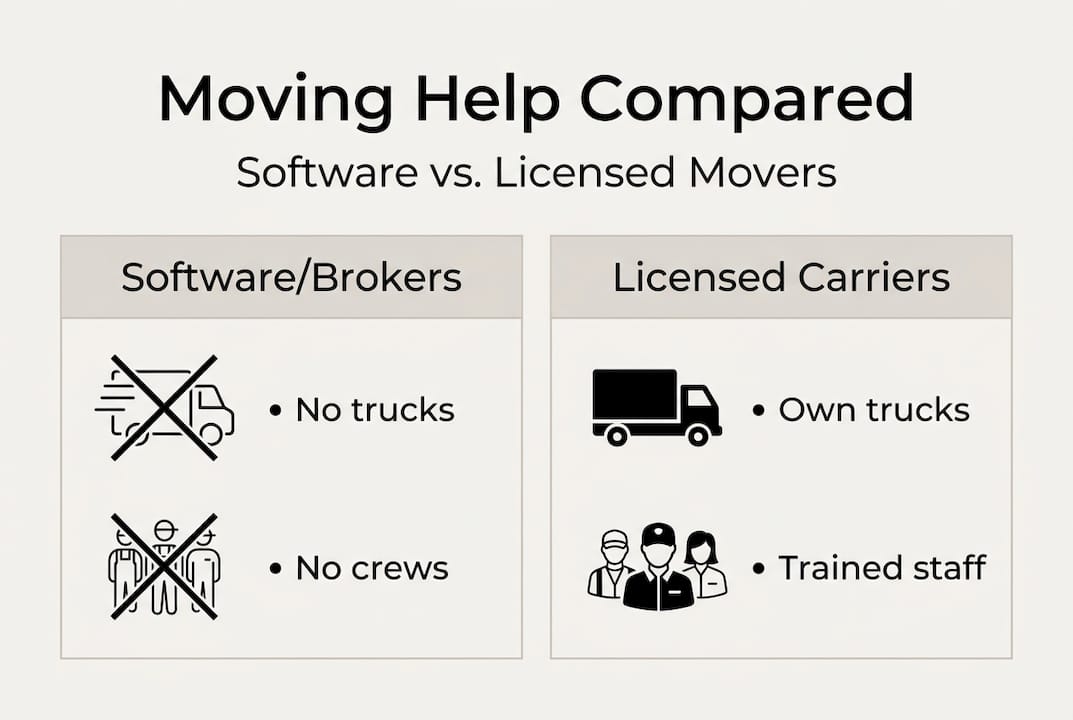
Consumers must weigh risks like triple complaint rates and non-refundable deposits against the apparent convenience of booking through a digital platform.
When moving software or a broker might make sense:
- You’re doing a small, local move and want to compare local prices quickly
- You have flexibility on dates and can absorb scheduling changes
- You’ve independently verified every carrier the platform suggests
- You’re comfortable doing your own FMCSA research before committing
When a licensed carrier is clearly the better choice:
- You’re relocating across state lines with a full household
- You have a firm move-out or move-in deadline
- You own valuable, fragile, or specialty items that need proper insurance
- You want one accountable contact for every part of your move
- You cannot afford to lose a non-refundable deposit if plans fall through
For families with complex moves, reviewing a thorough relocation logistics guide helps you plan timelines realistically. And if your move involves a gap between your move-out and move-in dates, exploring storage solutions for long-distance moves or storage for interstate relocations can bridge that gap safely with one trusted provider.
Our take: What most moving guides won’t tell you
Here’s what we’ve seen that most comparison articles skip over entirely. The initial quote from a tech platform almost always looks better. Sometimes by hundreds of dollars. But that number is almost never the final number.
Platforms and brokers earn their margin by quoting low and adjusting at pickup, when your furniture is already on the truck and your leverage is gone. We’ve heard from families who were quoted one price, paid a non-refundable deposit, and then faced a bill 30 to 40% higher on moving day with zero recourse. Following a thorough step-by-step moving guide before you book can help you spot these tactics early.
Peace of mind isn’t a marketing phrase. It means knowing that the person who quoted your move is the same person who shows up, that your binding estimate is actually binding, and that there’s a licensed, federally registered company accountable if anything goes wrong. Invest the time to verify before you shop on price alone. The research takes an hour. Recovering from a bad move can take months.
Ready to make your move stress-free?
If reading this made you realize you want real accountability and not just a low quote, you’re already thinking the right way about your move.
AMB Moving & Storage Inc. is a licensed interstate carrier operating across all 50 states. We own our trucks, employ trained crews, and carry full federal insurance, so you always know exactly who is responsible for your belongings. Whether you need long-distance moving services or are working with our interstate moving experts on a complex relocation, every step is handled by one accountable team. Ready to take the next step? Get a free moving quote today and see what a verified, licensed carrier can do for your family.
Frequently asked questions
How can I tell if a mover is a broker or a real carrier?
Look up the company’s USDOT number in the FMCSA SAFER database. If they’re listed as a broker rather than a carrier, they do not own trucks and will hand your move off to another company. FMCSA SAFER verification is free and takes under two minutes.
Why do moving brokers have more complaints than moving companies?
Brokers don’t control the quality of the carrier they assign to your move, so when things go wrong, you’re left dealing with a company you never chose. This disconnect produces complaint rates three times higher than direct licensed carriers.
Are non-refundable deposits with moving software or brokers risky?
Yes. If the broker cannot secure a carrier for your scheduled date, you may lose that deposit entirely with no move completed. Non-refundable broker deposits are one of the most common consumer complaints in the moving industry.
Is moving software ever the better choice?
Moving software can be a useful research and comparison tool, but it should never replace verifying the actual carrier you hire. Always confirm the company doing your move holds active USDOT carrier authority before signing any contract or paying any deposit.