


Moving across state lines doesn’t have to feel like controlled chaos. Most families assume the stress is just part of the process, but the truth is that disorganization, not distance, is the real culprit behind most moving nightmares. A moving coordinator changes that entirely. This professional takes ownership of your relocation from the first phone call to the final box being placed in your new home. In this guide, you’ll learn exactly what a moving coordinator does, why their role is critical for interstate moves, and how working with one can protect your time, your belongings, and your sanity.
Table of Contents
- What is a moving coordinator?
- Core responsibilities of a moving coordinator
- How a moving coordinator streamlines interstate moves
- What to expect when working with a moving coordinator
- Our take: Why most interstate moves flop without a coordinator
- Get expert moving coordination for your interstate relocation
- Frequently asked questions
Key Takeaways
| Point | Details |
|---|---|
| Centralized communication | A moving coordinator serves as your single point of contact, simplifying complex logistics. |
| Reduced moving stress | Coordinators anticipate and solve problems, making interstate moves less overwhelming. |
| Higher on-time success | Moves managed by coordinators frequently hit deadlines and avoid common pitfalls. |
| Tailored support | Coordinators create custom plans and adjust to your family’s specific needs and timeline. |
What is a moving coordinator?
Before diving into process, let’s clarify what a moving coordinator actually does. The term gets used loosely, so it’s worth pinning down a precise definition.
A moving coordinator is a professional who oversees every aspect of your relocation. Think of them as a project manager for your move. They don’t just show up with a truck. They plan, schedule, communicate, and troubleshoot from start to finish. As relocation logistics experts describe it, moving coordinators act as project managers for your move, handling complex logistics that most families aren’t equipped to manage alone.
It’s also important to distinguish between a moving coordinator, a moving consultant, and a generic mover. A consultant typically helps you compare options and plan at a high level, often before you’ve signed anything. A generic mover focuses on the physical transportation of your items. A coordinator bridges both worlds, staying involved throughout the entire process and acting as your single point of contact.
This role emerged because interstate moves are genuinely complicated. You’re dealing with federal transportation regulations, multi-state scheduling, storage handoffs, packing logistics, and tight delivery windows. One missed step can cascade into days of delays and hundreds of dollars in unexpected costs.
Here’s what a moving coordinator handles at a glance:
- Initial planning and timeline creation based on your move date and destination
- Vendor coordination including packing crews, transport teams, and storage facilities
- Real-time scheduling to keep every moving part aligned
- Troubleshooting when weather, traffic, or access issues arise
- Customer communication so you’re never left wondering what’s happening
“A moving coordinator is not a luxury for interstate relocations. They are the difference between a move that works and one that falls apart at the worst possible moment.”
Understanding this role sets the stage for everything else. When you know what a coordinator is responsible for, you can see exactly how they add value at every stage of your move.
Core responsibilities of a moving coordinator
Now that you know who a moving coordinator is, let’s examine exactly what they do. The responsibilities span the entire moving timeline, not just moving day.
- Initial assessment: The coordinator starts by learning about your home, your inventory, your timeline, and your destination. This shapes everything that follows.
- Custom moving plan: Based on your needs, they build a detailed plan covering packing schedules, loading dates, transit routes, and delivery windows.
- Vendor coordination: They communicate directly with packing crews, truck drivers, and storage facilities, so you don’t have to manage multiple vendors yourself.
- Real-time updates: Throughout the move, they keep you informed about where your belongings are and what’s happening next.
- Problem resolution: If something goes wrong, like a delayed truck or a scheduling conflict, the coordinator handles it immediately.
- Post-move support: After delivery, they follow up to confirm everything arrived correctly and address any concerns.
A solid relocation planning process depends on this kind of structured oversight. A coordinator’s checklist includes inventory management, vendor scheduling, and customer support, which are the three pillars that keep a move from unraveling.
Communication is arguably the most critical function a coordinator performs. When you’re preparing for movers and juggling work, kids, and a hundred other responsibilities, having one person to call with every question is invaluable. You don’t need to track down the truck driver, the packing crew, and the storage facility separately. Your coordinator handles all of it.
Pro Tip: When evaluating moving companies, ask specifically how their coordinator communicates. Do they use phone, email, or a tracking portal? A coordinator who responds quickly and proactively updates you is worth far more than one who only calls when there’s a problem.
How a moving coordinator streamlines interstate moves
With their responsibilities in mind, here’s how a coordinator’s skills tangibly improve your move.
The most common moving headaches are missed deadlines, lost or damaged items, and last-minute plan changes that nobody communicated properly. Each of these problems has one root cause: poor coordination. A professional coordinator eliminates that root cause.

Coordinated moves have a higher on-time delivery rate and lower damage costs compared to self-managed relocations. That’s not a coincidence. It’s the direct result of having someone whose entire job is to make sure nothing slips through the cracks.
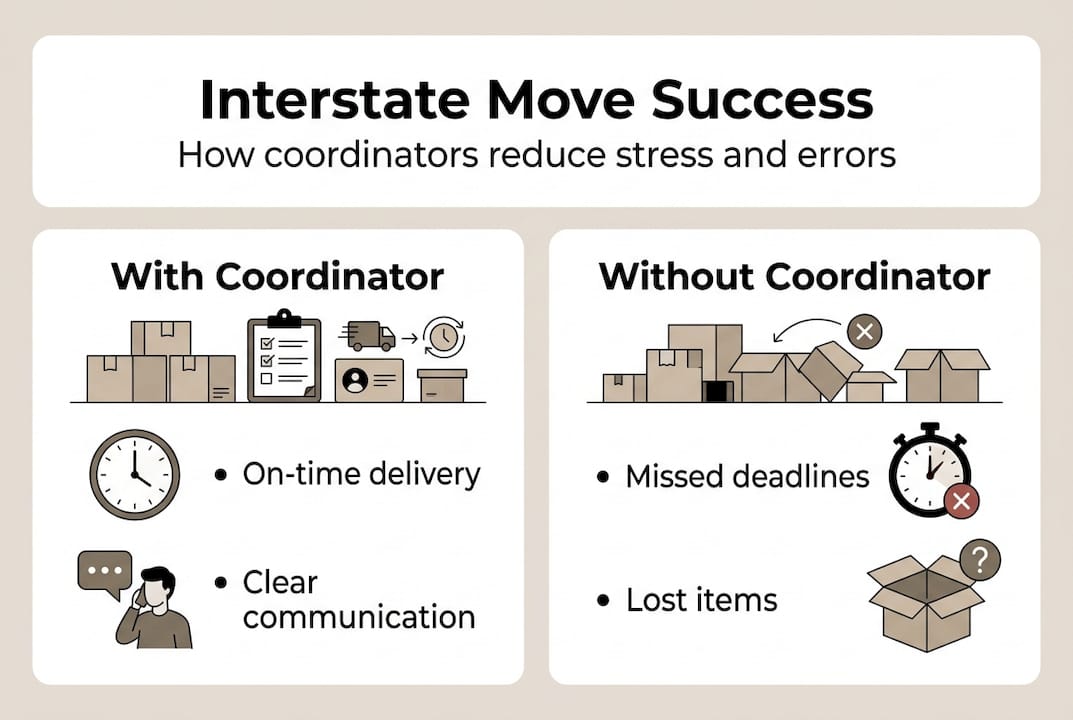
| Factor | With a moving coordinator | Without a moving coordinator |
|---|---|---|
| Timeline management | Proactive scheduling and updates | Reactive, often chaotic |
| Vendor communication | Centralized through one contact | Fragmented across multiple parties |
| Problem resolution | Fast, experienced responses | Delayed, stressful, DIY |
| On-time delivery | Significantly higher rate | Dependent on luck and follow-up |
| Stress level | Manageable and predictable | High and unpredictable |
| Item damage risk | Reduced through oversight | Higher without accountability |
The difference is stark when you see it laid out. Families who work with a coordinator for a stress-free family relocation consistently report a smoother experience than those who try to manage logistics on their own.
Here are the top stress-reduction benefits families experience with a moving coordinator:
- Single point of contact for all questions and updates
- No vendor juggling since the coordinator manages everyone
- Fewer surprises because problems are caught early
- Faster problem resolution when unexpected issues arise
- Confidence that your belongings are being tracked and protected
For interstate moves specifically, these benefits multiply. You’re not just moving across town. You’re coordinating a multi-day, multi-state operation with real financial and logistical stakes.
What to expect when working with a moving coordinator
Let’s walk through what the experience looks like step by step.
Working with a moving coordinator follows a predictable rhythm, and knowing what to expect helps you show up prepared. Coordinators maintain detailed timelines and proactive communication, reducing the risk of missteps at every stage.
| Phase | What the coordinator does | What you should do |
|---|---|---|
| Before the move | Builds your plan, confirms vendors, sets timelines | Share inventory, confirm dates, ask questions |
| Moving day | Oversees loading, updates you in real time | Stay accessible, keep documents handy |
| In transit | Tracks shipment, communicates ETAs | Confirm delivery address, prepare new home |
| After delivery | Confirms receipt, handles follow-up concerns | Inspect items, report any issues promptly |
Here’s how to prepare so your coordinator can do their best work:
- Create a detailed inventory of everything being moved before your first call.
- Confirm your move-out and move-in dates as early as possible to lock in scheduling.
- Identify any special items like antiques, pianos, or fragile artwork that need extra handling.
- Gather all relevant documents including lease agreements, building access rules, and elevator reservations.
- Set communication preferences so your coordinator knows the best way to reach you.
A realistic relocation expense breakdown is also something your coordinator can help you understand early in the process, so there are no financial surprises. For families planning cross-country moves, this kind of upfront transparency is especially valuable.
Pro Tip: Keep a single folder, physical or digital, with all your moving documents, contacts, and notes. When your coordinator needs a quick answer, you’ll have it ready. This small habit prevents delays and keeps communication flowing smoothly.
Our take: Why most interstate moves flop without a coordinator
Stepping back from the nuts and bolts, here’s our honest perspective on what really makes or breaks a successful move.
After handling hundreds of interstate relocations, we’ve seen a clear pattern. Moves don’t fall apart because the movers were bad. They fall apart because nobody was in charge of the big picture. Families underestimate how many moving pieces exist in a multi-state relocation. You have packing timelines, building access windows, truck schedules, storage handoffs, and delivery confirmations all happening at once.
Without a coordinator, each of those pieces is someone’s responsibility but nobody’s priority. That’s where things go wrong. A missed call here, an unconfirmed date there, and suddenly your belongings are sitting in a warehouse while you’re sleeping on an air mattress in your new home.
The real return on investment from a coordinator isn’t money saved. It’s stress averted and time protected. Families who invest in proper smooth relocation logistics don’t just have easier moves. They arrive at their new home with energy left to actually settle in. That’s the outcome worth paying for.
Get expert moving coordination for your interstate relocation
Ready to experience the difference a professional coordinator makes?
At AMB Moving & Storage Inc., our team handles the full scope of your interstate relocation so you don’t have to manage it alone. From your first call to your last box being delivered, we coordinate every detail with care and precision.

Explore our interstate moving services to see how we manage long-distance relocations from start to finish. If you’re still in the planning phase, our guide on choosing an interstate mover can help you ask the right questions. You can also review our state-to-state moving tips for practical advice on what to expect. Reach out today and let’s build a moving plan that works for your family.
Frequently asked questions
What does a moving coordinator actually do on moving day?
On moving day, the coordinator manages schedules, oversees the moving team, updates you in real time, and troubleshoots any issues that come up. They ensure real-time updates and problem-solving happen without you having to chase anyone down.
Is hiring a moving coordinator worth it for a long-distance move?
For interstate moves, a coordinator is almost always worth it because they reduce stress, prevent costly mistakes, and keep your entire relocation organized. Hiring a coordinator frequently results in fewer delays and a smoother overall experience.
How do moving coordinators help with unexpected problems?
Coordinators anticipate challenges before they escalate and act as your advocate to resolve delays, missing items, or last-minute changes. They provide real-time solutions and workarounds so your move stays on track even when surprises happen.
Will a moving coordinator help me save money?
A coordinator may not always lower your base moving costs, but they help you avoid expensive mistakes and unexpected fees. Preventing mistakes and reroutes saves time, money, and stress over the course of a long-distance move.