


Many business leaders mistakenly believe that commercial relocations are simply scaled-up versions of residential moves. This dangerous assumption leads to unexpected costs, extended downtime, and operational disruptions that can impact revenue for months. The reality is that moving an entire business across state lines involves complex logistics, regulatory compliance, specialized equipment handling, and careful coordination among multiple stakeholders. This comprehensive guide walks you through every critical phase of the commercial relocation process, from initial planning through post-move setup, helping you execute an efficient interstate move that minimizes disruption and protects your bottom line.
Table of Contents
- Key takeaways
- Understanding the commercial relocation process
- Planning and organizing your interstate commercial move
- Choosing the right professional moving services for your business
- Managing logistics, packing, and minimizing downtime
- Explore professional interstate moving services with AMB Moving
- FAQ
Key Takeaways
| Point | Details |
|---|---|
| Plan early and thoroughly | Effective interstate moves require planning months in advance to coordinate vendors, permits, and stakeholder expectations. |
| Dedicated relocation manager | Assign a single point of contact with authority to make quick decisions and prevent communication breakdowns. |
| Understand costs and regulatory requirements | Assess costs and regulatory requirements to avoid unexpected expenses and delays during the move. |
| Effective packing and logistics | Using specialized packing and coordinated transportation reduces downtime and protects assets during relocation. |
Understanding the commercial relocation process
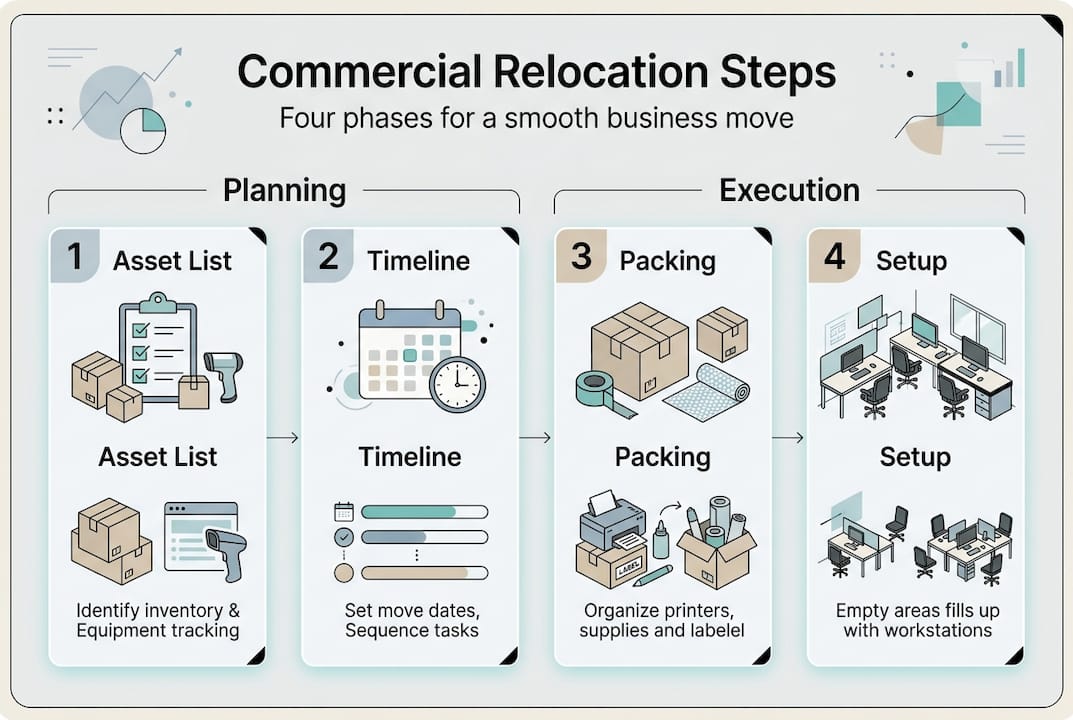
The commercial moving process unfolds across four distinct phases, each demanding meticulous attention and specialized expertise. Unlike residential moves, where belongings flow from one location to another in a relatively straightforward manner, commercial relocation involves multiple phases including planning, packing, transportation, and setup at the new location. Each phase requires careful coordination among internal teams, external vendors, IT specialists, and moving professionals to ensure nothing falls through the cracks.
The initial planning phase establishes your entire relocation framework. You’ll conduct comprehensive asset inventories, identify critical equipment requiring special handling, and develop contingency plans for potential disruptions. This groundwork determines whether your move proceeds smoothly or devolves into chaos. During the packing phase, specialized techniques protect everything from standard office furniture to sensitive servers and laboratory equipment. The transportation phase involves coordinated logistics across state lines, often requiring permits and compliance with interstate commerce regulations. Finally, the setup phase at your destination demands systematic unpacking and installation to restore operations as quickly as possible.
Mismanagement during any single phase creates cascading problems throughout your entire relocation. A poorly executed inventory leads to missing equipment at your new location. Inadequate packing results in damaged assets and insurance claims. Transportation delays without contingency plans extend your downtime beyond acceptable limits. Disorganized setup procedures leave employees unable to work effectively for weeks after arrival.
Pro Tip: Assign a dedicated relocation manager from your team to serve as the single point of contact for all moving-related decisions. This person should have authority to make quick decisions and coordinate across departments, preventing the communication breakdowns that plague committee-managed moves.
Early assessment of your asset inventory reveals hidden complexities that impact your timeline and budget. You’ll discover equipment that requires specialized crating, items needing climate-controlled transport, and assets that may be more cost-effective to replace than move. This assessment also identifies opportunities to purge outdated equipment, reducing your overall moving volume and costs.
Planning and organizing your interstate commercial move
Effective planning significantly reduces downtime and cost overruns during interstate commercial relocations. Your planning phase should begin at least six months before your target move date, allowing adequate time to address the complex requirements of cross-state business transitions. This extended timeline accommodates vendor coordination, permit acquisition, employee communication, and the inevitable unexpected challenges that emerge during large-scale relocations.
Follow these essential planning steps in sequence:
- Conduct a comprehensive asset audit documenting every item requiring relocation, including furniture, equipment, inventory, and technology infrastructure.
- Develop a detailed timeline with specific milestones for each phase, working backward from your target occupancy date.
- Identify critical business functions that cannot be interrupted and plan their transition carefully.
- Research and understand regulatory requirements in both your origin and destination states, including business licenses, permits, and tax registrations.
- Coordinate with all stakeholders including employees, clients, vendors, and service providers about the move timeline and any service interruptions.
- Arrange specialized transport solutions for sensitive equipment such as servers, medical devices, or manufacturing machinery.
- Develop comprehensive contingency plans for potential delays or complications.
Your state to state moving plan must account for regulatory differences between jurisdictions. Each state maintains unique requirements for business operations, and your relocation triggers compliance obligations in both locations. You may need to register your business entity in the new state, obtain new licenses and permits, update tax registrations, and notify regulatory agencies of your address change. Professional movers experienced with interstate commerce can guide you through transportation-specific requirements, but you remain responsible for business regulatory compliance.
Pro Tip: Create a detailed floor plan of your new space before the move, assigning specific locations for every desk, equipment piece, and storage area. Share this plan with your moving team so they can place items directly in their final positions, eliminating time-consuming reorganization after arrival.
| Planning Element | Timeline Before Move | Key Actions |
|---|---|---|
| Initial Assessment | 6 months | Inventory audit, budget development, vendor research |
| Vendor Selection | 4-5 months | Request quotes, verify credentials, negotiate contracts |
| Detailed Planning | 3-4 months | Floor plans, packing schedules, employee communication |
| Regulatory Compliance | 2-3 months | Permits, licenses, insurance updates |
| Final Preparation | 1 month | Confirm schedules, backup critical data, notify stakeholders |
Your relocation planning guide should address employee concerns proactively. Staff anxiety about relocations can impact productivity and retention. Communicate early and often about the move timeline, how it affects their work, what support you’ll provide, and what they need to do personally. Some employees may choose not to relocate, requiring you to plan for recruitment and training in your new location.
Choosing the right professional moving services for your business
Selecting experienced commercial movers ensures compliance with interstate transportation laws and protects valuable office assets throughout the relocation process. The moving company you choose becomes your primary partner in executing this complex transition, making this decision one of your most critical planning steps. Unlike residential movers who simply transport household goods, commercial moving specialists understand business continuity requirements, regulatory compliance, specialized equipment handling, and the financial implications of extended downtime.
Verify that any moving company you consider holds proper licensing and insurance credentials. For interstate moving, companies must be registered with the Federal Motor Carrier Safety Administration and display valid DOT and MC numbers. These registrations indicate the company has met federal safety standards and maintains required insurance coverage. Request proof of general liability insurance and cargo insurance, ensuring coverage limits adequately protect your assets. A legitimate moving company provides this documentation readily, while hesitation or evasiveness signals potential problems.
Assess each company’s proven experience specifically with commercial interstate relocations. Residential moving experience, while valuable, doesn’t translate directly to commercial requirements. Ask for references from businesses similar to yours in size and industry. Inquire about their experience moving specialized equipment relevant to your operations, whether that’s medical devices, manufacturing equipment, restaurant facilities, or technology infrastructure. Companies with relevant experience anticipate challenges specific to your industry and bring proven solutions.
Evaluate the full range of services each company offers beyond basic transportation. Comprehensive commercial movers provide packing services, custom crating for sensitive equipment, disassembly and reassembly of furniture and equipment, storage solutions for phased moves, and project management coordination. These additional services, while increasing upfront costs, often reduce total relocation expenses by preventing damage, minimizing downtime, and eliminating the need to coordinate multiple vendors.
Consider pricing structure and contract terms carefully when choosing moving company interstate moves partners. Reputable companies provide detailed written estimates after conducting on-site assessments of your current location. Be wary of quotes provided over the phone or online without seeing your actual moving requirements. Understand whether quotes are binding or non-binding, what circumstances allow for price adjustments, and what payment terms apply. Transparent pricing with clear explanations of all charges indicates a trustworthy partner, while vague estimates or pressure to sign quickly suggests potential problems.
Managing logistics, packing, and minimizing downtime
Proper packing and logistics coordination minimize equipment damage and reduce business downtime during moves. Your packing strategy directly impacts both the safety of your assets and the speed of your operational recovery at the new location. Professional commercial packing differs fundamentally from residential packing, requiring specialized materials, techniques, and planning to protect everything from standard office furniture to sensitive electronics and proprietary equipment.

Professional packing services offer significant advantages for commercial relocations. Experienced packers use commercial-grade materials designed for the rigors of long-distance transport, including heavy-duty boxes, custom crating, anti-static packaging for electronics, and specialized containers for sensitive items. They understand proper weight distribution, stacking techniques, and load securing to prevent shifting during transport. Most importantly, professional packers work efficiently, completing in days what might take your staff weeks, allowing employees to focus on their actual jobs rather than packing duties.
Compare the benefits and drawbacks of different packing approaches:
| Packing Approach | Advantages | Disadvantages | Best For |
|---|---|---|---|
| Full Professional Service | Fastest completion, expert handling, insurance coverage, minimal staff disruption | Highest upfront cost | Large offices, sensitive equipment, tight timelines |
| Partial Professional Service | Professional handling of critical items, cost savings on standard items | Requires coordination between teams, longer timeline | Medium offices with mixed equipment types |
| Self-Packing with Professional Materials | Lowest cost, complete control over process | Longest timeline, highest damage risk, significant staff time | Small offices with standard furniture, flexible timelines |
Organize your logistics for phased transport and setup to maintain some operational capacity throughout the transition. Rather than shutting down entirely, move departments or functions in stages, allowing portions of your business to continue operating. This approach works particularly well for businesses with multiple locations or those that can temporarily operate with reduced capacity. Phased moves require more complex coordination but dramatically reduce the financial impact of complete operational shutdowns.
Pro Tip: Color-code all boxes and furniture by department or room destination, matching colors to your new floor plan. This simple system allows movers to place items correctly without constant supervision, speeds up unpacking, and reduces the chaos of move-in day.
Plan specifically to minimize operational disruption during your most critical business periods. If you operate a retail business, avoid moving during peak shopping seasons. Professional services firms should schedule relocations during slower billing periods. Educational institutions typically move during summer breaks. Manufacturers might coordinate moves during planned maintenance shutdowns. Strategic timing of your relocation reduces revenue impact and customer disruption.
Consider storage solutions in moving as a buffer during your transition. Storage facilities provide flexibility when your move-out and move-in dates don’t align perfectly, when your new space requires renovation before occupancy, or when you need to downsize and haven’t yet determined which items to keep. Climate-controlled storage protects sensitive equipment and documents during extended storage periods. Some moving companies offer integrated storage as part of their service packages, simplifying logistics and reducing the number of times your items are handled.
Specialized equipment requires extra planning and expertise. Items like servers, manufacturing equipment, medical devices, or arcade machines need custom crating, climate-controlled transport, and often professional disconnection and reconnection services. Identify these items early in your planning process and arrange appropriate expertise. The cost of specialized handling is minimal compared to replacing damaged equipment or dealing with operational failures after your move.
Explore professional interstate moving services with AMB Moving
Navigating the complexities of commercial relocation requires experienced partners who understand both the logistics of interstate transport and the critical importance of business continuity. AMB Moving Services specializes in interstate moving services designed specifically for businesses facing the challenges of cross-state relocations. Our team brings decades of experience managing commercial moves of all sizes, from small professional offices to large corporate facilities, with a focus on minimizing downtime and protecting your valuable assets.
Our comprehensive approach addresses every aspect of your commercial relocation. We provide detailed planning support, helping you develop realistic timelines and identify potential challenges before they become problems. Our professional packing services protect everything from standard office furniture to sensitive technology infrastructure. We coordinate all logistics, manage regulatory compliance for interstate transport, and work within your schedule to minimize business disruption. When you’re ready to choosing moving company for interstate moves, our licensed and insured team provides the expertise and reliability your business deserves.
FAQ
What is the typical timeline for a commercial relocation?
Most commercial moves require three to six months of planning, with the actual physical relocation lasting anywhere from several days to several weeks depending on your business size and complexity. Larger organizations with multiple departments, extensive equipment, or specialized assets need longer timelines. Early planning helps accommodate unforeseen delays, vendor scheduling conflicts, and the inevitable complications that emerge during complex relocations. Rushing the process increases costs and risks.
How can I minimize downtime during a commercial move?
Coordinate phased moves that relocate departments or functions in stages rather than shutting down your entire operation simultaneously. Schedule packing and moving activities during off-hours, weekends, or slow business periods when disruption has minimal impact. Use professional movers experienced in efficient commercial transitions who can complete work quickly and systematically. Plan your IT and critical infrastructure moves with particular care, as these systems often represent your biggest operational dependencies. Having backup systems or temporary solutions ready ensures you can maintain essential functions even during the physical transition.
What should I look for when hiring a moving company?
Verify that any moving company holds proper licensing and insurance for interstate commercial moves, including valid DOT and MC numbers registered with the Federal Motor Carrier Safety Administration. Check their specialized experience with commercial interstate relocations specifically, not just general moving experience. Read customer reviews and request references from businesses similar to yours in size and industry. Evaluate their full service offerings including packing, storage, and specialized equipment handling. Ensure they provide detailed written estimates after on-site assessments and offer transparent pricing with clear contract terms.
Are there specific regulations for interstate commercial moves?
Interstate moves involve DOT regulations governing commercial transportation, including vehicle safety standards, driver qualifications, and cargo insurance requirements. Different states maintain varying requirements for business licenses, permits, tax registrations, and regulatory compliance that you must address when relocating across state lines. Professional interstate moving regulations specialists typically manage transportation compliance as part of their service. However, businesses remain responsible for updating their own licenses, permits, and registrations in both origin and destination states. Verify that your moving company holds all required credentials and understands the specific regulatory requirements for your origin and destination states.