


Moving across state lines feels like a bigger version of a local move. It is not. Interstate vs. intrastate rules are governed by entirely different federal frameworks, and the average interstate relocation costs 40 to 67% more than a move within one state. Federal regulations, mandatory documentation, and pricing structures that do not apply locally all come into play the moment your belongings cross a state border. This guide walks you through everything: what interstate moving actually means, how it is regulated, what it costs, and how to protect yourself and your family every step of the way.
Table of Contents
- What is state-to-state moving?
- How interstate moving is regulated
- Understanding interstate moving costs
- Types of interstate moving: Service options compared
- Valuation, insurance, and protection for your move
- Special edge cases and what can go wrong
- Practical tips to save money and stress
- Expert services for state-to-state moving
- Frequently asked questions
Key Takeaways
| Point | Details |
|---|---|
| Federal rules apply | Every interstate move is governed by FMCSA regulations and requires USDOT-registered movers. |
| Costs are higher | State-to-state moves cost 40–67% more than intrastate moves due to distance and legal requirements. |
| Compare service options | Choose between full-service, container, or DIY moves based on protection, cost, and convenience. |
| Save with decluttering | Reducing your moving weight saves about $0.50–$0.80 per pound and lowers your total bill. |
| Check for legal risks | Avoid hostage loads and delays by verifying mover credentials and understanding your rights. |
What is state-to-state moving?
State-to-state moving, also called interstate moving, means relocating your household goods from one U.S. state to another. That single detail changes everything about how your move is handled, priced, and protected. Interstate moving falls under federal jurisdiction, not state law, which means the rules are consistent no matter which two states you are moving between.
The Federal Motor Carrier Safety Administration, known as the FMCSA, is the federal agency that oversees all interstate household goods carriers. Every legitimate interstate mover must be registered with the FMCSA and hold a valid USDOT number. FMCSA regulations set the standards for pricing transparency, liability, and consumer rights that local movers simply are not required to follow.
Here is what makes interstate moves fundamentally different from local ones:
- Federal oversight applies from the moment your goods cross a state line
- Pricing is based on weight and distance, not hourly rates like most local moves
- Mandatory consumer documents must be provided before your move begins
- Liability and valuation rules are set by federal law, not the mover’s preference
- Delivery windows replace guaranteed delivery times, which is standard practice federally
Interstate moving is not just a longer drive. It is a federally regulated transaction with legal protections and obligations that both you and your mover must follow.
How interstate moving is regulated
Now that you know what interstate moving is and the role of federal regulations, let’s look at the rules and what paperwork to expect. The FMCSA requires every interstate mover to carry a USDOT number and an MC (Motor Carrier) number. You can verify any mover’s credentials at ProtectYourMove.gov, the FMCSA’s official consumer protection site.
Here is the step-by-step process for verifying and working with a licensed interstate mover:
- Search the mover’s USDOT number on ProtectYourMove.gov to confirm active registration
- Request a written estimate before any work begins, either binding or non-binding
- Receive the Bill of Lading, which is your legal contract and receipt for the shipment
- Get the FMCSA booklet titled Your Rights and Responsibilities When You Move, which movers are legally required to provide
- Confirm insurance and valuation options in writing before signing anything
According to long-distance moving requirements, interstate movers must provide all of these documents before your move date. Missing any one of them is a red flag. You can also learn more about verifying licensed movers and what to look for when choosing a moving company for your specific route.
Pro Tip: Never book an interstate mover who cannot provide a USDOT number on request. Legitimate carriers display it openly. If a company hesitates, walk away.
Understanding interstate moving costs
With the rules and paperwork clear, the next big question is cost. Interstate moving is priced differently from local moves, and understanding the structure helps you budget accurately and avoid surprises at delivery.
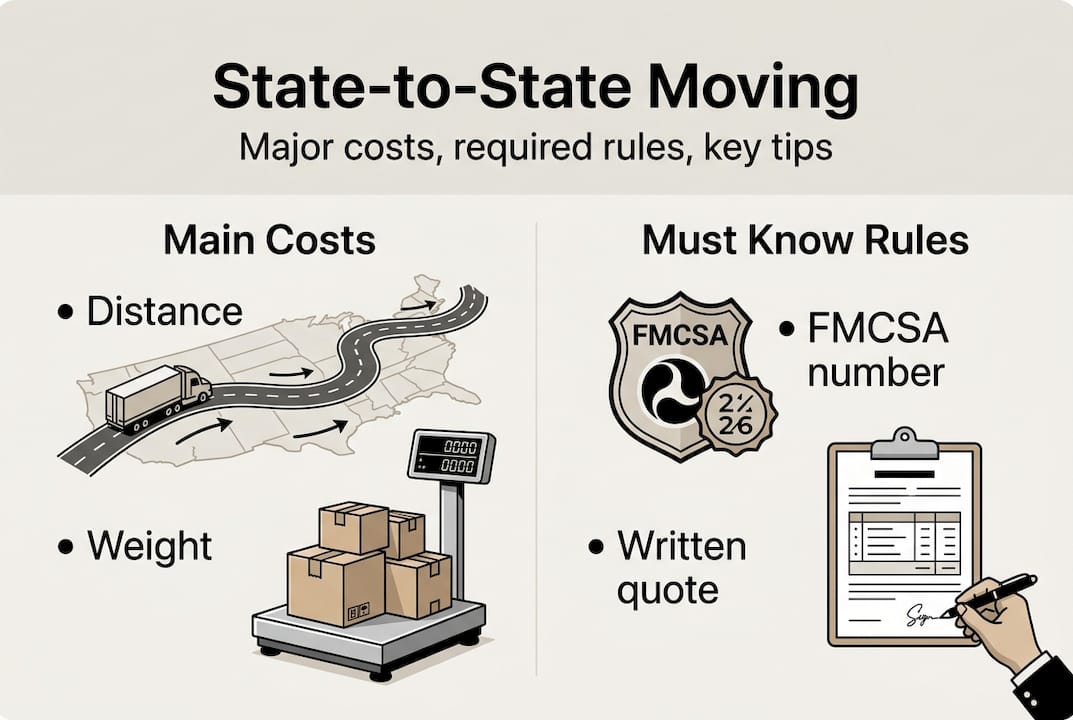
Two main factors drive your total cost: shipment weight and distance traveled. Add-on services like packing, storage, and specialty item handling increase the total. The 2026 interstate moving cost report shows average costs broken down by home size and route.
| Home size | Regional move | Cross-country move |
|---|---|---|
| Studio / 1 bedroom | $1,200 to $2,500 | $2,500 to $4,500 |
| 2 to 3 bedrooms | $3,500 to $5,500 | $5,500 to $7,500 |
| 4+ bedrooms | $5,500 to $8,500 | $7,500 to $12,000+ |
One rule every homeowner must know is the 110% rule. If you receive a non-binding estimate, your mover cannot legally charge you more than 110% of that estimate at delivery. This federal protection prevents surprise bills, but it only applies to non-binding estimates. Binding estimates lock in your price regardless of actual weight.
Here is what affects your final bill:
- Weight of your shipment (heavier loads cost more per mile)
- Total distance between origin and destination
- Packing services added to your contract
- Storage in transit if delivery is delayed
- Specialty items like pianos, safes, or artwork
- Peak season timing (summer months carry surcharges)
You can find a detailed moving cost breakdown and explore cost-saving tips for interstate moves to plan your budget more precisely. If you are also weighing the financial impact of relocating from a high-tax state, the real cost of moving from high-tax states is worth reviewing before you commit.
Types of interstate moving: Service options compared
Knowing your costs, let’s look at the options for moving state-to-state and what fits your needs. Not every family needs the same level of service, and the right choice depends on your budget, timeline, and how much physical work you want to handle yourself.
| Service type | Cost level | Effort required | FMCSA protection |
|---|---|---|---|
| Full-service mover | Highest | Minimal | Yes |
| Container / PODS | Moderate | Moderate | Partial |
| DIY truck rental | Lowest | High | No |
Full-service movers handle everything: packing, loading, transport, and delivery. You pay more, but your belongings are handled by professionals and covered under federal valuation rules. Types of moving services explains each option in detail so you can compare based on your specific situation.
Containers and PODS split the difference. The company drops a container at your home, you load it yourself, and they transport it. You save money but take on the physical labor and some of the risk. DIY truck rentals are the cheapest option but put all responsibility on you, including driving a large vehicle across state lines.
Full-service, FMCSA-licensed movers offer the strongest consumer protections for interstate moves. If something goes wrong, you have legal recourse. With DIY options, you largely do not.
Pro Tip: Before choosing a service type, compare not just price but also what happens if something breaks. Full-service movers carry liability. A DIY rental does not.
Valuation, insurance, and protection for your move
After picking your service option, understanding valuation and protection is critical for a stress-free move. Federal law requires all interstate movers to offer two levels of coverage.
Released Value Protection is the default and comes at no extra charge. However, it only covers your items at 60 cents per pound. That means a 50-pound television worth $800 would only be compensated at $30. It is minimal coverage.
Full Value Protection costs more but guarantees that your mover will repair, replace, or reimburse the full current market value of any lost or damaged item. For families moving valuable furniture, electronics, or heirlooms, this is the smarter choice.
Here is how to protect your belongings before and during the move:
- Photograph every item before packing, especially high-value pieces
- List serial numbers for electronics and appliances
- Keep jewelry, documents, and irreplaceable items with you personally
- Review the inventory list your mover creates and note any pre-existing damage
- Read your Bill of Lading carefully before signing at delivery
You can review your insurance options for interstate moves to decide which level of protection fits your situation.
Special edge cases and what can go wrong
Even with careful planning, things can go wrong. Here are the special cases and risks to watch for before and during your interstate move.
The most serious issue is a hostage load. This happens when a mover holds your belongings and demands extra payment before releasing them. It is illegal under federal law, but it does happen with unlicensed or rogue carriers. Navigating state regulations and choosing only FMCSA-registered movers is your best defense.
Other risks to plan for:
- Shipment delays: Delivery windows can span several days or even weeks for long routes
- Peak season surcharges: Summer moves (May through August) often carry higher rates
- Vehicle shipping: Moving a car across states requires a separate carrier and contract
- State-specific legal differences: Guardianship transfers, disability benefits, and professional licenses may not transfer automatically when you move states
If your mover demands cash payment above your written estimate before unloading your items, do not pay. Contact the FMCSA immediately and document everything.
Understanding these risks ahead of time lets you ask the right questions, choose the right mover, and build contingency time into your schedule.
Practical tips to save money and stress
Finally, let’s review practical ways to make your state-to-state move smoother and less expensive. Small decisions made weeks before moving day can save you hundreds of dollars.
- Declutter aggressively before your move date. Since interstate pricing is weight-based, every pound you eliminate saves money. Decluttering before your move can save you $0.50 to $0.80 per pound removed from your shipment. A 500-pound reduction saves $250 to $400.
- Book your move during off-peak months. September through April generally offers lower rates and more scheduling flexibility than the summer rush.
- Request a video survey for your estimate. A virtual walkthrough gives your mover a more accurate picture of your shipment, which leads to a more precise quote and fewer surprises.
- Get at least three written estimates from FMCSA-licensed carriers before committing.
- Confirm your delivery window in writing so you can plan your arrival at the new home accordingly.
Pro Tip: Ask every mover for a binding estimate if your budget is fixed. It locks in your price regardless of actual shipment weight and eliminates the risk of a higher bill at delivery.
You can also explore decluttering tips for interstate moves and review tax planning considerations if your relocation involves a significant change in state income tax.
Expert services for state-to-state moving
When you are ready to plan your state-to-state move, professional help can simplify the process significantly. At AMB Moving & Storage Inc., we are a federally licensed interstate carrier operating under U.S. DOT 3839636 and MC 1395855, which means every move we handle meets FMCSA standards for documentation, pricing transparency, and consumer protection.
You can browse our interstate moving services to request a quote and review available packages for your route. If you are still comparing carriers, our guide on how to choose your mover walks you through the exact questions to ask before signing anything. For the most current pricing data by route and home size, the 2026 moving cost report gives you real numbers to plan your budget with confidence. Our team is ready to help you move safely, on time, and without the stress.
Frequently asked questions
How do I check if my mover is legally licensed for interstate moves?
Visit ProtectYourMove.gov and search the mover’s USDOT number to confirm active FMCSA registration before booking.
What documents do I need for an interstate move?
Your mover must provide a written estimate, a Bill of Lading, and the FMCSA booklet titled Your Rights and Responsibilities When You Move before your move begins.
How much does moving across states usually cost?
A 2 to 3 bedroom interstate move averages $3,500 to $7,500, while cross-country moves for larger homes typically run $7,500 to $12,000 or more.
What happens if my belongings are damaged or lost in an interstate move?
You can file a claim under Released Value at 60 cents per pound or under Full Value Protection, which covers repair or full replacement depending on your chosen coverage.
What are hostage loads and how can they be avoided?
Hostage loads happen when a mover refuses to release your items without extra payment beyond your contract. Avoid them by only hiring FMCSA-licensed carriers and never agreeing to cash payments outside your written estimate.