


TL;DR:
- Relocation consultants manage planning, vendor coordination, and problem-solving for long-distance moves.
- They provide comprehensive services including scheduling, contract review, and post-move support.
- Hiring a consultant can save time, reduce stress, and prevent costly moving mistakes.
Planning a long-distance move can feel like managing a second job. You’re researching moving companies, comparing quotes, coordinating storage, notifying utilities, and trying not to forget anything important while keeping your household running. Most people underestimate how many moving parts are involved until something goes wrong. A relocation consultant is a professional who takes that chaos and turns it into a manageable plan. This guide explains exactly what relocation consultants do, what services they provide, how they work with moving companies, and how to decide whether hiring one makes sense for your situation.
Table of Contents
- Understanding the role of a relocation consultant
- What services does a relocation consultant provide?
- How do relocation consultants coordinate with moving companies and logistics?
- Evaluating the benefits and costs of hiring a relocation consultant
- Our perspective: When a relocation consultant is truly worth it
- How AMB Moving Services can support your long-distance move
- Frequently asked questions
Key Takeaways
| Point | Details |
|---|---|
| Consultants save you stress | Relocation consultants manage details, timelines, and vendors so you can focus on your new home. |
| Clear cost-benefit analysis | Hiring a consultant is usually offset by savings from avoided mistakes and better deals. |
| Ideal for complex moves | Families, professionals, and anyone with a complicated move benefit most from expert help. |
| Evaluate needs first | DIY is doable for small or local moves, but interstate relocations often require expert management. |
Understanding the role of a relocation consultant
A relocation consultant is a professional who manages the planning, coordination, and execution of a move on your behalf. Think of them as a project manager for your relocation. Their job is not to drive the truck or pack your boxes. Their job is to make sure every piece of the move fits together correctly, on time, and within your budget.
The role covers a wide range of tasks. A consultant starts by assessing your specific situation: where you’re moving from, where you’re going, your timeline, your budget, and any special circumstances like pets, elderly family members, or fragile valuables. From there, they build a plan that covers every phase of the move.
Here are the core responsibilities a relocation consultant typically handles:
- Initial needs assessment: Understanding your household size, move distance, timeline, and budget
- Vendor research and selection: Finding and vetting moving companies, storage providers, and packing services
- Timeline management: Creating a detailed schedule so nothing falls through the cracks
- Contract review: Reading the fine print on moving agreements so you don’t get surprised by hidden fees
- Problem-solving: Handling delays, damaged items, or scheduling conflicts as they arise
- Post-move support: Helping you settle in, including connecting utilities and updating your address with key institutions
As the relocation logistics guide explains, consultants act as intermediaries between clients and service providers, coordinating all parts of the move. That single point of accountability is what makes the role so valuable.
The people who benefit most from hiring a relocation consultant include busy professionals with limited time to research and coordinate, families with children or elderly relatives who need extra logistical support, individuals moving across multiple state lines for the first time, and anyone relocating on a tight or fixed timeline. If you’ve ever missed a utility cutoff date or discovered your mover wasn’t licensed, you already understand why professional oversight matters.
Pro Tip: One of the most overlooked benefits of working with a consultant is documentation. Consultants track every vendor agreement, payment, and communication in writing. If a dispute arises, you have a paper trail. DIY movers rarely keep records this thorough, and that gap can cost you significantly.
What services does a relocation consultant provide?
Building on the core responsibilities outlined above, let’s look at what a consultant actually does from day one through move-in day and beyond.
Here is a step-by-step breakdown of how a typical relocation consultant manages your move:
- Initial consultation: The consultant meets with you to understand your goals, budget, timeline, and any special requirements.
- Customized move plan: They create a detailed roadmap covering every task, deadline, and vendor involved in your relocation.
- Vendor sourcing: They research and recommend licensed, vetted moving companies, packing services, and storage providers.
- Quote comparison: They collect and compare estimates so you get fair pricing without spending hours on the phone yourself.
- Timeline coordination: They build a master schedule and keep all parties accountable to it.
- Move-day oversight: They stay in contact with all vendors on moving day to catch and resolve problems in real time.
- Post-move follow-up: They check in after delivery to confirm everything arrived correctly and help resolve any outstanding issues.
Relocation consultants often provide comprehensive moving checklists, cost estimates, and vendor selection assistance that would take an individual weeks to compile alone. That preparation is what separates a smooth move from a stressful one.
Here’s a comparison that shows the real difference between a consultant-managed move and a DIY approach:
| Factor | Consultant-managed move | DIY move |
|---|---|---|
| Vendor vetting | Professional screening | Self-researched |
| Timeline management | Structured and tracked | Often informal |
| Contract review | Expert oversight | Typically skipped |
| Problem resolution | Immediate, experienced | Reactive, stressful |
| Cost optimization | Negotiated pricing | Market rate or higher |
| Time investment | Minimal for the client | 20 to 40+ hours |
Understanding the role of a moving coordinator helps clarify how consultants differ from simply hiring a mover. A coordinator manages relationships and logistics. A mover transports your belongings. You need both, but the coordinator is the one making sure everything connects.
If you want to see how this planning process unfolds in practice, reviewing relocation planning steps gives you a concrete framework to work from.
Pro Tip: Consultants often have established relationships with vetted vendors and can access pricing that isn’t publicly available. That insider access alone can offset a significant portion of their fee, especially on long-distance moves where costs add up quickly.
How do relocation consultants coordinate with moving companies and logistics?
Having discussed what consultants do, let’s look at how they actually orchestrate the moving process from behind the scenes.
Coordination is where consultants earn their fee. On any given long-distance move, there are multiple vendors, multiple schedules, and multiple handoff points where things can go wrong. A consultant manages all of it so you don’t have to.

Here is what day-to-day coordination looks like across a typical interstate move:
| Phase | Consultant’s role | Handoff point |
|---|---|---|
| 6 to 8 weeks out | Vendor selection, contracts signed | Client approves vendors |
| 3 to 4 weeks out | Packing schedule confirmed | Packing team briefed |
| 1 to 2 weeks out | Moving truck reserved, storage arranged | Client confirms inventory |
| Move day | Oversees loading, confirms delivery window | Movers take possession |
| Delivery day | Confirms arrival, inspects items | Client accepts delivery |
| Post-move | Resolves claims, closes out vendors | Final sign-off |
This kind of structured handoff prevents the most common moving disasters: overlapping schedules, unconfirmed reservations, and gaps in communication between vendors.
When it comes to long-distance storage solutions, consultants are especially valuable. Storage needs often arise mid-move when a closing date shifts or a new home isn’t ready. A consultant anticipates this and has contingency plans ready. They know which storage options for moves are flexible, climate-controlled, and positioned along your route.
Consultants also handle contract negotiation with moving companies. They know what standard rates look like, what clauses to push back on, and what insurance coverage you actually need. Most individuals sign whatever is put in front of them. Consultants don’t.
“A relocation consultant functions as a single point of contact, handling communication with all service providers to streamline the process.”
That single point of contact matters more than people realize. When you’re managing a move yourself, you’re fielding calls from the mover, the storage facility, the utility company, and the building manager all at once. A consultant absorbs that noise so you can focus on your family and your job.
Here are the most common pitfalls that professional coordination prevents:
- Double-booked moving dates due to poor communication between vendors
- Unexpected storage fees from not having a confirmed delivery address
- Missing inventory because no one documented what was loaded
- Insurance gaps from not understanding what the mover’s liability actually covers
- Delivery delays caused by unclear communication about access or parking at the destination
Evaluating the benefits and costs of hiring a relocation consultant
Once you understand how consultants help, the next question is whether the investment makes sense for your specific move.
Relocation consultant fees vary based on the scope of the move and the billing model the consultant uses. The most common structures are:
- Flat fee: A fixed price for a defined set of services, often ranging from $500 to $2,500 for a full-service long-distance move
- Hourly rate: Typically $75 to $150 per hour, suitable for clients who need help with specific tasks only
- Percentage of move cost: Usually 5% to 15% of the total moving budget, common for corporate or high-value relocations
- À la carte: Pay only for specific services like vendor sourcing or contract review
Consultants often save clients money by avoiding inefficient decisions and optimizing moving schedules. When you factor in the cost of a botched move, a missed closing date, or a fraudulent mover, the math often favors professional help.
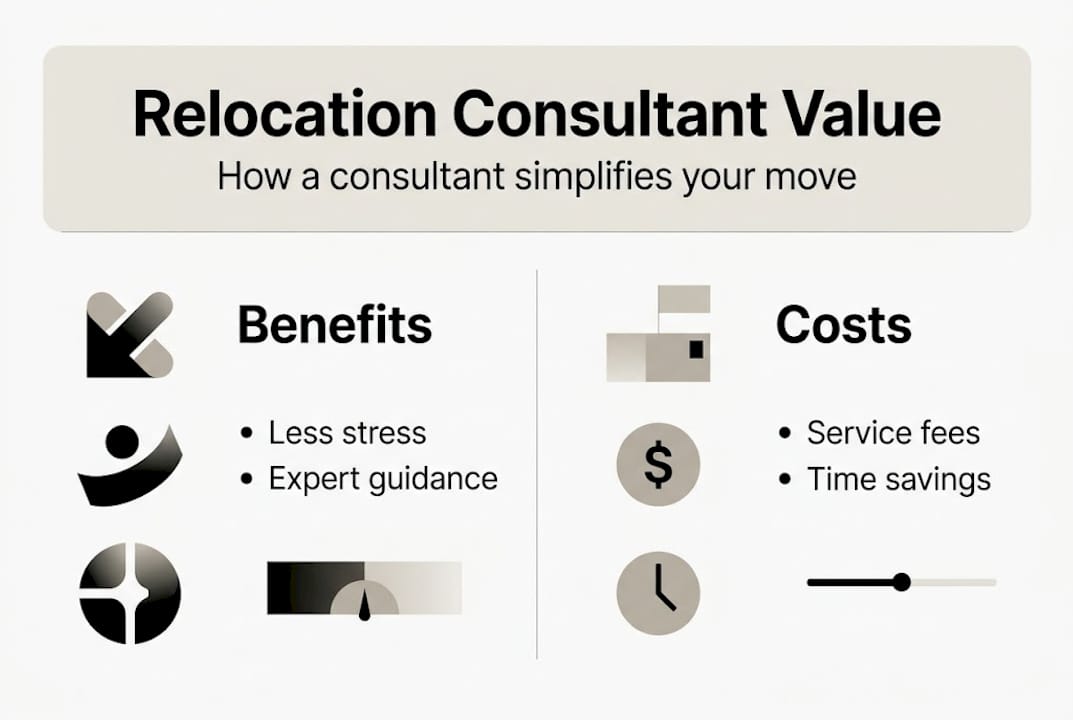
Reviewing examples of common relocation expenses shows just how quickly costs accumulate on interstate moves. Fuel, packing materials, storage, hotels, and meals in transit can easily add thousands of dollars to your total. A consultant helps you anticipate and control those costs.
Beyond dollars, the intangible benefits are real. Less stress. More time. Fewer decisions to make at 11 p.m. the night before moving day. For families with children, those benefits are often the deciding factor.
Before hiring a consultant, ask these questions:
- What specific services are included in your fee?
- How do you vet the vendors you recommend?
- What happens if something goes wrong on moving day?
- Do you have experience with moves along my specific route?
- Can you provide references from past clients?
- How do you handle billing if the scope of the move changes?
Pro Tip: If your move involves only one state line, a short distance, and minimal furniture, you may not need a full-service consultant. But if you’re moving across the country, relocating a family, or working with a tight timeline, the value of professional coordination almost always outweighs the cost.
Our perspective: When a relocation consultant is truly worth it
Here’s the conventional wisdom you’ll hear: relocation consultants are expensive and only necessary for corporate moves. We disagree, and here’s why.
After coordinating countless long-distance moves, we’ve seen the same pattern repeat. Families who try to manage everything themselves do fine until they don’t. One missed detail, one unvetted mover, one storage unit that isn’t available on the day they need it, and the whole move unravels. The cost of fixing those mistakes almost always exceeds what a consultant would have charged.
That said, a consultant isn’t right for every situation. If you’re moving a studio apartment two states over with plenty of lead time, you can likely manage with a solid checklist and a licensed mover. The in-depth relocation planning resources available online can carry you a long way.
But when the move involves a family with school-age children, a home full of furniture and valuables, a compressed timeline, or unfamiliar rules for state-to-state moves, a consultant’s experience pays for itself quickly. They’ve seen every scenario. They know what questions to ask before problems arise, not after.
The biggest misconception we encounter is that hiring a consultant means giving up control. The opposite is true. A good consultant gives you more control by making sure you have accurate information, vetted options, and a clear plan. You still make every decision. They just make sure you’re making those decisions with the full picture in front of you.
How AMB Moving Services can support your long-distance move
If this guide has helped clarify what a relocation consultant does and whether you need one, the next step is connecting with a team that can put that knowledge into action for your specific move.
At AMB Moving & Storage Inc., we specialize in interstate moving services for individuals, families, and businesses relocating across state lines. We’re federally licensed under U.S. DOT: 3839636 and MC: 1395855, which means you’re working with a carrier that meets federal safety and accountability standards. Our team provides transparent pricing, professional packing, and dependable long-distance transportation. If you’re still figuring out how to choose the right provider, our guide to choosing a mover walks you through every factor that matters. And if cost is a concern, the 2026 interstate moving cost report gives you real route data so you know what to expect before you commit. Reach out today for a custom quote.
Frequently asked questions
What does a relocation consultant actually do?
A relocation consultant manages every aspect of your move, from planning and vendor selection to problem-solving and move-in support. They oversee timelines, vendor negotiations, and moving logistics so you don’t have to juggle those responsibilities yourself.
How much does it cost to hire a relocation consultant?
Fees typically range from a few hundred to a few thousand dollars depending on the complexity of the move, but they can often be offset by cost savings. Consultant fees are often recouped through smarter decisions and avoidance of costly moving mistakes.
Is hiring a relocation consultant worth it for a small move?
For simple or local moves, DIY planning may be enough, but consultants add significant value for complex, interstate, or high-value relocations where the cost of mistakes is high.
What’s the difference between a relocation consultant and a moving company?
A relocation consultant manages the whole process and coordinates all providers, while a moving company handles only the transportation of your belongings. Consultants provide oversight and coordination that goes well beyond what any single mover offers.