


TL;DR:
- Many Americans are relocating from expensive coastal cities to lower-cost states in the Sun Belt and Southeast for better affordability, taxes, and remote work options. Migration trends show Texas, Florida, and North Carolina attracting the most newcomers due to job opportunities, climate, and tax benefits. When planning a move, individuals should consider personal needs, local expenses, and community resources to find the best fit beyond just cost indices.
Most people assume the most affordable places to live are obscure, overlooked towns with nothing to offer. The data tells a completely different story. Migration in 2026 is being driven by housing affordability, low taxes, and remote work flexibility, with the Sun Belt and Southeast emerging as dominant destinations. Millions of Americans are voting with their moving trucks, leaving expensive coastal metros for states that offer real financial relief without sacrificing quality of life. This guide breaks down which states lead on affordability, where people are actually moving, and how to evaluate your own best fit.
Table of Contents
- What drives Americans to move: Cost of living, taxes, work flexibility
- States leading for lowest cost of living in 2026
- Where Americans are actually moving: Migration data reveals trends
- Choosing your state: Practical tips for movers and families
- The reality behind cost-driven moves: Why ‘cheapest’ isn’t always best
- Get help moving to your next lower-cost state
- Frequently asked questions
Key Takeaways
| Point | Details |
|---|---|
| Main migration drivers | Housing affordability and lower taxes are key factors for Americans relocating in 2026. |
| State rankings matter | Mississippi, Oklahoma, Kansas, and Arkansas lead for lowest cost of living, but many move to Texas, Florida, and South Carolina. |
| Beyond cheapest costs | The best state for you balances finances, lifestyle, climate, and community—not just index scores. |
| Expert-driven decisions | Evaluate your priorities—remote work, retirement, family needs—before choosing a destination. |
| Moving solutions | Professional moving services help organize state-to-state relocations to affordable states. |
What drives Americans to move: Cost of living, taxes, work flexibility
Relocation is rarely a casual decision. When someone packs up their entire life and moves across the country, the reasons are usually financial and deeply personal at the same time.
Housing affordability sits at the top of the list. Mortgage payments and rent in cities like San Francisco, New York, and Seattle have stretched household budgets to the breaking point. A family that can barely afford a two-bedroom apartment in a coastal city discovers they can own a four-bedroom home with a yard in Tennessee or North Carolina. That contrast alone is enough to motivate a move.
Tax burden is the second major factor. IRS tax flow data shows a strong negative correlation (r = 0.33) between state tax rates and population inflows, meaning high-tax states lose both residents and income to lower-tax states. South Carolina recorded the highest per capita income inflow in recent years. States with no income tax, like Texas and Florida, pull in earners who feel the math simply works better in their favor.
Remote work has been a powerful accelerant. Before 2020, many high earners were tethered to expensive cities by their jobs. Now, a software engineer earning a San Francisco salary can move to Boise or Greenville and keep their income while cutting their expenses by 40% or more.
Here’s a quick look at the primary migration drivers:
- Housing affordability: Lower home prices and rent make homeownership achievable
- Low or zero state income taxes: Keeps more money in your pocket every year
- Remote work flexibility: Breaks the geographic tie to expensive job markets
- Lower property taxes: Reduces the long-term cost of owning a home
- Climate and lifestyle preferences: Especially relevant for retirees
“The most powerful financial move many Americans can make right now isn’t picking better stocks or cutting subscriptions. It’s relocating to a state where the cost structure works in your favor.”
Pro Tip: Before deciding on a destination, calculate your actual take-home pay after state income tax in both your current state and your target state. The difference can be thousands of dollars per year, and that changes the math on housing, savings, and retirement timelines.
Understanding moving costs from high-tax states is an important step, because the upfront expense of a long-distance move is often recovered within the first year of living somewhere more affordable.
States leading for lowest cost of living in 2026
Cost-of-living indices compare how far a dollar stretches in any given state relative to the national average, which is set at 100. A score below 100 means your money goes further there. A score above 100 means you’re paying a premium compared to the national baseline.

The 2026 rankings place Mississippi at the top with an index of 84, the lowest in the nation. Oklahoma follows at 87, then Kansas and Alabama at 88, and West Virginia and Arkansas at 89. These numbers reflect housing, groceries, healthcare, transportation, and utilities combined.
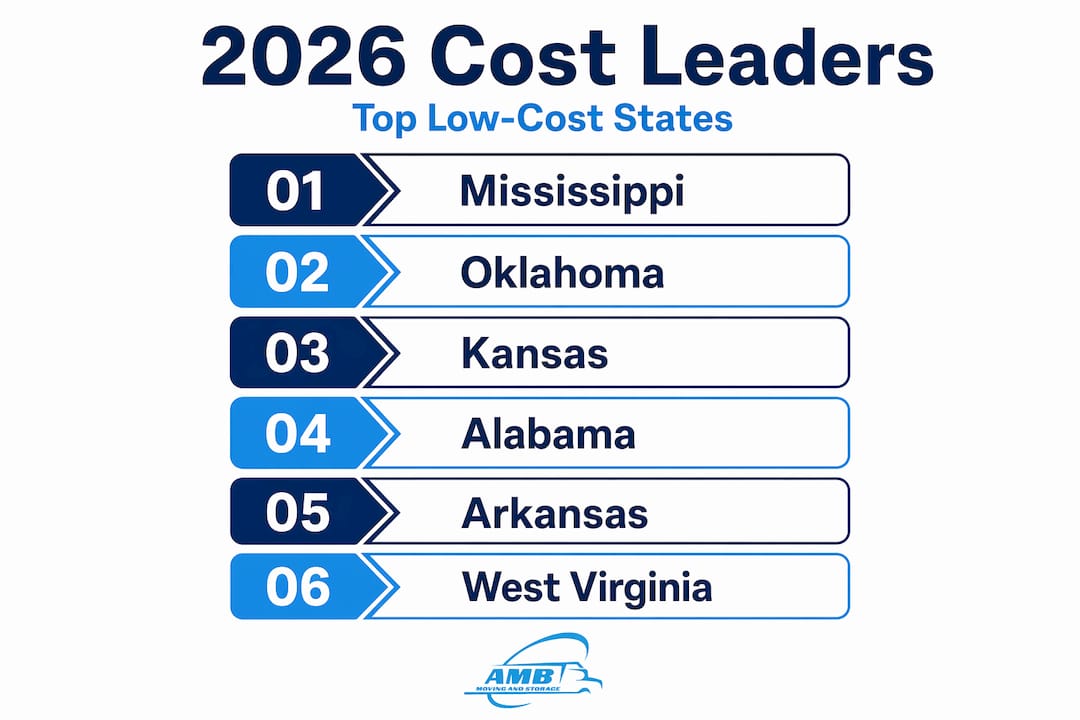
Here’s a comparison of the top affordable states:
| State | Cost of living index | Notable feature |
|---|---|---|
| Mississippi | 84 | Lowest housing costs in the U.S. |
| Oklahoma | 87 | Low property taxes, affordable metro areas |
| Kansas | 88 | Affordable suburbs, strong Midwest job market |
| Alabama | 88 | Growing tech and auto industry presence |
| West Virginia | 89 | Low housing prices, scenic outdoor lifestyle |
| Arkansas | 89 | Rapidly growing economy, low overall costs |
A separate affordability study ranked all 50 states using a composite score that factored in moving costs and overall affordability. Arkansas came out on top with a score of 88.43, followed by Mississippi, Louisiana, Missouri, Kansas, New Mexico, and South Dakota. This ranking is useful because it accounts for what it costs to actually get there, not just what it costs to live there after you arrive.
Key stats worth noting:
- Mississippi’s cost index is 16 points below the national average, meaning residents spend roughly $1 for every $1.19 a typical American pays
- Arkansas has seen steady population growth as affordability drives both domestic migration and new business formation
- Kansas offers strong suburban communities around Kansas City and Wichita at a fraction of comparable urban costs elsewhere
Understanding these numbers helps you calculate real savings. If you currently earn $85,000 in a state with a cost index of 110, moving to Mississippi is the financial equivalent of a significant raise, because every dollar buys more. Mapping your current and target states using these indices is a smart first step before you start researching neighborhoods or school districts.
For a complete breakdown of what routes cost, check out 2026 route moving costs so you can budget your move accurately from the start.
Where Americans are actually moving: Migration data reveals trends
Here’s where the data gets genuinely surprising. The states with the absolute lowest cost indices are not always the ones receiving the most newcomers. People factor in jobs, climate, family ties, and the overall energy of a place, not just a cost number.
The U-Haul Growth Index tracks over 2.5 million one-way rental transactions per year, making it one of the most reliable real-world indicators of where people are moving. The 2025 U-Haul rankings put Texas at number one with 50.7% inbound transactions, followed closely by Florida at 50.6%. North Carolina, Tennessee, and South Carolina rounded out the top five.
MoveBuddha’s 2026 analysis of 78,000 searches adds another dimension. Idaho leads with an in-to-out ratio of 2.05, meaning more than twice as many people are searching to move there as leave. South Carolina ranks high due to notably low property taxes and a growing coastal lifestyle appeal.
Here’s a look at the top inbound migration states:
| State | Migration trend | Primary draw |
|---|---|---|
| Texas | No. 1 inbound (U-Haul) | No income tax, booming job market |
| Florida | No. 2 inbound (U-Haul) | No income tax, retiree-friendly, climate |
| North Carolina | Top 5 inbound | Tech jobs, Research Triangle growth |
| Tennessee | Top 5 inbound | No income tax, affordable metros |
| South Carolina | Top 5 inbound | Low property taxes, coastal appeal |
| Idaho | 2.05 in-to-out ratio | Cheaper housing, property tax savings |
Why do Texas and Florida attract so many people when their cost indices aren’t as low as Mississippi or Arkansas? The answer is a combination of factors:
- No state income tax in both states frees up income immediately
- Strong job markets mean earning potential offsets slightly higher housing costs
- Climate appeal draws retirees who want warm winters without the California price tag
- Established infrastructure including major airports, healthcare networks, and universities
- Community growth creates new neighborhoods with modern amenities
- Remote work compatibility with growing tech hubs in Austin, Nashville, and Charlotte
Pro Tip: Look at the 2026 interstate moving cost report before finalizing your destination. Moving distance, home size, and route-specific pricing can vary significantly, and knowing the numbers upfront prevents budget surprises.
If you’re researching reliable popular state-to-state movers, understanding the flow of where people are going also helps you gauge demand and plan your timeline more strategically.
Choosing your state: Practical tips for movers and families
The research is clear: cost of living and migration data don’t always point in the same direction. Cost methodology studies confirm that pure cost-of-living rankings (led by Mississippi and Oklahoma) differ from actual migration hotspots (led by Texas, Florida, and the Carolinas) because real decisions involve more than index scores. Your job is to filter the data through your own life situation.
Here’s a practical framework for evaluating your move:
- Identify your non-negotiables: List the three things that can’t be compromised. For retirees, it might be healthcare access and warm climate. For families, it’s school quality and neighborhood safety. For remote workers, it’s internet reliability and cost savings.
- Run your personal cost comparison: Use state income tax rates, average home prices, and property tax rates to calculate your actual annual savings in each target state. Be specific, not approximate.
- Research local job markets: Even remote workers benefit from being near a growing economy. If your company downsizes or you want to pivot careers, local opportunities matter.
- Visit before you commit: A weekend trip to your target city reveals things no data set can. Is the community a fit? What does the neighborhood feel like at 8 p.m. on a Tuesday?
- Factor in moving costs: A $5,000 long-distance move that saves you $800 per month pays for itself in just over six months. Calculate your personal payback period.
- Check for community resources: Libraries, parks, healthcare facilities, and cultural amenities all affect day-to-day quality of life, especially for retirees and families with young children.
For families, the interstate moving guide for families walks through each stage of planning a state-to-state move in detail. And if you’re still deciding between destinations, the state-to-state moving tips resource covers rules, logistics, and financial considerations specific to interstate moves.
When comparing moving companies for your long-distance relocation, it’s worth reading through what to look for in a moving company to avoid costly mistakes and ensure your belongings arrive safely.
Key considerations by mover type:
- Remote workers: Prioritize internet infrastructure, cost savings on housing, and access to coworking spaces
- Retirees: Focus on healthcare quality, property tax exemptions for seniors, and climate
- Families: Weight school ratings, neighborhood safety, and cost of childcare alongside housing prices
The reality behind cost-driven moves: Why ‘cheapest’ isn’t always best
We’ve helped coordinate thousands of long-distance moves, and a pattern we see regularly is this: the people who research the numbers thoroughly, then move somewhere without visiting or understanding the local culture, often end up moving again within two years. That second move costs more than the first.
Mississippi and Oklahoma may have the lowest cost indices in the country, and that’s genuinely meaningful data. But a retired couple from Portland moving to rural Mississippi based on a cost index alone might find themselves in a place that doesn’t fit their social needs, access to healthcare, or lifestyle preferences. The numbers were right. The fit wasn’t.
The Sun Belt migration trend is real and backed by significant data. But there are trade-offs even in popular destinations. Florida offers no income tax and warm weather, but it also has rising home insurance premiums due to hurricane risk, infrastructure strain from rapid population growth, and summer heat that many newcomers underestimate.
Texas draws in hundreds of thousands of residents every year, and the economic opportunities are genuine. But property taxes in Texas are among the highest in the nation, which can offset the benefit of no state income tax, especially for homeowners.
A smarter approach weighs moving costs versus housing prices in the context of your full financial picture, not just one metric in isolation. The best state to move to isn’t always the one with the lowest index. It’s the one where your income, lifestyle, healthcare needs, climate preferences, and community values all align with what the state offers.
Our honest advice: use cost data as a filter, not a final answer. Let it narrow your list from 50 states to five or six. Then apply your personal criteria to pick the right one.
Get help moving to your next lower-cost state
Making the decision to relocate is the hard part. Once you’ve identified your target state, the right support team makes the actual move straightforward and far less stressful than doing it alone.

AMB Moving & Storage Inc. specializes in exactly this kind of move. Whether you’re relocating from California to Tennessee, New York to Florida, or anywhere else across the country, our long-distance moving services are built around the unique challenges of interstate relocation. We handle everything from packing and loading to transport and delivery, with the licensing, insurance, and federal compliance that protect your belongings and your peace of mind. Families planning multi-stage moves can also use our storage solutions guide to bridge the gap between leaving one home and settling into the next. Get a quote today and take the first step toward your lower-cost state.
Frequently asked questions
Which states have the lowest cost of living in 2026?
Mississippi, Oklahoma, Kansas, Alabama, Arkansas, and West Virginia have the lowest cost-of-living indices for 2026, all scoring well below the national average of 100.
Are most Americans moving purely for cost-of-living reasons?
Cost of living, taxes, and housing are the primary drivers, but jobs, climate, and remote work flexibility also play a significant role in where people choose to land.
Why are Texas, Florida, and South Carolina popular even if their cost index isn’t the lowest?
These states offer a combination of no income tax, strong job markets, warm climate, and growing communities, making them top destinations based on U-Haul inbound transaction data that tracks over 2.5 million real-world moves.
What factors should remote workers or retirees prioritize when relocating?
Remote workers should focus on housing cost savings, internet infrastructure, and state tax rates, while retirees should evaluate healthcare access, senior property tax exemptions, and climate before committing to a destination.
Can moving to a low-cost state save on property taxes?
States like Idaho and South Carolina are popular specifically because of lower property taxes and affordable housing, offering meaningful long-term savings for homeowners relocating from high-cost states.