
Moving from California to North Carolina is a cross-country haul of well over 2,000 miles, and for most households it is a financial win on housing and a real adjustment on almost everything else. Homes cost far less, but incomes are lower, and the move itself is a long-distance job that needs a written estimate, a realistic timeline and a crew licensed for interstate work. This guide covers what you will gain and give up, which North Carolina region fits which household, how moving cost estimates work, and how to move for less.
TL;DR
- North Carolina’s median home value is $288,900 versus $734,700 in California, but median household income is also lower ($72,388 versus $99,122).
- Charlotte leans toward banking and finance; the Raleigh-Durham Triangle leans toward tech, biotech and research. Pick the region around the job first.
- An interstate mover must give you a written estimate. Ask for a binding estimate based on an inspection, not a number quoted over the phone.
- The cheapest way to move is rarely the cheapest quote: cut volume, avoid peak season, and book 30 to 60 days ahead.
- Request a quote with your inventory and dates to get a number you can plan around.
Table of Contents
- Why the California to North Carolina move makes sense for many families
- Choosing where in North Carolina to land
- Taxes and insurance: what changes for your household
- What a California to North Carolina move costs
- The cheapest way to move from California to North Carolina
- Timing, storage and the gap between homes
- How to choose an interstate mover
- Our perspective: plan the move around the paperwork, not the truck
- Moving to North Carolina with AMB
- Practical notes before you go
- FAQ
- Sources
Why the California to North Carolina move makes sense for many families
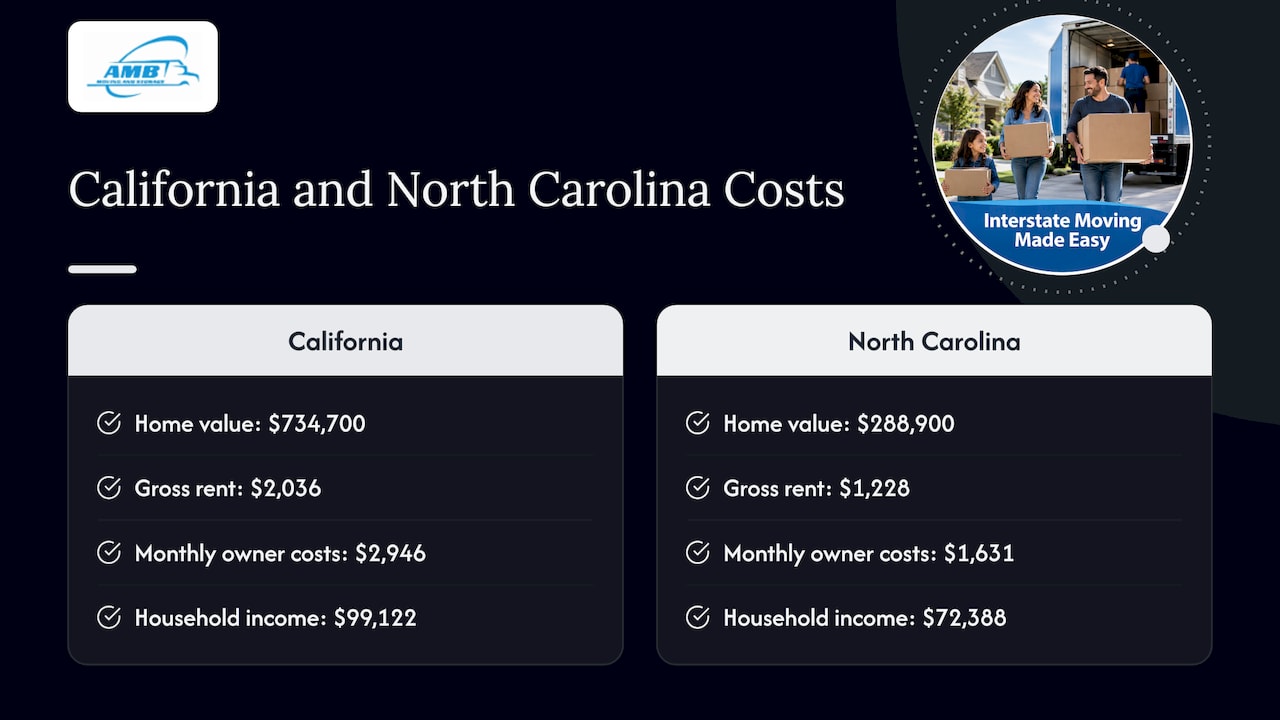
The pull is mostly arithmetic. According to the Census Bureau’s QuickFacts comparison for 2020 to 2024, the median owner-occupied home in North Carolina was valued at $288,900, against $734,700 in California. Median gross rent was $1,228 versus $2,036. Median monthly owner costs with a mortgage were $1,631 versus $2,946.
The same table shows the other side. Median household income was $72,388 in North Carolina and $99,122 in California. So the housing gap is large, but it narrows if your pay drops. If you are keeping a California-based remote salary, the math is at its best. If you are taking a local job, compare the offer against local pay, not your current one.
Commutes are a small plus: mean travel time to work was 25.1 minutes in North Carolina versus 28.7 in California, per the same Census source.
What actually surprises people
Three things come up again and again with families who have made the move:
- Home prices differ by region more than you expect. The statewide median hides a wide spread, covered below.
- Homeowners insurance is rising. Coastal and storm-exposed areas are hit hardest.
- Life gets more car-dependent and more seasonal. Humid summers, pollen springs and the occasional hurricane or ice storm replace California’s dry heat and wildfire season.
Choosing where in North Carolina to land
Most California arrivals look at two metro areas first. Your job, not the housing listings, should decide between them.
Charlotte
Charlotte is the state’s largest city, with about 964,784 residents as of July 1, 2025, according to Census QuickFacts. A local relocation comparison describes it as centered on banking, corporate finance, energy and professional services. If your work is in finance, accounting, energy or corporate roles, Charlotte is the natural starting point. The suburbs across the Union and Mecklenburg county lines are popular with families.
Raleigh, Durham and the Triangle
The same comparison puts the Triangle ahead in technology, pharmaceuticals, biotech, medicine and research. Raleigh had an estimated 506,306 residents in 2025, up 8.2% from the 2020 base. The Census Bureau’s county figures show how the two core counties compare:
| Measure (Census QuickFacts) | Wake County | Durham County |
|---|---|---|
| 2025 population estimate | 1,257,235 | 347,240 |
| Median owner-occupied home value, 2020-2024 | $461,300 | $389,400 |
| Median gross rent, 2020-2024 | $1,623 | $1,508 |
Source: Census QuickFacts, Wake and Durham counties. Wake County grew 11.3% from its 2020 base, so expect competition for homes in the better school zones.
Notice that both counties sit above the state median home value of $288,900. A California buyer will still feel the discount, but a house in Cary or Apex is not a $250,000 house.
Taxes and insurance: what changes for your household
North Carolina property taxes are set by each county, per $100 of assessed value. For 2025 to 2026, the state’s county rate table lists Mecklenburg at $0.4927, Wake at $0.5171, Durham at $0.5542 and New Hanover at $0.3060. On a $400,000 assessed home, a $0.5171 rate works out to about $2,068 a year, before any city or district levies. Always check the exact rate for the address you are buying, because municipalities can add their own.
Insurance deserves more attention than it usually gets. The North Carolina Department of Insurance settlement table shows approved 2026 homeowners increases of 9.2% for Mecklenburg and Union counties, 7.5% for Durham and Wake, and 15.9% for specified beach areas in Brunswick, Carteret, New Hanover, Onslow and Pender counties. If you are eyeing the coast, get an insurance quote before you make an offer, not after.
For income tax, North Carolina and California both tax residents, and your situation (a part-year move, stock compensation, a California employer) can be complicated. Ask a CPA who handles part-year residency returns before you set your move date, since the date you establish residency can affect which state taxes which income.
What a California to North Carolina move costs
No honest mover can give you a firm number without your inventory, your dates and the access at both homes. Interstate pricing depends on the weight or volume of your shipment, the distance, the season, and extra services. Anyone quoting a flat price after a two-minute call is guessing.
What you can rely on is the process. Federal rules require an interstate household-goods mover to give you a written estimate of transportation, accessorial and advance charges based on an actual or virtual inspection. Ask for a binding estimate: that guarantees you will not pay more than the estimate at delivery, except when you add items or services or unforeseen circumstances require a new estimate. Ask for it in writing and read what it excludes.
The line items that move the total
The base price of a cross-country move is driven by shipment size and distance. Then come the extras. These are the figures we publish on our moving cost guide:
| Item | Published rate |
|---|---|
| Professional packing | $1 to $2 per cubic foot |
| Storage | from $0.50 per cubic foot |
| Specialty item handling (pianos, safes) | from $200 |
| Elevator or stair fees | from $75 |
| Long carry charges | from $75 |
A long carry is charged when the truck cannot park close to the door. Stairs and elevators add handling time. If your Los Angeles apartment is on the fourth floor with no elevator, say so when you request a quote, or it will surface on moving day.
A worked example
Take a family leaving a three-bedroom house in San Diego for a rental in Raleigh. Suppose they decide to have the movers pack the kitchen and fragile items only, about 150 cubic feet of packed goods. At our published packing rate of $1 to $2 per cubic foot, that service alone would be $150 to $300. Add a piano at a specialty rate that starts at $200, and a second-floor walk-up at the destination at a stair fee from $75. None of that is the transportation charge, which depends on the shipment and the dates. It shows why you compare the full written estimate, not the headline number.
The cheapest way to move from California to North Carolina
The cheapest way is the one that does not cost you twice. A low quote that grows at delivery, or a company that cannot legally haul across state lines, costs far more than an honest mid-range estimate. Within a legitimate estimate, these are the levers that actually reduce the bill:
- Reduce volume before anyone measures it. Cross-country pricing tracks shipment size. Selling the bulky sectional, the second refrigerator and the garage clutter costs nothing and shrinks the load. With furniture that is cheap to replace in North Carolina, ask whether it is worth shipping at all.
- Move outside peak season. Summer is when most families move, and demand drives rates. Mid-week, mid-month and fall or winter dates are usually easier to schedule and price. Confirm the seasonal difference in your own estimate.
- Book 30 to 60 days ahead. That gives the mover time to inspect, schedule the truck and offer flexible pickup windows. Last-minute moves leave you with fewer options.
- Pack some things yourself, and let the crew handle the rest. Self-packing books and linens is easy. Dishes, art and electronics are where professional packing prevents claims. See our packing services for what is covered.
- Prevent access surcharges. Reserve the elevator, clear a parking space for the truck and tell your mover about stairs and long carries up front.
- Skip what you will not use. Our guide to items movers won’t move saves you from last-minute surprises with paint, propane and similar items.
Driving your own rental truck is rarely the bargain it looks like on a trip this long. Fuel, lodging, a car trailer and days of your time add up, and you carry the damage risk. If you are weighing it, price all of it, including your time off work.
Timing, storage and the gap between homes
Cross-country moves rarely line up perfectly. Your California lease ends on the 30th, but the North Carolina closing slips a week. Plan for that gap before it happens.
Short-term storage at a secure facility solves most of it: the crew loads in California, and your goods wait until your new home is ready. Our article on temporary storage for long-distance moves explains how it works, and our storage rate starts at $0.50 per cubic foot. Some families bridge a short gap with a rented storage container instead, which suits people who want to load at their own pace.
A simple 60-day timeline:
- 60 days out: Request estimates, decide on your destination metro, start decluttering.
- 45 days out: Schedule the in-home or virtual inspection and book your date. Compare the binding estimates line by line.
- 30 days out: Transfer school records, set up utilities in North Carolina, update your address with your employer and insurers.
- 2 weeks out: Pack non-essentials, confirm the pickup window and elevator reservations.
- Moving day: Walk through with the crew lead, review the inventory sheet before you sign, keep valuables and documents with you.
- Delivery: Check items against the inventory before the crew leaves and note any damage on the paperwork right away.
For a fuller walk-through, see our interstate moving step-by-step guide for families.
How to choose an interstate mover
When you compare interstate movers, cross country movers or any nationwide moving company, check these before price:
- Federal authority and insurance. Interstate movers must be registered with the federal government. The FMCSA consumer page explains that movers and brokers must hand you the booklet Your Rights and Responsibilities When You Move before an interstate household-goods move. If you never get it, treat that as a warning.
- Mover or broker. Ask directly. A broker sells your job to another carrier, which can change who shows up.
- Estimate type and inspection. Binding, written, based on your actual inventory.
- Valuation coverage. Understand released-value protection and what it pays. Our piece on custom crating explains how crating can help on high-value items.
- Clear delivery window. Cross-country shipments are not same-day. Ask for a realistic spread and a contact person.
We cover the rules in more detail in federal regulations for movers.
Our perspective: plan the move around the paperwork, not the truck
Most of the stress on a cross-country move does not come from the drive. It comes from vague estimates, missing inventory and surprises at the door. We build every interstate job around three habits: an inventory that matches what is actually going on the truck, an estimate that lists access charges and extras in plain terms, and a pickup and delivery window that is agreed in writing.
For California to North Carolina specifically, we tell families to settle two decisions early: where they are landing, and whether their new home will be ready on delivery day. Those two answers determine whether you need storage, what truck access looks like and how flexible your dates can be. We would rather talk through a gap in your timeline in week one than scramble in week eight.
Our work covers long-distance moving, interstate moving and nationwide moving, and we are licensed, insured and compliant with federal regulations.
— AMB
Moving to North Carolina with AMB
If you are planning this move, we handle the full job: interstate transportation, professional packing, secure storage and specialty items such as pianos and safes. Details on our North Carolina service are on our North Carolina moving page. Send us your inventory, addresses and preferred dates, and we will come back with a written estimate you can compare. Get your moving quote.
Practical notes before you go
- Climate and risk. North Carolina’s coast has hurricane exposure. In 2021 the state and FEMA approved a $1,610,260 grant to buy out and remove ten Robeson County homes damaged by Hurricane Florence and at high risk of repeat flooding. Check flood maps and insurance before you buy near rivers or the coast.
- Vehicles and licenses. You will need to handle registration and a driver’s license transfer with the North Carolina DMV after you establish residency. Check the state’s current deadlines on its official site.
- Schools. District quality varies by county and even by street. Visit before you commit to a rental lease.
- Visit first if you can. A long weekend in Charlotte or the Triangle tells you more than any statistic.
FAQ
Is it better to live in North Carolina or California?
It depends on your work and priorities. North Carolina is much cheaper on housing, with a median home value of $288,900 versus $734,700 in California, but median household income is also lower. California offers higher pay and a different climate; North Carolina offers lower housing costs, four seasons and shorter average commutes.
What is the cheapest way to move from California to North Carolina?
Shrink the shipment, move outside summer, book 30 to 60 days ahead and get a binding written estimate so the final bill cannot drift. Pack low-risk items yourself and have professionals handle fragile or heavy ones. Compare the total, not the headline rate.
How far in advance should I book interstate movers?
Plan on 30 to 60 days for a cross-country move, longer if you want a specific date in summer. That window covers the estimate inspection, scheduling and any storage you need.
What is a binding estimate, and why does it matter?
It guarantees you will not pay more than the estimate at delivery, unless you add items or services or unforeseen circumstances require a new estimate, according to FMCSA guidance. It protects you on a long haul where weight and extras can otherwise change the bill.
Which North Carolina city is best for people leaving California?
Choose by job. Charlotte suits finance, banking and energy careers; Raleigh and Durham suit technology, biotech and research. Wake County’s median home value is $461,300 and Durham County’s is $389,400, so compare neighborhoods, not just cities.
Sources
- U.S. Census Bureau QuickFacts: North Carolina and California
- U.S. Census Bureau QuickFacts: Charlotte city
- U.S. Census Bureau QuickFacts: Raleigh city
- U.S. Census Bureau QuickFacts: Wake and Durham counties
- North Carolina Department of Revenue: 2025-2026 county tax rates
- North Carolina Department of Insurance: homeowners insurance settlement table
- FMCSA frequently asked questions on household goods moves
- FMCSA consumer rights and responsibilities
- Raleigh vs. Charlotte: Which NC City Should You Move To?
- NC Department of Public Safety: Robeson County property acquisition