


TL;DR:
- Temporary storage provides secure, short-term holding of belongings during move-in gaps in long-distance relocations. It offers a controlled environment managed by vetted staff, with better security than public self-storage. Using a licensed mover like Ambmovingservices ensures coordinated logistics and reliable handling throughout the move.
What is temporary storage in a moving context?
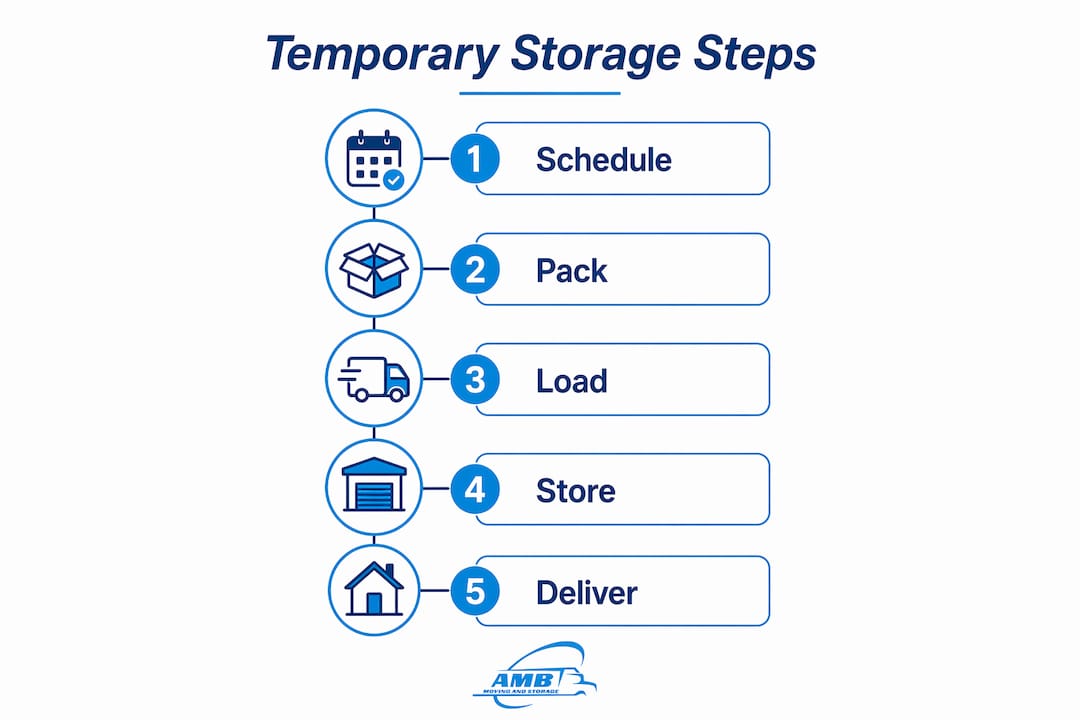
Temporary storage is the secure, short-term holding of your belongings during a gap between your move-out and move-in dates. In the context of long-distance moving, it functions as a managed custody solution: your items go from your origin home or office into a professional facility, then get delivered to your destination once you’re ready.
This is not the same as renting a self-storage unit and hauling boxes yourself. Professional temporary storage is coordinated directly with your moving crew, handled by vetted staff, and held in a controlled warehouse environment. For interstate and cross-country relocations, where scheduling mismatches are common, it’s often the difference between a chaotic move and a controlled one.
Common scenarios where temporary storage becomes necessary:
- Your new home isn’t ready on your move-out date due to construction delays or lease timing
- You’re downsizing and need time to decide what stays and what goes
- A commercial relocation requires phased delivery across multiple office floors
- You’re staging a home for sale and need furniture cleared before listing
- Travel time between states creates a multi-day gap in your schedule
Table of Contents
- How temporary storage supports long-distance and interstate moves
- What makes professional storage warehouses more secure?
- Planning your temporary storage: timing, costs, and what to expect
- Why Ambmovingservices handles temporary storage differently
- Quick summary: what you need to know about temporary storage
- How loading and unloading work with temporary storage
- Ambmovingservices makes temporary storage part of your move, not an add-on
- Key Takeaways
How temporary storage supports long-distance and interstate moves
Timing mismatches are the most frequent reason clients need short-term storage during a move. Unexpected delays from construction, lease expirations, or closing date shifts can leave you without a destination for days or weeks. Temporary storage absorbs that gap without forcing rushed decisions.
For interstate moves, the logistics are more complex than a local move. Travel distances stretch timelines, and coordinating truck arrivals with building access windows or elevator reservations adds another layer of scheduling pressure. Storage gives you a buffer.
Practical benefits for residential and commercial clients:
- Prevents overcrowding at the destination when not all rooms are ready
- Allows staged delivery, so you unpack one area at a time instead of all at once
- Protects belongings from construction dust or renovation damage at the new location
- Gives commercial clients flexibility to phase office furniture delivery by department
- Reduces physical and logistical pressure on move day itself
Using the same crew throughout the packing, loading, storage, and delivery process reduces confusion and lowers the risk of damage. That continuity matters more on a cross-country move than on a local one.
What makes professional storage warehouses more secure?
Professional moving warehouses operate as closed-stack environments with no public hallways and no walk-in access. Only vetted personnel with background checks can enter storage areas. That’s a structural security advantage over public self-storage, where any renter can walk the aisles at any hour.
Every item entering a professional warehouse gets logged into an inventory system. Each box or piece receives a unique ID with location and condition details recorded. If something shifts during storage, staff know exactly where it is and what state it was in when it arrived.
Security features that distinguish professional warehouse storage:
- Restricted access limited to background-checked staff only
- Surveillance cameras covering loading docks and storage areas
- Controlled entry points with no public foot traffic
- Professional inventory tracking with condition reporting per item
- Climate-controlled sections available for sensitive belongings
The contrast with public self-storage is worth stating plainly. When a moving company delivers your items to a self-storage unit, their liability ends the moment those items leave the truck. Any damage from climate exposure or being moved around by other renters becomes your problem. In a professional warehouse, the mover retains responsibility throughout.
Planning your temporary storage: timing, costs, and what to expect
The first thing to understand is access. Professional moving warehouses are not open to the public. Most providers require 24- to 48-hour advance notice to retrieve stored items, and some charge additional access fees. Plan your delivery window accordingly, especially if you’re coordinating a move-in date from another state.
Cost is the other variable clients consistently underestimate; leveraging specialized moving company SEO services can help movers effectively communicate and market these cost elements to clients. Temporary storage adds facility fees, extra transportation coordination, and sometimes double-handling charges on top of your base moving quote. Factor these into your moving cost estimates from the start, not as an afterthought.
What to put in storage versus what to move directly:
- Storage candidates: extra furniture, seasonal items, archival files, décor not needed immediately
- Move directly: daily essentials, medications, important documents, items you’ll need within 48 hours
- Special planning required: fragile or specialty items like pianos, mattresses, and appliances need expert packing before storage
Pro Tip: Tell your moving coordinator your target move-in date before storage begins, not after. Warehouses organize items by delivery date, so giving advance notice locks in your retrieval window and avoids rush fees.
Why Ambmovingservices handles temporary storage differently
AMB Moving & Storage Inc. is a licensed, insured, nationwide moving company built specifically for long-distance and interstate relocations. That specialization matters when storage is part of the equation. A company that only does local moves doesn’t have the warehouse infrastructure or the interstate logistics experience to manage storage across state lines cleanly.
What sets Ambmovingservices apart for temporary storage:
- Federally compliant and fully insured for interstate moves involving storage
- Closed-stack warehouse environments with vetted staff and inventory tracking
- One coordinated team handles packing, loading, storage, and final delivery
- Nationwide coverage for state-to-state relocations with complex scheduling needs
- Dedicated support throughout the storage period, not just on move day
Pro Tip: Ask your moving coordinator for a written inventory list before your items enter storage. Ambmovingservices documents every item, but having your own copy gives you a clear reference point at delivery.
Ambmovingservices also handles commercial relocations requiring phased storage and staged delivery, which is a different logistical challenge than a residential move. Office equipment, server infrastructure, and filing systems need sequenced delivery, and that requires a team with real warehouse coordination experience.
Quick summary: what you need to know about temporary storage
Temporary storage is a professional, secure holding solution for your belongings during the timing gaps that come with long-distance and interstate moves. It’s not a fallback plan. Used correctly, it’s a deliberate logistics tool.
TLDR:
- Temporary storage bridges the gap between your move-out and move-in dates
- Professional warehouse storage is more secure than public self-storage due to closed-stack access and vetted staff
- Access typically requires 24–48 hours advance notice; plan your delivery window early
- Costs include facility fees, handling, and transportation coordination beyond your base quote
- Items not needed immediately, like seasonal goods and extra furniture, are the best storage candidates
- Choosing a licensed, insured mover with integrated storage, like Ambmovingservices, keeps your entire move under one coordinated team
How loading and unloading work with temporary storage
The loading process for temporary storage follows the same professional standards as a standard long-distance move, with one key addition: every item gets inventoried before it enters the warehouse. Your crew wraps, pads, and properly packages bulky and delicate items, including pianos, appliances, and mattresses, before they’re stacked in the warehouse. Nothing goes in loose.
At the warehouse, items are positioned based on your scheduled delivery date. That’s why the 24- to 48-hour retrieval window exists: staff need time to locate, pull, and stage your specific inventory without disrupting other clients’ stored goods. When your delivery date arrives, the crew reloads your items onto the truck in the same careful sequence and delivers them to your new address.

Full-service storage means single handling from your origin door to the warehouse, and then from the warehouse to your destination. Fewer transfers mean fewer opportunities for damage. That’s the practical case for keeping storage and moving under one provider rather than splitting them between two companies.
Ambmovingservices makes temporary storage part of your move, not an add-on
When you’re planning a long-distance or interstate relocation and your dates don’t line up perfectly, you need more than a storage unit. You need a team that manages the entire chain: packing, loading, warehouse custody, and final delivery, without handing your belongings off to a third party mid-move.
Ambmovingservices offers exactly that. As a licensed, insured nationwide mover specializing in interstate and long-distance moves, the company integrates secure warehouse storage directly into your relocation plan. No scrambling for a separate storage provider. No liability gaps between your mover and your storage facility. One team, one coordinated plan.
Get a quote today at ambmovingservices.com/quote/ and tell them your move-out and move-in dates. They’ll build a storage plan around your actual timeline.
Key Takeaways
Professional temporary storage, managed by a licensed interstate mover, is the most secure and logistically sound way to handle timing gaps in long-distance relocations.
| Point | Details |
|---|---|
| What temporary storage is | Secure, short-term holding of belongings during timing gaps between move-out and move-in dates. |
| Warehouse vs. self-storage | Closed-stack professional warehouses restrict access to vetted staff; self-storage liability ends when the mover’s truck leaves. |
| Access and retrieval | Most professional providers require 24–48 hours advance notice to retrieve stored items. |
| Cost planning | Budget for facility fees, handling charges, and transportation coordination beyond your base moving quote. |
| Ambmovingservices | A licensed, insured nationwide mover that integrates warehouse storage into long-distance and interstate relocation plans under one coordinated team. |