


TL;DR:
- Moving from Virginia to Texas covers roughly 1,450 to 1,600 miles, requiring detailed planning and budgeting. Full-service movers cost between $3,059 and $7,232, with options like containers and DIY trucks offering cost-effective alternatives; booking early and choosing full protection insurance ensures a smooth transition. The move timeline spans at least 2 months, including vehicle registration within Texas’s strict deadlines and strategic packing to minimize stress and unforeseen expenses.
Moving from Virginia to Texas is a long-distance interstate relocation that typically spans 1,400 to 1,700 miles depending on your origin and destination cities. The distance between Richmond and Dallas, for example, runs roughly 1,450 miles, while a Norfolk to Houston move stretches closer to 1,600 miles. This guide covers everything you need to execute a smooth cross-country move: current cost estimates, planning timelines, mover verification, vehicle logistics, and arrival preparation. Whether you are relocating from Arlington to Austin or Virginia Beach to San Antonio, the same core framework applies.
How much does moving from Virginia to Texas cost in 2026?
Full-service movers cost between $3,059 and $7,232 for a 2-3 bedroom home on the Virginia to Texas corridor. That range reflects the single biggest variable in any long-distance move: service level. The more a licensed interstate mover handles, the higher the price and the lower your personal risk.
Three primary service types define the cost spectrum for this route.
| Move type | Estimated cost range | What’s included |
|---|---|---|
| Full-service movers | $3,059 to $7,232 | Packing, loading, transport, unloading, insurance |
| Moving containers (PODS, U-Pack) | $1,800 to $4,500 | You pack, they transport |
| Rental trucks (DIY) | $900 to $2,500 base | Truck only; fuel, lodging, and insurance add significantly |
Rental trucks are the cheapest option on paper, but fuel from Virginia to Texas alone can add $400 to $700 depending on truck size and gas prices. Add two nights of lodging, truck insurance, and the physical toll of driving 1,500 miles, and the savings shrink fast. Moving containers offer a middle ground: you load at your own pace, and the company handles transport. Full-service movers provide professional packing, loading, transport, unloading, and insurance coverage, which makes them the most reliable choice for larger homes or time-sensitive relocations.
Additional costs to budget for include packing materials ($150 to $400), full value protection insurance (typically 1% to 2% of declared goods value), and temporary storage if your Texas home is not ready at delivery. A studio or one-bedroom move runs considerably less, often $1,500 to $3,500 with full-service movers.
Pro Tip: Book your movers at least 8 weeks out and ask about consolidated shipment options. Sharing truck space with another customer’s load can reduce your cost by 15% to 25%, though it may extend delivery by one to three days.
What is the timeline for a Virginia to Texas move?
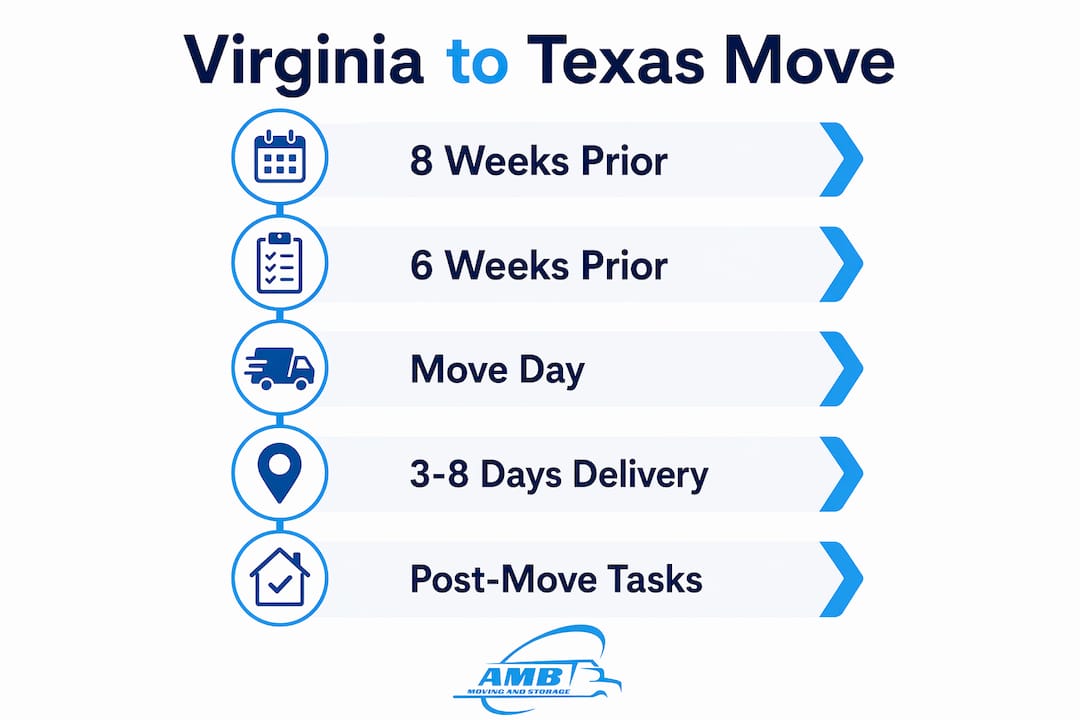
Delivery takes 3 to 8 days after pickup on the Virginia to Texas route, with the exact window depending on your specific cities, the mover’s route, and whether your shipment is consolidated. Planning the full relocation, however, requires a much longer runway.

Start planning at least 2 months ahead and begin packing 6 weeks before your move date. That timeline gives you enough space to collect multiple quotes, compare licensed movers, coordinate your home sale or lease end date, and handle logistics like vehicle transport and school enrollment for children.
| Milestone | When to complete it |
|---|---|
| Research movers, collect quotes | 8 to 10 weeks before move |
| Book movers and confirm dates | 6 to 8 weeks before move |
| Begin packing non-essentials | 6 weeks before move |
| File USPS Change of Address | 2 weeks before move |
| Pack remaining items, essentials last | Final week |
| Pickup day and transit begins | Move day |
| Delivery and unloading in Texas | 3 to 8 days after pickup |
Delays on this route are most commonly caused by shipment consolidation, weather events, mechanical issues, and delivery access problems at the destination. Choosing a mover with a written delivery window and clear communication protocols reduces that uncertainty significantly. For a deeper look at what affects transit duration, Ambmovingservices covers real interstate timelines in detail.
Pro Tip: Align your mover pickup date with your lease end or home closing date, but build in a two-day buffer. Rushing the handover of keys while movers are still loading creates avoidable stress and potential damage claims.
How to choose a licensed Virginia to Texas moving company
Verify the USDOT number and FMCSA authority of any mover you consider before signing a contract. The Federal Motor Carrier Safety Administration maintains a public database where you can confirm a company’s operating authority, insurance status, and complaint history in under two minutes. Any mover operating without active FMCSA authority is illegal for interstate moves and offers you zero federal protection.
Beyond licensing, evaluate movers on these criteria:
- Binding vs. non-binding estimates. A binding estimate locks in your price regardless of actual weight. A non-binding estimate can increase at delivery. Always request a binding or not-to-exceed estimate for long-distance moves.
- Insurance options. Released Value Protection caps liability at $0.60 per pound per article, which means a 10-pound laptop worth $1,500 is covered for only $6.00. Full Value Protection covers repair or replacement at market value and is the right choice for electronics, antiques, and fragile goods.
- Written contract. Every detail, including pickup window, delivery window, total cost, and inventory list, must appear in writing before you sign.
- Customer reviews. Check Google, the Better Business Bureau, and the FMCSA complaint database. Look for patterns in negative reviews, not isolated incidents.
It is worth inventorying high-value, low-weight items specifically when selecting your insurance tier. A box of jewelry, camera equipment, or original artwork weighs almost nothing but carries significant value. Default released value protection severely undercompensates those goods. Ambmovingservices has a full breakdown of interstate moving insurance options worth reviewing before you decide.
Pro Tip: Get at least three written estimates from licensed movers. If one quote is dramatically lower than the others, that is a red flag for a bait-and-switch scheme, not a bargain.
What to know about vehicle transport and Texas registration
Shipping a car from Virginia to Texas by open auto transport costs $900 to $1,150, with enclosed transport ranging from $1,350 to $1,700. Transit typically takes 4 to 6 days, but scheduling lead time adds another 2 to 3 weeks. Book your vehicle transport at the same time you book your household movers to avoid a gap where you are in Texas without a car.
Key steps for vehicle logistics on this move:
- Schedule auto transport 2 to 3 weeks before your move date to secure your preferred carrier and price.
- Choose open transport for standard vehicles and enclosed transport for luxury, classic, or low-clearance cars.
- Document your vehicle’s condition with photos before pickup and at delivery.
- Confirm the carrier’s insurance coverage and get it in writing.
Once you arrive in Texas, the state’s registration deadlines are strict. New Texas residents have 30 days to register vehicles and 90 days to transfer their driver’s licenses. Vehicle registration requires a state inspection, proof of Texas liability insurance, and a visit to your county tax assessor-collector’s office. Schedule both appointments in your first week in Texas to avoid penalties. For auto transport pricing details, the vehicle shipping cost guide from Whipshipper covers 2026 carrier pricing factors in depth.
Packing, mail forwarding, and settling into Texas
Packing for a 1,400-plus-mile move requires more structure than a local relocation. Start with rooms you use least, label every box with its destination room and a brief contents description, and pack fragile items in double-walled boxes with at least two inches of cushioning on all sides. Keep a separate “first night” box with essentials: medications, phone chargers, a change of clothes, and basic kitchen items. That box rides in your personal vehicle, not the moving truck.
Your Virginia to Texas moving checklist for the pre-move phase should include:
- File a USPS Change of Address 2 weeks before moving. Forwarding begins within 3 business days and covers First-Class Mail for 12 months.
- Update your address directly with your bank, employer, health insurer, and any subscription services. USPS forwarding does not update those accounts automatically.
- Contact Virginia Beach, Richmond, Norfolk, or Arlington utility providers to schedule disconnection on your move-out date.
- Set up Texas utilities at least one week before your arrival date to avoid gaps in electricity, internet, and gas service.
- Notify your children’s schools and request records transfers to their new Texas district.
Pro Tip: If your Texas home is not ready at delivery, ask your mover about short-term storage options. Many licensed interstate movers, including Ambmovingservices, offer secure storage that keeps your belongings in the same moving truck or a climate-controlled facility until your home is ready.
Key takeaways
A successful Virginia to Texas relocation depends on booking licensed movers early, budgeting accurately across all service tiers, and completing vehicle registration and license transfers within Texas’s strict legal deadlines.
| Point | Details |
|---|---|
| Cost range for full-service moves | Expect $3,059 to $7,232 for a 2-3 bedroom home using licensed interstate movers. |
| Start planning 8 weeks out | Book movers, collect binding estimates, and align dates with your lease or home closing. |
| Verify USDOT and FMCSA authority | Confirm every mover’s federal licensing before signing any contract or paying a deposit. |
| Choose Full Value Protection | Released Value covers only $0.60 per pound; Full Value Protection covers market replacement. |
| Meet Texas registration deadlines | Register your vehicle within 30 days and transfer your driver’s license within 90 days of arrival. |
What I’ve learned from Virginia to Texas moves
After working with hundreds of families on long-distance interstate relocations, the pattern I see most often is this: people budget carefully for the moving truck and then get surprised by everything else. Fuel for a personal vehicle driving 1,500 miles. Two or three nights of lodging en route. A week of eating out because the kitchen is not set up. The actual moving fee is rarely where the budget breaks down.
The second most common mistake is underinsuring. I have seen families ship a home office worth $8,000 in electronics under Released Value Protection and collect less than $200 after a damage claim. Full Value Protection costs more upfront, but it is the only coverage that makes financial sense for anything beyond basic furniture.
On the planning side, the families who have the smoothest moves are the ones who treat vehicle registration and license transfer as day-one tasks in Texas, not something to get to eventually. The 30-day vehicle registration deadline in particular catches people off guard. County tax offices have lines, and getting your inspection done first adds another step. Build those appointments into your arrival week calendar before you leave Virginia.
My honest recommendation: use a licensed, FMCSA-verified interstate mover, get a binding estimate, and select Full Value Protection for anything you cannot afford to replace. The cost difference between a protected move and an unprotected one is small. The financial difference after a claim is not.
— AMB
Plan your Virginia to Texas move with Ambmovingservices

Ambmovingservices is a licensed, FMCSA-authorized nationwide moving company with direct experience on the Virginia to Texas corridor. Whether you are moving from Richmond to Dallas, Norfolk to Houston, or Arlington to Austin, Ambmovingservices handles long-distance moving with professional packing, secure storage, and full-value insurance options. Every move includes a binding estimate, a written delivery window, and a dedicated point of contact from booking through delivery. Families relocating across state lines can also explore interstate moving services tailored to the specific regulations and logistics of cross-country relocations. Get a personalized cost estimate for your Virginia to Texas move by requesting a free moving quote today.
FAQ
How much does it cost to move from Virginia to Texas?
Full-service movers charge $3,059 to $7,232 for a 2-3 bedroom home on this route. Costs vary by home size, service level, and whether you choose full-service movers, moving containers, or a rental truck.
How long does a Virginia to Texas move take?
Delivery typically takes 3 to 8 days after pickup, depending on your specific cities and whether your shipment is consolidated with other loads. Planning and preparation should begin at least 8 weeks before your move date.
Do I need to transfer my driver’s license after moving to Texas?
Yes. New Texas residents have 90 days to transfer their driver’s license and 30 days to register their vehicle. Both require proof of Texas liability insurance and a visit to the appropriate state office.
What is the difference between Released Value and Full Value Protection?
Released Value Protection covers $0.60 per pound per item and is included at no extra charge. Full Value Protection covers repair or replacement at market value and is strongly recommended for electronics, antiques, and high-value goods.
When should I file a USPS Change of Address before moving?
File your Change of Address 2 weeks before moving. Forwarding begins within 3 business days and continues for 12 months for First-Class Mail, but you must update banks, employers, and subscriptions directly.