


TL;DR:
- Interstate moves typically take four to ten weeks from planning to delivery due to various variables.
- Planning early, especially during peak season, and building buffer time reduces delays and stress.
- Understanding each move stage and factors like distance, route, and storage helps create realistic timelines.
Planning an interstate move feels manageable until you realize the timeline is far longer than most families expect. Many households assume the entire process takes a week or two, but between booking movers, packing, loading, cross-country transit, and final delivery, the full window often stretches four to ten weeks or longer. Distance, move size, and the time of year all push that number in surprising directions. This article breaks down every phase of a long-distance move with real delivery windows, route-based examples, and practical strategies so you can plan around reality instead of wishful thinking.
Table of Contents
- Breaking down the stages: Pre-move planning to delivery
- What really determines your moving timeline?
- How long does moving take for most families? Realistic scenarios
- Quick strategies to maximize efficiency and minimize delays
- What most guides miss about real moving timelines
- Plan your interstate move with confidence
- Frequently asked questions
Key Takeaways
| Point | Details |
|---|---|
| Book early for best timing | Securing movers at least 2-8 weeks ahead off-peak and 4-6 months for summer is critical to avoid delays. |
| Build in extra time | Plan a 1-2 week buffer post-pickup, especially for families, to accommodate unexpected delays and housing gaps. |
| Understand stage durations | From booking and packing to delivery, each phase has its own window; knowing these helps manage expectations. |
| Efficiency tips save days | Smart planning, organized packing, and flexible storage solutions keep your move on track and manageable. |
Breaking down the stages: Pre-move planning to delivery
Every interstate move passes through the same core stages, but the time each stage takes varies considerably. Knowing what to expect at each step helps you build a calendar that actually holds.
Stage 1: Planning and booking. This is where most families lose the most time. Book movers 2-8 weeks ahead during off-peak months, but stretch that to 4-6 months if you’re moving in summer. Availability disappears fast in peak season. A good step-by-step interstate move guide shows you how to sequence this without missing critical deadlines.
Stage 2: Packing. Most professional movers recommend starting with non-essentials 4-6 weeks before pickup. A three-bedroom home easily requires two to three full weeks of thoughtful packing even with professional help.
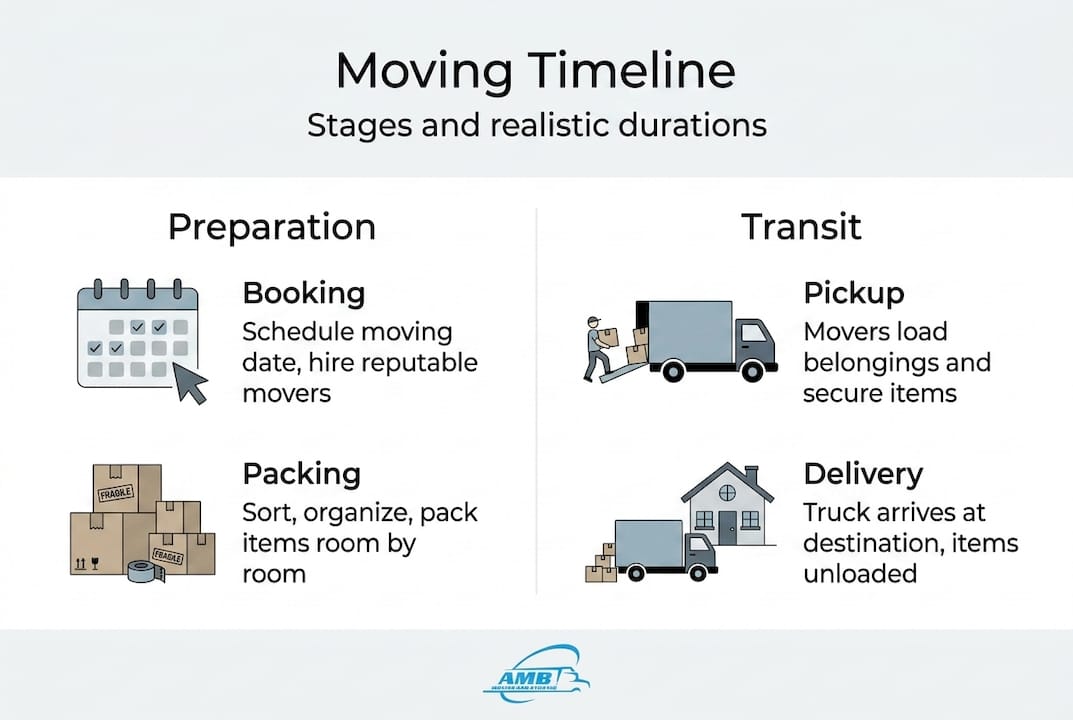
Stage 3: Pickup and loading. Loading day itself typically runs four to eight hours depending on home size. But your actual pickup window from the mover may span a day or two, so build that flexibility into your schedule.
Stage 4: Transit. This is where timelines vary most. Short moves (under 500 miles) typically take one to three days in transit. Mid-range moves (500 to 1,500 miles) usually run three to seven days. Full cross-country routes like New York to California can take seven to fourteen days, especially when movers consolidate multiple shipments on the same truck.
Stage 5: Delivery. Carriers provide a delivery window, not a guaranteed date. Expect a range of one to five business days around the estimated delivery date.
Here is a quick comparison of peak versus off-peak timelines:
| Move phase | Off-peak estimate | Peak season estimate |
|---|---|---|
| Booking lead time | 2-4 weeks | 4-6 months |
| Packing duration | 1-3 weeks | 2-4 weeks |
| Loading day | 4-8 hours | 4-10 hours |
| Transit (cross-country) | 7-10 days | 10-14 days |
| Delivery window | 1-3 business days | 3-5 business days |
Key phases to mark on your calendar:
- Start decluttering 8 weeks before move day
- Confirm mover booking and dates 4-6 weeks out
- Pack non-essentials starting 4-5 weeks before pickup
- Finish all packing 1-2 days before loading day
- Allow 1-2 extra weeks post-pickup for delivery and settling
Using a solid moving checklist for families keeps all of these phases running without overlap.
Pro Tip: Summer moves booked less than eight weeks in advance risk arriving at a new home before your belongings do. Carriers are at full capacity and route consolidation can stretch transit by three to five extra days.
What really determines your moving timeline?
Now that you understand the stages, it helps to know which variables push your timeline up or down the most.
Distance and route complexity are the biggest drivers. A move from New Jersey to Florida covers roughly 1,200 miles and typically takes five to eight transit days. A move from New York to California spans nearly 2,800 miles and can run ten to fourteen days. Routes through mountain passes, rural areas, or congested metro corridors add time that GPS apps never show you. The cross-country moving overview breaks down what to expect on the most common long-haul routes.
Shipment size and consolidation matter just as much. Smaller moves are frequently consolidated with other shipments, meaning your furniture rides in the same truck as two other households. That is efficient for cost but adds pickup and delivery stops that extend your timeline by several days.
Time of year shifts everything. May through September is peak moving season. Demand floods the system, and logistics sector data confirms that carrier route density during peak months increases scheduling delays across the board.
Families planning interstate moves should build a 1-2 week buffer after pickup to account for housing gaps and prevent scrambling for temporary lodging if delivery runs late. Renter’s Guide: A Moving Timeline
Housing gaps are a real risk families underestimate. Your lease might end on the 30th, your truck picks up on the 28th, and delivery arrives on the 10th. That gap needs a plan, which might mean a hotel, short-term rental, or choosing a mover who offers storage-in-transit.

| Timeline variable | Estimated impact |
|---|---|
| Every 500 miles of distance | Add 1-2 transit days |
| Peak season booking | Add 2-6 weeks lead time |
| Consolidation shipping | Add 2-4 transit days |
| Weather events (winter/storms) | Add 1-5 days |
| Large home (4+ bedrooms) | Add 1-2 days loading/unloading |
Factors to build into your own timeline:
- School schedules and pet transport logistics
- Overlap between old lease end and new home access date
- Whether you need temporary storage between pickup and delivery
- Holiday weekends near your move date
- Flexibility in your work start date at your destination
How long does moving take for most families? Realistic scenarios
Let’s translate all of this into concrete numbers with three common scenarios.
Scenario 1: Small move, moderate distance (NJ to NC, 650 miles). A couple with a two-bedroom apartment moving in early March books four weeks in advance. Packing takes ten days. Transit runs four to six days. Total time from first box packed to delivery: about three weeks. This is the smoothest category.
Scenario 2: Mid-size family, long distance (TX to WA, 2,100 miles). A family of four with a three-bedroom home moves in late June. Because of peak season, they need to book 4-6 months early to get their preferred dates. Packing takes three weeks. Transit runs eight to twelve days. Add a housing gap of four days waiting for key handover. Total from planning start to settled in: eight to ten weeks.
Scenario 3: Large peak-season cross-country move (NY to CA, 2,800 miles). A five-bedroom household moving in July faces the toughest conditions. Booking happens months in advance. Loading day takes two full days. Transit stretches twelve to fourteen days due to consolidation stops. Delivery window spans five business days. Planning this move properly involves preparing for a long-distance move at least twelve weeks before pickup.
Pro Tip: If your delivery date is uncertain, arrange for essential items like medications, important documents, a few days of clothing, and bedding to travel with you personally. This covers any gap days without crisis.
To map your own expected window, follow these steps:
- Confirm your pickup date first
- Add your carrier’s estimated transit days
- Add the delivery window range (usually 1-5 business days)
- Add a 7-14 day buffer for housing, weather, or logistics
- Work backward from that final date to set your packing start
Short-term storage solutions for long moves can bridge the gap when your belongings arrive before or after your new home is ready.
Quick strategies to maximize efficiency and minimize delays
You now have the knowledge. Here is how to use it.
- Book as early as possible. The earlier you lock in dates, the better the route options. Booking 2-8 weeks ahead off-peak gives you strong negotiating power and more date flexibility.
- Create a room-by-room packing plan. Tackle one room per day rather than everything at once. Label every box with its destination room at the new home to speed up unloading.
- Communicate weekly with your mover. Confirm pickup and delivery windows in writing once per week during the final month. Route changes or driver swaps can shift your window without warning.
- Use storage strategically. If your new home is not ready on move-in day, a short-term storage-in-transit option keeps your belongings safe and gives you breathing room.
- Declutter aggressively before loading. Every item you eliminate reduces load weight, which can lower your cost and speed up loading and unloading by hours.
- Track your shipment. Ask your mover for a tracking method or regular check-in schedule so you always know where your belongings are.
Pro Tip: A good guide to relocation logistics helps you stay ahead of week-by-week action items rather than reacting to surprises.
Week-by-week action items for the final month before pickup:
- Week 4: Confirm all dates with mover in writing
- Week 3: Finish packing non-essentials
- Week 2: Pack all remaining items except daily essentials
- Week 1: Final walkthrough, confirm delivery address and contact info with carrier
A printed storage solutions checklist gives you one reliable document to track what goes into storage versus what travels directly.
What most guides miss about real moving timelines
Here is what most moving guides quietly skip over: timeline estimates are written for ideal conditions, and ideal conditions are rare. Most articles present best-case scenarios as the norm.
The families who struggle most are the ones who plan for the minimum. They book late, expect transit to run perfectly, and find themselves living out of suitcases in a hotel for a week longer than expected. That is not a moving failure. It is a planning failure.
We have seen this pattern enough times to say clearly: no two interstate moves are alike. A storm in Kansas adds three days. A consolidation stop in Tennessee adds two more. A key handover delay at your new property adds another. Each of these alone is manageable. Together, they compound fast.
Building a 1-2 week buffer into your timeline is not pessimism. It is the single decision that separates a stressful move from a smooth one. The detailed family guide reinforces exactly this approach, and we have found that families who plan with extra padding consistently report less regret and fewer emergency costs.
Plan your interstate move with confidence
You now know how interstate moving timelines actually work, from booking lead times to transit windows to delivery buffers. The next step is putting that knowledge to work with a team that plans around real conditions, not optimistic estimates.
At AMB Moving & Storage Inc., we specialize in interstate moving services that account for every variable covered in this article. Whether you are managing a coast-to-coast move or a regional relocation, our team builds realistic timelines and stays in communication throughout. Explore your long distance moving options and lock in your preferred dates early. The sooner you plan, the more control you have. Get your moving quote today and start your move with a clear, honest timeline.
Frequently asked questions
What is the average time for an interstate move?
Most interstate moves take 2-3 weeks from pickup to delivery, but the full planning window including booking and packing often runs six to ten weeks total.
How far in advance should I book an interstate mover?
Book 2-8 weeks ahead during off-peak months and 4-6 months in advance if your move falls between May and September.
Can my belongings and my family arrive at our new home on the same day?
It is uncommon; a 1-2 week buffer after pickup is the standard recommendation to prevent housing gaps and avoid scrambling for temporary lodging.
What causes delays during an interstate move?
Peak season demand, weather events, route changes, and consolidation logistics are the most frequent causes, and they often stack on top of each other.
Does using storage impact the moving timeline?
Short-term storage adds a buffer that can actually reduce stress during housing gaps, though it typically extends the total move by a few days depending on pickup and drop-off scheduling.