


TL;DR:
- A corporate relocation policy is a formal HR document that outlines eligibility, benefits tiers, covered expenses, tax implications, and repayment obligations to guide employee moves effectively. Clear communication, tiered support levels, and transparency about tax treatments enhance employee satisfaction and help organizations control costs during transitions. Managed relocation programs through RMCs improve outcomes, reduce costs, and ensure policies are properly explained and executed.
A corporate relocation policy is a formal HR document that defines eligibility criteria, tiered benefit levels, covered expenses, tax treatments, management procedures, and repayment obligations to guide employee relocations effectively. Known in the industry as a “relocation policy” or “mobility policy,” this document is the operational backbone of any corporate move program. Without it, HR teams face inconsistent decisions, budget overruns, and frustrated employees. Organizations that invest in explaining corporate relocation policies clearly see measurably better retention during transitions and fewer disputes over reimbursements.
What are the key elements of corporate relocation policies?
A well-structured relocation policy defines eligibility, benefits tiering, reimbursement processes, and clawback rules in one authoritative document. Every HR professional responsible for employee moves needs to understand these components before communicating them to stakeholders or relocating employees.
Eligibility criteria form the policy’s first gate. Most organizations define eligibility by role level, tenure, move distance (typically 50 miles or more), and move type (domestic versus international). A new hire relocating from Chicago to Dallas for a director-level position will qualify under different terms than a lateral transfer moving 60 miles within the same metro area.
The core covered expenses in most corporate relocation guidelines include:
- Household goods moving: Professional packing, transport, and delivery of personal belongings, often with full-value protection coverage
- Temporary housing: Furnished accommodations for 30 to 90 days while the employee secures permanent housing
- Travel reimbursements: Flights or mileage for the employee and immediate family during the move
- Home sale and purchase assistance: Buyer value option programs, closing cost coverage, or mortgage differential payments
- Destination services: Area orientation tours, school search support, and spouse or partner career assistance
Expense reimbursement mechanics require equal attention. Policies must specify whether employees submit receipts for direct reimbursement, whether the company pays vendors directly, or whether a lump sum covers all costs. Each approach carries different administrative burdens and tax consequences.
Repayment clauses, often called clawback provisions, protect the company’s investment. A standard clause requires employees who leave within 12 to 24 months of relocation to repay a prorated portion of relocation costs. This provision must be documented in writing and acknowledged by the employee before the move begins.
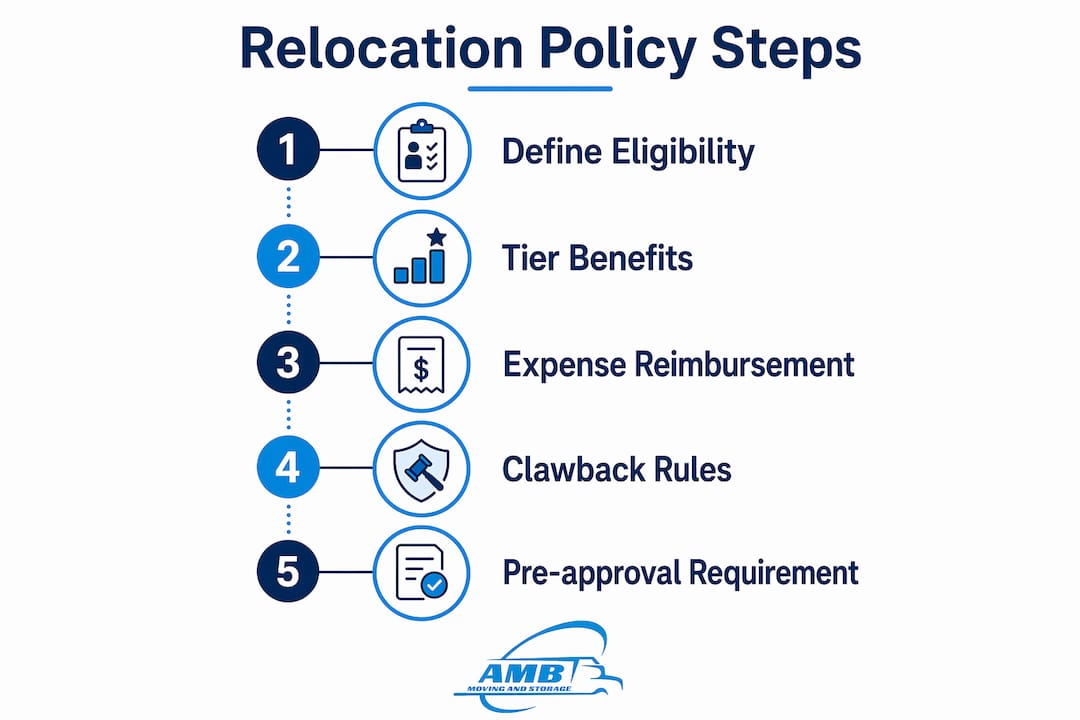
Pro Tip: Always include a pre-approval requirement for expenses above a defined threshold. This single rule prevents the most common source of reimbursement disputes and keeps relocation budgets predictable.
How do relocation benefit tiers work and why are they important?
Tiered relocation policies tailor benefits by employee level or move complexity to control costs and adjust benefit scope without applying a one-size-fits-all approach. Tiers give HR the flexibility to allocate resources where they deliver the most value while keeping total program spend manageable.

Most corporate move policies use three primary tiers:
| Tier | Typical employee level | Benefits included |
|---|---|---|
| Lump sum | Entry to mid-level | Fixed cash payment; employee manages all logistics independently |
| Managed move | Mid to senior level | Company-coordinated vendors, temporary housing, travel, and destination services |
| Full-service | Executive or critical hire | All managed move benefits plus home sale assistance, tax gross-up, and spouse support |
The lump sum tier is the most cost-predictable option for employers. The company pays a fixed amount, often between $2,500 and $10,000, and the employee assumes full responsibility for logistics. This works well for younger employees or short-distance moves but can create stress for families relocating across multiple states.
The managed move tier is where most mid-career employees land. HR or a Relocation Management Company (RMC) coordinates vendors, schedules moves, and manages temporary housing. This reduces the employee’s administrative burden significantly and produces more consistent outcomes than lump sum programs.
The full-service tier is reserved for executives and hard-to-fill roles where the cost of a failed relocation far exceeds the investment in premium support. Companies using tiered policies achieve cost savings while tailoring support to employee needs and simplifying managerial budgeting decisions.
Pro Tip: Build a documented exception process into every tier. Rigid tiers without flexibility create morale problems when an employee’s situation falls just outside the defined criteria. A formal exception request process keeps decisions consistent and defensible.
What tax considerations and implications affect corporate relocation policies?
Post Tax Cuts and Jobs Act (TCJA), most employer-paid relocation benefits are taxable to employees as ordinary income, a shift that fundamentally changed how HR must design and communicate relocation packages. Before 2018, qualified moving expense reimbursements were excluded from taxable income. That exclusion no longer applies for most civilian employees, which means every dollar the company spends on moving a domestic employee is potentially added to that employee’s W-2.
The tax implications HR must address in every policy include:
- Gross-up payments: The company pays additional funds to cover the employee’s estimated tax liability on relocation benefits. Gross-ups can add 30 to 40 percent to total relocation costs depending on the employee’s tax bracket and the gross-up methodology used.
- Imputed income reporting: All taxable relocation benefits must be reported on the employee’s W-2, regardless of whether the company provides a gross-up.
- International tax equalization: For cross-border moves, companies often implement tax equalization policies to ensure employees pay no more or less tax than they would have in their home country.
- Methodology documentation: The specific gross-up calculation method (flat rate, supplemental rate, or marginal rate) must be documented in the policy to set realistic employee expectations.
“Tax gross-up design should be documented as a cost-control mechanism, not a tax guarantee, setting employee expectations realistically. Actual tax burdens can differ; clear communication and methodology documentation are best practices.” — Altair Global
Transparent communication about tax treatments reduces employee frustration and builds trust even when tax exposure remains unavoidable. An employee who understands upfront that a $15,000 relocation benefit will appear as taxable income on their W-2 is far less likely to feel blindsided at tax time than one who discovers it after the fact.
What role do relocation management companies and policy administration play?
Managed relocation programs coordinated through Relocation Management Companies typically yield better outcomes and lower costs than lump sum approaches. An RMC acts as a centralized coordinator, managing vendor relationships, negotiating rates, tracking expenses, and providing the employee with a single point of contact throughout the move.
Here is how a managed relocation program typically operates:
- Policy intake and employee briefing: The HR or Global Mobility team initiates the relocation file and connects the employee with the RMC within the first week of the move authorization.
- Needs assessment: The RMC conducts a detailed interview with the employee to understand family size, housing preferences, timeline, and any special requirements such as pet transport or vehicle shipping.
- Vendor coordination: The RMC engages pre-vetted moving companies, temporary housing providers, and destination service consultants. This is where interstate moving expertise becomes critical for moves crossing state lines.
- Expense tracking and reporting: All costs are tracked against the policy budget in real time, giving HR visibility into spend before it becomes a problem.
- Post-move support: The RMC follows up at 30 and 90 days to address any unresolved issues and confirm the employee has settled successfully.
HR or Global Mobility functions are the central coordination points responsible for managing relocation vendors, immigration, and tax compliance. For international moves, immigration applications should begin at least 90 days before the employee’s start date to avoid legal and logistical delays.
Pro Tip: Even if your organization uses an RMC, assign an internal HR contact as the employee’s advocate. Employees who have one familiar face inside the company report significantly higher satisfaction with the relocation process.
How to communicate relocation policies clearly to employees
Unclear policy boundaries between covered and excluded items create employee dissatisfaction. Employees often misinterpret reimbursement as full coverage, which means HR must communicate what the policy does not cover with the same clarity as what it does.
Effective communication of corporate relocation guidelines requires a structured approach:
- Use plain language summaries. Translate the legal policy document into a one-page employee guide that answers the five most common questions: What is covered? What is my timeline? What do I need to submit? What happens if I leave early? Who is my contact?
- Present the policy as a transition timeline. Framing relocation support from pre-move to settling-in reduces delays and enhances assignment success by giving employees a predictable sequence of events rather than a static document.
- Hold a policy briefing call. A 30-minute call between the employee, HR, and the RMC at the start of the process prevents the majority of misunderstandings that surface mid-move.
- Document all exceptions in writing. When a manager approves a benefit outside the standard policy, that approval must be documented and shared with the employee and finance team to avoid disputes later.
- Use technology to support access. Platforms like Equus Software or Topia give employees self-service access to their relocation benefits, expense submission tools, and policy documents in one place.
For employees managing long-distance relocation expenses, a detailed breakdown of what qualifies for reimbursement versus what falls outside policy scope prevents the most common source of post-move frustration.
Key takeaways
A corporate relocation policy succeeds when it defines eligibility, tiers benefits by role level, addresses tax obligations transparently, and is communicated to employees as a clear transition timeline rather than a compliance document.
| Point | Details |
|---|---|
| Define eligibility precisely | Specify role, tenure, distance, and move type to prevent disputes before they start. |
| Use tiered benefit structures | Align lump sum, managed, and full-service tiers to employee level and move complexity. |
| Address tax obligations upfront | Document gross-up methodology and imputed income rules so employees have no surprises at tax time. |
| Leverage RMC coordination | Managed relocation programs reduce cost leakage and improve employee experience through expert vendor management. |
| Communicate as a timeline | Present policy benefits as a pre-move to settling-in sequence to set predictable expectations and support retention. |
What we have learned from managing corporate moves
After working with HR teams and business leaders across hundreds of interstate and long-distance corporate relocations, the pattern is consistent: the policies that fail are not the ones with insufficient benefits. They are the ones that were never explained properly.
The most common breakdown happens at the tier level. An employee hears “managed move” and assumes it means full-service. When they discover home sale assistance is not included, the frustration is immediate and often irreversible. The fix is not a better policy. It is a better briefing.
Tax transparency is the second area where most programs underperform. HR teams often avoid the gross-up conversation because it feels complicated. But employees who learn about their tax liability from their accountant in April, rather than from HR in October, feel deceived. That perception damages trust far more than the tax bill itself.
The organizations that get this right treat the relocation policy as a communication tool, not just a compliance document. They review it annually, update it when tax law changes (as TCJA demonstrated), and train managers to explain it accurately. They also partner with moving providers who understand the corporate context, not just the logistics.
One piece of advice that consistently makes a difference: build the exception process before you need it. Every policy will face edge cases. Having a documented, fair process for handling them protects both the employee and the company.
— AMB
Move your employees with confidence using Ambmovingservices
When your relocation policy calls for professional execution, Ambmovingservices delivers the interstate and long-distance moving expertise that corporate HR teams rely on. From coordinating household goods transport across state lines to supporting managed move programs with reliable scheduling and full-value protection, Ambmovingservices handles the logistics so your employees can focus on their new roles.
Whether you are relocating a single executive or managing a multi-employee transfer program, Ambmovingservices provides nationwide moving coverage with the licensing, insurance, and federal compliance standards your policy requires. Get a moving cost estimate today and give your relocating employees the professional support they deserve.
Request a corporate moving quote
FAQ
What is a corporate relocation policy?
A corporate relocation policy is a formal HR document that defines which employees qualify for relocation support, what benefits are covered, how expenses are reimbursed, and what obligations the employee assumes in return. It serves as the governing framework for all company-sponsored employee moves.
What expenses does a typical relocation package cover?
Most relocation packages cover household goods moving, temporary housing for 30 to 90 days, travel reimbursements, and home sale or purchase assistance. Additional benefits at senior tiers often include destination services and spouse career support.
Are relocation benefits taxable to employees?
Post-TCJA, most employer-paid relocation benefits are taxable as ordinary income to the employee. Companies often provide a tax gross-up payment to offset this liability, though gross-ups can add 30 to 40 percent to total relocation costs.
What is a relocation management company?
A Relocation Management Company (RMC) is a third-party provider that coordinates all aspects of an employee’s move on behalf of the employer, including vendor management, expense tracking, and employee support. RMC-managed programs typically produce better outcomes and lower costs than unmanaged lump sum approaches.
How should HR communicate relocation policies to employees?
HR should translate the formal policy into a plain-language employee guide, present benefits as a step-by-step transition timeline, and hold a briefing call with the employee and RMC at the start of the process. Clear communication about covered versus excluded expenses prevents the majority of post-move disputes.