


TL;DR:
- Commercial relocations involve complex planning, compliance, and coordination across multiple departments.
- Interstate moves are heavily regulated by federal rules requiring specific documentation and insurance coverage.
- Proper planning, vendor selection, and staff communication are critical to minimizing costs and downtime.
Moving your business across state lines is not just a logistics project. It’s a cross-functional operation involving compliance, cost control, IT migration, and risk management all at once. Average downtime runs 2.4 days and costs can hit $45,000 for a 10,000 sq ft office, yet most business owners still treat relocation like a simple packing job. This guide breaks down exactly what commercial relocation involves, what federal rules apply when you cross state lines, how to plan your timeline, what drives costs, and how to keep your move on track from day one.
Table of Contents
- What is commercial relocation?
- Key steps in commercial relocation and timeline planning
- Rules, compliance, and risk: what business owners must know
- Cost drivers, budgeting, and how to optimize your move
- Our perspective: what most business owners miss about commercial moves
- Start your commercial relocation with confidence
- Frequently asked questions
Key Takeaways
| Point | Details |
|---|---|
| Start planning early | Effective commercial relocations require at least 6-12 months of preparation for minimal downtime and disruption. |
| Prioritize compliance | Interstate moves involve federal regulations, mandatory documents, and insurance requirements that must not be overlooked. |
| Purge to save costs | Clearing out unused inventory and equipment can cut your moving expenses by up to 30 percent. |
| Utilize expert support | Choosing experienced commercial movers reduces risk and ensures your business transitions efficiently. |
What is commercial relocation?
Commercial relocation means moving a business, its people, equipment, furniture, and systems, from one physical location to another. It’s not just a bigger version of moving apartments. The scale, the legal requirements, the insurance obligations, and the operational stakes are entirely different.
Businesses move for many reasons. Some outgrow their current space due to rapid hiring. Others downsize after a restructuring or merger. Lease expirations, access to new markets, and cost-cutting initiatives are also common triggers. In 2023, 45,000 U.S. corporate office relocations took place, which tells you this is a routine business event, but one that still catches many owners underprepared.
Here’s what separates a commercial move from a residential one:
- Scale and complexity: You’re moving dozens or hundreds of workstations, servers, filing systems, and specialized equipment.
- IT systems: Servers, network infrastructure, and data security protocols require careful handling and often a dedicated IT migration plan.
- Insurance requirements: Commercial moves demand higher coverage limits and more specific policy language.
- Timing sensitivity: Every hour of downtime has a dollar cost attached to it.
- Regulatory compliance: Especially for interstate moves, federal rules apply that simply don’t exist for residential relocations.
The commercial relocation process also requires involvement from multiple departments. HR needs to communicate with staff. IT needs to plan the system migration. Finance needs to approve and track the budget. Facilities or operations leads the physical logistics. No single person can manage all of this alone.
“A commercial move is really a change management project disguised as a logistics problem. The businesses that treat it as pure logistics are the ones that struggle most.”
Pro Tip: Assign a dedicated internal move coordinator from the start. This person owns the project timeline, vendor communication, and internal updates. Without a single point of accountability, tasks fall through the cracks.
Common triggers that push businesses to relocate include mergers and acquisitions that consolidate offices, rapid headcount growth that outpaces current space, and lease renewals that come with steep rent increases. Whatever the reason, the planning process looks largely the same.
Key steps in commercial relocation and timeline planning
Knowing what commercial relocation is leads directly to the next question: How do you actually manage one without losing productivity or blowing your budget?
The answer starts with lead time. Midsize offices with 50 to 200 employees need 6 to 12 months of planning to execute a smooth move. Smaller offices might compress that to 3 to 6 months, but rushing always creates problems.
Here’s a practical step-by-step framework:
- Form a cross-functional move team. Include representatives from operations, IT, HR, and finance. Use a RACI matrix (Responsible, Accountable, Consulted, Informed) to define who owns each task.
- Audit and purge your inventory. Before you move anything, decide what’s worth taking. Old furniture, outdated equipment, and redundant files add cost with zero return.
- Define the full move scope. Document every asset, every department’s needs, and every special handling requirement before you contact a single vendor.
- Develop your budget with a contingency line. Build in 10 to 15% above your base estimate for unexpected costs. They will come up.
- Select and vet your moving company. For interstate moves, verify FMCSA licensing. A full-service provider reduces risk significantly compared to piecing together multiple vendors.
- Build a communication timeline for staff. Use T-60, T-30, and T-7 day milestones to keep employees informed and reduce anxiety.
- Coordinate IT migration separately. Plan for systems to be down as briefly as possible, and test everything before the first employee shows up at the new location.
Pro Tip: Review your relocation logistics guide before finalizing your vendor list. Understanding what full-service movers actually cover helps you avoid gaps in your plan.
Stat to know: Businesses that skip the purge step often pay to move items they immediately discard at the new location. Purging before the move is one of the fastest ways to reduce your final invoice.
Solid relocation planning also means building in buffer time around your move date. Don’t schedule client-facing commitments for the week of the physical move. Give yourself room to absorb delays.
Rules, compliance, and risk: what business owners must know
A solid timeline matters, but if your move crosses state lines, legal compliance is not optional. Federal regulations govern interstate commercial moves, and ignoring them exposes your business to serious financial and legal risk.
The Federal Motor Carrier Safety Administration (FMCSA) regulates all interstate moving companies. FMCSA rules require that any mover handling an interstate shipment must hold a USDOT number, provide a written estimate, issue a bill of lading, and offer valuation coverage options.
Here’s a quick comparison of what applies depending on your move type:
| Requirement | Interstate move | Intrastate move |
|---|---|---|
| FMCSA regulation | Yes | No (state rules apply) |
| USDOT number required | Yes | Varies by state |
| Written estimate required | Yes | Varies by state |
| Bill of lading required | Yes | Varies by state |
| Pricing basis | Weight and distance | Often hourly |
| Federal valuation coverage | Yes | No |
The bill of lading is your legal contract with the mover. It documents what’s being moved, the agreed price, and the delivery terms. Never let a mover start loading without one.
Valuation coverage is also mandatory to offer, though many business owners confuse it with insurance. Released value protection (the basic option) covers items at $0.60 per pound. Full-value protection covers repair or replacement at current market value. For a commercial move with expensive IT equipment and furniture, full-value protection is almost always worth the added cost.
Key risks to watch for:
- Unlicensed movers: Always verify licensed movers before signing anything.
- Insurance gaps: Your business insurance policy may not cover goods in transit. Confirm this before move day.
- Binding vs. non-binding estimates: A binding estimate locks in your price. A non-binding estimate can increase based on actual weight. Know which one you’re signing.
For interstate moves, also review your interstate moving requirements so you understand exactly what your mover is legally obligated to provide.
Cost drivers, budgeting, and how to optimize your move
With compliance handled, your next priority is controlling what you spend. Commercial relocations have a wide cost range, and knowing what drives the number helps you make smarter decisions before you commit to anything.

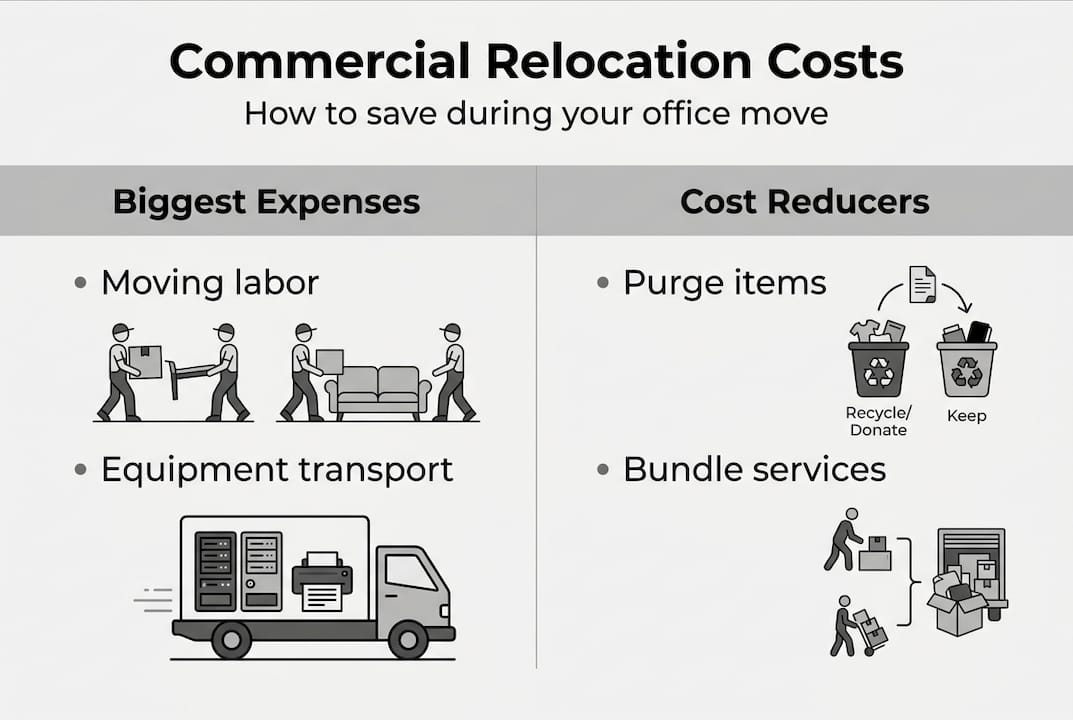
The average cost for a 10,000 sq ft office move is $45,000, and experts recommend adding a 10 to 15% contingency on top of that. For larger offices or those with specialized equipment, costs climb quickly.
Main cost drivers:
- Volume and weight: The more you move, the more you pay. Simple as that.
- Distance: Longer hauls cost more, especially for interstate moves priced by weight and mileage.
- Building access: Elevators, loading docks, parking restrictions, and building hours all affect labor time.
- Specialty items: Server racks, safes, medical equipment, and custom furniture require special handling.
- Timing: Moving during peak season (summer, end of month) costs more than off-peak periods.
- Insurance level: Full-value protection adds cost but protects your assets.
Here’s a typical expense breakdown for a midsize office move:
| Expense category | Estimated share of budget |
|---|---|
| Moving labor and transportation | 40 to 50% |
| Packing materials and service | 10 to 15% |
| IT migration and setup | 15 to 20% |
| Insurance and valuation | 5 to 10% |
| Storage (if needed) | 5 to 10% |
| Contingency reserve | 10 to 15% |
Purging unnecessary items before the move can reduce total costs by 20 to 30%. That’s a significant saving that requires no negotiation, just discipline.
Pro Tip: Get at least three written estimates from licensed movers and compare them line by line. Vague estimates are a red flag. Review relocation expenses examples to benchmark what each line item should realistically cost.
Bundling services with one provider, such as packing, transport, and storage, often yields better pricing than hiring separate vendors for each task. It also simplifies accountability when something goes wrong.
Our perspective: what most business owners miss about commercial moves
After working with businesses relocating across state lines, one pattern stands out clearly. Most owners spend enormous energy on the logistics checklist and almost none on the human side of the move.
Staff anxiety is a real cost. When employees don’t know what’s happening, when the new office will be ready, or how their daily routine will change, productivity drops before the move even begins. Clear communication at T-60, T-30, and T-7 days isn’t just courtesy. It’s risk management.
The second thing most businesses underestimate is the value of specialized providers. Piecing together a move with a general freight carrier, a separate IT vendor, and a local packing crew sounds cost-effective. In practice, it creates coordination gaps that lead to damaged equipment, missed deadlines, and finger-pointing when things go wrong.
Our commercial moving experience shows that businesses investing in a single, qualified, full-service provider almost always see lower total cost when you factor in avoided downtime and post-move fixes. The upfront quote may look higher, but the final outcome is usually better on every metric that matters.
Change management is not a soft skill in this context. It’s the difference between a move that energizes your team and one that costs you key employees.
Start your commercial relocation with confidence
Planning a commercial move across state lines means managing compliance, cost, timing, and people all at once. That’s a lot to coordinate without the right support.

At AMB Moving & Storage Inc., we specialize in exactly this kind of move. As a federally licensed interstate carrier operating under U.S. DOT: 3839636 and MC: 1395855, we provide transparent estimates, full-service coordination, and professional handling from the first box to the final delivery. Whether you need help understanding your interstate moving services options, want to review relocation cost examples before budgeting, or are ready to explore your full state-to-state relocation guide, our team is ready to help you move with confidence.
Frequently asked questions
What is the difference between commercial and residential relocation?
Commercial relocation involves moving a business with office equipment, IT infrastructure, and compliance requirements, while residential moves cover individual household goods. The scale, systems, and compliance involved in commercial moves are significantly more complex.
How long does an interstate office relocation typically take?
A midsize office typically needs 6 to 12 months of planning, with the physical move averaging 2.4 days of downtime. Larger or more complex offices may require additional time on both ends.
Are there specific regulations for moving a business across state lines?
Yes. FMCSA regulations require interstate movers to hold a USDOT number, provide written estimates, issue a bill of lading, and offer valuation coverage options to protect your shipment.
What are the biggest cost drivers in commercial relocation?
Total volume and weight, distance, labor, and specialty handling are the primary drivers. Purging inventory before the move can reduce your total cost by 20 to 30%, making it one of the most impactful budget levers available.
Recommended
- Master the commercial relocation process: your complete guide
- Guide to relocation logistics: smooth and stress-free moves
- Moving storage solutions for long-distance relocations
- Examples of relocation expenses for long-distance moves
- Streamlining Your International Move with Dream Move Relocation Services