

TL;DR:
- A moving estimate defines your relocation cost and whether that amount is final or preliminary.
- Choosing the correct estimate type, such as binding or binding not-to-exceed, is essential to avoid unexpected charges and protect yourself legally.
A moving estimate is a written document that defines what you will pay for your relocation, and the type of estimate you accept determines whether that number is final or just a starting point. Three estimate types govern interstate moves in the United States: binding, non-binding, and binding not-to-exceed. The Federal Motor Carrier Safety Administration (FMCSA) identifies estimate type as the critical factor influencing whether your final bill matches your quote. Choosing the wrong type can cost you hundreds or thousands of dollars in surprise charges. This guide covers moving estimate types explained in plain terms, with the legal framework and practical steps you need to protect yourself.

What is a binding moving estimate?
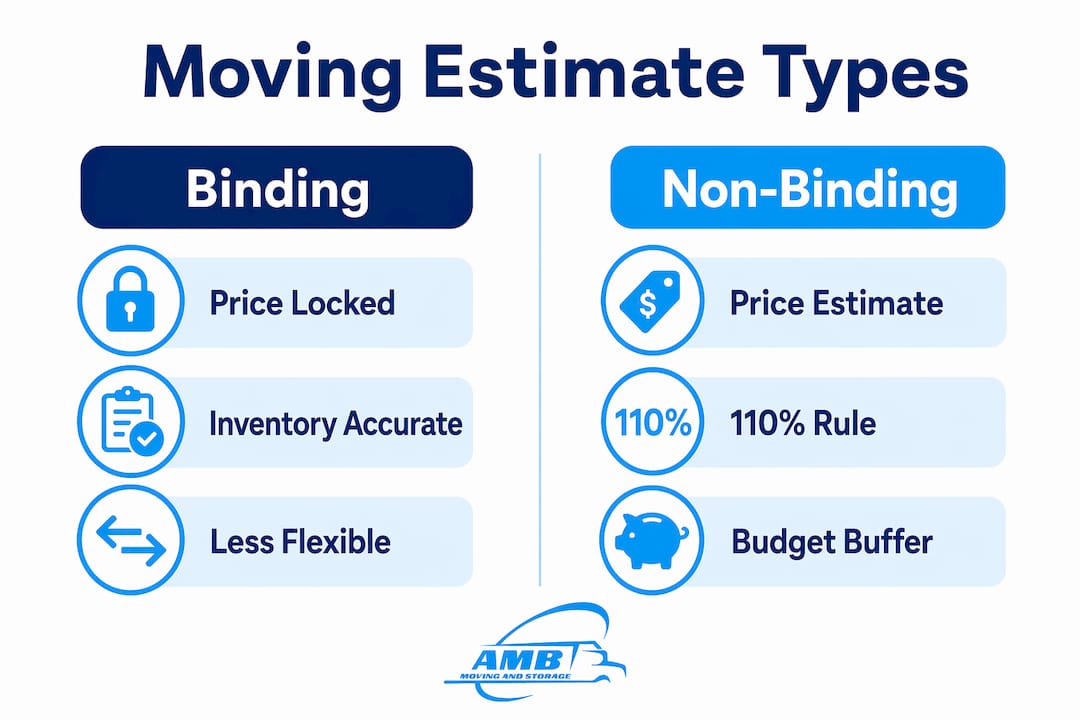
A binding estimate is a locked price. The mover agrees to transport your listed inventory and perform the listed services for exactly the amount stated, regardless of the actual weight of your shipment. Federal regulation 49 CFR 375.403 requires the document to be written, signed by both parties, and labeled “Binding Estimate” to be legally enforceable.
The key condition is inventory accuracy. If you add items not listed on the original estimate, the mover can charge extra for those additions. If your inventory stays the same, the price cannot increase. That protection makes binding estimates the clearest choice for families who have finalized their packing list and want no financial surprises on delivery day.
Binding estimates work best when your move scope is well defined. A three-bedroom household moving from Chicago to Dallas with a complete furniture list is an ideal candidate. The mover surveys your belongings, either in person or by video, and commits to a firm price. Accurate inventory surveys are the foundation of any meaningful binding estimate, because a survey done over the phone with no visual inspection produces a number that is little more than a guess.
Pro Tip: Request that the mover conduct a full walkthrough of every room, including attics, basements, and garages, before signing a binding estimate. Items missed during the survey can void your price protection.
One limitation of binding estimates is reduced flexibility. If you decide to add a large piece of furniture after signing, expect a revised estimate or a separate charge. Plan your inventory carefully before committing.
How non-binding moving estimates work and their implications
A non-binding estimate is an educated projection, not a guaranteed price. The mover calculates a cost based on a visual or virtual survey, but the final bill reflects the actual weight of your shipment and the services rendered. Under 49 CFR 375.405 and 49 CFR 375.407, movers must provide written non-binding estimates that clearly disclose all charges, but those charges can change after your goods are weighed.
The most misunderstood protection in non-binding estimates is the 110% rule. At delivery, you are required to pay no more than 110% of the original estimate. That sounds reassuring, but the 110% rule caps only immediate payment. The mover can bill you for the remaining balance within 30 days. Your total final cost can still exceed the original quote by a significant margin.
Non-binding estimates carry real financial risk. Many movers use low non-binding quotes to win business, then charge more once your belongings are loaded. Choosing the lowest price alone is risky because companies can use low non-binding estimates to attract customers and increase the final cost after delivery. Consumers often underestimate this risk until they receive a bill that is far above the original number.
When does a non-binding estimate make sense? Consider these situations:
- Your inventory is not finalized and you expect to add or remove items before moving day.
- You are moving a small shipment where weight variation is minimal.
- You are comparing baseline costs across multiple movers before narrowing your choice.
- The mover cannot conduct a proper survey and a rough estimate is all that is available.
- You understand the 110% rule fully and have budgeted for potential overages.
Even in these cases, treat a non-binding estimate as a floor, not a ceiling. Budget at least 15–20% above the quoted figure to avoid a cash shortfall at delivery.
What is a binding not-to-exceed estimate?
A binding not-to-exceed estimate is the most consumer-friendly option in the industry. It sets a maximum price you will pay, but if your shipment weighs less than estimated, your final bill drops accordingly. You get the price ceiling of a binding estimate combined with the potential savings of a non-binding one.
Binding not-to-exceed estimates are considered most consumer-friendly because they cap your price but allow you to pay less if the shipment is lighter. Despite this clear advantage, movers rarely offer this estimate type without being asked. Consumers should specifically request binding not-to-exceed estimates to gain maximum protection and potential savings.
Here is how the billing works in practice:
| Scenario | Estimated price | Actual weight result | Amount you pay |
|---|---|---|---|
| Shipment weighs exactly as estimated | $4,500 | Matches estimate | $4,500 |
| Shipment weighs less than estimated | $4,500 | Lighter than expected | Less than $4,500 |
| Shipment weighs more than estimated | $4,500 | Heavier than expected | $4,500 (capped) |
The table shows why this estimate type benefits you in every scenario. You never pay more than the cap, and you pay less when your shipment is lighter. The only scenario where binding not-to-exceed does not outperform a standard binding estimate is when your shipment weighs exactly as projected.
Pro Tip: When calling movers for quotes, ask directly: “Do you offer binding not-to-exceed estimates?” If a mover says no or seems unfamiliar with the term, that tells you something about their commitment to consumer protection.
Negotiating this estimate type requires an accurate survey. A mover cannot set a meaningful cap without knowing what they are moving. Schedule an in-home or video survey before requesting this estimate type, and show the surveyor every item you plan to move.
How to compare moving estimates and avoid common pitfalls
Comparing moving quotes requires more than looking at the bottom line. The estimate type, the accuracy of the inventory, and the services included all determine whether two quotes are actually comparable. Getting at least three written estimates helps you identify outliers and build a realistic picture of market pricing.
Use this checklist when evaluating each estimate:
- Estimate type: Is it binding, non-binding, or binding not-to-exceed? Never compare a binding quote to a non-binding one without adjusting for risk.
- Survey method: Was the estimate based on an in-home or video survey, or a phone call? Phone-based estimates are unreliable for long-distance moving and should be treated with skepticism.
- Inventory list: Does the estimate include a written inventory? If not, the price has no legal anchor.
- Included services: Does the quote cover packing, disassembly, stair fees, and long-carry charges? Missing line items create hidden costs.
- Deposit requirements: FMCSA advises avoiding movers who demand large upfront payments. A legitimate mover collects payment at delivery, not before.
- Mover credentials: Verify the mover’s FMCSA registration and check complaint databases before signing anything.
Red flags that signal a problematic estimate include verbal quotes with no written follow-up, unusually low bids that are 30% or more below other estimates, vague language about “approximate” charges, and pressure to sign quickly. Interstate movers must provide written estimates; verbal estimates carry no legal weight and offer no consumer protection.
Validate credentials through the FMCSA’s registration database before committing. Ambmovingservices publishes a detailed FMCSA verification guide that walks you through the process step by step. Checking a mover’s license takes less than five minutes and eliminates a significant category of fraud risk.
What federal and state regulations govern moving estimates in 2026?
Federal regulations set the baseline for all interstate moving estimates. The FMCSA, operating under the Department of Transportation, enforces rules that apply to every mover crossing state lines. Key protections include:
- Written estimates required: All interstate estimates must be in writing. Verbal or incomplete estimates must be rejected by consumers.
- 110% rule for non-binding estimates: Movers cannot collect more than 110% of the non-binding estimate at delivery.
- Mandatory disclosure: Estimates must list all charges, including fuel surcharges, packing fees, and accessorial services.
- Consumer rights in disputes: If a mover holds your goods and demands payment above the legal limit, you have the right to file a complaint with the FMCSA.
- Moves over 56 miles: These moves calculate cost by weight and distance, making written, inventory-based estimates legally required for accurate billing.
State regulations add another layer. Washington State’s Utilities and Transportation Commission (UTC), for example, requires movers to show all items including those in attics and basements during the survey to prevent later price adjustments. Other states have similar disclosure requirements. Check your state’s transportation authority for rules specific to your move.
Verifying a mover’s interstate moving credentials through both federal and state databases gives you the most complete picture of their compliance record. A mover with FMCSA registration and a clean state record is a fundamentally safer choice than one with gaps in either database.
Key Takeaways
The type of moving estimate you accept is the single most important factor determining whether your final bill matches your original quote.
| Point | Details |
|---|---|
| Binding estimates lock your price | The final bill cannot increase if your inventory stays the same as listed. |
| Non-binding estimates carry real risk | The 110% rule limits delivery payment, but the full balance can be billed within 30 days. |
| Binding not-to-exceed is the best option | It caps your maximum price and lowers your bill if the shipment weighs less than estimated. |
| Written estimates are legally required | Verbal quotes have no legal standing for interstate moves under FMCSA rules. |
| Compare at least three written estimates | Get multiple quotes and verify each mover’s FMCSA registration before signing. |
What I have learned from years of moving estimate disputes
The most common mistake families make is accepting the lowest quote without asking what type of estimate it is. A non-binding estimate at $3,800 is not cheaper than a binding estimate at $4,200. It is a different product with a different risk profile. When the shipment weighs more than projected, that $3,800 quote can become $5,000 or more, with the mover fully within their legal rights to collect the difference.
Binding not-to-exceed estimates are the clearest win for consumers, yet most families have never heard of them. Movers do not volunteer this option because it limits their upside. Asking for it directly changes the negotiation. A mover who refuses to offer binding not-to-exceed on a well-surveyed shipment is telling you something important about how they operate.
The other mistake I see repeatedly is skipping the in-home or video survey. A phone estimate is a number pulled from thin air. It has no inventory basis, no legal weight, and no ability to protect you at delivery. Insisting on a proper survey before signing any estimate is the single most effective step you can take to prevent surprise charges.
Read the estimate document before signing. Confirm the estimate type is labeled correctly. Confirm the inventory list matches what the surveyor saw. Confirm all services are itemized. A five-minute review at signing can prevent a five-hour dispute at delivery.
— AMB
Get an accurate moving estimate from Ambmovingservices
Ambmovingservices provides written binding and binding not-to-exceed estimates for long-distance and interstate moves across the United States. Every estimate is based on a thorough survey, complies with FMCSA regulations, and includes a complete inventory and itemized service list.
Families planning cross-country relocations deserve a quote that reflects the actual scope of their move, not a lowball number designed to win business. Ambmovingservices builds estimates on accurate surveys and transparent pricing. Request your personalized moving quote online today and get a written estimate you can rely on from a licensed, insured nationwide moving company.
FAQ
What are the three types of moving estimates?
The three types are binding, non-binding, and binding not-to-exceed. Each offers a different level of price certainty and consumer protection for interstate moves.
What does a binding estimate mean for my move?
A binding estimate locks your price for the listed inventory and services. The mover cannot charge more unless you add items or services not included in the original estimate.
How does the 110% rule protect me on a non-binding estimate?
The 110% rule limits what a mover can collect at delivery to 110% of the original non-binding estimate. The remaining balance can still be billed within 30 days, so your total cost may exceed the original quote.
Why should I request a binding not-to-exceed estimate?
A binding not-to-exceed estimate caps your maximum price but lowers your bill if your shipment weighs less than estimated. Industry experts consider it the most consumer-friendly option, but movers rarely offer it without being asked.
How do I verify a mover’s credentials before signing an estimate?
Check the mover’s registration through the FMCSA database and your state’s transportation authority. Ambmovingservices publishes a step-by-step mover verification guide to help you confirm credentials before committing.