


TL;DR:
- Moving carriers are licensed entities that handle actual transportation of belongings, unlike brokers.
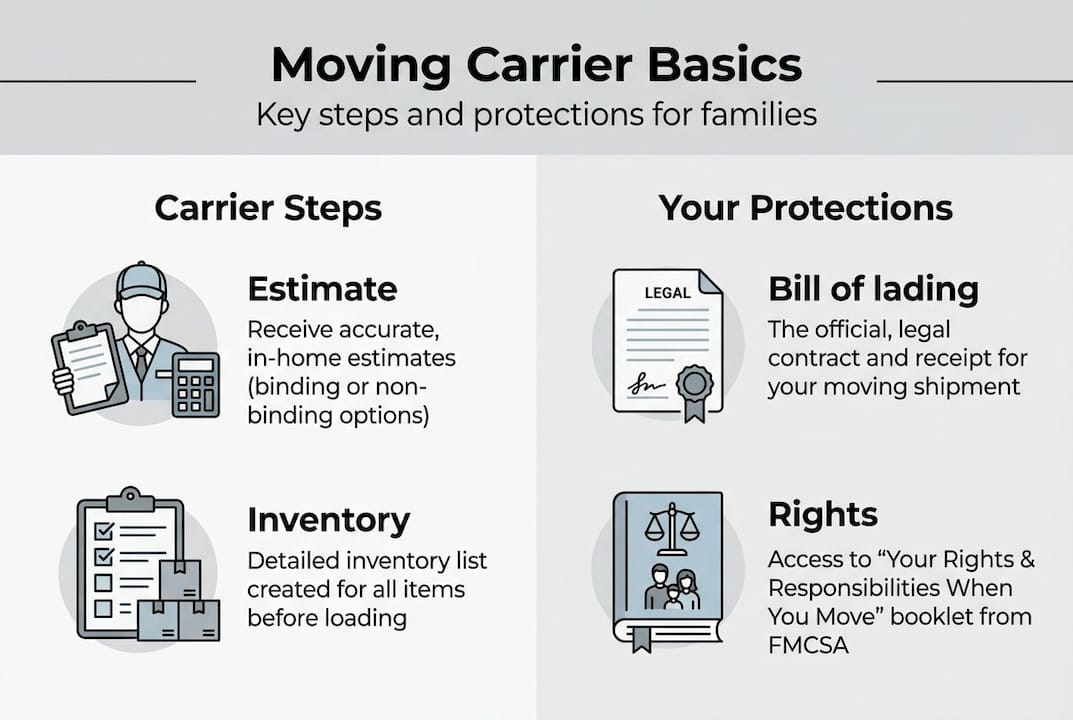
- Federal regulations require carriers to provide written estimates, inventories, and liability options.
- Clear communication and proper documentation are essential for a smooth, risk-free move.
Most families planning a long-distance move assume all moving companies work the same way. They don’t. There’s a critical difference between a moving carrier and a moving broker, and confusing the two can lead to unexpected costs, lost belongings, or zero legal recourse. A moving carrier is the licensed entity that actually handles and transports your possessions. Understanding this distinction before you sign anything is one of the most important steps you can take for a smooth relocation. This guide walks you through what moving carriers are, how they operate, what your rights look like, and exactly how to evaluate your options before committing to a provider.
Table of Contents
- Defining a moving carrier: Roles and responsibilities
- Understanding the moving carrier process: Step-by-step guide
- Comparing moving carriers: What matters and how to decide
- What to expect: Costs, protections, and your rights with moving carriers
- What most guides miss about moving carriers
- Next steps: Work with a trusted moving carrier
- Frequently asked questions
Key Takeaways
| Point | Details |
|---|---|
| Moving carrier definition | A moving carrier is the company directly responsible for transporting your belongings during long-distance moves. |
| Regulatory protections | Federal law requires moving carriers to provide clear estimates, inventory lists, and liability options to protect your items. |
| Cost and comparison basics | Compare carriers based on estimates, protections, and reviews to select the most reliable service for your needs. |
| Consumer rights | You are entitled to written documentation and full disclosure of costs and protections from your chosen moving carrier. |
Defining a moving carrier: Roles and responsibilities
A moving carrier is a company that physically transports your household goods from one location to another. They own or operate the trucks, employ the crew, and are legally responsible for your belongings during transit. This is fundamentally different from a moving broker, who acts as a middleman by selling your job to a carrier without ever touching your items. It’s also different from a general moving company that may only operate locally within a single state.
When you hire a carrier for a long-distance move, you’re entering a federally regulated relationship. That matters more than most people realize. The federal government requires interstate carriers to follow strict rules about how they handle your move from start to finish. Understanding the different moving service types available helps you recognize exactly what a carrier is responsible for and what they are not.
Here’s what a licensed moving carrier is required to do:
- Conduct an inventory survey of your belongings before providing an estimate
- Offer you a choice between a binding estimate (locked price) or a non-binding estimate (subject to adjustment)
- Issue a bill of lading, which is the legal contract for your move
- Provide a written inventory list of every item being transported
- Explain your liability options before you sign anything
- Deliver your goods within the agreed timeframe
The legal backbone for all of this is 49 CFR 375, the federal regulation governing household goods carriers. Under this rule, carriers must provide binding or non-binding estimates based on inventory surveys, issue bills of lading and inventories, and offer liability options including released value or full value protection.
“The difference between a carrier and a broker isn’t just technical. It determines who is legally responsible for your belongings if something goes wrong.”
For families moving across state lines, this distinction is everything. If you hire a broker thinking you’re hiring a carrier, you may have no direct legal relationship with the company that actually moves your furniture. That gap in accountability is where most moving horror stories begin. When you’re planning an international furniture transport or a complex cross-country relocation, knowing exactly who holds responsibility for your goods is non-negotiable.
Carriers also vary in the specialty services they offer. Some focus purely on residential moves, while others handle commercial relocations, storage, or fragile item packing. The size of the carrier doesn’t always predict quality, but their licensing status and federal registration always do.
Understanding the moving carrier process: Step-by-step guide
Now that you know what a moving carrier is, let’s break down exactly how the process works and where your rights and choices come into play.
The moving carrier process follows a clear sequence. Knowing each step in advance removes the anxiety that catches most families off guard.
- Initial contact and inventory survey. You reach out to the carrier, and they schedule an in-home or virtual survey to assess the volume and nature of your belongings. This survey is the foundation for your estimate.
- Written estimate provided. Based on the survey, the carrier gives you either a binding estimate (a firm price that cannot increase) or a non-binding estimate (an approximate price that may change based on actual weight). Per 49 CFR 375, carriers must base estimates on actual inventory surveys, not guesses.
- Liability options explained. You choose between released value protection (free but minimal, covering only $0.60 per pound per item) or full value protection (covers repair or replacement at current market value).
- Bill of lading signed. This is your legal contract. It includes pickup and delivery dates, the agreed price, your liability selection, and the carrier’s contact information. Never let a crew load your belongings without a signed bill of lading in hand.
- Pickup and inventory check. On moving day, the crew loads your items and creates a detailed inventory list. Review this list carefully and note any pre-existing damage before signing.
- Transportation and tracking. Your belongings travel to the destination. Reputable carriers provide tracking or regular updates.
- Delivery and final review. At delivery, compare items against your inventory list. Note any damage immediately on the delivery paperwork before the crew leaves.
For a deeper look at planning your timeline and logistics, the relocation logistics guide covers scheduling and coordination in detail. You should also review federal interstate moving rules to understand your full rights before signing anything.
Using a furniture moving checklist during the packing phase can also help you stay organized and reduce the risk of missing items at delivery.
Pro Tip: The most common red flag families miss is a carrier who refuses to provide a written estimate or asks for a large cash deposit upfront. Legitimate carriers do not require more than a small deposit, and everything must be in writing before your move begins.
Comparing moving carriers: What matters and how to decide
Knowing the process is just the beginning. Making the right choice means knowing how to compare your options carefully.
Not all carriers are equal, even among licensed providers. Here are the key criteria to evaluate before committing:
- Federal licensing. Confirm the carrier has a valid U.S. DOT number and MC number through the FMCSA database. This is non-negotiable for interstate moves.
- Insurance coverage. Ask specifically what liability options they offer and whether they carry cargo insurance beyond the federal minimum.
- Estimate type. Understand whether you’re getting a binding or non-binding estimate and what triggers a price change.
- Written documentation. Every promise, every service, every fee must appear in writing.
- Customer reviews. Look for patterns in reviews, not just star ratings. Consistent complaints about delivery delays or damaged goods are serious warning signs.
- Specialty services. If you have fragile antiques, a piano, or oversized furniture, confirm the carrier has experience handling those items.
Here’s a practical comparison of features to look for when evaluating carriers:
| Feature | What to look for | Red flag |
|---|---|---|
| Licensing | Active DOT and MC numbers | No federal registration |
| Estimate type | Binding or non-binding in writing | Verbal-only estimate |
| Liability options | Released value or full value protection | No liability discussion |
| Inventory process | In-home or virtual survey | Estimate without survey |
| Documentation | Bill of lading before loading | No written contract |
| Customer reviews | Consistent positive patterns | Repeated damage complaints |
| Deposit required | Small or none | Large upfront cash deposit |
As required by 49 CFR 375, carriers must provide binding or non-binding estimates based on inventory surveys and offer proper liability options. If a carrier skips any of these steps, walk away.
For a thorough breakdown of what separates reliable providers from risky ones, the guide on choosing a moving company is a strong resource. If you’re planning a long-haul move, reviewing cross-country moving services will help you understand what a full-service carrier engagement looks like in practice.
A safe moving guide can also help you prepare your items for transport, reducing the risk of damage regardless of which carrier you choose.
Pro Tip: Price should never be your primary filter. A carrier offering a suspiciously low estimate is often planning to add fees later or lacks the insurance coverage to protect your belongings. Get at least three written estimates and compare the full scope of services, not just the bottom line.
What to expect: Costs, protections, and your rights with moving carriers
Once you’ve picked your carrier, it’s vital to understand costs, protections, and your rights to ensure no surprises on moving day.
Moving carrier costs depend on three main factors: the weight of your shipment, the distance traveled, and the services included. Packing, storage, and specialty handling all add to the base rate. Understanding how estimates work protects you from unexpected charges.

Binding vs. non-binding estimates explained:
A binding estimate locks in your price based on the inventory survey. Even if your actual shipment weighs more than estimated, you pay the agreed amount. A non-binding estimate is based on projected weight and can change. Under federal rules, if the actual cost exceeds the non-binding estimate, you are only required to pay 110% of the estimate at delivery. The carrier must bill you for any remaining balance afterward.
| Estimate type | Price locked? | Risk to you | Best for |
|---|---|---|---|
| Binding | Yes | Low | Predictable budgets |
| Non-binding | No | Medium | Flexible timelines |
| Not-to-exceed | Yes (cap) | Very low | Peace of mind |
Liability options side by side:
- Released value protection: Free but covers only $0.60 per pound per item. A 50-pound TV damaged in transit would yield just $30 in compensation.
- Full value protection: Costs extra but covers repair, replacement, or cash settlement at current market value. This is the smarter choice for most families with valuable belongings.
Your rights under 49 CFR 375 include receiving written estimates, a bill of lading, a complete inventory, and a clear explanation of your liability options before your move begins. These aren’t optional courtesies. They are federal requirements.
Research consistently shows that families who opt for full value protection are significantly more likely to recover costs when items are damaged or lost during long-distance moves. The upfront cost of better protection is almost always less than the out-of-pocket replacement cost for even one major item.
For a full breakdown of what you’ll spend on a typical interstate move, the state-to-state moving costs page gives you real numbers by distance and load size. You can also review relocation expenses examples to build a realistic budget before contacting carriers.
Always review your bill of lading line by line before signing. Look for any fees not discussed during the estimate phase, and ask for written clarification on anything unclear.
What most guides miss about moving carriers
Most articles about moving carriers stop at licensing and price comparison. That’s useful, but it misses the single biggest factor in whether your move goes smoothly: communication quality.
We’ve seen moves fall apart not because of bad trucks or unlicensed crews, but because nobody clearly confirmed the delivery window, nobody documented pre-existing furniture damage, and nobody followed up when the timeline shifted. The paperwork exists precisely to prevent these gaps. But paperwork only works when both sides actually read and discuss it.
The families who have the worst experiences tend to be the ones who trusted verbal assurances over written documentation. A friendly sales rep does not equal a reliable carrier. What matters is whether the company’s process forces clarity at every stage: the estimate, the inventory, the bill of lading, and the delivery confirmation.
Another misconception worth addressing is that bigger carriers are automatically safer. Company size does not guarantee careful handling or responsive customer service. A mid-sized carrier with a strong track record and a dedicated moving coordinator often delivers a far better experience than a national brand that treats your move as one of thousands.
The uncomfortable truth is that most moving problems are preventable. They happen when families rush the selection process, skip reading the paperwork, or assume the carrier will handle everything without clear instructions. Slow down, ask questions, and insist on documentation at every step.
Next steps: Work with a trusted moving carrier
You now understand what separates a legitimate moving carrier from a risky one, and you know what to look for at every stage of the process.

AMB Moving & Storage Inc. is a federally licensed interstate moving carrier operating under U.S. DOT: 3839636 and MC: 1395855. We provide transparent written estimates, complete inventory documentation, and full liability options on every move. Whether you’re relocating across two states or coast to coast, our team handles the logistics so you don’t have to. Explore our full-service moving solutions to see exactly what’s included, or start with our relocation planning guide to map out your timeline. When you’re ready to move, book interstate moving with a carrier that puts everything in writing from day one.
Frequently asked questions
What is the difference between a moving carrier and a moving broker?
A moving carrier physically transports your belongings using their own trucks and crew, while a broker arranges moves by connecting you with carriers but never handles your items directly. Carriers are directly responsible for transport under federal regulations, giving you a clear legal relationship in case of damage or loss.
Are moving carriers regulated at the federal level?
Yes, all interstate moving carriers must comply with federal rules that protect your rights and property throughout the move. Carriers must provide estimates and follow consumer protections under 49 CFR 375, including liability disclosures and written documentation requirements.
What legal documents should a moving carrier provide?
You should receive a written estimate, a complete inventory list, a bill of lading, and a clear explanation of your liability options before loading begins. Estimates, bills of lading, and inventories are all required by federal law, not optional.
How do moving carriers calculate costs?
Most carriers base costs on the weight of your shipment, the distance of the move, and any additional services like packing or storage. Binding or non-binding estimates are always based on a proper inventory survey, never on a rough guess over the phone.