
October 29, 2026
Storage Insurance Options for a Long-Distance Move
Compare your storage insurance options: homeowners or renters limits, facility plans, mover liability and fine art coverage, plus how to pick a limit.
You have four main ways to insure items in storage: the off-premises coverage in your homeowners or renters policy, a protection plan sold by the storage facility, a separate policy from an independent insurer, and the liability coverage your mover offers while your goods are in its care. Most people need a mix. Your existing policy usually covers far less than people assume, and a mover’s default liability is lower still. This guide shows what each option covers, what it tends to cost, and how to choose a limit before your goods go into a unit.
It is written for families and homeowners moving across state lines, where belongings often sit in storage for weeks between a closing date and a delivery date.
TL;DR
- Your homeowners or renters policy probably covers stored items, but usually only up to 10% to 20% of your personal-property limit, and flood is not included.
- Storage-facility plans are the simplest add-on. One insurer’s guide puts typical plans around $15 to $30 a month for a standard unit.
- On an interstate move, a mover’s default liability is 60 cents per pound per item unless you choose full value protection.
- Fine art, jewelry, instruments and collections usually need scheduled coverage, not a general limit.
- Build an inventory with photos and values first. The total tells you which option you need.
Table of Contents
- Four ways to insure belongings in storage
- Option 1: your homeowners or renters policy
- Option 2: a storage facility protection plan
- Option 3: a separate or specialty policy
- Option 4: mover liability while goods move and wait
- How to choose a coverage limit
- What we recommend, from our moves
- Insure your move and your storage with AMB
- Common mistakes to avoid
- FAQ
- Sources
Four ways to insure belongings in storage
The right answer depends on who holds the goods, how long they stay, and what they are worth. Here is the full list, then each one in detail.
| Option | Who provides it | Best for | Main weakness |
|---|---|---|---|
| Off-premises coverage in your home or renters policy | Your current insurer | Modest stored value, short stays | Low sub-limit, exclusions |
| Facility protection plan | The storage operator or its insurance partner | Simple, fast, fits a standard unit | Fixed tiers, may not match your inventory |
| Independent storage or inland marine policy | A separate insurer or agent | High-value contents, long stays | More shopping and paperwork |
| Mover liability and valuation coverage | Your moving company | Goods in transit and in the mover’s storage | Default level pays by weight |
Option 1: your homeowners or renters policy
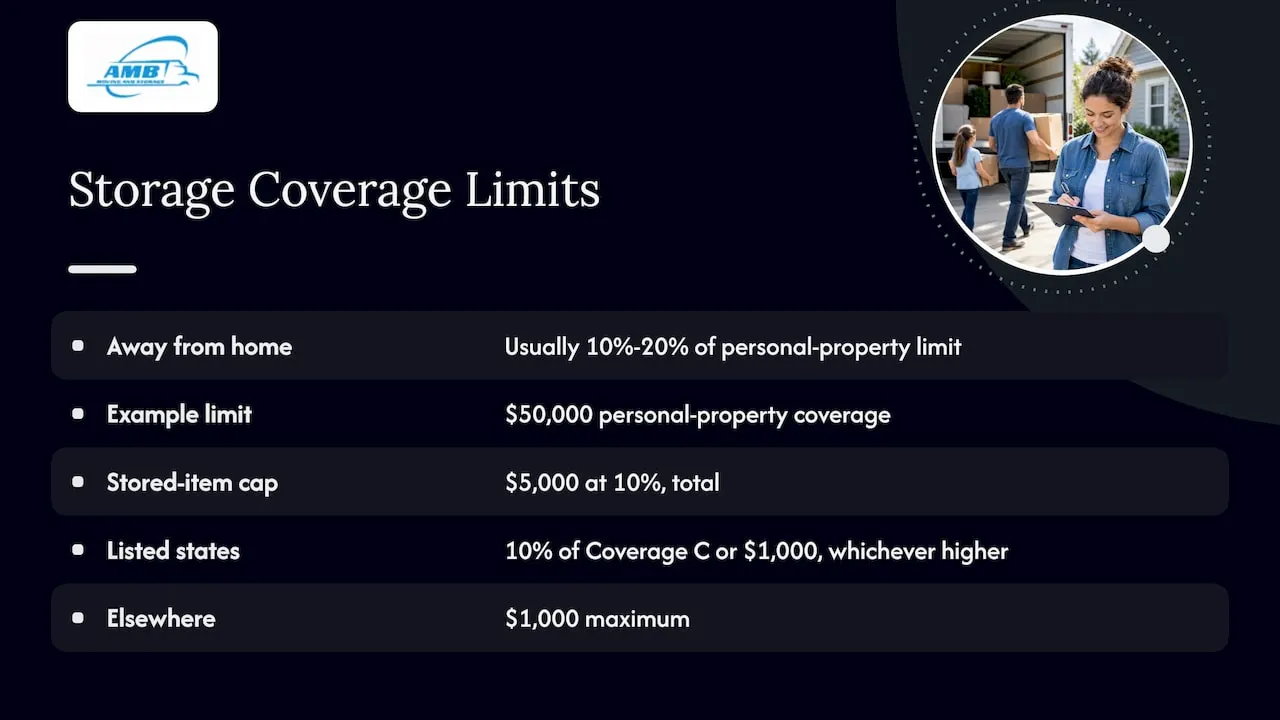
Start here, because you may already be paying for some protection. According to the Texas Department of Insurance, a home or renters policy probably provides some coverage for items kept away from home, usually limited to 10% to 20% of your personal-property limit, and flood damage needs a separate policy.
A worked example makes the cap concrete. Say your renters policy carries $50,000 in personal property coverage. At 10%, the stored items are covered up to $5,000 in total, no matter what you actually put in the unit. A three-bedroom household with furniture, appliances and boxed kitchenware can pass that number easily.
State rules also vary. One insurer reports that in California, New York, Connecticut, Virginia and Florida the storage-unit coverage on its renters policies is 10% of Coverage C or $1,000, whichever is higher, and a $1,000 maximum elsewhere. That is one company’s terms, so treat it as an example of how low the numbers can go and read your own declarations page.
What these policies usually exclude
The Insurance Information Institute notes that standard policies may cover off-premises belongings but typically exclude damage from flooding, earthquakes, mold, mildew, vermin and poor maintenance. Two more gaps matter during a move:
- Vehicles. Renters policies generally exclude motor vehicles and similar items, even when they sit in a storage unit.
- Business items. The same source notes that business-related property often has restricted coverage or total exclusions in storage compared with at home.
Also check whether your policy is still active at the old address. If you cancel it the day you hand over the keys, your stored goods may be uninsured until the new policy starts. Line up the new policy start date before you cancel the old one, and ask your agent in writing whether stored items are covered during the gap.
Option 2: a storage facility protection plan
Most facilities sell tenant protection, and some are licensed to sell insurance, so read the rental contract carefully, as the Texas Department of Insurance advises. Plans are usually sold in tiers: pick a coverage amount, pay a monthly premium, and the charge appears on your rental bill.
Cost depends on the limit you pick. One insurer’s guide says a plan for a typical unit runs around $15 to $30 a month. Local prices differ, so get the actual tier table from the facility.
Before you accept a plan, ask four questions:
- Is this insurance, or a waiver of the facility’s own liability? The two are not the same, and only one pays you for a loss.
- What is the maximum per unit, and are there sub-limits for electronics, furs, jewelry or documents?
- Which causes of loss are excluded, and is there a deductible?
- Is coverage valued at replacement cost or at depreciated value?
GEICO recommends asking about the facility’s insurance requirements before you sign, so you do not pay for duplicate coverage. If the facility requires proof of insurance, your own policy may satisfy it. If it requires its plan, you can still ask whether an existing policy can be accepted instead.
Facility security and condition shape your risk more than most people expect. The III points out that the choice of facility, including security, climate control and maintenance, affects how safe your belongings are. Our guide to which storage security features actually matter lists what to look for, and you can use its questions to ask before you book storage at the walk-through.
Option 3: a separate or specialty policy
When the stored contents are worth more than a facility tier or your home sub-limit allows, ask an independent agent about a dedicated storage policy or an endorsement on your home policy. This route is common when you are storing a whole household for months, or when you are storing business inventory.
For individual items that exceed standard limits, the usual tool is a scheduled personal property endorsement. Typical eligible categories include jewelry, fine art, musical instruments, firearms, collections and antiques. Each item is listed with its appraised value, so coverage is tied to that item rather than to a general cap.
Fine art and other high-value pieces
For art, a general storage plan is rarely the right fit. A better approach has three parts:
- Schedule the piece. Get a current appraisal or documented purchase price and list the work on a scheduled endorsement or a fine art policy, and confirm in writing that coverage applies in transit and in storage, not only at your home.
- Choose the storage environment first. Specialized facilities exist for valuables that need specific temperature and humidity levels, according to the III. Our page on climate controlled storage explains what that protects and when it is worth it.
- Ask the insurer about moving. Some policies cover a piece at its home address and pause during a long-distance move. Ask your agent directly whether the move and the storage period are both included.
If you are moving a safe or a piano, handling and insurance go together. Our moving cost guide lists specialty item handling from $200.
Option 4: mover liability while goods move and wait
If a mover is handling your goods across state lines, its liability is the coverage that applies first, and it is the one people understand least. The FMCSA says that for interstate moves, movers must offer two liability options: full value protection, where the mover is liable for the replacement value of lost or damaged items, or released value protection, where liability is limited to 60 cents per pound per item.
The arithmetic shows why this matters. A 50-pound flat-screen TV valued at $800 under released value is worth 50 × $0.60, which is $30. That is the scenario our guide Avoid a $30 TV Payout walks through. Under full value protection, the mover repairs, replaces or pays the current value of the item, subject to the terms you sign.
How this applies to storage depends on the arrangement:
- Storage-in-transit with the mover. If your goods are held in the mover’s storage between pickup and delivery, ask in writing which valuation level covers them during the stay and whether storage charges and coverage are listed on the same estimate.
- Third-party storage you rent yourself. Mover liability does not follow your goods into a unit you rent on your own. Options 1 to 3 apply.
For a broader overview, see what moving insurance is and how to protect your items and moving insurance for interstate moves.
How to choose a coverage limit
A limit is only useful if it matches what you own. Here is a process that takes an evening.
Step 1: inventory what is going into storage
List each room’s contents, noting brand, age and condition. Photograph or video each item and the sealed boxes. The III recommends adding stored items to your home inventory to check you have the right amount of insurance. Our walkthrough on building a household inventory before your move gives a room-by-room format.
Step 2: put a replacement value on it
Ask what it would cost to buy each thing again today, not what you paid. A used sofa, a mattress, kitchen gear and winter clothing add up faster than expected. Add the items first, then round the total up by a margin for things you forgot.
Step 3: compare the total with each option
| If your stored total is… | Likely fit |
|---|---|
| Below your policy’s off-premises limit | Your existing policy, after confirming exclusions |
| Above it, standard household goods | A facility plan tier, or a higher endorsement |
| Includes art, jewelry, instruments | Scheduled coverage for those items, plus a general plan for the rest |
| Includes a vehicle or business stock | A separate policy built for that purpose |
Step 4: read the exclusions, then decide on the deductible
Flood, earthquake and pests are common gaps. If your unit is in a flood-prone area, a flood policy is a separate purchase. Pick a deductible you could pay without stress, since small claims for scuffs and dents often fall below it.
Step 5: keep the paperwork
Save the inventory, photos, receipts, appraisals and a copy of the policy or plan certificate in cloud storage. Keep a copy of the storage rental agreement with the unit number. After a loss you will need all of these.
What we recommend, from our moves
We plan interstate moves where storage sits in the middle, and the gap we see most often is not a missing policy but a mismatch. People assume their home insurance follows the boxes, then learn the limit is a fraction of what they packed. Others buy the cheapest facility tier and never check it against an inventory.
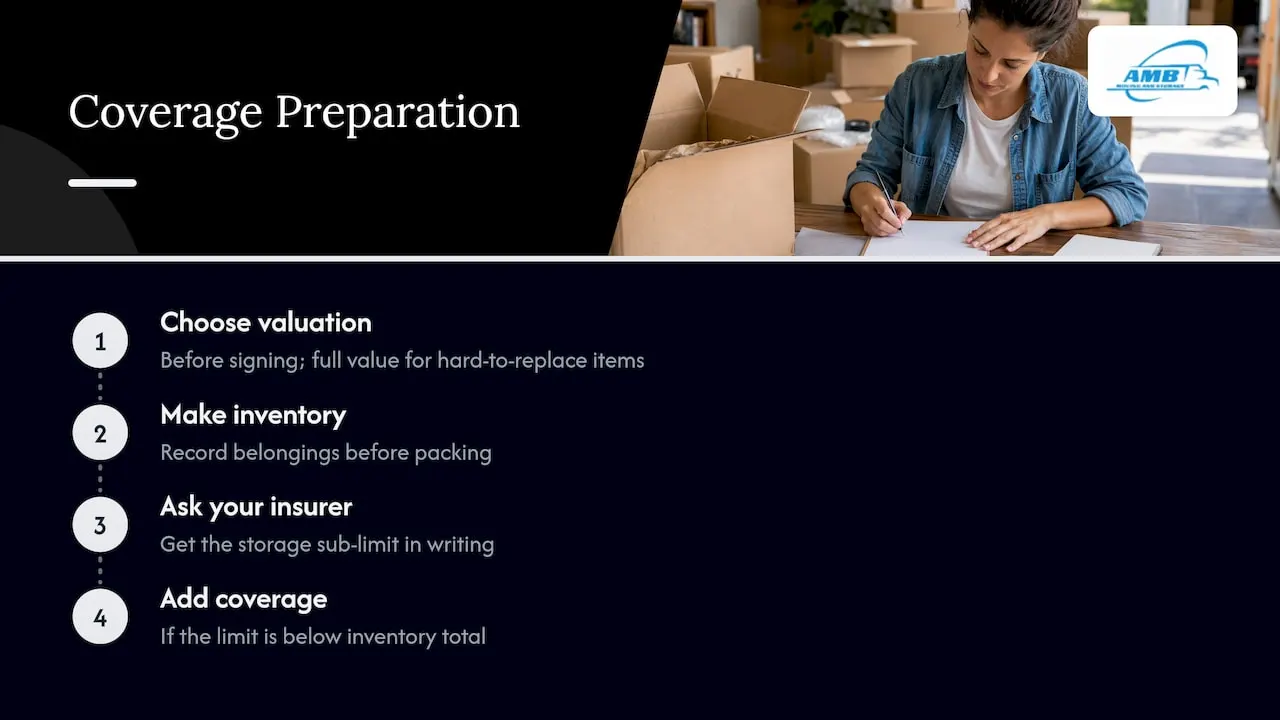
Our advice is simple. Decide your valuation level with the mover before the contract is signed, and pick full value protection for anything you could not easily replace. Take the inventory before packing, not after. Ask your own insurer one specific question in writing: what is the sub-limit for items in storage, and does it apply during an interstate move? If the answer is lower than your inventory total, add coverage before the truck is loaded.
No insurance replaces careful packing. Our professional packing services are priced at $1 to $2 per cubic foot, and good packing is the cheapest way to avoid a claim in the first place.
— AMB
Insure your move and your storage with AMB
AMB Moving & Storage Inc. is a licensed and insured nationwide moving company, and storage is part of how we plan long distance moving. Storage services start from $0.50 per cubic foot, and the details sit in our moving cost guide. Whether you are comparing interstate movers or looking for a cross country mover that can hold your goods between homes, we put valuation and storage terms in writing before you commit.
Tell us your origin, destination and timeline, and we will build moving cost estimates with storage and coverage options listed. Request your free quote. You can also read about our interstate moving and nationwide moving services.
Common mistakes to avoid
- Paying twice. Buying a facility plan while your own policy already satisfies the facility’s requirement, or the reverse. Check the rental agreement and your declarations page side by side.
- Cancelling the old policy too early. A gap between policies can leave stored goods uncovered.
- Assuming the mover’s coverage follows you into a self-rented unit. It does not, so arrange separate coverage for that period.
- Storing items the policy excludes. Vehicles, business stock and some valuables may be excluded or restricted.
- Skipping the photo record. Without proof of what was in the unit, even a valid claim is hard to value.
- Ignoring the unit itself. A dry, secure, well-run unit lowers the chance you ever file a claim. Our storage solutions checklist covers what to confirm before the move.
FAQ
Does homeowners or renters insurance cover items in a storage unit?
Usually in part. Policies typically extend some off-premises coverage, often limited to 10% to 20% of your personal-property limit, and flood is excluded, according to the Texas Department of Insurance. Ask your insurer for the exact stored-property sub-limit on your policy.
How much does storage insurance cost?
It depends on the coverage amount and the provider. One insurer says plans from a storage company for a typical unit cost around $15 to $30 a month. Higher limits and valuable contents cost more, so ask for the full tier table.
Do I need storage insurance if the facility does not require it?
Not legally in most cases, but you carry the risk of loss if you skip it. If your inventory total is higher than your home policy’s stored-property limit, the gap is yours to cover. A short stay with low-value items may be fine on your existing policy.
How do I insure fine art during a move and in storage?
Schedule each piece with its appraised value on a fine art policy or endorsement, and confirm it covers transit and storage. Choose a facility with the temperature and humidity control the work needs. Never rely on a general storage tier for high-value art.
Does my mover’s insurance cover goods in storage?
Only while the goods are in the mover’s care. On interstate moves the default released value protection pays 60 cents per pound per item, while full value protection covers replacement value. Goods in a unit you rent yourself need a separate policy or plan.
Sources
- Do I need insurance for my self-storage unit? (Texas Department of Insurance)
- Self-storage facility coverage and tips (Triple-I)
- Does Renters Insurance Cover Storage Units? (GEICO)
- Does Renters Insurance Cover Storage Units? (Lemonade)
- Does Renters Insurance Cover Storage Units? (Insure.com)
- How do I insure my belongings during a move? (FMCSA)
- What is Scheduled Personal Property Coverage? (The Zebra)