

TL;DR:
- Legally reputable interstate movers must hold active USDOT, MC, and HHG authority numbers.
- Verify credentials via the FMCSA SAFER database to ensure company compliance and safety standards.
- Even accredited companies can underperform; thorough research and clear contracts remain essential.
Not every moving company you find online is legally allowed to carry your belongings across state lines. Many homeowners assume that if a company has a website and a phone number, it must be legitimate. That assumption costs people thousands of dollars every year. Interstate moving companies in the US must register with the FMCSA (Federal Motor Carrier Safety Administration), obtaining a USDOT number and MC number for household goods authority. Without those credentials, a company is operating outside the law, and you have almost no recourse if something goes wrong. This guide walks you through exactly what accreditation means, how to verify it, and how to spot the warning signs before you sign anything.
Table of Contents
- What moving company accreditation really means
- How to verify a moving company’s credentials using FMCSA tools
- Red flags and accreditation pitfalls to avoid
- Making a confident choice: Beyond basic accreditation
- Why focusing on accreditation isn’t enough: Our expert take
- Choose a fully accredited moving partner for peace of mind
- Frequently asked questions
Key Takeaways
| Point | Details |
|---|---|
| Legal accreditation is essential | Only FMCSA-licensed companies with active USDOT and MC numbers can legally move your goods across state lines. |
| Verify with government tools | Always check a mover’s credentials and safety record using the FMCSA’s SAFER database before booking. |
| Watch for red flags | Missing numbers, name mismatches, and hidden brokers are common warning signs of fraud or poor compliance. |
| Go beyond credentials | Review insurance options, pricing transparency, and customer feedback for a truly safe and smooth relocation. |
What moving company accreditation really means
When people talk about a moving company being “accredited,” they often picture a gold star rating or a Better Business Bureau badge. The reality is more specific and more important. For interstate moves, accreditation means a company holds the legal authority to transport household goods across state lines under federal law. That authority comes from the FMCSA, the federal agency that regulates all commercial motor carriers in the United States.
Every legitimate interstate mover must hold three things: an active USDOT (United States Department of Transportation) number, an active MC (Motor Carrier) number, and valid HHG (household goods) authority. The USDOT number is a unique identifier assigned to each carrier. The MC number confirms the company has been granted operating authority for a specific type of freight. The HHG authority is what specifically allows a carrier to move your furniture, appliances, and personal property between states.
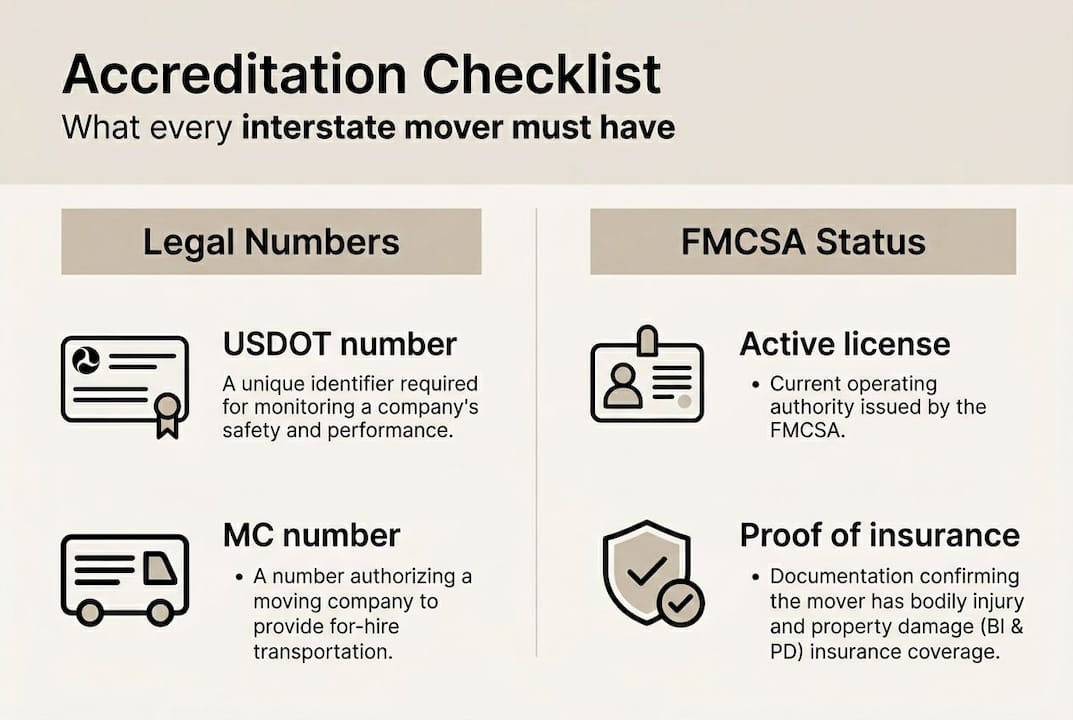
Understanding interstate moving requirements is the first step to protecting yourself. Without all three credentials active and in good standing, a company cannot legally move your household goods across state lines, period.
What happens if you hire a company without proper accreditation? The risks are serious:
- No valid cargo insurance, meaning your belongings have zero protection in transit
- No federal oversight or accountability if the company disappears with your goods
- No legal recourse through FMCSA dispute resolution processes
- Potential for “hostage load” scams where movers demand more money before releasing your items
- No verifiable safety record or inspection history
As the FMCSA puts it plainly: only accredited companies can legally move household goods across state lines.
When choosing a moving company for a long-distance relocation, you should request the following documents before any agreement is signed:
- Written proof of active USDOT number
- Written proof of active MC number with HHG authority
- Certificate of insurance (cargo and liability)
- A copy of the company’s tariff or pricing schedule
- A signed order for service and bill of lading
The FMCSA registration database is publicly accessible, and primary accreditation through FMCSA licensing, meaning active USDOT and MC numbers for HHG, is your baseline. From there, you can use the SAFER (Safety and Fitness Electronic Records) system to dig deeper into safety benchmarks and compare a company’s performance against national averages. Think of accreditation as the entry ticket. What you do after checking the ticket determines whether you actually have a safe ride.
How to verify a moving company’s credentials using FMCSA tools
Knowing what credentials matter is only useful if you know how to look them up. The good news is that the federal government provides free, public tools to check any interstate mover’s standing in minutes. Here is how to do it:
- Ask the mover for their USDOT and MC numbers before any conversation about pricing or dates. A legitimate company will provide these without hesitation.
- Go to the SAFER Company Snapshot at safer.fmcsa.dot.gov. Enter the USDOT or MC number in the search field.
- Check the operating status. The snapshot will show whether the company’s authority is “Active” or “Inactive.” Active is the only acceptable status.
- Confirm household goods authority. Look for “Authorized for HHG” in the authority section. If it says “No” or is blank, they cannot legally move your belongings.
- Review insurance on file. The snapshot lists the insurance carrier and whether coverage is current. No insurance on file is an immediate red flag.
- Check the safety rating. Ratings include “Satisfactory,” “Conditional,” and “Unsatisfactory.” Only Satisfactory is acceptable for a company you trust with your home.
- Compare out-of-service percentages. These numbers show what percentage of vehicles and drivers were pulled off the road during inspections.
The SAFER Company Snapshot is your most powerful verification tool. It pulls real-time data from FMCSA records and gives you a clear picture of a carrier’s compliance history.
Pro Tip: Always compare vehicle and driver out-of-service rates against the national averages. Ideally, you want a mover whose rates fall below those averages, not above them.
Here is a quick reference table for what to look for in the SAFER snapshot:
| Field | What to look for | Acceptable range |
|---|---|---|
| Operating status | Active | Active only |
| HHG authority | Authorized | Yes |
| Insurance on file | Current carrier listed | Must be present |
| Safety rating | Satisfactory | Satisfactory only |
| Vehicle out-of-service rate | Below national average | Under ~22% |
| Driver out-of-service rate | Below national average | Under ~6.7% |
| Carrier vs broker | Carrier or broker disclosed | Carrier preferred; broker must disclose |
One detail many people miss: the company name in the SAFER database must match the name on your contract. If a mover operates under a DBA (doing business as) name, both names should be listed. A mismatch between what you see online and what appears in the federal database is a serious warning sign. Using a nationwide moving checklist that includes credential verification as a step can help you stay organized through this process.

Red flags and accreditation pitfalls to avoid
Verifying credentials is the right move, but knowing what to do when something looks off is just as important. Moving scams are more common than most people realize, and they often target people who are stressed, time-pressured, and trusting.
Here are the most common red flags to watch for:
- Missing or inactive USDOT or MC numbers. Any mover who cannot or will not provide these is operating without authority.
- Company name discrepancies. If the name on your estimate does not match the name in the SAFER database, ask for a clear explanation in writing.
- Undisclosed brokers. Some companies present themselves as carriers but are actually brokers arranging your move with third parties. By law, brokers must disclose their role. If they do not, that is a violation.
- Unusually high complaint counts. The SAFER snapshot includes complaint history. A pattern of unresolved complaints is a strong signal of poor business practices.
- No written estimate or contract. Legitimate movers provide written, binding estimates. Verbal promises mean nothing.
Key statistic: The national vehicle out-of-service average sits around 22%, and the driver out-of-service average is approximately 6.7%, according to FMCSA data. A mover whose numbers are significantly above these averages has a safety problem worth taking seriously.
Common scams follow predictable patterns. The most damaging is the “hostage load” scenario: a mover loads your belongings, then demands a much higher payment before they will unload. Another variation involves fake insurance certificates that look real but are not backed by any actual policy. Some fraudulent companies create websites that mimic legitimate movers, complete with fabricated reviews and copied license numbers.
The questions to ask moving companies before booking can expose these schemes early. Ask directly: “Are you a carrier or a broker?” Ask for a copy of their insurance certificate and call the insurer to confirm it is active.
Pro Tip: Always demand written proof of active authority before you allow any mover to load a single box. If they push back or delay, walk away.
If you experience fraud or noncompliance, file a complaint directly with the FMCSA. The agency investigates interstate moving violations and can take enforcement action. Understanding the difference between a moving carrier and broker is also essential, since brokers and carriers have different legal obligations and different levels of accountability for your shipment.
Making a confident choice: Beyond basic accreditation
Once you have confirmed that a mover holds active credentials and passes the SAFER check, the work is not quite finished. Regulatory compliance tells you a company is legally allowed to operate. It does not tell you whether they will treat your belongings with care, honor their quoted price, or communicate clearly when something changes.
Here is a practical checklist for evaluating a mover beyond the federal database:
- Request a binding or not-to-exceed estimate in writing. This protects you from price hikes after loading.
- Read the contract in full before signing. Look for vague liability clauses or language that limits the mover’s responsibility.
- Ask about insurance options. Basic released-value protection covers only 60 cents per pound per item. Full-value protection is worth the extra cost for high-value goods.
- Check third-party reviews on Google, Yelp, and the BBB. Look for patterns, not just star ratings.
- Confirm the physical address. A company with only a P.O. box or a virtual office is harder to hold accountable.
As a licensed moving company guide makes clear: FMCSA accreditation is foundational, but ongoing safety, insurance coverage, and transparency are what distinguish genuinely trustworthy companies from those who just barely meet the minimum bar.
Here is a side-by-side comparison to help you see the difference:
| Factor | Reputable mover | Barely compliant mover |
|---|---|---|
| Estimate type | Binding or not-to-exceed | Vague or verbal only |
| Contract clarity | Detailed, itemized | Minimal or unclear |
| Insurance options | Full-value available | Released-value only |
| Communication | Proactive updates | Hard to reach |
| Reviews | Consistent, detailed | Sparse or suspicious |
| FMCSA standing | Satisfactory, low OOS rates | Conditional or high OOS rates |
Third-party reviews add real-world context that no database can provide. A company with a Satisfactory rating but dozens of complaints about damaged furniture or missed delivery windows deserves scrutiny. Reviews reveal how a mover behaves when things go wrong, which is ultimately the most important test.
As one principle in the industry holds true: Good movers see government rules as a minimum, not the ceiling. Look for those who go further.
Checking a moving insurance guide before your move can also clarify exactly what coverage you need and how to ask for it. Do not leave that conversation until moving day.
Why focusing on accreditation isn’t enough: Our expert take
After years of working in long-distance relocation, we have seen something that surprises most people: the moves that go badly wrong are rarely caused by unaccredited companies. Most of the real headaches come from accredited movers who cut corners on communication, hide fees in vague contract language, or understaff crews on delivery day.
Accreditation ensures a company has crossed the legal threshold to operate. It does not guarantee they will pick up your call when your delivery is three days late. It does not mean their estimate reflects your actual inventory. And it certainly does not mean they will handle your grandmother’s antique dresser the way you would.
We have seen fully licensed movers produce outcomes that were genuinely awful for customers, not because they lacked a USDOT number, but because their internal processes were disorganized and their pricing was deliberately vague. The customer had done everything right by checking the licensed moving company guide, verified the credentials, and still ended up with a nightmare move.
The lesson: treat accreditation as the floor, not the ceiling. Pair your FMCSA checks with detailed written estimates, clear liability agreements, and direct conversations about how the company handles delays and damage claims. The companies that welcome those conversations are the ones worth trusting.
Choose a fully accredited moving partner for peace of mind
You now have the tools to verify any interstate mover’s credentials, spot red flags before they cost you, and evaluate what separates a truly reliable company from one that just meets the legal minimum. The next step is finding a mover who actually lives up to that standard.
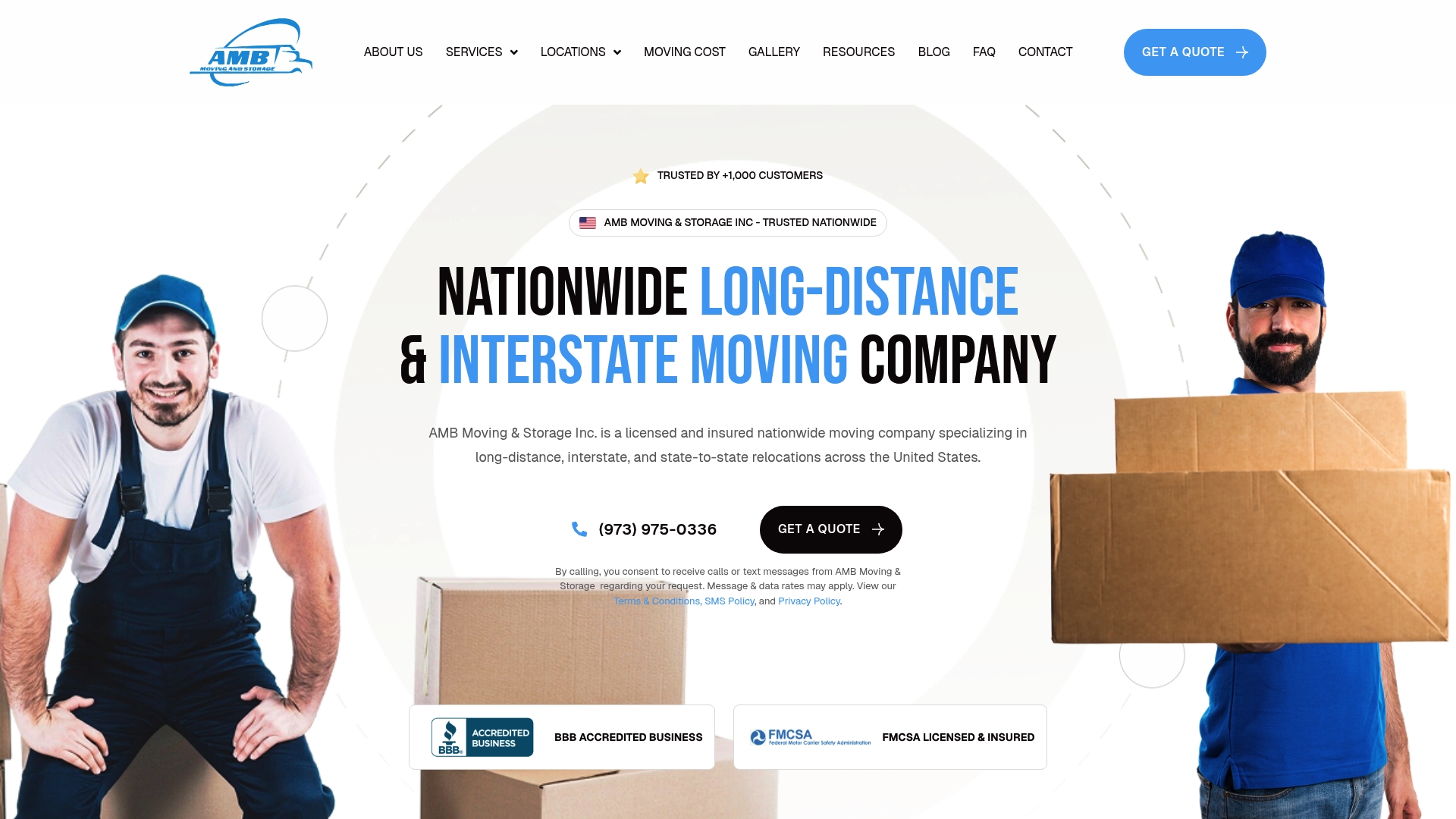
AMB Moving & Storage Inc. is a federally licensed interstate carrier operating under U.S. DOT: 3839636 and MC: 1395855, fully authorized for household goods transport across all states. As trusted interstate moving experts, we provide transparent, no-surprise estimates backed by written documentation from day one. Whether you are choosing the best mover for a family relocation or a commercial move, our team is ready to walk you through every step. You can also review interstate costs explained to understand exactly what your move should cost before committing to anything.
Frequently asked questions
How do I know if a moving company is accredited for interstate moves?
Search for the company’s USDOT and MC numbers on the FMCSA’s SAFER database and verify they are active and authorized for household goods. Any status other than active means the company cannot legally move your belongings between states.
What is the difference between a moving carrier and broker?
A carrier transports your goods directly using their own trucks and crew, while a broker arranges service with third-party carriers and must disclose their broker role by law. Knowing which one you are hiring affects who is legally responsible for your shipment.
What are the warning signs of an unaccredited moving company?
Look out for missing or inactive USDOT and MC numbers, company name mismatches between their website and the FMCSA database, and refusal to provide written documentation. These are clear signals of potential fraud or unlicensed operation.
Can I file a complaint if I suspect fraud by a moving company?
Yes, you can file a complaint directly with the FMCSA if you experience fraud or noncompliance on an interstate move. The agency investigates violations and can take enforcement action against carriers who break federal moving regulations.