


TL;DR:
- Accurate interstate moving quotes require in-home or video surveys and detailed documentation.
- Binding estimates lock in the price and are safer than non-binding or vague quotes.
- Be cautious of red flags like no survey, unverifiable USDOT numbers, or low-ball estimates.
Shopping for an interstate moving quote feels straightforward until you realize most of the numbers you see online are legally non-binding ballpark figures that can change dramatically by moving day. Families planning a cross-country relocation in the next 30 to 60 days are especially vulnerable to surprise charges, low-ball estimates, and even outright moving fraud. This guide walks you through exactly what it takes to secure an accurate, legally sound, and scam-proof moving quote so you can budget with confidence and protect your household goods.
Table of Contents
- What’s required for accurate moving company quotes?
- Step-by-step: How to get and verify your moving company quote
- Common pitfalls and moving scam red flags
- How to compare multiple moving company quotes for an interstate move
- Why law-backed quotes and documented surveys matter more than website calculators
- Get a binding quote and moving support for your next interstate move
- Frequently asked questions
Key Takeaways
| Point | Details |
|---|---|
| Inventory survey required | Federal law mandates an in-home or virtual inspection for any written interstate moving quote. |
| Weight and mileage matter | Long-distance move prices are determined by total shipment weight and the distance, not hourly labor costs. |
| Scam warning signs | Low-ball estimates, large cash deposits, and refusal of surveys are common moving scam red flags. |
| Written quote comparison | Always compare written quotes for equivalent scope, services, and inventory to get the fairest pricing. |
| FMCSA resources available | Use FMCSA’s ‘Protect Your Move’ checklists to navigate paperwork and avoid fraud with interstate movers. |
What’s required for accurate moving company quotes?
Once you understand the challenge, the next step is knowing what actually makes a quote legitimate. A number on a website or a quick phone estimate is not a real quote for interstate moves. Federal regulations draw a clear line between an estimate that’s worth something and one that isn’t.
Binding vs. non-binding estimates: Know the difference
A binding estimate locks in your total price regardless of the actual weight your shipment turns out to be. A non-binding estimate is a prediction. It can increase when the carrier weighs your goods at a certified scale, which happens after your belongings are already on the truck. For most families, the binding estimate is the safer option, even if it costs slightly more upfront.
According to long-distance pricing standards, interstate moving costs are based on shipment weight and mileage, and any online calculator you use is producing a non-binding estimate. That’s not useless information, but it should never be your budget ceiling. You can check our interstate moving cost report for real route data that gives you a sharper starting point.
The federal inspection requirement
Here’s something many families don’t know until it’s too late. Federal law requires that for interstate moves, a moving company must conduct an in-home or live video survey before providing a written binding or non-binding estimate, unless the customer explicitly waives that right in writing. Any company that skips this step and still sends you a written quote is either breaking the law or producing an estimate that has no real accuracy behind it.
You can learn more about what this means for your move in our overview of interstate moving requirements.
Key information movers need to build your quote
Before you schedule anything, gather the following details:
- Inventory list: Room-by-room breakdown of furniture, appliances, and boxes
- Origin and destination addresses: Full zip codes and floor access details
- Move date or target date range: Specific date or a two-week window
- Special items: Pianos, safes, gun cabinets, antiques, or fragile artwork
- Storage needs: Whether you’ll need short or long-term storage between moves
- Packing services: Full-pack, partial-pack, or self-pack
Pro Tip: Take a video walkthrough of your entire home before scheduling your survey. Sharing it with the moving coordinator in advance means the in-home or video survey goes faster and more accurately.
| Information type | Why movers need it | Impact on price |
|---|---|---|
| Inventory volume | Determines estimated weight | High |
| Shipment weight | Primary pricing variable | Very high |
| Mileage | Second primary variable | Very high |
| Access conditions | Affects labor time | Medium |
| Special items | Require special handling | Medium to high |
| Packing level | Adds materials and labor | Medium |
Our in-home estimates guide breaks down how the inspection process works and how to make the most of it.
Step-by-step: How to get and verify your moving company quote
With requirements clarified, here’s how to actually secure your quote step by step.
Step 1: Build your inventory before calling anyone
Go room by room and document every large item and every box you expect to move. Be specific. “Living room stuff” is useless. “1 sectional sofa, 2 end tables, 65-inch TV, entertainment center” is useful. The more precise your list, the more accurately a mover can assess your shipment weight before the physical survey.
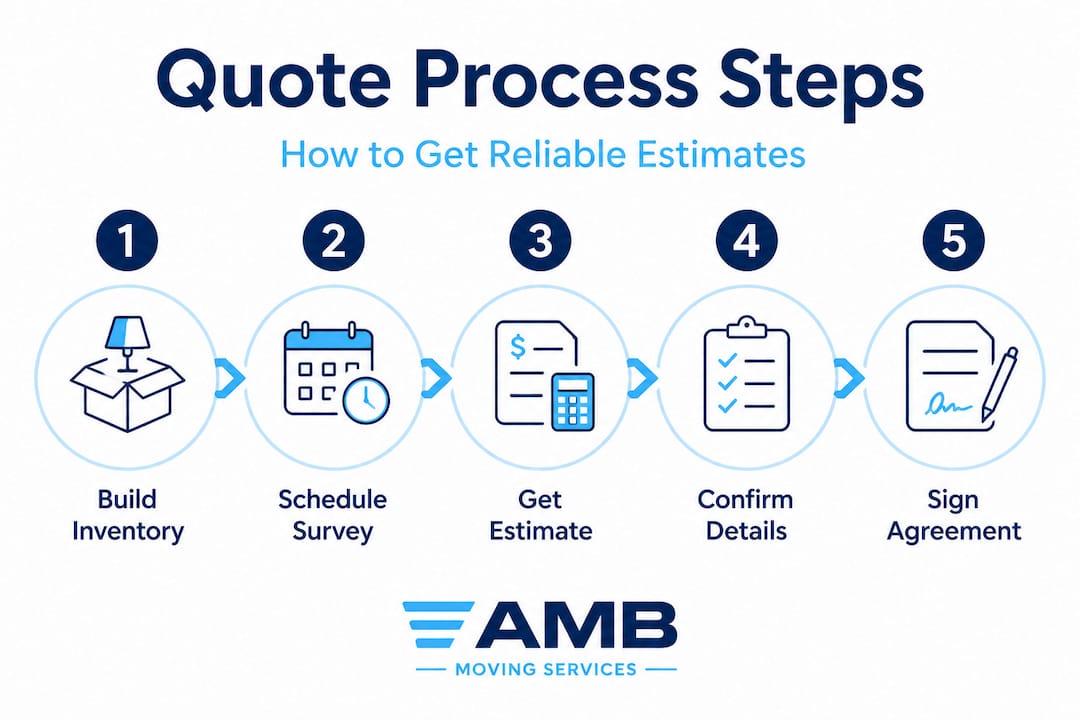
Step 2: Schedule your in-home or live video survey
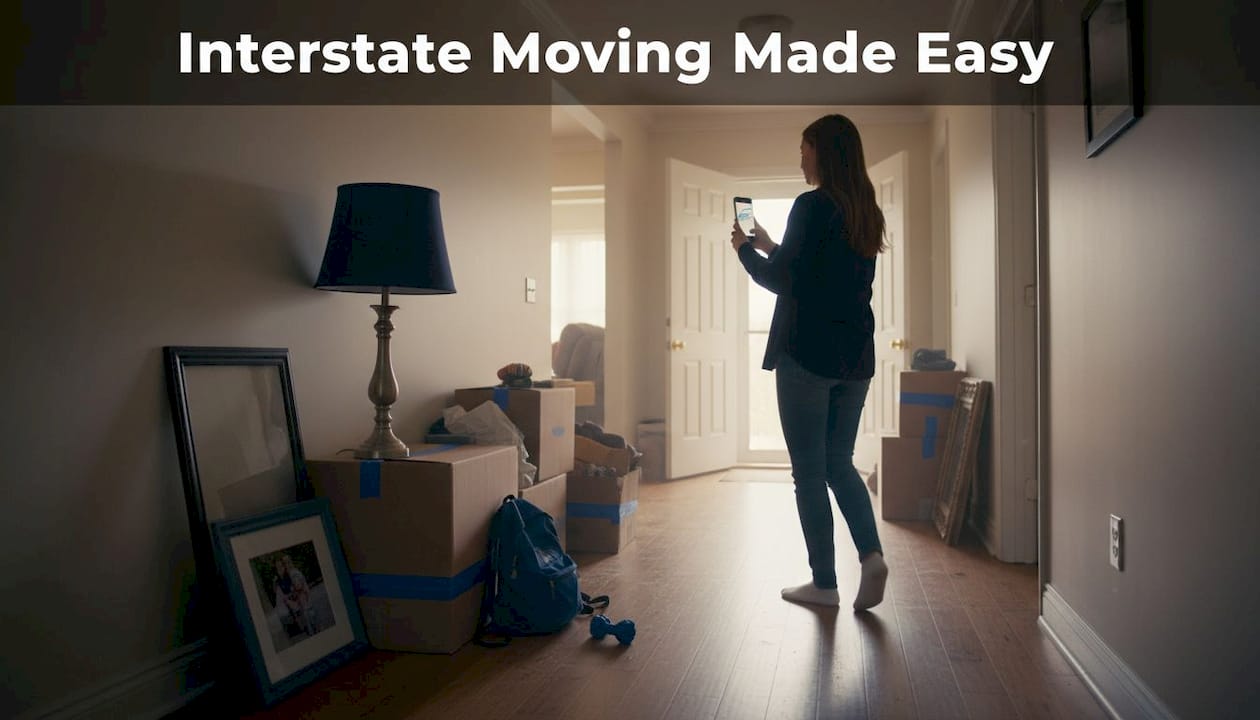
Federal regulations require that any written estimate for an interstate move be backed by either a physical on-site inspection or a live video survey, unless you waive that in writing. Schedule surveys with at least three companies. During the survey, walk the representative through everything, including your attic, garage, and basement. Don’t minimize your inventory to get a lower quote. That backfires badly when the actual weight comes in higher.
Step 3: Review the written estimate carefully
Every legitimate interstate mover must provide a written estimate. Read it line by line. Look for:
- Estimated weight of your shipment in pounds
- The mileage used for the calculation
- Origin and destination charges listed separately
- Packing materials and service fees itemized
- Fuel surcharges and any accessorial charges
- Whether the quote is binding, non-binding, or “binding not-to-exceed”
Step 4: Check the quote structure and legal disclosures
Reputable movers are legally required to provide you with a copy of “Your Rights and Responsibilities When You Move,” a federal booklet that outlines your protections. If a company skips this, treat it as a warning sign. Our step-by-step interstate guide walks you through every document you should receive before signing anything.
A legitimate written estimate always includes the carrier’s USDOT number, the estimated delivery window, and a clear breakdown of all charges. If any of these are missing, ask directly, and if the company deflects, walk away.
Step 5: Verify before you commit
Before signing, cross-check the estimate against what was discussed during your survey. If numbers shifted without explanation, ask for a written reason. Use our prevent surprise costs resource to understand which charges are normal and which are red flags.
| Quote type | Price guaranteed? | Risk level | Best for |
|---|---|---|---|
| Binding | Yes | Low | Budget-sensitive families |
| Non-binding | No | Medium to high | Light, predictable loads |
| Binding not-to-exceed | Yes, with savings upside | Very low | Most recommended option |
Common pitfalls and moving scam red flags
Even with quote requirements met, moving scams and quote games are all too common. Here’s what to look out for.
Moving fraud is not rare. The Federal Motor Carrier Safety Administration (FMCSA) documents thousands of complaints every year involving movers who exploit the quote process to trap families. Understanding the patterns is the single best way to protect yourself.
The low-ball estimate trap
A company sends you an estimate that’s $1,500 to $2,000 lower than every other quote you received. You assume they’re the best deal. What often happens instead is that the mover deliberately underestimates your shipment weight, loads your belongings, then presents a dramatically higher bill on delivery day, holding your items until you pay. This is called a “hostage load.”
Common moving scam patterns include deliberately low-ball estimates, refusal to conduct in-home or video surveys for large moves, large upfront cash deposits, fake or unverifiable USDOT numbers, and a complete lack of written documentation. Each of these, individually or combined, is a serious warning signal.
Key red flags to watch for:
- No in-home or video survey offered: If a mover gives you a written estimate without ever seeing your belongings, the number is fabricated
- Cash-only deposits: Legitimate movers don’t require large cash deposits before your move date
- No physical address: If the company can’t provide a verified street address, that’s a problem
- USDOT number is missing or unverifiable: Every interstate mover must be registered with the FMCSA. You can verify their USDOT number directly on the FMCSA website
- Unmarked trucks on moving day: A professional company uses branded vehicles and uniformed staff
- Verbal-only agreements: If they resist putting anything in writing, every verbal promise is worthless
Our resource on how to choose interstate movers covers the vetting process in detail, including exactly how to look up a mover’s registration status.
What the numbers say
Moving fraud cost American consumers an estimated $300 to $400 per incident on average in additional charges, but the real cost often runs into thousands when families face hostage-load situations. You can file a complaint directly through the FMCSA’s complaint portal if you become a victim, but prevention is far less painful than recovery. Our breakdown of interstate moving costs and insights also shows you what realistic pricing looks like for major routes in 2026, so you have a reference point before entering any negotiation.
If a quote feels too good to be true, it almost certainly is. A legitimate binding estimate for a 3-bedroom home moving 1,000 miles rarely comes in below $4,000 to $6,000. Use realistic benchmarks, not wishful thinking, to evaluate your options.
How to compare multiple moving company quotes for an interstate move
When you’ve gathered multiple quotes, here’s how to compare them apples-to-apples.
Getting at least three quotes is the standard recommendation, but collecting three quotes doesn’t help you if you don’t know how to compare them correctly. Many families make the mistake of lining up the bottom-line totals and picking the lowest. That approach ignores the structure of each quote and sets you up for surprises.
Match the scope before comparing prices
Accurate quote comparison requires that you verify each estimate covers the same services, including packing level, special item handling, the same inventory list, and an explicit written pricing breakdown. Quote structure, whether binding or non-binding, should also be confirmed in writing. If one quote includes full packing and another assumes you’ll pack yourself, comparing their prices tells you nothing useful.
Use this checklist before placing quotes side by side:
- Are the estimated weights within a reasonable range of each other? Large discrepancies signal that one company may be underestimating deliberately.
- Do all quotes cover the same origin and destination access conditions?
- Are packing services included, excluded, or optional in each?
- Is specialty item handling (piano, artwork, safe) included or added as a separate charge?
- Are fuel surcharges and insurance levels explicitly stated?
| Comparison factor | Company A | Company B | Company C |
|---|---|---|---|
| Estimated weight (lbs) | 6,200 | 5,800 | 6,400 |
| Quote type | Binding | Non-binding | Binding not-to-exceed |
| Packing included | Partial | None | Full |
| Fuel surcharge | Included | 8% added | Included |
| Specialty item fee | $250 | Not listed | $300 |
| Total quoted | $5,800 | $4,900 | $6,400 |
Looking at this table, Company B’s quote appears cheapest. But it’s non-binding, excludes packing, doesn’t list a specialty item fee, and adds an 8% fuel surcharge. The real cost could be $2,000 or more above the stated total. Company C, while highest upfront, carries the least financial risk.
Pro Tip: Ask every mover to quote the exact same inventory list. Email your itemized list to all three companies before the survey so each representative works from the same starting point.
Watch for vague line items
Look out for charges labeled “miscellaneous,” “administrative fees,” or “fuel and logistics” with no dollar amount attached. A legitimate binding estimate accounts for every known charge upfront. Vague descriptions are how surprise charges appear on delivery day. Our overview of relocation expense examples helps you understand what each line item should and shouldn’t include.
Why law-backed quotes and documented surveys matter more than website calculators
Here’s a perspective most moving guides skip entirely. The moving industry has a problem that doesn’t get discussed enough: the gap between the quote a family receives and the price they actually pay is almost always caused by skipping the documentation steps that federal law requires. That’s not an accident. It’s a business model for bad actors.
Families understandably want the process to be fast and simple. They fill out an online calculator, get a number, and feel like they’ve done their research. But FMCSA consumer protection resources, including their “Protect Your Move” program, point specifically to required booklet delivery and documented checklists as the tools that separate professional movers from fraudulent ones. Most families never receive the required booklet. Most never ask for it.
The documented survey is not bureaucratic paperwork. It is the mechanism by which you establish a legally defensible record of what was agreed to. If your mover claims your shipment weighed more than estimated, and you have a documented survey conducted by a licensed carrier, you have leverage. Without it, you have nothing.
We’ve built our interstate moving consumer protections resource and our protect your move guide specifically because too many families arrive at moving day without understanding that law-backed documentation is their best financial protection. Online calculators are useful for budgeting conversations. They are not contracts, and they were never meant to be.
The best thing you can do before signing anything is to treat the quote process as a legal transaction, not a sales conversation. Request everything in writing. Verify every license. And choose a mover who welcomes that scrutiny rather than deflecting it.
Get a binding quote and moving support for your next interstate move
If you’ve made it through this guide, you already know more about interstate moving quotes than most families who’ve already completed their moves. Putting that knowledge to work means partnering with a mover who operates within the legal framework and delivers transparent, written documentation every step of the way.
At AMB Moving & Storage Inc., our long distance moving services are built around exactly the kind of binding, survey-backed estimates this guide describes. Our team handles the inspection, the documentation, and the communication so you’re never left guessing about what you agreed to or what you’ll owe. Whether you’re moving across two states or coast to coast, our interstate moving expertise covers every detail of a compliant, professional relocation. When you’re ready to get a real number you can plan around, request your moving quote and a coordinator will walk you through the entire process.
Frequently asked questions
How are interstate moving quotes calculated?
Interstate moving prices are based on shipment weight and mileage between your origin and destination, not hourly rates like local moves use.
Do I have to schedule an in-home or video inspection to get a written quote?
Yes. Federal law requires an in-home or virtual survey before a mover can issue a written estimate for an interstate move, unless you waive that requirement in writing.
What are the signs of a moving scam?
Watch for deliberate low-ball estimates, refusal to conduct a survey, demands for large cash deposits, missing or unverifiable USDOT numbers, and any company that avoids written documentation.
What’s the difference between a binding and non-binding quote?
A binding quote guarantees your price in writing regardless of final weight, while a non-binding quote can increase after your shipment is weighed on delivery day.