


TL;DR:
- An interstate move crosses a state line and falls under federal FMCSA regulations, while local moves stay within one state.
- Federal rules for interstate moves include written estimates, valuation options, and documentation, regardless of distance.
An interstate move crosses a state line and falls under federal FMCSA rules; a local move stays inside one state and is regulated at the state or local level. That single distinction changes how you’re charged, what insurance you’re entitled to, and how long delivery takes.
TL;DR: Here’s what shifts the moment your move crosses a state border:
- Pricing model: Local moves bill hourly; interstate moves charge by shipment weight and distance.
- Regulation: Interstate movers need a USDOT number and MC number; local movers answer to state agencies.
- Valuation: Federal law requires interstate carriers to offer Released Value and Full Value Protection; local moves follow state defaults.
- Timeline: Local moves typically finish in a single day; interstate moves involve multi-day transit windows.
- Documentation: Interstate moves require a written estimate, bill of lading, and certified weight tickets.
The first thing to check: does your move cross a state line? If yes, you’re in interstate territory regardless of how short the drive looks on a map.
Table of Contents
- What counts as a local, intrastate, or interstate move?
- How pricing works: hourly local rates vs. interstate weight-and-distance tariffs
- What regulations govern your mover, and how do you verify them?
- What does your moving insurance actually cover?
- How do pickup, transit, and delivery timelines compare?
- How far ahead should you book, and what paperwork do you need?
- How to hire a mover and the red flags that should stop you cold
- How Ambmovingservices handles local vs. interstate moves
- Key Takeaways
- Why licensed nationwide movers are worth it for interstate moves
- Planning an interstate move? Here’s how Ambmovingservices can help
- Official references and further reading
What counts as a local, intrastate, or interstate move?
The moving industry draws a hard line between these categories, and mileage is not the deciding factor.
Interstate move: FMCSA defines an interstate move as any transportation of household goods between a place in one state and a place in another state, or between two points in the same state if the shipment passes through another state. The moving truck does not have to physically cross the state line. If the goods do, or if the move originates outside the state, federal rules apply.

Intrastate move: This is a move that starts and ends within the same state without passing through another state. Intrastate moves are regulated by state agencies, not the FMCSA. Rules vary considerably. Some states require movers to register with a Public Utilities Commission (PUC) or state DOT; others have their own tariff schedules or consumer protection boards.
Local move: Most states define a local move as an intrastate move under a certain mileage threshold, commonly 50–100 miles depending on the state. Local moves are almost always billed hourly. Some states set maximum hourly rates or minimum charge periods.
The edge case that trips people up: a 30-mile move from a suburb of Kansas City, Missouri to a suburb of Kansas City, Kansas is an interstate move. Full federal requirements apply, including written estimates and valuation options. Distance means nothing here.
Key insight: FMCSA guidance frames interstate status by the “essential character” of the movement and the shipper’s intent at the time of shipment. A short cross-border move triggers the full federal rulebook just as a cross-country move does.
Pro Tip: Ask any mover you’re considering for their USDOT number and MC number before discussing price. If they’re handling interstate moves without both, walk away. You can verify registration in minutes at FMCSA SAFER.
For a deeper breakdown of state-to-state moving costs and rules, including how classification affects your contract, that resource covers the nuances well.
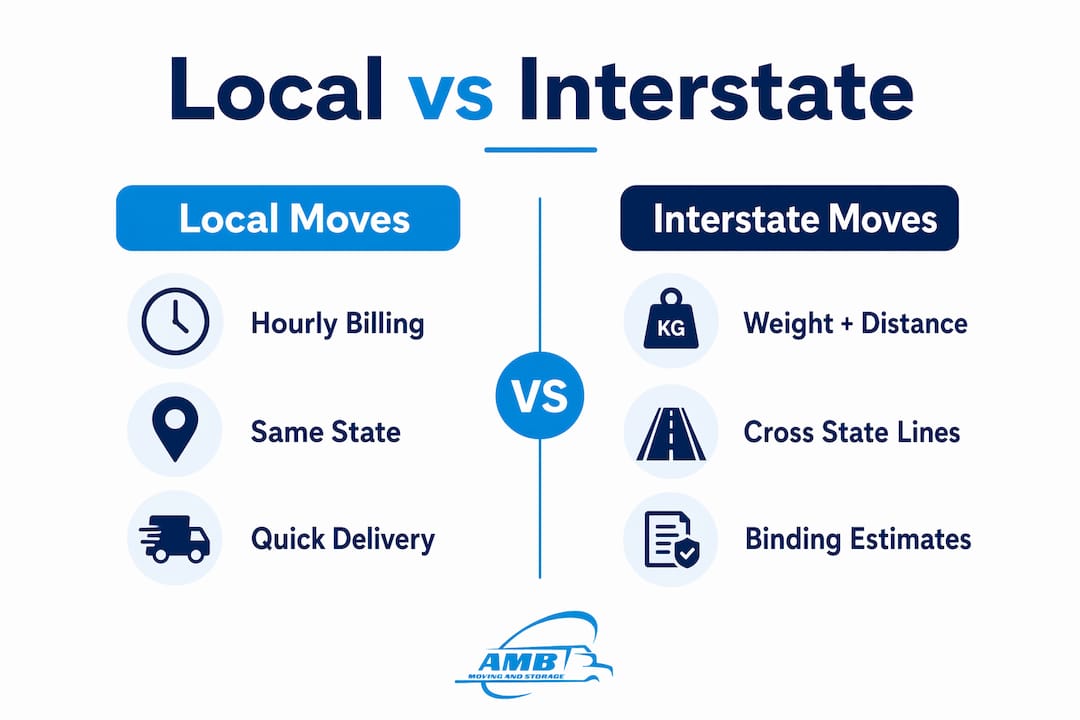
How pricing works: hourly local rates vs. interstate weight-and-distance tariffs
The pricing structures for local and interstate moves are fundamentally different, and understanding which one applies to you changes how you read an estimate.

Local and intrastate: hourly billing
Local moves are billed by crew size multiplied by hours worked, plus materials. A two-person crew for a one-bedroom apartment typically works a few hours, with a minimum charge often applied. Most companies charge a minimum of two to three hours, and materials (boxes, tape, moving blankets) are typically itemized separately. Accessorial charges, such as stair carries, long walks from truck to door, or disassembly of furniture, are added on top.
Interstate: weight and distance
Interstate rates apply per pound across distance bands, calculated against published tariff schedules. The carrier weighs your shipment on certified scales at origin, and sometimes again at destination. Fuel surcharges, packing labor, and accessorials are added to the base rate. This is why two moves of similar distance can cost very differently: a household with heavy furniture pays more per mile than one with mostly clothing and books.
Typical cost ranges by move type
| Move scenario | Distance | Estimated cost range |
|---|---|---|
| 1-bedroom apartment, local | Under 50 miles | — |
| 2–3 bedroom home, local | Under 100 miles | — |
Interstate figures are tariff-based estimates and vary by carrier, declared weight, and accessorials.
Common accessorial charges that affect both move types
- Packing services: Full or partial packing billed per box or per hour
- Stair carries: Per-flight fees when elevators aren’t available
- Long carry: Charged when the truck can’t park within a standard distance of the entrance
- Appliance servicing: Disconnecting/reconnecting washers, dryers, or refrigerators
- Storage-in-transit: Daily or monthly rates if delivery is delayed
- Shuttle service: When a large moving truck can’t access your street, a smaller vehicle is used at extra cost
For a detailed look at long-distance moving costs by route and home size, Ambmovingservices publishes route-based cost data that’s worth reviewing before you request estimates.
What regulations govern your mover, and how do you verify them?
This is where the differences between local and interstate moving matter most from a consumer protection standpoint.
Federal rules for interstate movers
FMCSA regulations require every interstate household goods carrier to hold a USDOT number and an MC (motor carrier) number. By federal law, interstate movers must provide a written estimate and offer two valuation options before the move. They must issue a bill of lading, which is your legal contract and receipt. They’re also required to offer arbitration for unresolved disputes over loss or damage.
Moving brokers, who book your move and sell it to a carrier, are not movers. They don’t own trucks or employ crews. Always confirm whether the company you’re speaking with is the actual carrier or a broker, and get the carrier’s USDOT number before signing anything.
State-level oversight for local and intrastate movers
Intrastate movers are regulated locally, and the rules vary significantly by state. Some states require movers to register with a PUC or state DOT and carry a state-issued permit. Others have consumer protection boards that set maximum rates or handle complaints. A few states have minimal oversight. This inconsistency is why checking your specific state’s requirements matters.
Consumer protection note: For interstate moves, federal law requires carriers to provide written estimates and offer specified valuation options. For local moves, those protections depend entirely on your state. Don’t assume the same rules apply.
Verification checklist before you book
- Confirm USDOT and MC numbers via FMCSA SAFER (interstate movers only)
- Check state PUC or DOT registration for intrastate/local movers
- Request a written estimate before any deposit changes hands
- Ask for proof of cargo insurance and liability coverage
- Confirm the company uses its own crews and trucks, not subcontracted labor
- Get a written bill of lading before the truck is loaded
Pro Tip: Never pay a large deposit before you have a written estimate and have verified the mover’s registration. For interstate moves, the FMCSA’s federal regulations guide explains exactly what documentation you’re entitled to before the move begins.
What does your moving insurance actually cover?
Most people assume their belongings are fully covered during a move. They’re usually not, and the gap between assumption and reality is widest on interstate moves.
Released Value Protection
Released Value is the default coverage on interstate moves. It costs nothing extra, but it pays only $0.60 per pound per item for any loss or damage. Federal law requires interstate carriers to offer this option, but it’s rarely adequate for anything of real value.
Full Value Protection
Full Value Protection requires the carrier to repair, replace, or pay the current market value of any item lost or damaged during the move. This coverage usually costs about one percent of the declared value of your shipment. For most households with furniture, electronics, and appliances, that cost is worth it. Industry advisors consistently recommend Full Value Protection or a third-party policy for interstate shipments with high-value items.
Local and intrastate valuation
Local moves follow state-level valuation defaults, which may or may not mirror the federal Released Value standard. Some states set their own minimums; others leave it to the carrier’s contract. Always ask your local mover what their default coverage is and whether Full Value Protection is available. If it isn’t, a third-party moving insurance policy fills that gap.
For a full explanation of interstate moving insurance options, including how to file a claim, that resource walks through the process step by step.
Claims checklist
- Photograph all items before loading, especially high-value pieces
- Keep a written inventory with estimated values for each item
- Note any pre-existing damage on the bill of lading before signing
- Retain all weight tickets (required for interstate claims)
- File your claim in writing within the timeframe stated in your contract
- Follow the mover’s written claim procedure exactly; deviating from it can void your claim
How do pickup, transit, and delivery timelines compare?
Local moves are operationally simple: the crew arrives, loads, drives, and unloads, usually within a single day. You know exactly when your belongings will arrive because you’re watching the truck.
Interstate moves work differently. Shipments are weighed on certified scales at origin, sometimes at destination, and then scheduled into line-haul runs that may consolidate multiple customers’ shipments. That process adds time. Delivery windows on interstate moves are typically stated as a range of dates, not a single day.
Typical timeline by move distance
| Move type | Distance | Typical transit time |
|---|---|---|
| Local | Under 100 miles | Same day |
| Regional interstate | — | 1–3 days |
| Mid-distance interstate | — | 3 days |
| Cross-country | 1,500–— | — |
Transit times vary by carrier, season, and whether your shipment is consolidated with others.
- Peak season (May–September): Delivery windows widen; book earlier and expect the outer edge of the window.
- Off-peak (October–April): Faster transit is more common, and pricing is often lower.
- Exclusive use of vehicle: Paying for a dedicated truck shortens delivery windows significantly but raises cost.
Pro Tip: Pack a “first-night box” with essentials (medications, chargers, a change of clothes, basic toiletries) that travels with you, not on the truck. On interstate moves, your delivery window is a range, not a guarantee. Assume the later date and plan accordingly.
How far ahead should you book, and what paperwork do you need?
Booking timelines differ sharply between move types, and waiting too long on an interstate move is one of the most common planning mistakes.
Recommended booking windows:
- Local moves: 2–4 weeks is usually enough, though summer weekends book fast.
- Interstate moves: 4–8 weeks minimum; 10–12 weeks for peak season (June–August) or cross-country routes.
What movers will ask for
- Complete inventory of items being moved (room by room)
- Pickup and delivery addresses, including floor levels
- Elevator availability and stair counts at both locations
- Parking access for a large moving truck at both ends
- Any shuttle or long-carry constraints
- Preferred pickup and delivery date ranges
- Declared value of the shipment (for interstate valuation)
Binding vs. non-binding vs. binding not-to-exceed estimates
A non-binding estimate is a good-faith quote; the final bill can be higher or lower based on actual weight. A binding estimate locks in the price regardless of actual weight. A binding not-to-exceed estimate caps your cost at the quoted price but lets you pay less if the actual weight comes in lower. For interstate moves, binding not-to-exceed estimates are the strongest consumer protection available. Always request one.
Booking checklist
- Request an in-home or video survey so the estimate is based on your actual inventory
- Get the written estimate before paying any deposit
- Confirm the mover’s USDOT/MC number and verify on FMCSA SAFER
- Pay only a reasonable deposit, avoiding excessive upfront payments to reputable carriers.
- Finalize your inventory list and confirm it with the mover at least one week before pickup
How to hire a mover and the red flags that should stop you cold
Hiring the wrong mover is a costly mistake that’s entirely avoidable with the right questions.
Key questions to ask every mover
- Are you licensed for interstate moves? What is your USDOT and MC number?
- Do you use your own crews and trucks, or do you subcontract?
- How do you charge: hourly or by weight and distance?
- What valuation options do you offer, and what does Full Value Protection cost for my shipment?
- Will you provide a binding not-to-exceed estimate?
- What is your claims process for lost or damaged items?
Verification steps
- Look up the USDOT number on FMCSA SAFER to confirm active registration and insurance
- Check your state’s PUC or DOT website for intrastate mover registration
- Search the company name on the FMCSA complaint database
- Request a written contract and review it before signing
- Confirm the bill of lading will be provided before loading begins
Red flags that signal a problem
- Large upfront cash-only deposits before the move
- A flat-rate quote given without a physical or video survey of your belongings
- No written estimate or refusal to provide one
- Inability or unwillingness to provide a USDOT/MC number
- Vague answers about who actually performs the move (broker vs. carrier)
- Unusually low quotes that seem too good relative to other estimates
A sample script for your first call: “Can you give me your USDOT number? I’d like to verify your registration before we go further. And will you be performing this move with your own crews and trucks?” A legitimate mover answers both questions without hesitation.
How Ambmovingservices handles local vs. interstate moves
Ambmovingservices operates as a licensed nationwide moving company, and the operational differences between local and interstate jobs are built into how every move is quoted, documented, and executed.
For interstate moves, Ambmovingservices provides binding not-to-exceed estimates based on a detailed inventory survey. Shipments are weighed on certified scales, and customers receive a full bill of lading before loading begins. Valuation options, including Full Value Protection, are presented in writing before any contract is signed.
For local and shorter intrastate jobs, hourly quotes are based on crew size and estimated job duration, with accessorials itemized upfront so there are no surprises on the final bill.
Trust signals Ambmovingservices brings to every interstate move:
- Active USDOT and MC registration, verifiable on FMCSA SAFER
- Proof of cargo and liability insurance provided on request
- Binding not-to-exceed estimates for interstate shipments
- Full Value Protection options presented in writing
- Packing, crating, and specialty handling for fragile or high-value items
- Secure short- and long-term storage for shipments requiring staging
- Specialty move experience: senior relocations, student moves, military and government transfers
Delivery windows for interstate jobs are communicated at booking and updated as the shipment moves through routing. Accessorial charges (shuttle service, long carry, storage-in-transit) are disclosed in the estimate, not added at delivery.
Pro Tip: When requesting your quote, provide the most complete inventory you can. The accuracy of a binding not-to-exceed estimate depends entirely on the declared inventory. Undisclosed items added on moving day can change your contract terms.
| Feature | Local move | Interstate move |
|---|---|---|
| Pricing model | Hourly | Weight + distance tariff |
| Estimate type | Hourly quote | Binding not-to-exceed |
| Regulatory oversight | State/local | FMCSA (federal) |
| Valuation options | State defaults | Released Value + Full Value Protection |
| Delivery timeline | Same day | Multi-day window |
| Documentation | Basic receipt | Bill of lading + weight tickets |
Key Takeaways
The single most important rule: if your move crosses a state line, federal FMCSA rules apply, and you’re entitled to written estimates, two valuation options, and a bill of lading regardless of how short the distance is.
| Point | Details |
|---|---|
| State line = interstate | Any move crossing a state border triggers FMCSA rules, even if the distance is under 50 miles. |
| Pricing model follows move type | Local moves bill hourly; interstate moves charge by certified shipment weight and distance. |
| Released Value is rarely enough | Released Value leaves most households underprotected; Full Value Protection costs roughly 1% of declared value. |
| Book interstate moves early | Plan 4–12 weeks ahead for interstate moves; 2–4 weeks is usually enough for local moves. |
| Ambmovingservices for interstate moves | Ambmovingservices provides binding not-to-exceed estimates, Full Value Protection options, and FMCSA-verified licensing for nationwide relocations. |
Why licensed nationwide movers are worth it for interstate moves
The regulatory burden on an interstate move is real, and most people don’t appreciate how much complexity a licensed carrier absorbs on their behalf. Certified weighing, tariff compliance, bill of lading requirements, valuation disclosures, and arbitration obligations are all federal mandates that a legitimate interstate carrier handles as a matter of course. A carrier that cuts corners on any of these isn’t just being sloppy; they’re operating outside federal law.
The cost trade-off is straightforward. A licensed nationwide mover with proper insurance and binding estimates costs more upfront than an unlicensed or loosely regulated alternative. But the risk profile is completely different. When something goes wrong on an interstate move, and occasionally it does, a licensed carrier with Full Value Protection gives you a documented claims process and a legal obligation to respond. An unlicensed operator gives you a phone number that may or may not still work.
There’s also a practical point about pricing transparency. Tariff-based interstate pricing can look intimidating compared to a flat-rate quote from an unknown carrier. But a binding not-to-exceed estimate from a licensed mover is a price ceiling, not a guess. The flat-rate quote from an unverified carrier is often the starting point for a negotiation you didn’t know you were in.
Planning an interstate move? Here’s how Ambmovingservices can help
Ambmovingservices specializes in interstate and long-distance moving for residential and commercial clients across the country. The difference from a generic quote is specificity: binding not-to-exceed estimates based on your actual inventory, Full Value Protection options disclosed before you sign, and delivery windows confirmed at booking rather than guessed at.
Services include full-service packing and crating, secure short- and long-term storage, specialty handling for senior, student, military, and government relocations, and commercial moves for businesses relocating across state lines. Every interstate move is handled by licensed crews using Ambmovingservices’s own trucks, not subcontracted labor.
Get a quote for your move at ambmovingservices.com/quote/. For more detail on what interstate moving involves operationally, the interstate moving services page covers the full process from survey to delivery.
Official references and further reading
These sources are worth bookmarking if you’re planning an interstate move or want to verify a mover’s credentials before booking.
- FMCSA: What is an interstate move? — The primary federal definition of interstate moves, including the scenarios that trigger FMCSA jurisdiction. Start here to confirm your move’s classification.
- FMCSA Regulations and Enforcement — Full list of federal regulations governing interstate household goods carriers, including tariff requirements, bill of lading rules, and arbitration obligations.
- FMCSA SAFER Company Snapshot — The official lookup tool for verifying a carrier’s USDOT number, MC number, insurance status, and complaint history. Use it before signing any interstate moving contract.
- FMCSA FAQs: Protect Your Move — Plain-language answers to common questions about interstate moves, brokers vs. carriers, and consumer rights under federal law.
- NC Department of Justice: Moving — A representative example of state-level consumer protection guidance for intrastate moves, including what to look for in a local mover’s contract. Check your own state’s attorney general or consumer protection office for equivalent guidance.