
October 22, 2026
Cube Sheet for Moving: How to Read and Check Yours
A cube sheet sets the volume, weight and price of an interstate move. Learn how to read one, check it room by room and spot a low-ball estimate.

A cube sheet is the room-by-room inventory a mover uses to total the cubic feet of your shipment. On an interstate move that total drives the weight estimate and the price, so a few missing items can change your bill. This guide shows how a cube sheet works, how to build your own, and how to audit the one a mover hands you before you sign anything.
TL;DR
- A cube sheet lists every item and box in your home with its cubic-feet value. The sum is the volume of your move, and the estimate follows from it.
- Movers commonly convert volume to weight at about 7 pounds per cubic foot, so a 1,000 cubic foot move is roughly 7,000 pounds.
- Boxes are the line most often under-counted. Cartons can make up around a third of a household’s volume.
- Federal rules require a written estimate that says whether it is binding or non-binding, and you can ask for a physical or virtual survey.
- Build your own list first, compare it with every quote, and ask the mover to explain any gap before you book.
Table of Contents
- What a cube sheet is
- Why movers use cubic feet when weight decides the bill
- A sample cube sheet, line by line
- How to build your own cube sheet
- Auditing the cube sheet a mover gives you
- What federal rules say about estimates and inventories
- Our perspective: the cube sheet should be a shared document
- Ways to bring the cube down
- Special items that do not fit a standard cube value
- Using a cube sheet for a cross-country move
- Get your estimate from an inventory you trust
- FAQ
- Sources
What a cube sheet is
A cube sheet, sometimes spelled “qube sheet,” is an itemized inventory that records how much space each item takes up, measured in cubic feet. A surveyor or sales rep walks through your home, lists the furniture and boxes, assigns each a cube value, and adds it up.
A cubic foot is a box 12 inches by 12 inches by 12 inches. In long-distance moving, your price is driven mainly by how much space your belongings occupy in a trailer shared with other shipments. A single medium carton typically measures about 3 cubic feet.
That is why the cube sheet matters more than almost any other page in your moving paperwork. It is set before anything is loaded, and it sets the number every other charge is built on.
Why movers use cubic feet when weight decides the bill
Interstate household goods are usually priced by weight and distance. Weight, though, can only be confirmed on a scale after the truck is loaded. Volume can be measured in your living room.
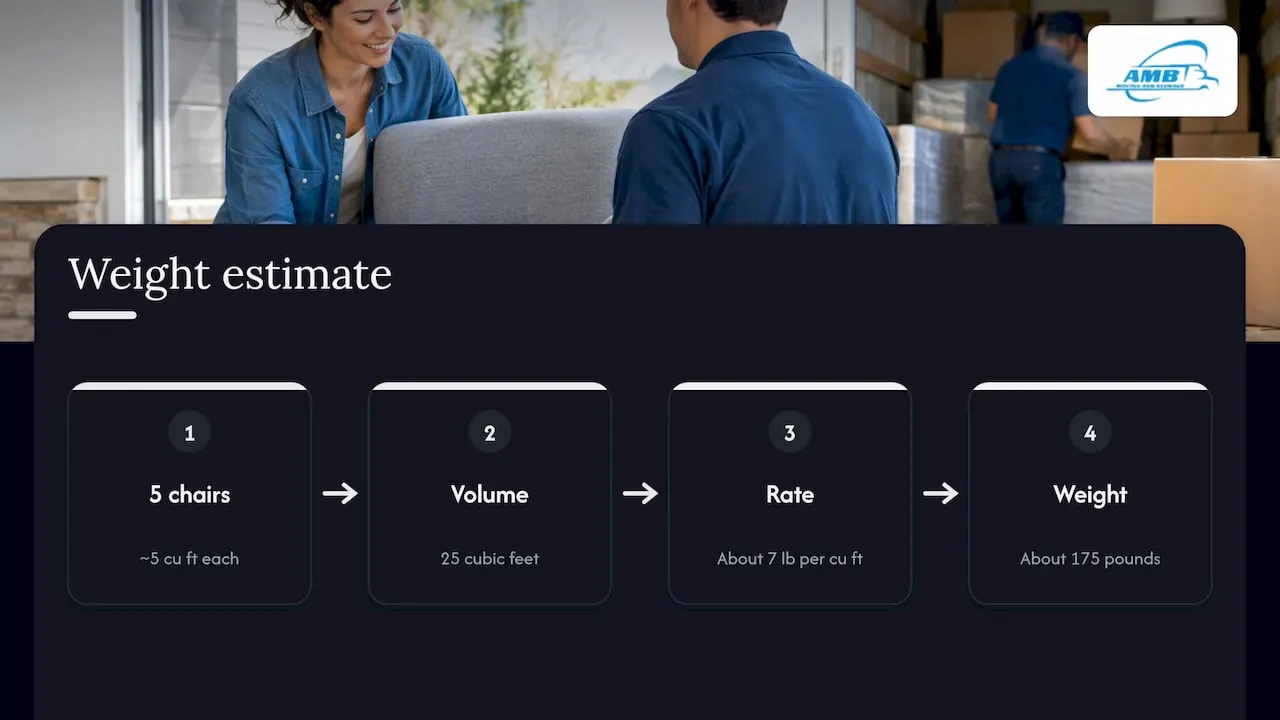
So the cube sheet converts one into the other. The common industry figure is about 7 pounds per cubic foot: five dining chairs at roughly 5 cubic feet each come to 25 cubic feet, or about 175 pounds. According to the U.S. Moving Protection Organization, volume gives you clearer upfront planning, because it reduces the surprise when estimated weight and actual weight drift apart on moving day.
We cover the trade-offs of each method in our guide to weight-based vs cubic-foot estimates. The short version: whichever method a mover quotes, the inventory behind it should be one you have seen and understood.
A sample cube sheet, line by line
The numbers below are illustrative round figures to show the arithmetic. Real cube values vary by mover and by the exact piece, so use the sheet your own mover provides.
| Room | Item | Count | Cu ft each | Subtotal |
|---|---|---|---|---|
| Living room | Three-seat sofa | 1 | 50 | 50 |
| Living room | Armchair | 2 | 20 | 40 |
| Dining room | Table with leaves | 1 | 40 | 40 |
| Dining room | Chairs | 6 | 5 | 30 |
| Bedroom | Queen bed with frame | 1 | 60 | 60 |
| Bedroom | Dresser | 1 | 30 | 30 |
| Throughout | Medium cartons | 80 | 3 | 240 |
| Total | 490 |
At 7 pounds per cubic foot, 490 cubic feet is about 3,430 pounds. Notice that the 80 cartons make up almost half of this total. That is the pattern to watch: boxes and cartons often account for roughly one-third of a household’s volume, and customers frequently under-report them.
Where the numbers go wrong
- Unpacked boxes. The surveyor sees an empty garage shelf and counts it as empty. Eight weeks later it holds 25 cartons.
- Off-site items. Storage units, sheds, attic crawl spaces and the trunk of the second car.
- Disassembly. A bed counted as assembled takes more cubic feet than a bed broken down. If a piece comes apart, measure the components separately to avoid paying for empty air.
- Heavy small items. Books, tools and canned goods are dense. A box of books is small in volume but heavy, which is why a rough FMCSA rule of thumb of 40 pounds per item, rising to 45 or more for heavy goods, is useful as a cross-check.
How to build your own cube sheet
Do this before you request your first quote. It takes an evening, and it gives you a baseline to hold every estimate against.
- Walk one room at a time. Use a worksheet such as the household inventory worksheet from the U.S. Moving Protection Organization, or its guided cubic-feet inventory that keeps a running total.
- Measure at the widest points. Do not measure the footprint alone. Measure the item at its widest, longest and tallest points, including arms, legs and protruding hardware, and round up to the nearest half-foot.
- Separate what comes apart. Tables, bed frames and shelving units are measured as components.
- Decide what is not going. Mark items you plan to sell, donate or discard now, not on loading day. Every cubic foot you remove before the survey is a cubic foot you are not quoted for.
- Estimate your boxes honestly. Count what is packed and what will need packing. Multiply by 3 cubic feet for medium cartons, and add the closets, garage and attic.
- Photograph everything. Photos give you evidence if the mover’s total differs from yours.
Auditing the cube sheet a mover gives you
When estimates arrive, put them next to your list. Three comparisons catch most problems.
Compare total volume
If one quote is far below the others and below your own total, ask why. A low volume produces a low price that rarely survives loading day. If your totals are close and the prices are far apart, the difference is in rates and services, which is a different conversation.
Compare line items
Ask for the itemized sheet, not just the total. Look for missing rooms, a single “misc boxes” line that is too small, and large items such as sectionals, armoires or a basement workshop that simply do not appear.
Compare what is included
The cube sheet covers the goods. Separately, check whether packing, stairs, elevators or long carries are in the number. At AMB, our moving cost guide lists the figures we publish: professional packing at $1-2 per cubic foot, storage from $0.50 per cubic foot, elevator and stair fees from $75, long carry charges from $75, and specialty item handling such as pianos and safes from $200.
What federal rules say about estimates and inventories
The cube sheet is not just a sales tool. It sits inside a regulated process for interstate household goods moves.
Written estimates. FMCSA requires your mover to provide written estimates on every shipment, and a verbal quote is not an official estimate. The estimate must state whether it is binding or non-binding. A binding estimate guarantees the cost as long as the inventory and services stay the same. A non-binding estimate can change with the actual weight or volume at loading.
The 110 percent limit. On a non-binding estimate, if your mover loads the shipment without writing a new estimate, it may not collect more than 110 percent of that estimate at delivery for the services and quantities shown. You still owe the balance later, so a low-ball cube sheet is a delay in paying, not a saving.
Surveys. Under 49 CFR 375.401, you can ask for a physical or virtual survey to establish the inventory. A free virtual survey tool is also available if you want to document and measure your belongings yourself.
The loading-day inventory. This is a separate document from the cube sheet, and it is a legal one. Before signing, you and the mover should agree on the condition of each item. Your ability to recover damages for lost or broken goods is tied to the notations on this inventory. Verify that every item listed is present, never sign a blank or inaccurate form, and if no inventory is provided, write and sign a detailed list yourself. If you have a dispute or a claim, contact FMCSA or a state consumer protection office for your specific situation.
Our perspective: the cube sheet should be a shared document
We move households and businesses across state lines, and the pattern is consistent. Disputes seldom start with a rate. They start with a number nobody checked before it was signed.
Our view is simple. The cube sheet should be something you can read, question and keep. A customer who has counted their own boxes and measured their own sectional can tell in two minutes whether an estimate is realistic. That is good for you, and it is good for us, because a quote built on an accurate inventory is one we can honor on moving day.
Three habits make a difference. Plan the inventory early, ideally 30 to 60 days before your move date. Ask for the volume and the line items, not only the total. And tell us about the garage, the attic and the storage unit up front, because those are the rooms that turn a tidy estimate into a surprise.
If you want to see how we approach this, read why you should get moving quotes before a long-distance move and how to get a moving estimate online.
— AMB
Ways to bring the cube down
A smaller volume is the most direct way to lower an interstate bill. Practical options:
- Sell or donate before the survey. Furniture you would replace anyway, old mattresses, and bulky exercise equipment are common candidates.
- Pack dense items in small cartons. This keeps boxes under safe weights. Our guide on keeping fragile boxes under 45 lb explains the logic.
- Disassemble what you can. Beds, desks and shelving cost less cube when broken down.
- Compare packing in-house vs. by crew. Professional packing at $1-2 per cubic foot adds to the bill, but it can also reduce breakage. See our packing services.
- Review other levers. Our cost-saving strategies for long-distance moves cover timing and scope.
Special items that do not fit a standard cube value
Some belongings are priced and handled separately from their cubic feet.
- Pianos, safes and similar pieces require specific crew, equipment and sometimes crating. Our specialty item handling starts from $200, and details are on our long-distance moving page.
- High-value or fragile art and antiques can be worth a custom crate. Read about custom crating and released value before deciding.
- Items movers will not take should be removed from your list altogether. Check our checklist of items movers won’t move.
- Storage between homes is priced from $0.50 per cubic foot, so an accurate cube also helps you plan a storage budget.
Using a cube sheet for a cross-country move
The longer the haul, the more the volume matters. On a cross country move your shipment typically shares a trailer with others, so each cubic foot is space you are renting. An extra 150 cubic feet is not a rounding error; at 7 pounds per cubic foot it is over 1,000 pounds added to the weight estimate.
A few scenarios we see often:
- A family moving from a house with a garage. The garage is the largest unknown. Tools, bikes, holiday storage and lawn equipment all need to be on the sheet.
- A couple downsizing to an apartment. The cube sheet doubles as a decision tool: if the new space cannot hold the volume, storage or selling is cheaper than moving it.
- A job relocation on a short timeline. A virtual survey with photos is often the fastest way to get a firm inventory without waiting for a scheduled visit.
Whether you are comparing interstate movers, cross country movers or a nationwide moving company, ask each one the same questions and give each the same inventory. That is the only fair way to compare moving cost estimates.
Get your estimate from an inventory you trust
AMB Moving & Storage Inc. is a licensed and insured nationwide moving company for long-distance, interstate and state-to-state relocations, with packing, secure storage and specialty handling available as part of a move. Read about our long-distance moving, interstate and state-to-state services and nationwide moving, then request your moving quote. Bring your own room-by-room list and we will walk through it with you.
FAQ
What is a cube sheet in moving?
It is an itemized inventory listing each piece of furniture and each box with its cubic-feet value. The total gives the volume of your shipment, which the mover converts to an estimated weight and price. You can ask to see it with any estimate.
How many pounds is a cubic foot in moving?
The industry standard is about 7 pounds per cubic foot, so 1,000 cubic feet is roughly 7,000 pounds. Dense items such as books can weigh more, and light bulky items less. Treat it as an estimating average, not a guarantee.
Can a mover charge more than the estimate?
On a non-binding estimate, FMCSA rules say the mover cannot collect more than 110 percent at delivery for the services and quantities listed, and the rest is billed later. A binding estimate guarantees the price if the inventory and services do not change. Ask which type you are getting, in writing.
How accurate is a virtual survey compared with an in-home one?
You have the right to request either under 49 CFR 375.401. A virtual survey is as accurate as the rooms you show and the items you disclose, so cover closets, garage, attic and storage areas. Photos and measurements also give you a record to compare against the final inventory.
What should I do if the cube sheet looks too low?
Put your own list beside it and ask the mover to explain each gap, especially boxes and large items. Do not accept a low number just because the total is attractive. An accurate sheet protects you from a revised bill after loading.
Sources
- Cubic Feet in Moving: How to Count Yours, USMPO
- The Size of Your Move, USMPO
- Household inventory worksheet, USMPO
- Guided Moving Inventory, USMPO
- Free Virtual Moving Surveys, USMPO
- Your Rights and Responsibilities When You Move, FMCSA
- Estimating Charges (Subpart D), FMCSA
- Pickup of My Shipment of Household Goods (Subpart E), FMCSA
- What Is a Cube Sheet in Moving? Mover’s Guide, MoversTech