


Accessorial charges are the fees movers add on top of the base transportation cost for extra services like packing, long carries, or elevator access. The single biggest protection you have is simple: get a written estimate that lists every accessorial service, and ask to see the mover’s tariff before you sign anything. FMCSA requires both, and a nationwide carrier like AMB Moving & Storage Inc. builds its estimates around that same rule.
TL;DR:
- A written, line-item estimate and accessorial tariff are essential to prevent surprise charges, especially for services like long carries or specialty handling.
- Non-binding estimates allow up to 110% of the initial cost at delivery, but charges not identified before the bill can only be billed after 30 days post-delivery.
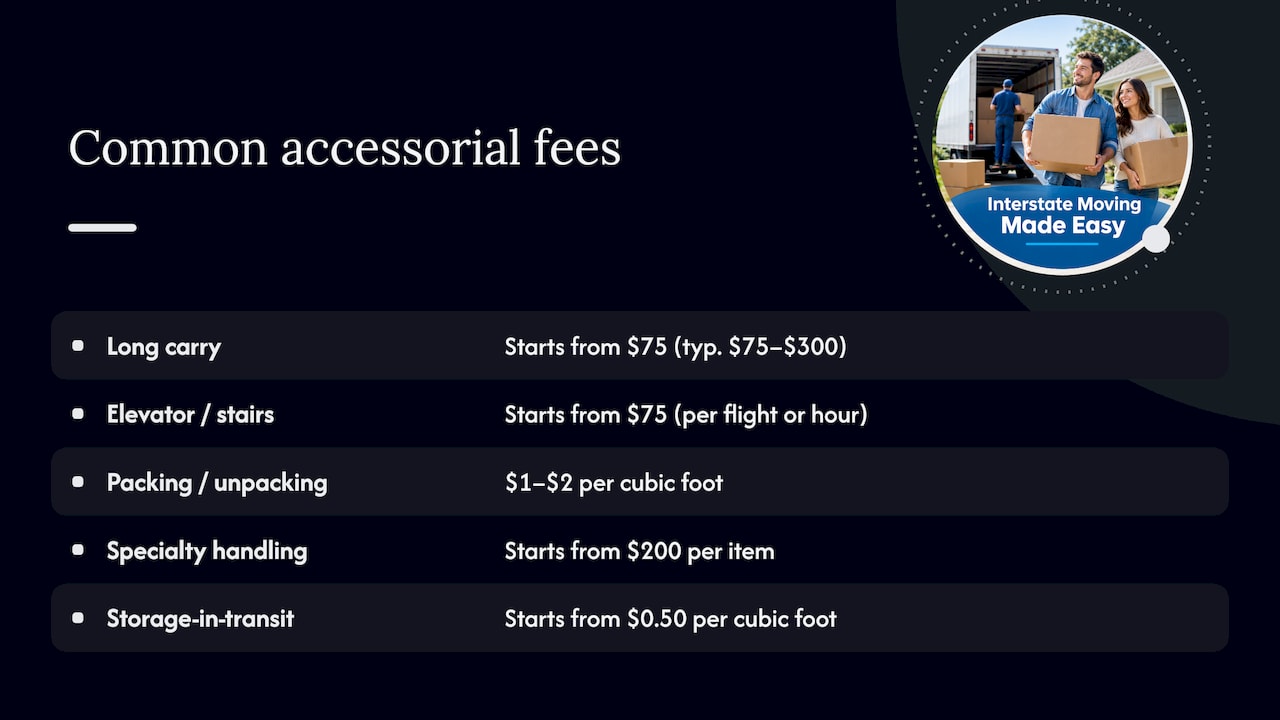
- Common accessorial fees include charges starting from $75 for long carries and elevator or stair fees, which depend on property-specific conditions.
- A thorough pre-move survey that covers parking, staircases, and large items reduces the risk of unexpected fees or billing errors at delivery.
- Disputes over unlisted charges can be challenged by requesting tariff proof and filing complaints with FMCSA if necessary.
Table of Contents
- What Counts as an Accessorial Service
- How Movers Set and Document Accessorial Charges
- Estimates, the 110% Rule, and When Movers Can Bill Later
- The Most Common Accessorial Fees and What Drives Them
- How to Avoid Surprise Accessorial Charges Before Moving Day
- What to Do If You’re Billed an Unexpected Accessorial Charge
- How a Nationwide Mover Documents and Prevents Accessorial Surprises
- The Real Problem With Accessorial Charges Isn’t the Fees, It’s the Timing
- Get a Written Estimate That Lists Every Accessorial Charge
- Where to Verify These Rules Yourself
- Sources
- FAQ
What Counts as an Accessorial Service
Accessorial, or additional, services are anything beyond loading your goods and driving them to the new address. Federal rules define accessorial services as charges a mover collects separately from the line-haul rate, and the list is longer than most people expect going into a move.
The most common examples include packing and unpacking, long carry fees when the truck cannot park near your door, elevator or stair charges in multi-story buildings, shuttle service when a smaller vehicle has to ferry goods from a full-size truck, appliance servicing for disconnecting a washer or icemaker, piano or safe handling, storage-in-transit when your goods sit in a warehouse between pickup and delivery, and waiting time when crews are held up through no fault of their own.
What triggers each charge varies:
- A service you specifically request, like full-service packing, gets priced as soon as you ask for it.
- A service the move physically requires, like a long carry because the driveway is blocked, gets priced once the crew sees the property.
- A service tied to someone else’s rules, like a building requiring a certificate of insurance or a scheduled freight elevator slot, can add cost even if you never asked for it.
Picture four scenarios: a third-floor walkup with no elevator (stair-carry charge), a downtown condo where the truck has to park a block away (long carry), a move that includes a grand piano (specialty handling), and a cross-country relocation where your furniture needs to sit in a warehouse for three weeks before your new home is ready (storage-in-transit). Each one adds a line to the final bill, and each one should appear on your estimate before moving day, not after.
Pro Tip: Ask the estimator to name every accessorial charge that could apply to your specific address, not just a generic list, since a building’s access rules often drive the biggest fees.
How Movers Set and Document Accessorial Charges
Accessorial pricing is not arbitrary. Movers operating in interstate commerce publish tariffs, which are formal rate schedules that spell out exactly how much each accessorial service costs and under what conditions it applies. Once you accept an estimate, the tariff provisions become part of your contract, whether or not you ever read the document.
FMCSA requires movers to inform you of your right to inspect those tariffs before you book, and a legitimate mover will produce the relevant pages on request rather than waving you off with a verbal estimate. The tariff is what turns “long carry fee” from a vague phrase into a specific number tied to distance, weight, or time.
The bill of lading and order for service carry the same weight. 49 CFR Part 375 requires the bill of lading to include a complete description of any special or accessorial services ordered, along with any applicable minimum weight or volume charges. If a service is not described there, the mover has a much weaker position to bill you for it later.
Before you sign:
- Ask for the specific tariff pages covering any accessorial service you expect to need.
- Confirm the bill of lading lists each accessorial by name, not a lump sum.
- Request a copy of both documents for your own records before the truck leaves.
This paperwork is not a formality. It is the evidence you will need if a charge on your final invoice does not match what you agreed to. A mover that resists showing you tariff language or rushes you through the bill of lading is giving you a reason to ask more questions, not fewer.
Estimates, the 110% Rule, and When Movers Can Bill Later
Your estimate type determines how much financial exposure you carry on accessorial charges. FMCSA requires a written estimate for every household goods shipment, and that estimate has to include transportation, accessorial, and advance charges together, not as a separate afterthought.
There are two estimate types:
- Binding estimate. The price is fixed in advance, including listed accessorial services, and the mover cannot charge more than that figure at delivery except for services you request after the estimate is written.
- Non-binding estimate. The mover gives a good-faith prediction of weight and cost, but the final bill of lading can require payment of up to 110% of that estimate at delivery, with any remaining balance billed afterward.
The 110% figure is a federal cap, not a mover’s discretion: a non-binding estimate can require up to 110% of the estimated charges at delivery, with the rest billed later.
Timing matters just as much as the percentage. Movers are expected to determine accessorial charges, such as elevator access or long carries, before they prepare the bill of lading. When a mover fails to do that and only discovers the need for an accessorial service after the fact, federal rules limit that mover to billing for those charges no sooner than 30 days after delivery. That 30-day window exists because the mover, not you, missed the chance to price it correctly up front.
There is also a cap on so-called impracticable operations, services that become necessary during the move but could not reasonably have been foreseen.
In practice, this means two things at delivery. First, a binding estimate protects you from almost every surprise except services you add yourself. Reading the difference between weight-based and cubic-foot estimates helps explain why two moves of similar size can land on very different final numbers. For a broader rundown of estimate structures, see this guide to moving estimate types.
The Most Common Accessorial Fees and What Drives Them
Most accessorial charges fall into a handful of categories, and each one has its own logic for how it gets calculated.
Long carry fees apply when the truck cannot park close enough to your door and crews have to carry items an extended distance. Many tariffs set a baseline distance, often referenced as a 75-foot threshold, beyond which a per-foot or per-increment charge kicks in.
On AMB’s own cost guide, long carry charges start from $75 and scale with distance, which lines up with the typical $75 to $300 range seen on difficult-access moves.
Elevator and stair charges apply in buildings without a service elevator, or where scheduling a freight elevator adds time. These are often priced per flight of stairs or per hour of extra labor, and AMB lists them starting from $75.
Shuttle fees come into play when a full-size moving truck cannot access a property at all, requiring a smaller vehicle to make multiple trips. These are usually priced per trip or per load.
Packing and unpacking can be billed per hour of crew time or as a flat rate per room, depending on the mover’s tariff structure. AMB prices packing services at $1 to $2 per cubic foot, a structure that scales naturally with the volume of goods rather than a flat per-room guess.
Specialty item handling, including pianos and safes, typically carries its own line item because of the extra labor and equipment involved. AMB lists specialty handling starting from $200 per item.
Storage-in-transit applies when your goods need to sit in a warehouse between pickup and final delivery, priced by cubic foot and by the length of time in storage. AMB’s storage services start from $0.50 per cubic foot.
Appliance servicing, often billed as an advance charge paid to a third-party technician, covers disconnecting or reconnecting gas and water lines.
Industry tariffs also build in per-hundredweight and per-hour pricing structures with set minimums, a pattern common across freight tariffs generally, where published rate schedules function as the rulebook for what gets charged and when. The exact dollar figure for any accessorial service always comes down to the individual mover’s tariff, which is why the pricing shapes above (per-foot, per-hour, per-trip, per-cubic-foot) matter more than any single number you see quoted online.
How to Avoid Surprise Accessorial Charges Before Moving Day
The best defense against a surprise bill is a thorough pre-move survey, done in person or virtually, that captures every detail a mover needs to price accessorials correctly.
- Walk the property and note parking distance from the door to the truck’s likely stopping point.
- Count stair flights or confirm elevator availability and any building scheduling rules.
- Check for permit requirements, such as a residential parking permit or a loading dock reservation.
- Take photos of entry points, hallways, and any tight turns the crew will need to navigate.
- List large or awkward items, such as a piano, safe, or oversized appliance, separately.
- Ask whether the new address has the same access challenges as the old one.
When you talk to an estimator, ask directly: which accessorial services apply to my specific addresses, can I see the tariff pages for those services, will this be a binding or non-binding estimate, and what payment methods are accepted at delivery. Request a copy of the line-itemed estimate and the relevant tariff excerpts in writing before you sign.
Pro Tip: If your survey is virtual, walk the camera slowly through every doorway and stairwell the crew will use, since a rushed video call is the single biggest reason movers miscalculate long carry and stair fees. AMB’s online estimate process is built around capturing these details before quoting a price, which is exactly the standard federal guidance expects.
What to Do If You’re Billed an Unexpected Accessorial Charge
If a charge shows up at delivery that you did not agree to, address it before the crew leaves if at all possible.
- Ask to see the tariff page that supports the charge and request an itemized invoice rather than a lump sum.
- Note any disagreement directly on the delivery paperwork before you sign it.
- Remember that under a binding estimate, you should not owe more than the agreed price for listed services, and under a non-binding estimate, your payment at delivery is capped at 110% of the original estimate.
- Keep copies of your written estimate, bill of lading, and any photos from your pre-move survey as evidence.
If the mover bills you after delivery for a service it never listed on your original paperwork, insist on a written itemization explaining why. If the mover failed to determine that accessorial charge before preparing the bill of lading, federal rules require it to wait at least 30 days post-delivery before billing you, giving you time to dispute it.
If the mover does not resolve the dispute directly, you can file a complaint with FMCSA, which investigates consumer complaints against household goods movers operating in interstate commerce. For disputes that involve state-level consumer protection issues or amounts that warrant it, your state attorney general’s consumer protection office or small claims court are additional paths worth pursuing.
How a Nationwide Mover Documents and Prevents Accessorial Surprises
AMB Moving & Storage Inc. operates as a licensed, insured, and federally compliant nationwide moving company specializing in long-distance, interstate, and state-to-state relocations across the United States. That compliance posture is not incidental: it shapes how estimates get built in the first place, with accessorial services identified during the survey rather than discovered on moving day.
The company’s site lays out detailed descriptions of its core services, including packing, commercial and business relocations, secure storage, specialty item handling, and long-distance moving, reflecting the kind of operational range needed to manage complex multi-state logistics. For a residential client, that might mean coordinating elevator access in a downtown high-rise. For a commercial client, it might mean scheduling a loading dock and sequencing a multi-phase office relocation. Both scenarios depend on the same underlying discipline: identify accessorial needs before the bill of lading is written, not after.
The Real Problem With Accessorial Charges Isn’t the Fees, It’s the Timing
Most advice on accessorial charges focuses on the dollar amounts, as if a $150 stair fee is the injury. The real damage happens when a charge appears on moving day that nobody mentioned during the quote, because at that point you have no leverage and a truck full of your belongings. The fee itself is usually reasonable; the ambush is not.
Conventional checklists tell people to “get everything in writing,” which is true but incomplete. The sharper move is to make the mover prove it did its job: ask to see the specific tariff provision behind any accessorial charge before you sign, not just a vague mention that extra fees may apply. A mover that priced your move correctly will have that paperwork ready. One that didn’t will stall, and that hesitation tells you more than any online review.
Prioritize the pre-move survey over the sales pitch. The number on your estimate matters less than how thoroughly the person building it asked about your stairs, your parking, and your piano.
— AMB
Get a Written Estimate That Lists Every Accessorial Charge
A cross-country move involves enough moving parts without wondering whether a long carry or a stair fee is going to show up unannounced on your final invoice. AMB Moving & Storage Inc. builds estimates for long-distance moving and interstate and state-to-state relocations around the same federal standard covered above: a written estimate, clearly marked as binding or non-binding, with every accessorial service itemized rather than buried in a lump sum.
When you request a quote, ask for:
- A clear binding or non-binding designation, so you know your payment exposure at delivery.
- Line-itemed accessorial charges for packing, long carry, stair access, or specialty handling.
- Tariff excerpts covering any service specific to your address.
- A list of accepted payment methods for delivery day.
AMB Moving & Storage Inc. operates as a licensed and insured nationwide moving company, including commercial and office relocations, built around federal compliance from the first survey call to final delivery. Request your written moving estimate today and get the accessorial details in writing before moving day arrives.
Where to Verify These Rules Yourself
Every federal rule referenced in this guide comes from FMCSA’s consumer protection pages and the eCFR text governing household goods movers. Subpart D covers estimating charges, including the 110% rule and the 30-day billing limitation. Subpart A defines accessorial services and confirms they are billed separately from line-haul charges. Subpart B covers your right to inspect a mover’s tariffs before booking. 49 CFR Part 375 sets the bill of lading content requirements referenced throughout.
To request tariff copies, ask your mover directly and cite your right under federal consumer protection rules; a compliant mover will provide the relevant pages without resistance. To file a complaint against a mover operating in interstate commerce, use FMCSA’s consumer complaint process, which accepts documentation such as your estimate, bill of lading, and final invoice as supporting evidence.
Sources
- Estimating Charges (Subpart D) | FMCSA
- 49 CFR Part 375 — Transportation of Household Goods in Interstate Commerce
FAQ
What is an accessorial charge in moving?
An accessorial charge is a fee for a service beyond basic transportation, such as packing, long carries, elevator access, or storage-in-transit. Federal rules require these charges to be listed separately from the line-haul rate on your estimate and bill of lading.
What is the 110% rule in moving?
The 110% rule applies to non-binding estimates: a mover can require payment of up to 110% of the original estimated charges at delivery, with any remaining balance billed afterward. It does not apply to binding estimates, which fix the price in advance for listed services.
How much is a long carry fee?
Long carry fees typically apply once the distance from the truck to the door exceeds a standard threshold, often referenced around 75 feet. AMB lists long carry charges starting from $75, with the final amount set by distance and the mover’s tariff.
Can a mover bill me for accessorial charges after delivery?
Yes, but only under specific conditions. If a mover failed to determine an accessorial charge before preparing the bill of lading, federal rules require it to wait at least 30 days after delivery before billing for that charge.
How do I dispute an unexpected moving charge?
Start by requesting the tariff page and an itemized invoice supporting the charge, and note any disagreement on the delivery paperwork. If the mover does not resolve it, you can file a complaint with FMCSA or pursue state consumer protection or small claims options.