

In a courtroom, chain of custody means a written record of who held an item, when, and why. On a long-distance move, the idea is the same and the stakes are personal. From the day your belongings leave your home to the day they are delivered, you want a paper trail that shows who had them, what condition they were in, and where they were stored. You also need your own important records to stay under your control the whole time. This guide covers both: how to document custody of your household goods, and how to protect the paperwork that must not ride in a truck.
TL;DR
- Chain of custody for a move means a signed, dated record of every handoff: your home to the crew, the crew to the truck or warehouse, and the warehouse to your new address.
- The inventory is your main custody document. Federal rules say interstate movers prepare one, and you should sign each page and keep your copy with the bill of lading.
- Keep irreplaceable records (IDs, titles, tax files, medical papers) with you, not in the shipment, and back up scans in a password-protected format.
- If your goods go into storage, ask for the warehouse name and address, and know the written notice your mover owes you before storage converts to permanent.
- Keep every estimate, receipt, photo and delivery note in one folder. Claims have deadlines.
Table of Contents
- What chain of custody means for household belongings
- Start with the inventory: your core custody document
- Records that should never ride in the truck
- Custody while your belongings are in storage
- Delivery day: closing the chain
- The move folder: what to keep and why
- A realistic timeline for a 30 to 60 day move
- Our perspective
- Plan your move with a clear paper trail
- The bottom line
- FAQ
- Sources
What chain of custody means for household belongings
Chain of custody started as a legal and forensic term. The SANS Institute describes a chain of custody form as a record of the date and time, who handed the item over, who received it, and the purpose of each change of custody, with names, organizations and signatures from both parties. Courts and labs use it to show an item was never tampered with or lost track of.
A household move is not an evidence locker, but the same logic works. Your belongings change hands several times, often across several states:
- Your home to the packing and loading crew.
- The crew to the truck.
- The truck to a delivery address, or to a warehouse if your new home is not ready.
- The warehouse back to a truck.
- The truck to your new home.
Every one of those transitions is a point where an item can be damaged, miscounted or misplaced. A good record answers three questions at each point: what was handed over, in what condition, and who accepted responsibility. If you can answer those, most disputes are short.
There are really two custody problems in a move, and they need different tools:
- Your goods in the mover’s care. Handled with the inventory, the bill of lading and photos.
- Your records in your own care. Handled by keeping them out of the shipment entirely.
The rest of this article takes each in turn.
Start with the inventory: your core custody document
The inventory is where custody begins on paper. The Federal Motor Carrier Safety Administration (FMCSA) explains in its moving rights and responsibilities handbook that an interstate mover must prepare an inventory, normally at loading, listing each item along with any damage or unusual wear. You and the mover should both sign each page, and you should keep the inventory with your bill of lading.
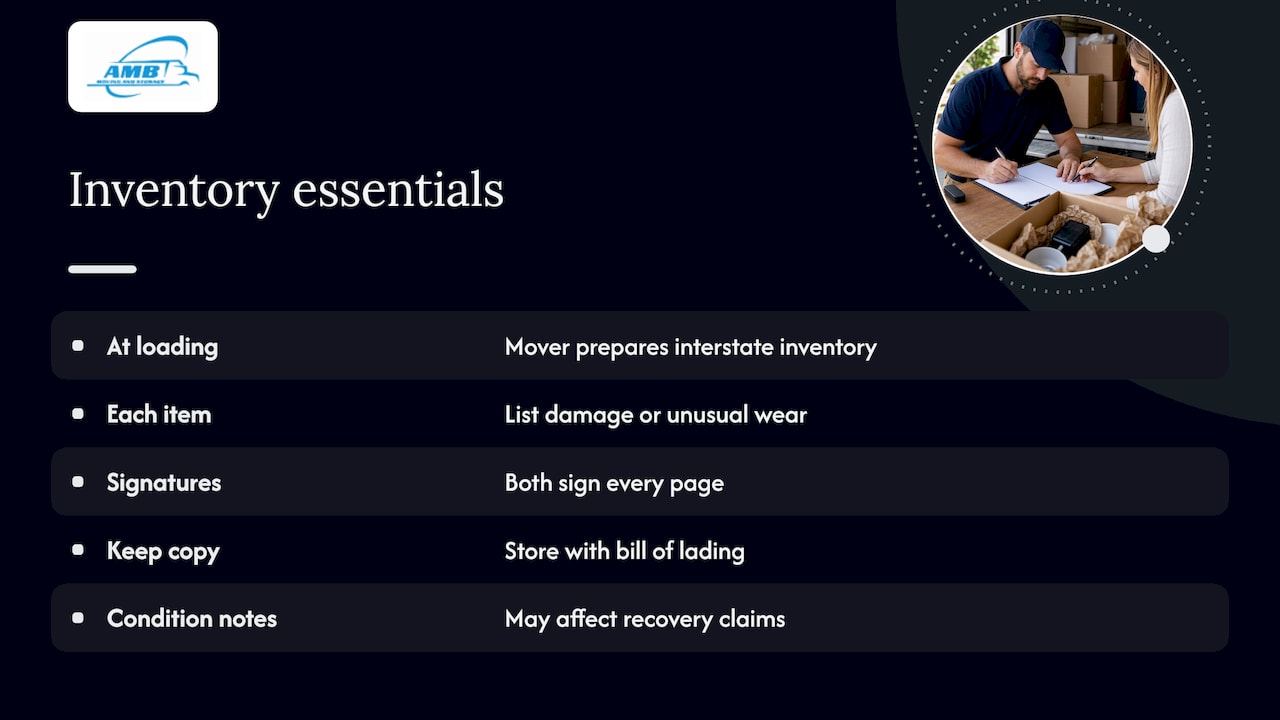
The condition notes matter more than most people expect. The same FMCSA guidance says recovery for missing or damaged goods may depend on the condition notations made before transport. If a dresser is listed as “scratched, left side” at pickup and arrives with a deep gouge on top, the record shows what changed. If nothing was noted, the conversation gets harder.
How to review the inventory at pickup
- Walk with the crew lead while items are tagged. Do not wait until the end of the day.
- Check that the description of each item is specific: “oak dining table, chip on one corner” beats “table.”
- Confirm that boxes the crew packed are listed by room and contents when possible, and that cartons you packed yourself are marked as such.
- Photograph high-value furniture, electronics and artwork from several angles before it is wrapped.
- Sign each page only when it matches what you see. Keep your copy, whether paper or a photo, before the truck leaves.
If you want a head start, our guide on building a household inventory before your move walks through room-by-room lists, photo habits and how to flag high-value items.
A note on release forms
FMCSA states that movers may not require a shipper to sign a document releasing the mover from all liability for loss or damage in exchange for delivery. If you are handed a form like that at delivery, read it carefully and ask questions before signing anything.
Records that should never ride in the truck
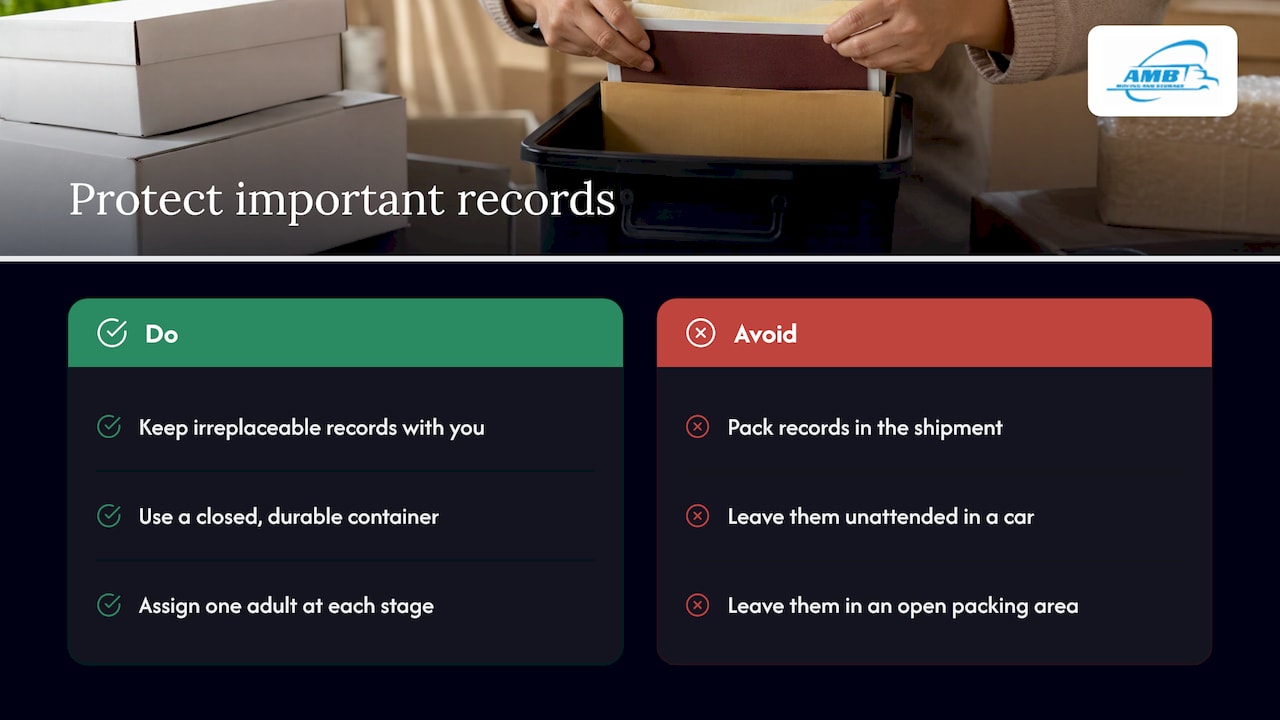
The inventory covers your goods. Your documents are a different category. Passports, birth certificates, Social Security cards, property deeds, vehicle titles, current medical records, prescriptions, tax papers and anything you would need in the first week at your new address should stay with you.
A simple rule: if replacing it would take weeks or cost real money, it travels with a responsible adult, in a closed, durable container, not in the general shipment. Assign one person in the household to hold it at each stage, such as the drive, the hotel night and the arrival day, so it never sits unattended in a car or open packing area.
What the federal guidance recommends
FEMA’s Safeguard Critical Documents and Valuables guide recommends taking an inventory of household documents, contacts and valuables. It then suggests keeping paper copies in a fireproof and waterproof box or safe, in a bank safe deposit box, or with a trusted friend or relative. For electronic copies, it recommends a password-protected format on a removable flash drive or external hard drive, or in a secure cloud-based service. The agency wrote it for disaster preparedness, but the same logic applies when your home is in boxes.
A two-layer system that works for a move
- Physical go-folder. Originals and a few key copies, kept with you. Include medication lists, school and pet records, and insurance cards.
- Digital backup. Scans of everything in the folder, password protected, on a drive that you keep separate from the folder. Open each scan once to confirm it is readable.
Keep the two in different places during travel. If a bag is lost, you still have the other layer.
When you need to ship a box of papers separately
Sometimes records cannot travel with you, for example when you fly and have a box of files for a home office. In that case, treat the box as its own custody chain: seal it, photograph it, note the weight, and keep the receipt and tracking details. For practical packing and routing ideas, see this guide to shipping boxes efficiently when moving house.
Custody while your belongings are in storage
Long-distance moves often include a gap. Your closing date shifts, a lease starts late, or the new house needs repairs. Your goods go into a warehouse. This is the part of the journey where homeowners most often lose track of who is responsible for what.
Know the storage-in-transit rules
When a mover holds household goods in storage-in-transit, federal rules require a written notice to you. Under 49 CFR 375.609, the carrier must tell you in writing:
- the date storage converts to permanent storage,
- that a nine-month claim period exists after conversion,
- that the carrier’s liability is ending, and
- that the warehouse’s rules and charges will apply.
The notice generally must be sent at least 10 days before the storage period expires. For storage of less than 10 days, it is due one day before expiration. Put a reminder in your calendar based on the storage period in your contract, and ask your mover how you will receive the notice.
Early delivery and warehouse custody
The rules also cover a different situation. Under 49 CFR 375.607, if a mover could deliver more than 24 hours before the date you specified and you do not agree to early delivery, the mover may place the shipment in storage at its own account and expense in a warehouse near your destination. It must immediately tell you the warehouse’s name and address, and it remains responsible for the shipment under the bill of lading. If you ever get that call, write down the name, address, date and time, and who told you.
A custody checklist for storage
- Ask for the warehouse name and address in writing.
- Confirm whether your goods stay in their original containers or are moved to a different one.
- Ask how access is recorded when staff open or move your shipment.
- Ask what happens to your paperwork when storage converts from temporary to permanent.
- Photograph your shipment at delivery to the warehouse if you are present.
Our pages on temporary storage for long-distance moves and storage security features that matter go deeper on questions to raise before you book.
What storage can cost
Our published starting rate for storage services is from $0.50 per cubic foot, and the full list of add-ons and fees sits on our moving cost guide. Because storage is billed by volume, a precise inventory also helps you avoid surprises. Moving cost estimates are only as accurate as the list behind them.
Delivery day: closing the chain
Delivery is where the record pays off. FMCSA advises that at delivery you compare the items that arrive against the inventory and note any new damage before you sign. A practical routine:
- Keep your copy of the inventory in hand as items come off the truck.
- Check off each item and carton number as it enters the house.
- Open boxes labeled fragile or high value while the crew is still present when practical.
- Write any damage or missing items on the delivery paperwork, with specifics, before signing.
- Photograph damage immediately, including wide shots that show the item’s location.
If an item is missing, note it right away rather than assuming it is in a box you have not opened. You can add to the list later, but the first notation carries weight.
Claim deadlines
The Moving and Storage Institute’s rights and responsibilities booklet states that a written loss or damage claim generally must be filed within nine months of delivery. For a lost entire shipment, the clock runs from the date the shipment should have been delivered. The mover has 30 days to acknowledge a claim and 120 days to give a disposition, subject to stated extensions. Do not wait for the final unpacking to start your list; start the day of delivery.
The move folder: what to keep and why
Think of this as your own chain-of-custody file. A single binder or cloud folder works. Include:
| Document | Why you keep it |
|---|---|
| Estimate and any revisions | Shows what was agreed and what changed |
| Service order and bill of lading | Establishes the contract and the shipment |
| Signed inventory | Records items and their condition at pickup |
| Valuation choice | Defines how loss or damage is compensated |
| Payment receipts | Proves what you paid and when |
| Photos and videos | Back up condition notes |
| Storage notices and warehouse details | Tracks where your goods are and when terms change |
| Delivery paperwork | Records what arrived and what you noted |
| Contact and deadline list | Keeps claim windows and phone numbers in one place |
This mirrors what move-planning checklists commonly advise, and it costs nothing but ten minutes at each stage. Keep it for at least a year after the move, longer if you moved for work and may need records for taxes.
A realistic timeline for a 30 to 60 day move
Most interstate moves are booked about a month or two out. Here is how to build custody habits into that window:
- Six to four weeks out: Request moving cost estimates, choose your mover, and start your inventory and photo log. Sort documents into carry and ship piles.
- Three to two weeks out: Scan important records, set passwords, and test your backup. Confirm packing arrangements and whether storage is likely.
- Final week: Assemble the go-folder, label do-not-load items and tell the crew which rooms or closets are off limits.
- Pickup day: Walk the inventory, photograph high-value pieces, sign only what is accurate, keep your copies.
- Transit and storage: Keep contact details handy and track any storage notices.
- Delivery: Check against the inventory, note issues, photograph damage, start the claim file if needed.
If you are comparing interstate movers or cross country movers, ask each one how they handle inventories, storage records and delivery paperwork. The answers tell you a lot about how organized the operation is.
Our perspective
Most custody problems we see in long-distance moving come from missing paper, not bad intent. A scratch nobody noted, a storage date nobody tracked, a box of tax files that went on the truck when it should have gone in the car.
That is why we treat the move as a documented process. We are a licensed and insured nationwide moving company, and we plan interstate moves around federal rules, a clear inventory and clear communication. Our approach is built around structured planning and transparent pricing, so you know what is being moved, where it is going and what it should cost.
For long-distance moving, we encourage customers to bring their own inventory and photos, to keep irreplaceable records with them, and to ask about storage terms before the truck is loaded. Professional packing, secure storage and specialty handling for items such as pianos and safes work best when the paperwork is as careful as the crew.
AMB
Plan your move with a clear paper trail
We handle long-distance moving, interstate moving and nationwide moving for homeowners, families and businesses. If your timeline includes a storage gap, we can arrange secure storage, with rates starting from $0.50 per cubic foot, and professional packing at $1 to $2 per cubic foot. Details on packing are on our packing services page.
Specialty items such as pianos and safes start from $200, and elevator, stair and long-carry charges start from $75 each. All of these are listed on our moving cost guide. Ready for a written estimate? Request your free quote and tell us your dates, your route and whether you expect to need storage.
The bottom line
Chain of custody for a move comes down to two habits. First, document every handoff of your goods: a signed inventory with specific condition notes, a known warehouse if storage is involved, and a careful delivery check. Second, keep your irreplaceable records out of the shipment, in a closed container under one adult’s care, with a tested digital backup. Add a single folder for estimates, receipts, photos and notices, and you can resolve almost any question about where something was, who had it and what shape it was in.
FAQ
Does chain of custody apply to a regular household move?
Not as a legal requirement the way it applies to evidence, but the principle helps. A signed inventory, condition notes and dated records of each handoff give you a clear account of your belongings. Federal rules already require interstate movers to prepare an inventory, so the foundation is there.
What records should I keep with me instead of packing them?
Keep irreplaceable and immediately needed originals: IDs, titles, deeds, tax files, medical and school records, and prescriptions. FEMA recommends fireproof and waterproof storage for paper copies and password-protected electronic backups. Carry them in a closed container, and do not leave them in a parked car.
Who is responsible for my belongings while they are in storage-in-transit?
The mover remains responsible under the bill of lading during storage-in-transit, until the storage converts to permanent. The mover must give you written notice, generally at least 10 days before conversion, explaining the date, the nine-month claim period and the warehouse’s rules and charges. Ask your mover how it will deliver that notice.
How long do I have to file a claim for lost or damaged items?
A written claim generally must be filed within nine months of delivery, according to the Moving and Storage Institute’s booklet. The mover has 30 days to acknowledge it and 120 days to give a disposition, subject to stated extensions. Start documenting damage on delivery day.
How do I get an accurate moving cost estimate for an interstate move?
Bring a complete inventory, your dates, both addresses and any special items like pianos or safes. Mention stairs, elevators and long carries, since those can add fees. Request a quote with those details and we will build the estimate around them.
Sources
- FMCSA, Your Rights and Responsibilities When You Move
- eCFR, 49 CFR 375.609
- eCFR, 49 CFR Part 375 (March 23, 2026)
- Moving and Storage Institute, Your Rights and Responsibilities
- FEMA, Safeguard Critical Documents and Valuables
- SANS Institute, Chain of Custody form