

A typical cross-country move in the United States runs between $2,391 and $6,868, with a national average near $4,572, and true coast-to-coast routes like New York to Los Angeles often push closer to $10,300. The two levers that move that number more than anything else are your moving method (full-service versus DIY or container) and your shipment’s weight relative to distance. Before booking anything, insist on a binding, inventory-based estimate and confirm the carrier’s FMCSA authority.
TL;DR:
- Coast-to-coast moves typically cost around $10,300, which is roughly double the national average, due to larger household size and complex logistics.
- The main factors influencing cost are your chosen moving method, shipment weight, and distance, with full-service moves being the most expensive.
- Additional fees such as stair carries, long carries, bulky item handling, and storage can significantly increase your final bill if not carefully managed.
- Federal rules allow non-binding estimates to increase by up to 10%, so requesting a binding estimate based on an inventory reduces overcharges.
- Moving during off-peak seasons and self-packing can cut costs by 20 to 40 percent without sacrificing coverage, but require planning and effort.
Table of Contents
- Cross Country Moving Cost by Method and Home Size
- How Distance and Weight Combine to Set Your Price
- What Drives Your Final Bill (and the Fees That Sneak In)
- How Interstate Estimates Work Under FMCSA Rules
- Released Value vs Full-Value Protection: What Happens If Something Breaks
- Sample Budgets for Common Home Sizes and Routes
- How to Vet a Mover and Get a Quote You Can Trust
- Realistic Transit Times for a Cross-Country Move
- Practical Ways to Cut Costs Without Losing Protection
- Our Take: Why Transparency Beats the Lowest Number
- Get a Binding Quote Before You Commit to a Moving Date
- Sources
Cross Country Moving Cost by Method and Home Size
The single biggest decision you’ll make on price isn’t which company you call. It’s which moving method you pick. Full-service movers handle everything from loading to unloading and charge accordingly. Container services split the difference. DIY truck rental is the cheapest option on paper but shifts labor, fuel, and lodging costs onto you.
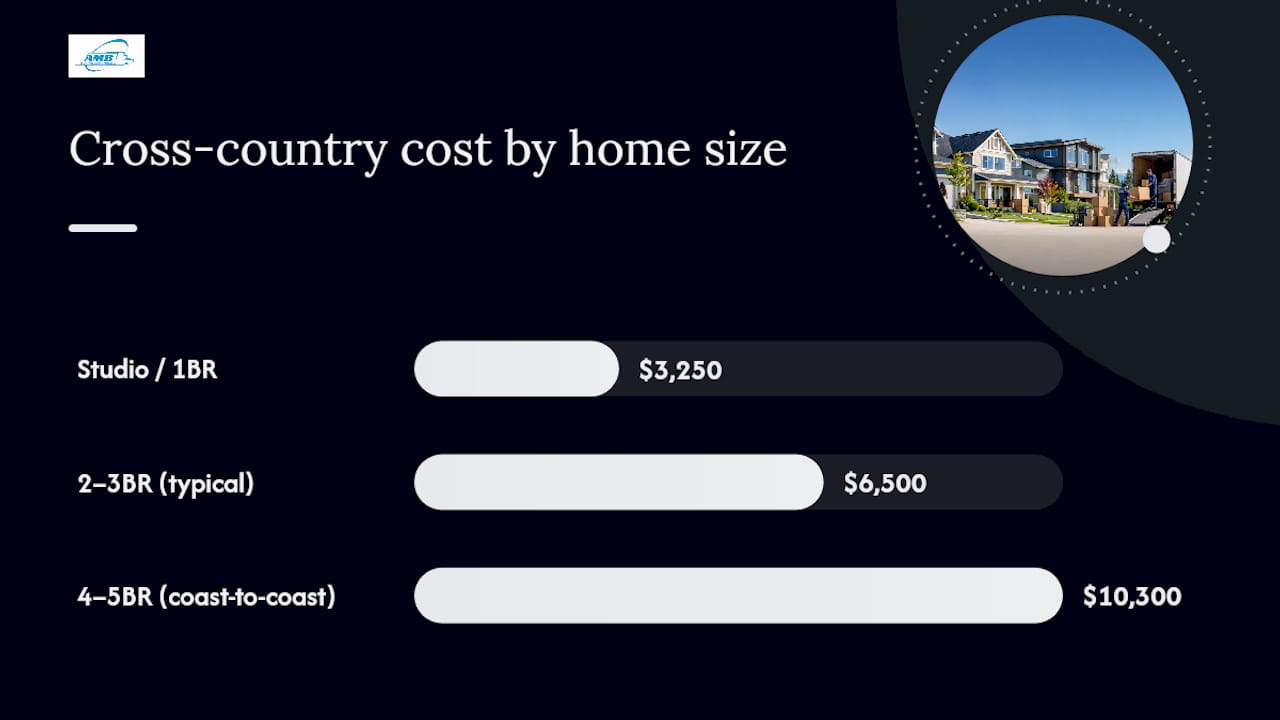
For a studio or one-bedroom apartment moving cross-country, full-service pricing typically starts around $2,000 and can reach $4,500 depending on distance. A two-to-three-bedroom home, the most common household size for interstate moves, runs $4,000 to $9,000 with full-service carriers. Larger four-to-five-bedroom homes with a full household of furniture can climb past $9,000, and coast-to-coast full-service moves for big households have been known to exceed $17,000.
| Home Size | Full-Service | Container Service | DIY Truck Rental |
|---|---|---|---|
| Studio/1BR | $2,000–$4,500 | $2,000–$2,800 | $1,200–$1,500 |
| 2–3BR | $4,000–$9,000 | $2,800–$4,500 | $1,500–$2,500 |
| 4–5BR | $9,000–$17,000+ | $4,000–$6,500 | $2,500–$2,900+ |
Container services, where a portable unit is dropped off, loaded on your schedule, and shipped, tend to land in the middle. You do your own packing and loading, but a professional driver handles the actual transport. Freight or shared-trailer services sit at the low end of cost but stretch out transit time since your goods travel alongside other shipments.
Here’s the number that surprises most people planning a move from, say, Boston to Seattle or Miami to Portland: coast-to-coast averages run closer to $10,300, roughly double the general national average for interstate moves. Distance alone doesn’t explain that gap. Full coast-to-coast routes also tend to involve larger households and more complex logistics, which compounds the weight and mileage math. If your move falls into that true coast-to-coast category, budget toward the higher end from the start rather than anchoring on the $4,572 national figure.
How Distance and Weight Combine to Set Your Price
Movers don’t price by mileage alone. They price by a combination of distance and shipment weight, usually expressed in hundredweight, or CWT, meaning cost per 100 pounds. A heavier shipment costs more to move the same distance, and the same shipment costs more the farther it travels. That’s why two families with identical three-bedroom homes can get very different quotes if one is moving from Ohio to Kentucky and the other from Ohio to Oregon.
Rough price bands for a typical two-to-three-bedroom household, full-service, look like this:
- For moves around 500 miles, costs tend to be lower.
- For moves around 1,000 miles, costs increase accordingly.
- For long moves like coast-to-coast ones (~2,500 miles), costs become substantially higher.
Weight-based pricing matters because it’s auditable — you can request a reweigh, dispute a certified weight ticket, or compare your actual shipment weight against the estimate. Cubic-foot pricing, which some movers use instead, is harder to verify after the fact and has been linked to surprise charges once the truck is loaded. If a mover doesn’t tell you whether your quote is weight-based or cubic-foot-based, that’s worth asking directly before you sign anything.
Coast-to-coast routes routinely land above the $4,572 national average, sometimes by more than double, simply because distance and typical household weight both scale up at once on those routes.
What Drives Your Final Bill (and the Fees That Sneak In)
Your base quote covers distance and weight. Everything else gets added on top, and add-ons are where budgets quietly blow past expectations. The primary drivers behind any interstate quote are shipment weight, mileage, the season you move in, access at both properties, how much packing you need, specialty items, and whether storage sits in the middle of your move.
Common add-on fees to watch for in a written estimate:
- Stair carry fees: $50–$150 per flight when there’s no elevator access
- Long carry fees: charged when the truck can’t park within a set distance of your door, often $75–$250
- Shuttle service: needed when a full-size truck can’t access your street, typically $200–$500
- Bulky or specialty item handling: pianos, safes, pool tables, often $150–$500 per item
- Fuel surcharges: variable, tied to current diesel pricing and route length
- Storage-in-transit: charged daily or monthly if your move date and delivery date don’t align
Some of these costs are entirely within your control. Decluttering before the movers arrive reduces weight, which reduces price directly. Packing your own boxes (or having Ambmovingservices handle it as a bundled service) changes the labor line item. Booking outside peak summer months, when demand and prices both spike, can meaningfully lower your quote. Access issues like long carries and stair fees are harder to avoid, but a mover who does an accurate walkthrough or video survey beforehand will catch them before moving day instead of adding them as a surprise on the invoice.
How Interstate Estimates Work Under FMCSA Rules
Federal regulation, specifically 49 CFR Part 375, governs how interstate movers are allowed to quote and bill you, and understanding these categories protects you from one of the most common long-distance moving disputes: the final bill that doesn’t match the estimate.
There are three estimate types you’ll run into:
- Binding estimate: the price is locked in writing before the move, regardless of final weight, as long as your inventory doesn’t change.
- Non-binding estimate: the price is an approximation based on estimated weight. The actual bill depends on the certified weight at pickup.
- Binding-not-to-exceed estimate: you get the protection of a price ceiling, but you pay less if the actual weight comes in lower.
The rule that trips up the most people involves non-binding estimates specifically. Federal rules allow the mover to collect up to 110% of that non-binding estimate at delivery, with any remaining balance due within 30 days. So a $5,000 non-binding estimate can legally become a $5,500 bill on delivery day, and you’re still on the hook for anything above that once the final invoice settles.
Pro Tip: Push for an inventory-based binding estimate, done in person or over video, rather than a phone quote. A mover who won’t walk your home before quoting can’t accurately estimate weight, and that gap tends to show up as a nasty surprise on move day.
For readers who want the full mechanics of how these estimates get built, our guide on weight-based versus cubic-foot estimates breaks down exactly how carriers calculate the number they hand you.
Released Value vs Full-Value Protection: What Happens If Something Breaks
Every interstate mover is required to offer valuation coverage, but the default option is far less generous than most people assume. Released value protection, the free option that applies unless you choose otherwise, pays out at roughly $0.60 per pound per item, regardless of what that item actually cost.

Think about what that means for a $2,000 flat-screen TV. If it weighs 25 pounds and gets damaged in transit under released value coverage, your settlement is $15. Under full-value protection, the mover is obligated to repair it, replace it, or pay you a cash settlement based on its current market value, so you’d be looking at a settlement close to the TV’s actual worth minus depreciation.
The gap between $15 and a real settlement is the entire reason full-value protection exists, and on a cross-country move where your belongings sit on a truck for days or weeks, the odds of at least minor damage go up.
Full-value protection typically costs a premium based on your declared shipment value, often calculated per $1,000 of coverage. For most households moving cross-country, that premium is a small fraction of the total move cost relative to the protection it buys. If you’re moving anything with real replacement value, electronics, furniture, family heirlooms, elect full-value protection rather than defaulting to the free minimum.
Sample Budgets for Common Home Sizes and Routes
Turning a quoted range into an actual budget means adding the line items a base estimate often leaves out: packing materials, valuation coverage, travel costs if you’re driving separately, and a contingency buffer.
Studio/1BR, ~1,000 miles:
- Base transport: $2,800–$4,000
- Packing materials/labor: $200–$500
- Full-value protection: $100–$200
- Contingency (15–20%): $450–$700
2–3BR, ~1,000 miles:
- Base transport: $4,500–$6,500
- Packing materials/labor: $400–$900
- Full-value protection: $200–$400
- Contingency (15–20%): $750–$1,200
4BR, ~2,500 miles (coast-to-coast):
- Base transport: $9,000–$14,000
- Packing materials/labor: $700–$1,500
- Full-value protection: $350–$700
- Contingency (15–20%): $1,500–$2,400
To build your own version, start by measuring your home’s rough weight (movers can help estimate this from room count), choose your method, layer in any services like packing or storage, and then add a 15 to 20 percent buffer on top of whatever quote you receive. That buffer covers the incidentals that never make it onto a written estimate: extra tape and boxes, tips for the crew, a hotel night if the drive runs long.
How to Vet a Mover and Get a Quote You Can Trust
Choosing a mover for an interstate relocation carries more risk than a local move, mainly because your belongings are farther from home and harder to recover if something goes wrong. Where possible, work directly with a carrier rather than a broker. Brokers subcontract your move to a carrier you never vetted yourself, which adds a layer of uncertainty.
Before signing anything, confirm the following:
- The company’s FMCSA operating authority is active, searchable on the FMCSA’s public database
- Proof of at least $750,000 in public liability and property damage coverage, the federal minimum for interstate carriers
- A written binding estimate based on an in-home or video inventory walkthrough, not a phone guess
- A copy of the bill of lading and clarity on whether pricing is weight-based (CWT) or cubic-foot
- Proof of cargo insurance separate from general liability coverage
Watch for red flags: a mover demanding a large cash deposit upfront, quotes given over the phone with no inventory review, or vague delivery windows spanning several weeks with no explanation. A reasonable deposit is typically modest, with the balance due at delivery, not before your goods leave the truck.
Pro Tip: A phone quote with no inventory is the highest-risk scenario in long-distance moving. Without a documented inventory tied to a binding estimate, you have almost no leverage if the mover raises the price once your belongings are already on the truck.
Our guide to requesting an online moving estimate walks through exactly what information to have ready so you get an accurate number the first time.
Realistic Transit Times for a Cross-Country Move
Transit time depends heavily on the method you pick. Freight and shared-trailer services commonly take 7 to 21 days since your shipment travels alongside other customers’ goods. Container and full-service dedicated trucks typically deliver in 5 to 14 business days for most cross-country corridors, depending on routing and season.
Tighter delivery windows cost more. A dedicated truck that goes straight to your new address without other stops is faster but pricier than a shared load. If your move date is flexible, you can often save money by accepting a wider delivery window.
A workable planning timeline: book your mover 6 to 8 weeks out for peak season (May through September), start packing non-essentials 4 weeks before move day, and notify utilities and update your address 2 weeks before departure.
Practical Ways to Cut Costs Without Losing Protection
Full-service isn’t the only path to a safe cross-country move, and there are real ways to trim the bill without gambling on coverage.
- Move during off-peak months (October through April) when demand drops and rates follow.
- Declutter and sell heavy furniture before the walkthrough. Every pound removed lowers a weight-based quote.
- Self-pack or use a hybrid approach, packing boxes yourself while leaving furniture disassembly and loading to professionals.
- Choose container or shared-freight service for smaller loads where speed isn’t critical.
Combining these tactics can realistically cut a full-service quote by 20 to 40 percent. The tradeoff is usually time or effort. Self-packing takes days you might not have, and shared freight means a longer wait for delivery. Neither cuts corners on liability protection, so you can save money on the transport line item while still electing full-value protection on what you own.
Pro Tip: If you’re short on packing time but still want the savings, ask about a hybrid quote where Ambmovingservices packs fragile and high-value items only, and you handle the rest.
Our Take: Why Transparency Beats the Lowest Number
We’ve watched enough long-distance moves go sideways to know the cheapest quote is rarely the best one. A number that seems too good almost always hides a non-binding estimate, cubic-foot pricing, or released value coverage as the default. At Ambmovingservices, we build estimates from an actual inventory, walk customers through binding versus non-binding options before they sign, and explain valuation coverage in plain terms instead of burying it in fine print. If you want a straight answer on what your move will actually cost, request a binding estimate and compare it against whatever phone quote you’ve already gotten elsewhere.
— AMB
Get a Binding Quote Before You Commit to a Moving Date
Ambmovingservices builds every cross-country estimate from an actual inventory walkthrough, not a guess over the phone, which is the single fastest way to avoid the 110% surprise that comes with a non-binding quote.
To get a fast, accurate number, have your zip codes, target move date, and a rough home size (bedroom count works fine) ready when you reach out. Ambmovingservices handles long distance moving and interstate relocations as a licensed, insured carrier operating nationwide. This means one point of contact from pickup to delivery instead of a broker handing your shipment to a subcontractor you’ve never vetted. If packing or short-term storage fits into your timeline, those get built into the same estimate rather than tacked on as a surprise later. Request your binding quote now and lock in a number you can actually plan around.
Sources
Before booking any interstate mover, confirm their standing directly. The FMCSA’s protect-your-move resource explains your rights around estimates, while the federal insurance minimums page lets you confirm a carrier’s coverage on file. Cross-check any quote against current industry cost benchmarks and read the long-distance mover vetting checklist before signing anything. A few minutes of verification beats a disputed bill on delivery day.
- What is a binding move estimate? | FMCSA
- How much does it cost to move across country? | iBuyer (industry summary)
- How to vet a long-distance mover | Mover Scorecard