


Default to de-racking equipment before any interstate or long-distance move; only move loaded cabinets when you have certified rack-moving equipment and a confirmed level, obstruction-free route. Before anything else, verify backups with a test restore, assign one runbook owner, and confirm elevator weight limits and door clearances at both ends. Expect the process to take longer and require more hands than a typical office relocation.
TL;DR:
- Test restore backups on nonproduction systems at least 48 hours before shutdown, and assign every runbook task an owner, prerequisite, duration, and verification step.
- Move loaded cabinets only on short, internal, level, clear routes with certified equipment and verified caster, bracing, and elevator capacity; otherwise remove the equipment first.
- Interstate Released Value pays only $0.60 per pound per article, while Full Value Protection covers repair, replacement, or cash value; declare expensive components explicitly.
- Plan one to two weeks for documentation and surveys, one to two days to pack several racks, and two to four days for reinstallation checks.
- After damage, preserve photos and inventory records; you have nine months to file an interstate moving claim, and movers must acknowledge it within 30 days.
Table of Contents
- Build a runbook-style planning checklist for move night
- Should you unrack equipment or move loaded cabinets?
- Equipment and site protections for a safe rack move
- Packing, labeling, and re-racking procedures that protect your data
- Liability, insurance, and valuation options for interstate moves
- A detailed timeline from preparation to reinstallation
- What a server rack move actually costs
- What a nationwide mover does differently on IT relocations
- Get a quote for your server rack relocation
- FAQ
- Sources
Build a runbook-style planning checklist for move night
A server rack move fails or succeeds on documentation, not muscle. Start by creating per-rack elevation drawings that record every unit’s position, cabling path, and power source, along with a complete asset register tied to serial numbers. Facility migration guidance from Lawrence Berkeley National Laboratory stresses validating destination power, cabling, and hot and cold aisle orientation before any hardware leaves its current rack, since skipping that step adds hours to reinstallation.
Every task in the runbook needs a named owner, an estimated duration, a prerequisite, and a verification step, a structure that Park Place Technologies identifies as the backbone of a workable relocation plan. Build in rollback triggers: if a verification step fails or a task runs past its budgeted time, the team pauses rather than pushing forward on hope.
- Confirm and test-restore backups on non-production systems at least 48 hours before shutdown.
- Map circuits and PDU assignments so every device’s power source is documented before disconnection.
- Walk the route at both locations to confirm elevator capacity, freight door width, and staging area availability.
- Run a pilot move with one low-priority rack, verify it boots and passes checks at the destination, then release subsequent waves.
- Hold a post-move verification gate before declaring the project complete, confirming every system checks in and every drive mounts correctly.
Untested backups amount to a planning gap you only discover at the worst possible moment, a point Park Place Technologies raises directly: recovery should be verified on non-production systems before any shutdown, not assumed. Set a fixed rollback trigger, such as four hours without successful verification, so the decision to abort and re-stage is made in advance rather than negotiated under pressure.
Pro Tip: Photograph every rack from the front and rear before disconnecting a single cable; it turns a guessing game into a reference document during re-racking.
Should you unrack equipment or move loaded cabinets?
Moving a fully populated rack concentrates hundreds of pounds above a narrow caster base, and that high center of gravity makes tipping a real risk on ramps, thresholds, or uneven pavement. Caster failure, vibration damage to drives, and shear stress on rail-mounted components are the most common failure points, and elevator or doorway constraints often make loaded moves physically impossible regardless of risk tolerance. Vendor checklists from ServerLIFT recommend de-racking wherever possible and treat populated moves as unsafe unless the equipment and route are certified for the load.
Loaded moves can work under narrower conditions:
- The route is unbroken, level, and free of ramps, gaps, or raised-floor transitions.
- You are using certified rack-moving devices rather than generic equipment.
- Casters and bracing have been validated for the rack’s actual loaded weight.
- The move is a short internal relocation, not a cross-dock or interstate leg.
Before committing to a loaded move, run this checklist against each rack: is the route level end to end, does the elevator’s rated capacity exceed the rack’s loaded weight with margin, is certified equipment on site, and has declared value been set for insurance purposes. A rack that fails any one of these checks should be depopulated first.
Equipment and site protections for a safe rack move
General warehouse equipment was not built for server racks, and that mismatch is where most preventable damage happens. Forklifts, standard pallet jacks, and improvised lifting with straps or dollies all risk tipping, puncturing raised floors, or shearing cable management arms. Purpose-built gear exists specifically to close that gap.
- Server-rack tugs provide controlled, low-speed movement across flat interior paths without the jerking motion of manual pushing.
- Hydraulic rack jacks lift and stabilize a cabinet for short repositioning, useful when a rack needs to shift within a room before loading.
- Powered server lifts (ServerLIFT-style units) raise and transport loaded racks with a stabilizing mast, the closest equivalent to safely moving a populated cabinet over short, level distances.
Raised floors and thresholds need their own protection. RSP Engineers notes that general material handling equipment can damage raised-floor tiles, and recommends laying Masonite, plywood, or metal transition plates along the planned caster path before anything rolls across it. Plan the route in advance so plates are down before move night, not improvised mid-move.
For transport, decide between crated and uncrated shipment based on distance and handling exposure. Shock-rated crates absorb vibration on long interstate hauls, and climate-controlled or heated trucks matter for cold-weather routes where drives and power supplies can be damaged by extreme temperature swings before they are powered back on.

Pro Tip: Never substitute a pallet jack for a rated rack-moving device, even for a short hallway trip; the narrow wheelbase and lack of stabilization make tip-overs common on uneven flooring.
Packing, labeling, and re-racking procedures that protect your data
Photograph and label every unit before it comes out of the rack, a step community reports from IT staff consistently point to after moves that lost drives or damaged components from skipped documentation. Bag and tag screws, rail hardware, and cable ends per rack so reassembly does not become a scavenger hunt.
- Photograph each rack’s front, rear, and cable runs, then label every unit with its rack position and destination slot.
- Place drives and other sensitive media in locked containers with a documented chain of custody from pickup to delivery.
- Stage a quick-repair kit per rack: spare drives, cables, fans, and DRAC or iDRAC cards, labeled and ready before reinstallation begins.
- Re-rack bottom-up, heaviest units first, to keep the cabinet’s center of gravity low during reassembly.
- Power on in stages, verifying each tier boots and checks in before energizing the next, rather than flipping every breaker at once.
This sequence shortens recovery time because problems surface one layer at a time instead of all at once during a full power-on. For packing materials and methods that extend beyond IT equipment, our guide to efficient office packing covers the same labeling discipline applied to broader office moving relocations.
Liability, insurance, and valuation options for interstate moves
Federal rules require movers on interstate jobs to offer two valuation options, and the gap between them matters enormously for lightweight, expensive IT gear. Under FMCSA liability guidance, Released Value limits recovery to $0.60 per pound per article, while Full Value Protection covers repair, replacement, or the item’s cash value.
A server component’s compensation under Released Value is limited to 60 cents per pound, often far below actual value—for example, a 10-pound component worth $1,000 would receive minimal payout, a gap wide enough to make Full Value Protection the only sensible choice for IT equipment moves, per FMCSA.
- Declare high-value items explicitly on the bill of lading so they fall under Full Value Protection.
- Photograph each item’s condition before pickup to establish a pre-move baseline.
- Keep declared-value records and inventory lists on hand in case a claim becomes necessary.
If damage occurs, FMCSA guidance gives shippers 9 months to file a claim, with movers required to acknowledge it within 30 days and settle within 120 days, so preserving photos and inventory records immediately after delivery protects your position.
A detailed timeline from preparation to reinstallation
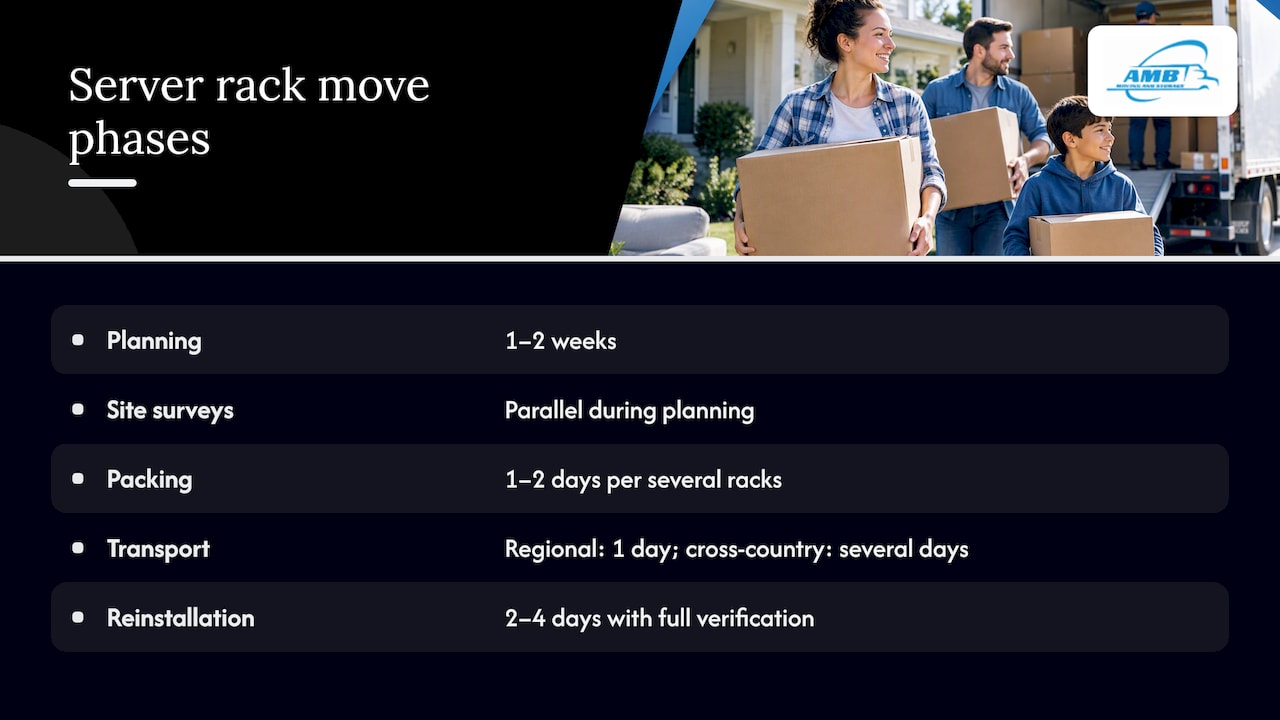
A realistic server rack move runs in five phases, and skipping ahead on any of them tends to cost more time than it saves. Planning and documentation, including elevation drawings, asset registers, and backup verification, typically take one to two weeks depending on rack count. Site surveys at both locations, covering elevator capacity, door clearances, and floor protection needs, usually run in parallel during that same window.
Depopulation and packing follow, with each rack photographed, labeled, and broken into individually packed units, generally a one- to two-day effort per several racks depending on crew size. Transport time depends entirely on distance: a regional move might take a single day, while a true cross-country relocation can run several days in a shock-rated, climate-controlled truck.
Reinstallation is the longest hands-on phase at the destination: bottom-up re-racking, cable reconnection, staged power-on, and verification gates at each tier. For a mid-sized deployment, expect reinstallation and full verification to take two to four days before the environment is declared production-ready. Building slack into each phase, rather than assuming back-to-back perfection, is what keeps a tight migration window from collapsing under one missed step.
What a server rack move actually costs
Costs break into four categories, and IT equipment moves rarely fit a flat per-mile quote the way household moves do. Packing is typically billed per cubic foot, and our professional packing services are priced at $1 to $2 per cubic foot, a relevant baseline when estimating specialty IT packing materials and labor.
Specialty item handling, which applies to high-value or delicate equipment requiring extra care, starts from $200 per our moving cost guide. Storage fees, if staging equipment between sites is required, are generally calculated per cubic foot according to common moving cost structures. Site-specific fees add up fast in commercial buildings: elevator and stair fees start from $75, and long carry charges, which apply when equipment must travel a distance from the truck to the building entrance, also start from $75, both per our moving cost guide.
Insurance is the category most IT teams underestimate. Declaring full value on server equipment costs more upfront than default coverage, but given that Released Value pays out $0.60 per pound per article under FMCSA rules, the declared-value premium is far cheaper than an uncovered loss. Transport and reinstallation labor vary by distance, crew size, and whether equipment ships crated or uncrated, so a site survey remains the only reliable way to get a firm number.
What a nationwide mover does differently on IT relocations
We build task-level runbooks for every interstate relocation, assigning a named owner and a verification step to each action rather than treating the move as one undifferentiated job. Our IT relocation checklist reflects that same discipline: specialty packing for sensitive equipment, secure storage when timelines require staging, and licensed, insured interstate transport handled by crews who have moved data center equipment before. We’re the right call when a project crosses state lines, runs on a tight window, or when your team lacks the certified lifting equipment a loaded rack move demands.
Get a quote for your server rack relocation
We start every IT relocation with a site survey and a written runbook before quoting a schedule, so you know exactly what moving your racks involves before committing. Licensed and insured for nationwide moves, we handle the interstate leg so your team can focus on the systems, not the truck. Request a quote and we will scope your move, from packing through reinstallation.
FAQ
Do server racks have wheels?
Many server racks come with caster wheels built into the base for short-distance repositioning within a single room or data hall. Casters are not rated for loaded transport over long distances, ramps, or uneven surfaces, which is why vendor guidance recommends depopulating racks before any interstate or long-distance move.
How do I secure a server rack during a move?
Secure a server rack by removing or bracing all mounted equipment, bagging and labeling hardware, and using rated straps or bracing designed for the rack’s loaded or empty weight. For any move involving a loaded cabinet, use certified rack-moving equipment rather than generic straps or dollies, since casters and improvised bracing are common failure points on uneven routes.
How do I unrack a server before a move?
Photograph and label each unit first, then disconnect cables in a documented order, starting from the top of the rack and working down. Bag hardware per unit, store drives in locked containers with a documented chain of custody, and pack each component individually rather than leaving multiple units banded together.
What is a server rack called in the industry?
Server racks are also called server cabinets, rack enclosures, or equipment racks, with “42U” describing a common full-height unit based on its internal unit count. The terminology varies by vendor, but all refer to the same standardized frame used to mount rack-compatible servers, switches, and storage units.
How much does it cost to move server racks long distance?
Costs depend on packing, transport distance, insurance valuation, and site-specific fees like elevator access or long carry charges. Packing typically runs $1 to $2 per cubic foot, specialty item handling starts from $200, and site fees like elevator or stair access start from $75 each, per our moving cost guide.
Sources
- Liability & protection | FMCSA
- Data center migration best practices: ensuring smooth relocation | Park Place Technologies
- 10 Steps to Successfully Move Server Racks and Cabinets | ServerLIFT