

TL;DR:
- A moving consultation is a free, detailed assessment that creates a customized plan and accurate estimate for long-distance relocations. It identifies logistical challenges, determines crew size, and helps prevent delays and unexpected costs. Virtual consultations are now common, offering accuracy similar to in-person surveys when clients prepare by filming their property beforehand.
A moving consultation is a professional evaluation that creates a customized moving plan tailored to your home, belongings, and schedule. The role of moving consultation is to give interstate and long-distance movers a clear, accurate picture of every logistical detail before a single box is packed. A trained relocation expert assesses your inventory, home layout, access points, and special requirements, then translates that information into a binding estimate and a structured moving day plan. Without this step, families risk cost surprises, crew shortages, and delays that could have been prevented in a single 30-minute conversation.
What happens during a moving consultation?
A pre-move survey is a free, structured assessment that typically lasts 30–60 minutes in person or 15–30 minutes via video. That time window is enough for a trained consultant to gather every detail that shapes your final moving plan and cost estimate.
During the consultation, the moving consultant covers:
- Home layout and access: Stairwells, elevator availability, parking restrictions, and narrow hallways all affect crew size and equipment choices.
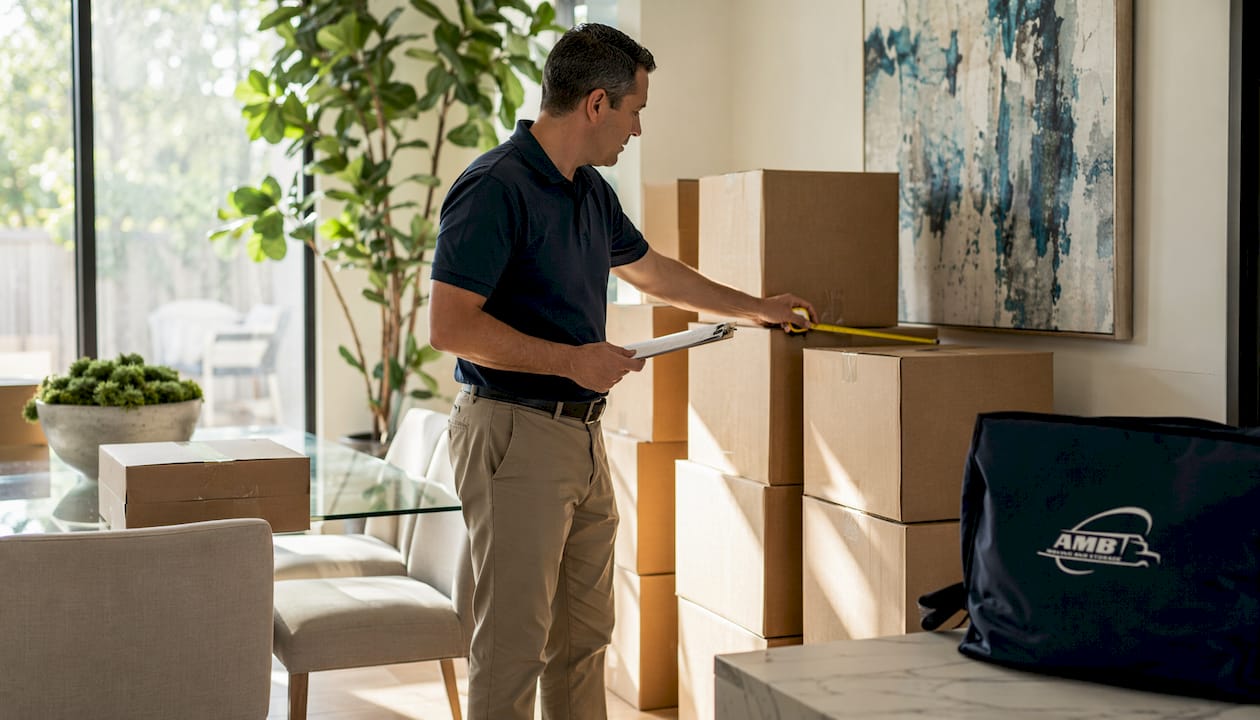
- Full inventory assessment: Room-by-room walkthrough to log furniture dimensions, quantity of boxes, and total volume.
- Special items: Pianos, artwork, antiques, and fragile electronics require custom packing materials and handling protocols.
- Packing and disassembly needs: The consultant identifies which items need professional packing and which furniture requires disassembly before loading.
- Storage requirements: If your new home is not ready on moving day, the consultant flags items that need short-term storage solutions and coordinates accordingly.
- Timeline and scheduling: Preferred move dates, flexibility windows, and delivery deadlines are recorded to build a realistic schedule.
The information gathered during this walkthrough feeds directly into your moving plan. Crew size, truck capacity, equipment lists, and packing timelines all depend on what the consultant documents. A thorough consultation eliminates guesswork on moving day.
Pro Tip: Before your consultation, walk through every room and make a written note of anything oversized, fragile, or high-value. Consultants work faster and produce more accurate estimates when clients come prepared.
Why is moving consultation important for long-distance moves?
Long-distance and interstate moving carries financial and logistical risks that local moves do not. A professional consultation addresses those risks before they become problems.
Here is why the importance of moving consultation is especially high for cross-country relocations:
-
Binding estimates protect your budget. On long-distance moves, binding estimates lock in cost based on the initial survey, preventing unexpected charges that FMCSA regulations allow under non-binding agreements. Binding estimates shift the financial risk of volume underestimation to the mover, not the family.
-
Accurate crew and equipment planning. A consultant who has seen your home knows whether you need two movers or five, a 26-foot truck or a full semi. Guessing wrong on crew size costs time and money.
-
Early identification of logistical challenges. Narrow driveways, building permit requirements for street parking, and HOA restrictions in your destination city are all issues a consultant flags in advance. Discovering them on moving day causes delays and added fees.
-
Structured scheduling reduces stress. A moving coordinator who has reviewed your consultation data becomes a single informed point of contact for scheduling, inventory tracking, and communication throughout the move. That single point of contact is critical for complex moves involving multiple stops or storage.
-
Accurate moving cost estimates. Families who skip the consultation often receive non-binding estimates that balloon at delivery. A thorough pre-move survey produces a number you can actually budget around.
The consultation is not a formality. For a family moving from Chicago to Phoenix, the difference between a thorough survey and a quick phone estimate can mean thousands of dollars and hours of moving day chaos.
How virtual moving consultations have transformed the relocation process
Virtual consultations are now the industry standard. In 2026, 70–85% of residential moves use AI-assisted asynchronous video surveys. That adoption rate reflects a genuine shift in how families prefer to interact with service providers.
The speed advantage is significant. Leads contacted within 5 minutes of inquiry are 21 times more likely to qualify than those contacted after 30 minutes. Virtual survey technology makes that response speed possible at scale, allowing moving companies to schedule consultations the same day a family submits a quote request.
Virtual vs. in-person accuracy
| Factor | Virtual consultation | In-person consultation |
|---|---|---|
| Duration | 15–30 minutes | 30–60 minutes |
| Scheduling speed | Same day or next day | 2–5 business days |
| Estimate accuracy | 91–94% weight and volume | 95–97% weight and volume |
| Best suited for | Standard household moves | Complex, high-value, or large moves |
| Consumer preference | High (remote-first trend) | Preferred for specialty items |
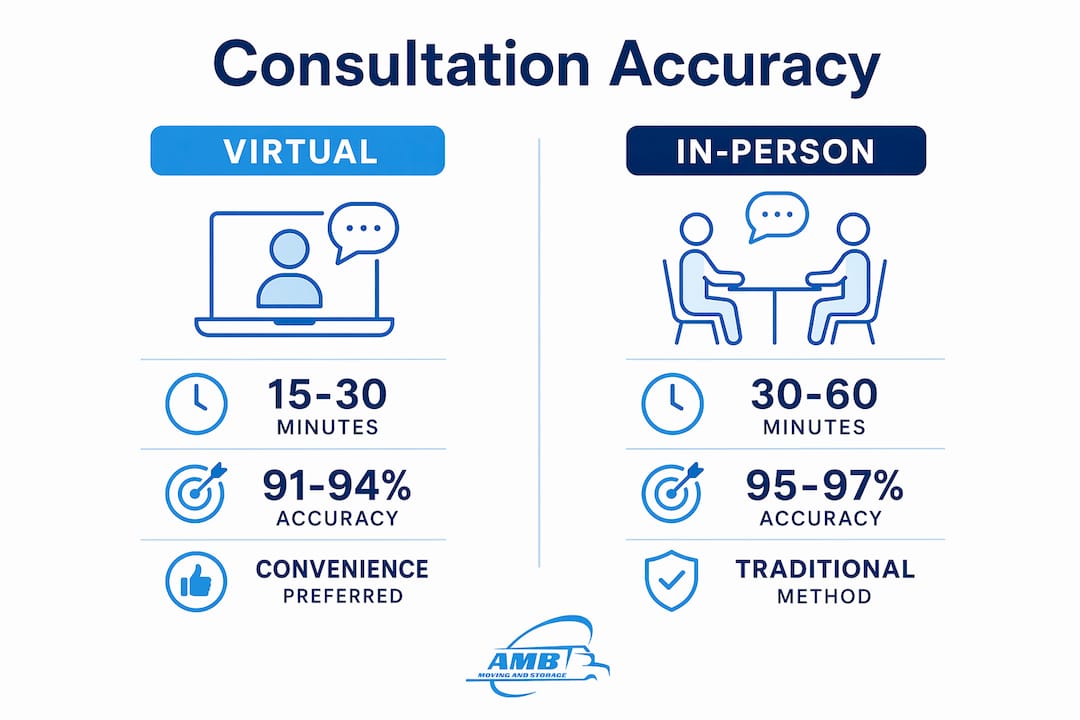
The accuracy gap between virtual and in-person surveys narrows to under 2% with proper estimator training and disciplined client preparation. That margin is acceptable for most standard household moves. For moves involving grand pianos, large art collections, or commercial equipment, an in-person survey remains the stronger choice.
Consumer preference strongly favors remote-first service interactions, with 75% of consumers maintaining digital service channel use after the pandemic. Moving consultations have followed that trend directly.
Pro Tip: For a virtual consultation, film a slow walkthrough of each room before the call. Share the video with your consultant in advance so they can prepare questions. This cuts the session time and improves estimate accuracy.
How moving consultations help tailor your moving day plan
A structured moving plan developed during the consultation addresses load sequencing, crew size, and special handling needs. That plan is what separates a smooth moving day from a chaotic one.
The consultation outcome translates into operational decisions across every phase of the move:
- Load sequencing: Heavy furniture and appliances load last and unload first. The consultant maps this sequence based on your floor plan and the destination layout, so the crew never has to move items twice.
- Special handling protocols: Items flagged during the survey, such as a marble dining table or a vintage guitar collection, receive written handling instructions. The crew knows exactly what materials and techniques to use before they arrive.
- Crew and timing allocation: A consultant who has seen a three-story home with no elevator will schedule extra crew time and a ground-floor staging area. That decision prevents injuries and protects your belongings.
- Packing coordination: The consultation identifies which rooms need professional packing services and which the family will handle independently. That split determines packing supply orders and crew arrival times.
- Storage integration: When delivery windows do not align, the consultant coordinates moving inventory management so items in storage are cataloged and retrievable without confusion.
- Communication checkpoints: The plan includes scheduled updates at key milestones, such as truck departure, estimated arrival, and delivery confirmation. Families know what to expect and when.
A consultation-backed plan also gives the crew a reference document. When questions arise on moving day, the answer is already written down. That reduces decision fatigue for both the crew and the family.
Key takeaways
A thorough moving consultation is the single most effective step a family can take to protect their budget, timeline, and belongings on a long-distance move.
| Point | Details |
|---|---|
| Consultation defines your plan | A pre-move survey produces the inventory data, crew size, and schedule that drive every moving day decision. |
| Binding estimates protect families | Surveys that result in binding estimates prevent surprise charges that FMCSA rules allow under non-binding agreements. |
| Virtual surveys are now standard | In 2026, 70–85% of residential moves use AI-assisted video surveys with accuracy rates of 91–94%. |
| Early problem detection saves money | Consultants identify access issues, permit needs, and special handling requirements before they become moving day delays. |
| Plans reduce moving day stress | Load sequencing, crew allocation, and communication checkpoints built during consultation prevent on-site confusion. |
What a good consultation actually changes
After years of coordinating long-distance moving for families across the country, the pattern is consistent. The families who struggle most on moving day are the ones who skipped the consultation or treated it as a formality.
The most common mistake is underreporting. Families forget the garage, the attic, or the storage unit down the street. A consultant who walks the property catches those items. A consultant working from a phone estimate does not. That gap in inventory shows up as a truck that is too small or a crew that runs out of time.
The second mistake is not asking questions during the consultation. This is your opportunity to negotiate clear pricing, confirm what is included in the estimate, and get service guarantees in writing. Ask specifically whether your estimate is binding or non-binding. Ask what triggers additional charges. Ask how the company handles delays at the destination. A good consultant answers all of these without hesitation.
The consultation is also the right moment to discuss relocation logistics for your specific destination. A move to a high-rise in Manhattan requires different planning than a move to a rural property in Montana. The consultant who has handled both knows what questions to ask. The family who skips the consultation finds out the hard way.
— AMB
Planning a long-distance move with Ambmovingservices
Ambmovingservices conducts thorough pre-move consultations for every long-distance moving client, whether the move is across two states or across the country. Each consultation produces a customized moving plan, a transparent cost estimate, and a dedicated point of contact who manages scheduling and communication from start to finish.
Families planning interstate relocations can request a free quote directly through Ambmovingservices. The process starts with a consultation, either in person or via video, and results in a binding estimate and a clear moving day plan. Ambmovingservices is licensed, insured, and compliant with FMCSA regulations, so every estimate and service guarantee is backed by federal standards. Get your free moving quote and start your relocation with a plan built around your home, your schedule, and your budget.
FAQ
What is a moving consultation?
A moving consultation is a free pre-move survey, lasting 30–60 minutes in person or 15–30 minutes via video, where a relocation expert assesses your inventory, home layout, and logistics to produce a customized moving plan and cost estimate.
How does a moving consultation affect my moving cost?
A thorough consultation produces a binding estimate that locks in your price based on the actual survey. Under FMCSA rules, non-binding estimates can result in higher charges at delivery, so a detailed consultation directly protects your budget.
Are virtual moving consultations as accurate as in-person surveys?
Virtual surveys achieve 91–94% accuracy in weight and volume estimates compared to 95–97% for in-person surveys. The gap narrows to under 2% when the estimator is well-trained and the client prepares a room-by-room video walkthrough in advance.
When should I schedule a moving consultation?
Schedule your consultation as early as possible, ideally 6–8 weeks before your move date for long-distance relocations. Early scheduling gives the moving company time to allocate crew, equipment, and truck capacity accurately.
Do I need a moving consultation for a local move?
Local moves with minimal inventory may not require a formal consultation. For complex or long-distance moves, a consultation is the most effective way to prevent cost surprises, crew shortages, and moving day delays.