


TL;DR:
- Moving inventory management tracks and documents household or business belongings during relocation, ensuring protection against loss and damage. It involves record-keeping from pre-move documentation to delivery verification, with digital systems offering verifiable timestamps, photos, and condition notes that improve accuracy and dispute resolution. Proper planning and early inventory preparation help control costs, verify item conditions, and facilitate a smoother, more reliable long-distance or interstate move.
Inventory management in moving is the systematic process of documenting, tracking, and controlling every item belonging to a household or business throughout a relocation. The industry standard term is “moving inventory control,” and it functions as both a logistical tool and a legal record. For long-distance moving and interstate relocations, this process is not optional. It determines whether your belongings arrive safely, whether disputes get resolved quickly, and whether your moving cost estimates reflect reality. Ambmovingservices applies structured inventory protocols on every move to protect clients from loss, damage, and billing surprises.
What is inventory management in moving?
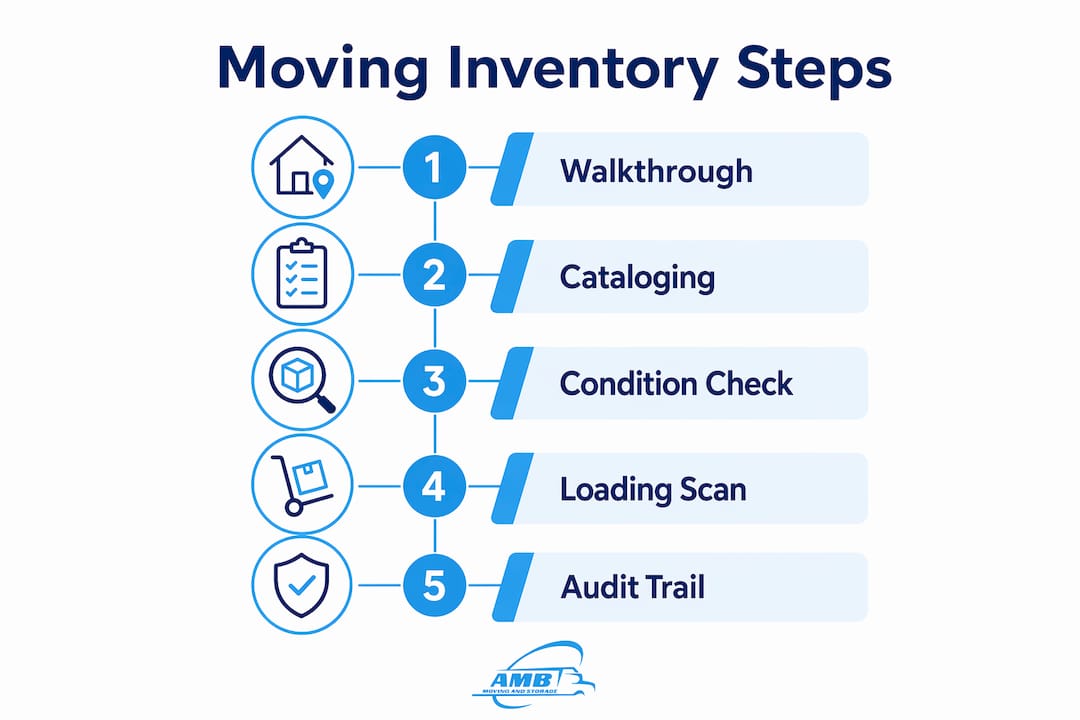
Moving inventory management is the end-to-end system movers and clients use to record, label, and track every item from origin to destination. It covers three distinct phases: pre-move documentation, in-transit tracking, and delivery verification. Each phase builds on the last, creating a complete record of what was packed, in what condition, and where it went.

The pre-move phase starts with a walkthrough of your home or office. A professional mover catalogs items by room, notes their condition, and assigns each one a unique identifier. Digital inventory systems combine labels, scans, photos, and timestamps to track belongings through transport, storage, and multiple handling points. This creates a chain-of-custody audit trail that reduces lost or misplaced items and clarifies shipment status at any moment.
On loading day, movers scan each item as it enters the truck. Condition codes, such as “scratched,” “dented,” or “good,” are assigned and logged. Condition codes and photos taken at loading establish the baseline in liability contracts, making disputes about damage easier to resolve. At delivery, the same items are scanned again and checked against the original log.
Pro Tip: Ask your mover to walk you through the inventory scan at loading. Watching each item get logged in real time gives you a chance to flag condition issues before the truck leaves.
The result of this process is a timestamped audit trail. Digital timestamped audit trails record chain of custody across multiple handlers and locations, preventing the common dispute where no party accepts responsibility for damage or loss. That paper trail is what turns a frustrating claim into a resolved one.
What are the key components of moving inventory?
Moving inventory has two distinct layers: the personal inventory you create and the official mover’s inventory the moving company produces. Understanding the difference between them is one of the most overlooked aspects of relocation planning.
Personal inventory vs. official mover’s inventory
The mover’s official inventory primarily limits liability and serves as the legal reference document. Your personal inventory helps you track contents but carries no legal weight in a dispute. Both are necessary, and they serve different purposes.
Key components of a complete moving inventory system include:
- Item identification: Each piece gets a unique barcode or QR code linked to photos and condition notes.
- Condition documentation: Written descriptions and photographs taken before loading establish the item’s state at pickup.
- Room categorization: Items are grouped by room or area, making unpacking and verification faster.
- Digital bill of lading: A client-signed record that secures the chain of custody and serves as the legal contract for the shipment.
- Timestamps: Every scan, photo, and status update is time-stamped to create a verifiable sequence of events.
Paper lists vs. digital tracking
Paper inventory sheets are still used by some movers, but they carry real risks. Handwriting errors, missing condition notes, and lost pages all create gaps in the record. Digital automation replaces traditional paper sheets to improve accuracy and accountability. A digital system updates in real time, can be accessed remotely, and produces reports that hold up in claims proceedings.
The practical difference shows up most clearly during disputes. A paper list might say “lamp, good condition.” A digital record shows a photo of the lamp, the exact condition code assigned, the name of the mover who logged it, and the time it was loaded. That level of detail changes the outcome of a claim.
Why is inventory management critical for long-distance and interstate moves?
Long-distance and interstate moves involve multiple handlers, storage facilities, and transport modes. A sofa that leaves your home in Chicago may pass through a warehouse in St. Louis before arriving in Dallas. Each handoff is a point where items can be lost, damaged, or misrouted. Without a documented inventory, proving what happened and when becomes nearly impossible.
“Automation and real-time tracking enhance overall moving service quality and customer trust, and are now seen as a critical differentiator in the moving industry.” — LogiMove
Digital inventory controls shift moving companies from reactive to proactive management, raising customer satisfaction by reducing claims resolution time and increasing real-time shipment visibility. That shift matters most on cross-country moves where the client cannot physically monitor the shipment.
The legal implications are equally significant. The mover’s inventory is a legal document that records item condition at pickup and is the primary reference for damage dispute resolution upon delivery. Federal regulations governing interstate movers require this documentation. Without it, a client’s ability to file a successful claim is severely limited.
Inventory data also directly affects moving cost estimates. An accurate item count and weight estimate, produced during the pre-move walkthrough, prevents billing surprises at delivery. Movers who use detailed inventories produce more accurate quotes because they know exactly what they are transporting. For high-value or fragile items, the inventory record also triggers appropriate packing and handling protocols, reducing the risk of damage before the truck even leaves.
Pro Tip: For interstate relocations, photograph every high-value item individually and keep copies of those photos on your phone. If a claim arises, your personal photos combined with the mover’s digital record create an airtight case.
How can you optimize your moving inventory for a smoother move?
The most effective approach to moving inventory starts well before moving day. Planning your inventory at least 2 months before moving helps categorize belongings by room, identify special handling needs, and supports accurate moving quotes. Starting early also gives you time to declutter, which reduces both the inventory size and the final cost.
Follow these steps to build a complete and useful personal inventory:
- Start room by room. Beginning with one room and counting boxes, furniture, fragile items, and noting access difficulties produces an accurate and organized list. Do not try to catalog the entire home at once.
- Photograph every item. Take photos from multiple angles, especially for electronics, antiques, and furniture. Date-stamp the photos using your phone’s camera settings.
- Note existing damage. Record scratches, dents, and wear before the mover arrives. This protects you from being held responsible for pre-existing conditions.
- Assign categories. Label items as fragile, high-value, or standard. This helps your mover allocate the right packing materials and handling care.
- Share your inventory with your mover. Give the moving company your personal list before the walkthrough. It speeds up the official inventory process and reduces the chance of items being missed.
Common mistakes that create problems at delivery include skipping condition notes, leaving items uncategorized, and failing to update the inventory when you add or remove items from the move. An incomplete list is almost as problematic as no list at all. Review your residential moving checklist alongside your inventory to make sure nothing falls through the cracks.
Pro Tip: Create a separate “do not move” list for items you are keeping behind, donating, or selling. Giving this list to your mover prevents accidental loading and keeps your official inventory clean.
Key takeaways
Effective moving inventory management is the single most reliable way to protect your belongings, resolve disputes, and control costs during a long-distance or interstate relocation.
| Point | Details |
|---|---|
| Inventory is a legal document | The mover’s official inventory is the primary reference for damage claims and liability disputes. |
| Digital tracking outperforms paper | Barcodes, QR codes, photos, and timestamps create verifiable records that paper lists cannot match. |
| Start planning two months early | Early inventory planning supports accurate quotes and identifies special handling needs before moving day. |
| Personal and official inventories differ | Your personal list tracks contents; only the mover’s signed inventory carries legal weight in a claim. |
| Long-distance moves need chain-of-custody records | Multiple handlers and storage points make timestamped audit trails non-negotiable for interstate relocations. |
What I’ve learned about inventory after years in long-distance moving
Most clients come to us thinking a moving inventory is a packing list. It is not. A packing list tells you what is in a box. A moving inventory tells you what condition that box was in when it left your home, who handled it, when it was loaded, and whether it arrived intact. That distinction matters enormously when something goes wrong 1,200 miles from home.
The most common failure I see is incomplete condition documentation. A client will note “TV” on their personal list but skip the photo and the condition note. Then the TV arrives with a cracked screen, and there is no baseline record to compare against. The claim stalls. Everyone is frustrated. The fix costs nothing and takes two minutes.
Digital inventory tools have changed this industry significantly. When Ambmovingservices uses a digital system that timestamps every scan and links photos to each item record, the entire claims process becomes faster and fairer for everyone. Clients who engage with that process, who ask to see the inventory log and who provide their own photos, get better outcomes. Proactive clients are harder to shortchange.
My honest advice: treat your inventory like a legal document from day one, because it is one. Review it before you sign the bill of lading. Flag anything that looks wrong. A two-minute review at pickup can save weeks of dispute resolution later.
— AMB
Ambmovingservices and your long-distance move inventory
Ambmovingservices brings structured inventory management to every long-distance and interstate move it handles. Every shipment gets a digital item log with condition codes, photographs, and timestamped scans at loading and delivery. That record protects you if anything goes wrong and gives you real-time visibility into your shipment status.
Whether you are relocating a household across three states or moving a commercial office nationwide, Ambmovingservices builds the inventory documentation your move requires. Get a detailed, no-obligation quote and see how professional inventory control makes your relocation safer and more predictable. Request your moving quote today and get started with a team that treats your belongings as carefully as you do.
FAQ
What is a moving inventory?
A moving inventory is a detailed record of every item being relocated, including condition notes, photographs, and unique identifiers. The mover’s official version is a legal document used to resolve damage or loss claims.
What is inventory tracking in moving?
Inventory tracking in moving is the real-time monitoring of items using barcodes, QR codes, and digital logs from loading through delivery. It creates a chain-of-custody record that shows who handled each item and when.
Why does inventory management matter for interstate moves?
Interstate moves involve multiple handlers and storage points, making documented inventory control the only reliable way to prove item condition and location at each stage of the shipment.
How early should I start my moving inventory?
Start your personal inventory at least two months before your move date. Early planning supports accurate moving cost estimates and gives you time to identify items that need special handling or packing.
What is the difference between a personal inventory and the mover’s inventory?
Your personal inventory tracks what you own and helps you organize the move. The mover’s official inventory is a signed legal document that establishes item condition at pickup and governs liability throughout the relocation.