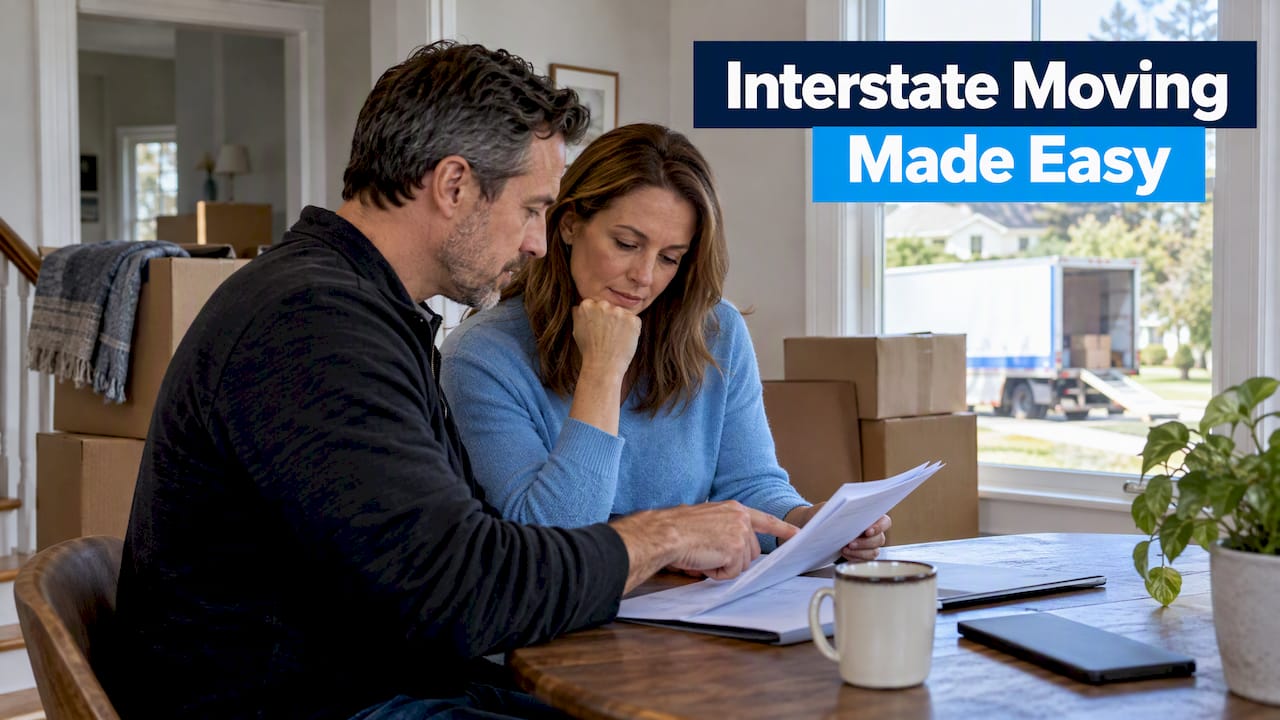
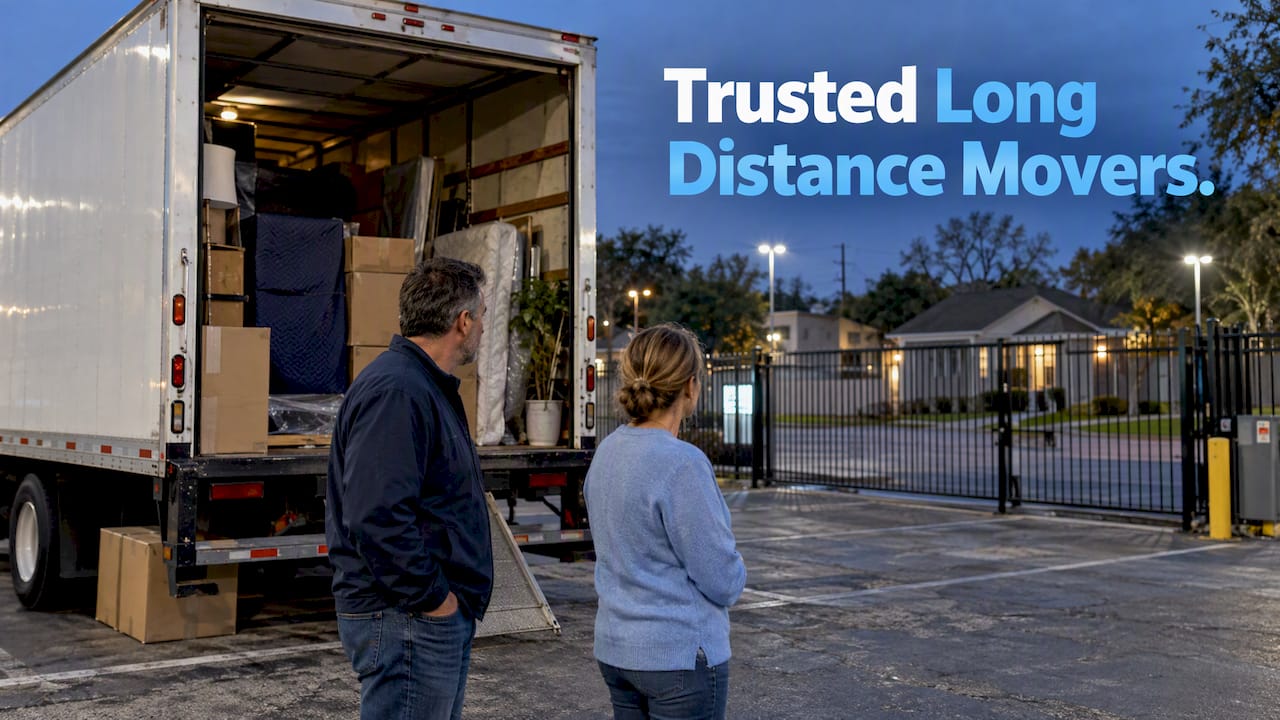

For an interstate or cross-country move, the safest overnight option for a loaded moving truck is a mover-secured yard or an arranged private site. A municipal permit for curb parking is a workable second choice only when local rules and your truck’s dimensions allow it. Whichever route you choose, lock the cab, chock the wheels, and check every tie-down and door latch before you walk away, and confirm permit rules and truck size limits with your city before loading day.
TL;DR:
- A mover-secured yard or short-term storage is the safest overnight parking for a loaded truck, especially when it will sit more than one night.
- Only a municipal permit issued well in advance is suitable for short stays in areas where local rules clearly permit curb parking, and it does not override posted restrictions.
- Written permission and liability confirmation are essential before parking in private driveways or lots, which are locations that many cities restrict for large vehicles.
- Always verify the exact address rules, secure a permit or permission, and photograph the scene to ensure enforceability and avoid tickets or towing.
- Proper cargo securement, such as checking tie-downs and locking doors, is critical before leaving a truck unattended overnight to prevent load shifting or theft.
Table of Contents
- Practical options: permit, private property, or a mover-secured yard
- Move-day checklist: what to confirm, record, and inspect
- Permit examples: timelines, fees, and common limits
- Cargo securement and safety checks before leaving a loaded truck
- How professional movers handle overnight stops
- Cost and timing expectations to budget for
- The bottom line on overnight truck parking
- Safety considerations for overnight truck parking locations
- Maintaining engine and vehicle systems overnight
- Guidelines for overnight parking in commercial or industrial areas
- How truck size and type affect your parking options
- AMB perspective: what years of long-distance moves have taught us
- How we help you avoid the overnight-parking guesswork
- FAQ
- Sources
Practical options: permit, private property, or a mover-secured yard
Three realistic choices exist when you can’t finish unloading in a single day, and each fits a different situation.
A municipal moving permit lets you hold curb space in front of a specific address for a set window. Cities issue these through a streets or transportation department, and most limit them to a single address, a specific vehicle, and a short time frame of one to several days. The tradeoff is enforcement risk: a permit covers only the restriction it names, and it does not cancel out street sweeping schedules, fire hydrant clearances, or residential commercial-vehicle bans that Houston and similar cities enforce with citations, immobilization, or towing.
A private driveway or lot works when a neighbor, employer, or business owner gives explicit written permission. Get that permission in writing, confirm who carries liability if the truck is damaged or damages the property, and measure the driveway or lot against your truck’s actual footprint before you commit to it.
A mover-secured yard or short-term storage facility is the option professional crews lean on most for a loaded truck sitting overnight, because it removes the guesswork around local ordinances entirely and keeps the cargo behind a controlled gate rather than on a public street.
Use these rules of thumb to decide:
- Choose a mover-secured yard when the truck is loaded and will sit more than one night.
- Choose a municipal permit when the stay is short and local rules clearly allow it.
- Choose a private lot only with written permission and a clear answer on insurance.
Move-day checklist: what to confirm, record, and inspect
Before you leave a loaded truck anywhere overnight, work through this sequence in order:
- Verify jurisdiction rules for the exact address. Call the local parking or transportation department rather than assuming a neighboring block follows the same rule.
- Secure a permit number or written property-owner permission, and keep a copy in the truck’s cab at all times.
- Record the truck or trailer’s length and weight along with the dates and times it will be parked, and post any required signage or permit placard exactly as the city instructs.
- Photograph the scene: curb markings, posted signs, and the parked truck showing the permit or signage in view.
- Check cargo securement: tie-downs, load bars, door latches, and tarps, then set the parking brake and chock the wheels.
- Notify your mover and confirm the pickup window, leaving a working phone number visible alongside the permit.
Pro Tip: Take the permit and signage photos the moment you park, not the next morning. Time-stamped photos are your best evidence if a parking enforcement officer questions the vehicle.
Skipping the jurisdiction check is the most common mistake. A permit issued for one block doesn’t carry over to a loading zone two doors down, and officers ticket based on posted signage at the exact spot, not on the paperwork in your glove box.
Permit examples: timelines, fees, and common limits
Permit rules differ block by block, but a few cities illustrate the pattern well enough to plan around.
- Philadelphia requires a Temporary No Parking permit for moving trucks, asks for at least four full business days’ notice, and provides posted no-parking signs through the local police district; fees run by the 40-foot segment per day, with Center City priced higher than outlying areas, typically between $25 and $50.
- Pittsburgh’s moving-truck permit is valid for two days, costs approximately $50 per truck, and the city advises allowing up to a week for review. The permit is tied to the address on the application and cannot be extended, so an unfinished job means reapplying from scratch.
- Santa Monica’s Overnight Oversized Parking Permit requires ID, proof of residency, and DMV registration, limits use to a two-block radius of the applicant’s address, and explicitly does not override other posted restrictions like street sweeping or metered zones.
- Smaller cities run lighter versions of the same system. San Dimas sells overnight permits for a few dollars a night for passenger vehicles but restricts or excludes trailers and larger vehicles entirely.
The lesson across every city: a permit is address-specific, vehicle-specific, and time-limited, and it never substitutes for reading the full posted sign at your actual curb.
Cargo securement and safety checks before leaving a loaded truck
Federal cargo securement principles exist to keep a load from shifting in ways that affect vehicle stability or let items fall, and that standard doesn’t pause just because the truck is parked for the night. The FMCSA’s cargo securement rulemaking sets expectations for tie-down working load limits and proper installation, and a quick inspection before you walk away catches most problems before they become overnight ones.
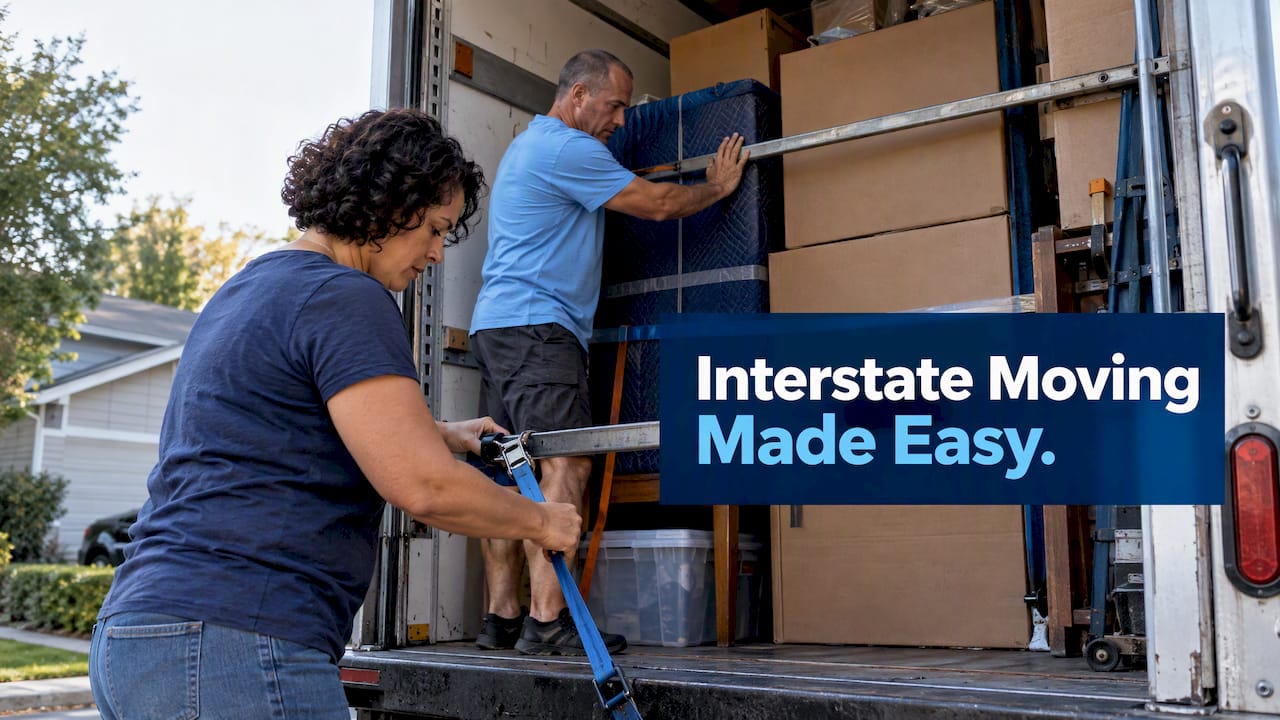
Before locking up, check tie-down tension and condition, confirm load bars and blocking or bracing haven’t loosened during the day’s driving, latch and lock every door, and throw a tarp over anything exposed to weather.
An overnight stop is also when cargo risk quietly rises. Boxes or furniture that shifted slightly during the day can settle against a door latch, a loose tie-down can work free overnight, and an unlocked roll-up door is an open invitation. Running the same five-minute check every evening of a multi-day move costs far less than discovering a shifted load or a theft claim the next morning.
How professional movers handle overnight stops
Professional interstate crews default to secured yards or contracted storage when a loaded truck has to sit overnight, mainly because it removes the variables a curbside permit can’t control: no weather exposure risk, no reliance on a sign staying posted, and a gated lot instead of open street access.
Before you hand off responsibility for an overnight stop, ask your mover these questions:
- Do you have secure yard or storage access along this route, and is it insured for a parked, loaded vehicle?
- Who is liable if cargo is damaged or stolen while staged overnight?
- How do you schedule the handoff so the truck doesn’t sit longer than planned?
- If curb parking is the only option, can you show me the permit before the truck is left unattended?
Insist on mover-arranged staging whenever the truck will be loaded and unattended for more than a few hours. Private-site permission is acceptable only when you have it in writing and the mover confirms it doesn’t create a gap in coverage.
Cost and timing expectations to budget for
Municipal permit fees typically run from $25 to $50 or more per day per truck, and lead times range from 48 hours to a full week depending on the city, so apply as soon as your moving date is set. Storage or mover-yard fees are usually a modest per-day charge, often cheaper than the cost of a tow, impound fee, or a damaged or stolen item if a curbside stop goes wrong. Last-minute permit applications or last-minute storage requests tend to cost more and sometimes can’t be processed in time at all, so lock in your plan before loading day rather than the morning of.
The bottom line on overnight truck parking
Default to a mover-secured yard or contracted storage for a loaded truck staying overnight. Fall back to a municipal permit only when local rules clearly allow it and you’ve applied with enough lead time. Confirm your truck’s dimensions and call your local parking authority or your mover today, before loading day arrives.
Safety considerations for overnight truck parking locations
Lighting and visibility matter as much as legality once a truck is parked for the night. A curb spot under a working streetlight, in view of occupied homes or active businesses, discourages tampering far more than a quiet side street with no foot traffic. Gated lots and mover yards typically add surveillance cameras and controlled access, which is part of why professional crews favor them over open curb parking for anything loaded.
If curb parking is your only option, avoid isolated industrial frontages, dead-end streets, and blocks with a history of vehicle break-ins in your area; a quick call to local police nonemergency lines can tell you whether a specific block has had recent issues. Park nose-out when possible so you can see the area ahead of the cab, and avoid leaving the truck in the same unattended spot for multiple consecutive nights, since a predictable pattern is easier to target than a one-night stop.
A locked cab and a visible permit or signage won’t stop a determined thief, but they do remove the easy opportunities: an unlocked door, a cargo box visible through a window, or a truck that looks abandoned. Treat the choice of location with the same weight as the choice of permit. A legal spot in a poorly lit, isolated area is not actually a safer option than a slightly less convenient spot under a streetlight near other people.
Maintaining engine and vehicle systems overnight
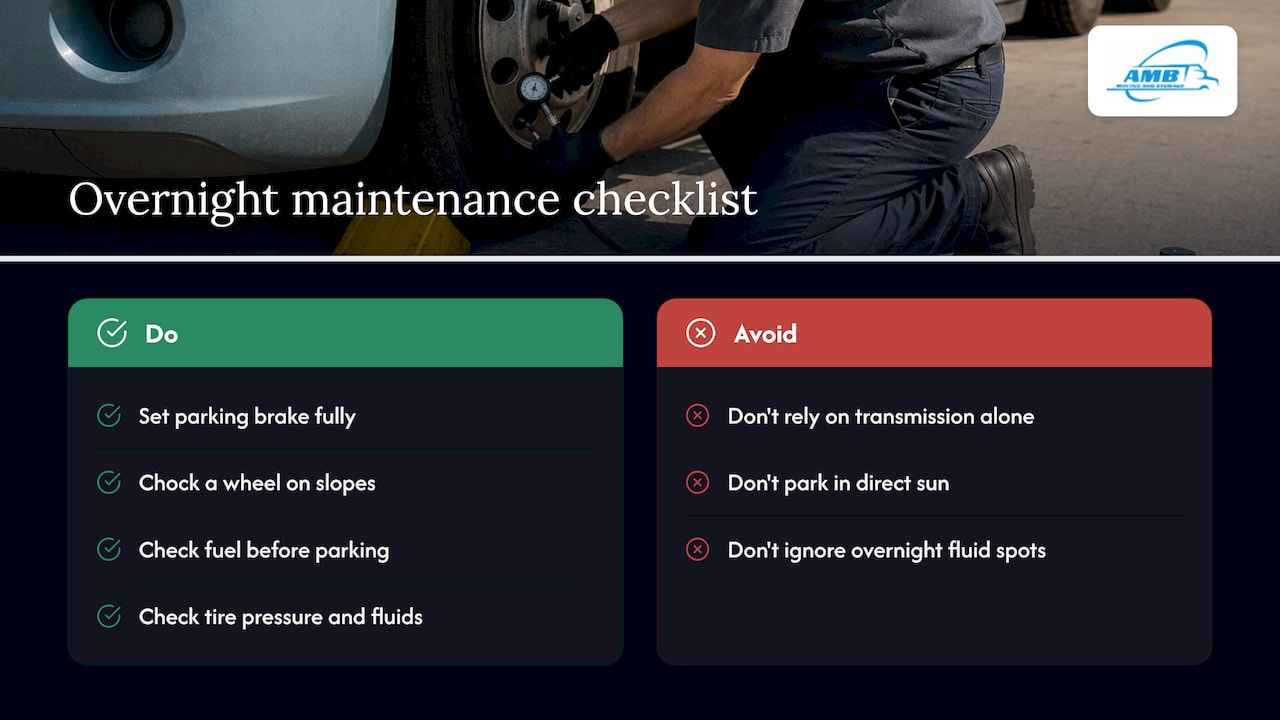
A rental or company moving truck sitting overnight still needs basic mechanical attention, especially on a multi-day interstate run. Set the parking brake fully rather than relying on the transmission alone, and chock at least one wheel on a slope of any kind. Check the fuel level before parking for the night so you’re not searching for an open station at 6 a.m. in an unfamiliar town.
In cold weather, a diesel truck left overnight in freezing temperatures can be harder to start the next morning; plugging into a block heater where one is available, or parking somewhere sheltered from direct wind, reduces that risk. In hot climates, a truck sitting in direct sun all day can see cabin and cargo-area temperatures climb enough to affect temperature-sensitive items, so shade matters as much for the engine bay as for anything you’re hauling.
Glance at tire pressure and look for fresh fluid spots under the vehicle before you drive off the next morning. A slow leak that wasn’t obvious the day before often shows up as a small puddle overnight, and catching it before you’re back on the interstate beats discovering it fifty miles down the road. If a trailer or box truck needs more involved mechanical attention before a long leg of the trip, mobile fleet services like Premier Fleet Repair’s maintenance guidance cover the kind of pre-trip inspection points worth running through before you resume driving.
Guidelines for overnight parking in commercial or industrial areas
Commercial and industrial zones often look like easy overnight options because the streets are wider and businesses are closed, but the same permit and signage rules still apply. Many municipalities restrict overnight parking of large vehicles in commercial districts during specific hours, commonly overnight windows meant to keep loading docks and fire lanes clear for the next business day.
Private commercial lots sometimes allow overnight parking with the property owner’s permission, which puts you back in the same written-permission situation as a private driveway: get it in writing, confirm liability, and don’t assume an empty lot is an invitation. Loading docks and designated truck bays are usually reserved for the business that controls them, and parking in one without clearance risks a tow regardless of how empty it looks at 9 p.m.
Industrial areas can also carry weight and length restrictions tied to road surface or bridge limits that residential streets don’t have, so a permit valid in a residential zone may not automatically cover an industrial access road. If your move involves a business relocation and a vendor has offered a lot or dock for the night, treat that offer the same way you’d treat a private driveway: confirm it in writing before you count on it.
How truck size and type affect your parking options
A 10-foot cargo van and a 26-foot box truck face very different rules at the same address. Most residential permits and private-lot arrangements assume a single vehicle within a stated length, and oversized vehicles beyond that threshold are frequently excluded outright, as seen in smaller-city programs like San Dimas’s overnight permit, which restricts RVs and trailers even though it allows standard passenger vehicles.
Weight matters separately from length. Some municipal codes cap the gross vehicle weight allowed on residential streets regardless of how short the truck is, which can rule out a loaded box truck even when its length would otherwise qualify. Trailers add another layer: a permit written for a single truck doesn’t necessarily cover a truck-and-trailer combination, and some cities require a separate application or flatly prohibit trailer parking in residential zones.
Before you assume a permit applies to your situation, check the vehicle description on the application itself. A permit approved for a 20-foot truck doesn’t protect a 26-foot truck parked in the same spot, and enforcement officers measure what’s actually on the street, not what was requested on the form.
AMB perspective: what years of long-distance moves have taught us
We default to secured yards, documented permits, and early communication with every customer rather than hoping curb parking works out. We prioritize confirming a plan thoroughly rather than leaving a loaded truck to chance.
— AMB
How we help you avoid the overnight-parking guesswork
We build overnight contingencies into every long-distance move we plan, so you’re never left deciding at 8 p.m. where a loaded truck should sit for the night.
- Long-distance and interstate moving with staging built into the schedule, not left for you to improvise.
- Secure short-term storage when a load needs to sit safely between legs of a cross-country move.
- Professional packing and specialty item handling for pianos, safes, and other items worth extra protection during any overnight stop.
Get a free moving quote and we’ll map out the overnight logistics for your specific route before moving day arrives.
FAQ
Can I park a moving truck on the street overnight?
In many cities you need a temporary no-parking or moving permit to legally hold curb space overnight, and the rules are address-specific. Always confirm with your city’s parking or transportation department before assuming a public street is an option.
How much does a moving truck parking permit cost?
Fees typically range from $25 to $50 or more per day per truck depending on the city and zone, with Pittsburgh charging about $50 per truck for a two-day permit. Smaller cities sometimes charge only a few dollars per night for passenger vehicles, though trailers and larger trucks often face separate restrictions.
How far in advance do I need to apply for a moving permit?
Lead times vary by city: Philadelphia asks for at least four full business days, while Pittsburgh advises allowing up to a week for review. Apply as soon as your moving date is confirmed rather than waiting until the week of the move.
Does a parking permit override street sweeping or no-parking signs?
No. A moving permit covers only the specific restriction it was issued for, and Santa Monica’s program explicitly states that it does not override other posted rules like street sweeping or metered zones. Always check for additional posted signage at the exact curb spot.
What’s the safest place to leave a loaded moving truck overnight?
A mover-secured yard or contracted short-term storage facility is generally the safest overnight option for a loaded truck, since it removes exposure to weather, theft, and local enforcement risk. If that’s not available, a private lot with written permission is the next best choice, followed by a properly obtained municipal permit.
Sources
- Temporary No Parking for Moving Truck, Container Placement & Dumpster Placement | City of Philadelphia Streets Department
- Moving Permit Information Sheet | City of Pittsburgh (DOMI) 2026
- Overnight Oversized Parking Permit application and guidelines | City of Santa Monica
- Large vehicle enforcement | City of Houston