


Choosing the right interstate moving company can make or break your relocation experience. With over 7,000 registered interstate carriers operating across the United States, selecting a reliable partner requires more than comparing prices online. Hidden fees, damaged belongings, and unreliable service plague thousands of families each year who rush into decisions without proper research. This guide provides you with expert-backed strategies to identify trustworthy movers, verify credentials, interpret contracts, and prepare for a smooth transition to your new home.
Table of Contents
- Key takeaways
- Understanding your moving needs and priorities
- Researching and verifying moving companies
- Evaluating cost estimates and service agreements
- Preparing for and managing your move day
- Choose AMB Moving Services for your interstate relocation
- FAQ
Key Takeaways
| Point | Details |
|---|---|
| Know your move type | Identify whether your relocation is job related, family oriented, or retirement so you know which services and timing matter most. |
| Reliability matters more than price | Choosing a carrier with strong complaint resolution, years in business, and route expertise lowers the risk of delays and damaged goods. |
| Verify licensing and DOT status | All interstate movers must be registered with the FMCSA and hold a DOT number, so use the FMCSA tool to confirm licensing, insurance, and safety history. |
| Preparation and communication reduce stress | Inventory special items, confirm timelines, and maintain clear, ongoing communication to prevent delays and misunderstandings. |
Understanding your moving needs and priorities
Before you contact a single moving company, spend time identifying what your specific relocation requires. Your move type directly impacts which services matter most and what you should expect to pay. According to FMCSA moving industry statistics, job-related moves account for 15.21% of interstate relocations while family moves represent 14.27%, and these different motivations create distinct priorities for timing, budget flexibility, and service levels.
Start by categorizing your move. Job relocations often come with tight deadlines and employer reimbursement, making speed and documentation critical. Family moves for lifestyle changes typically allow more flexibility but require careful handling of sentimental items. Retirement relocations may involve downsizing and storage coordination. Each scenario demands different expertise from your moving company.
Next, inventory your special requirements. Do you own a piano, antique furniture, or valuable artwork that needs custom crating? Will you transport vehicles separately or need the mover to handle them? Do you require temporary storage between your move-out and move-in dates? Companies specializing in these services charge more but deliver results that generalists cannot match. Create a checklist of must-have services versus nice-to-have options to guide your research.
Budget planning requires honest assessment of what you can afford versus what quality service costs. The temptation to choose the lowest bid is strong, but data shows this approach correlates with higher complaint rates and service failures. Mid-tier pricing from established carriers typically reflects realistic labor costs, proper insurance coverage, and professional equipment. When reviewing moving cost considerations, factor in the total value of your belongings and what replacing damaged items would cost.
Pro Tip: Companies that specialize exclusively in interstate moves understand federal regulations, multi-state logistics, and long-distance coordination far better than local movers who occasionally take long-distance jobs. Their expertise reduces your risk significantly.
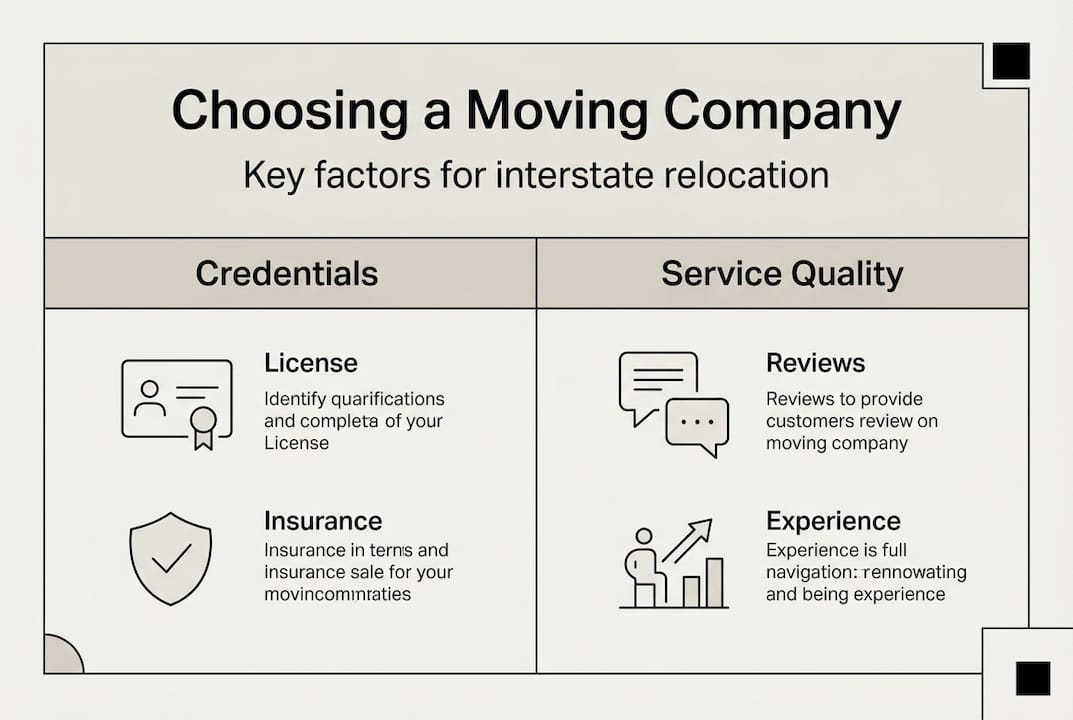
Prioritize reliability metrics over price alone. A company’s years in business, complaint resolution record, and specialization in routes similar to yours matter more than saving a few hundred dollars. Research shows that choosing based solely on the lowest estimate increases your likelihood of experiencing delays, damaged goods, or surprise fees. Review the full range of moving company services to understand what comprehensive support looks like and what corners budget movers cut to offer lower prices.
Researching and verifying moving companies
Once you know what you need, begin systematic research to identify legitimate, qualified companies. The moving industry attracts both professional carriers and fraudulent operators, making verification your most important protection step. Every interstate moving company must register with the Federal Motor Carrier Safety Administration and obtain a U.S. Department of Transportation number to operate legally.

Visit the FMCSA website and use their search tool to verify any company’s DOT number, licensing status, insurance coverage, and safety record. This free government resource shows you complaint history, out-of-service orders, and whether the company maintains required insurance levels. A clean FMCSA record does not guarantee perfect service, but problems in this database signal serious red flags you should not ignore.
Review analysis requires more nuance than checking star ratings. According to Move.org’s interstate moving research, review volume matters more than perfect scores, and evidence of resolved complaints demonstrates better customer service than companies with suspiciously few reviews. Read beyond the ratings to understand specific experiences. Do complaints mention the same problems repeatedly? Does the company respond professionally to negative feedback and work toward resolution? A company with 500 reviews averaging 4.2 stars and visible problem-solving often outperforms one with 20 perfect reviews.
| Verification step | Tool or resource | What it reveals |
|---|---|---|
| Check DOT license | FMCSA website database | Legal operation status and federal compliance |
| Review insurance | FMCSA records | Cargo and liability coverage levels |
| Read complaint history | Better Business Bureau | Patterns of problems and resolution efforts |
| Verify physical address | Google Maps and state records | Legitimate business location versus mail drop |
| Check years in business | State business registration | Company stability and experience |
Insurance and bonding protect your belongings if something goes wrong. Federal law requires interstate movers to offer basic liability coverage at 60 cents per pound per item, but this minimal protection leaves you severely undercompensated for damage. Quality companies offer full-value protection options and clearly explain coverage differences. Ask specific questions about what their insurance covers, exclusion clauses, and the claims process before you sign anything.
Watch for common scam warning signs that indicate you should walk away immediately. Unusually low estimates that undercut competitors by 30% or more often precede bait-and-switch tactics where prices balloon after loading your belongings. Companies that refuse in-home estimates for large moves or demand large cash deposits upfront operate outside industry norms. Lack of a physical business address, pressure to sign contracts immediately, or reluctance to provide references all signal potential fraud.
Pro Tip: Use the FMCSA’s Protect Your Move website to access official complaint data, understand your rights, and verify that any company you consider has active federal authority to transport household goods across state lines.
For detailed instructions on checking credentials, follow the comprehensive steps in this licensed interstate moving verification guide. Understanding interstate moving regulations helps you recognize when companies cut corners or operate outside legal requirements.
Evaluating cost estimates and service agreements
Moving estimates come in three distinct formats, and understanding the differences protects you from surprise costs. Binding estimates guarantee a fixed price regardless of actual weight, provided you do not add items or services after signing. Non-binding estimates provide an approximate cost based on estimated weight, with final charges determined after weighing your shipment. Binding not-to-exceed estimates cap your maximum cost while allowing lower charges if actual weight comes in under the estimate.
| Estimate type | Price guarantee | Best for | Risk level |
|---|---|---|---|
| Binding | Fixed total cost | Budget certainty, exact inventory | Low if inventory accurate |
| Non-binding | Approximate only | Flexible moves, uncertain inventory | High for cost overruns |
| Binding not-to-exceed | Capped maximum | Protection with potential savings | Low with upside potential |
According to FMCSA industry data, the contrast between choosing low-price movers versus reliability-focused companies shows up most clearly in hidden fees and service quality. Request detailed written estimates from at least three companies and compare line items carefully rather than just total prices. Legitimate movers provide itemized breakdowns showing transportation charges, packing services, special handling fees, and insurance costs separately.
Common hidden fees catch unprepared customers off guard on moving day. Watch for charges related to:
- Stair carry fees for buildings without elevators or ground-floor access
- Long carry charges when the truck cannot park within 75 feet of your door
- Shuttle fees if large trucks cannot access your street and require smaller vehicles
- Fuel surcharges that fluctuate with diesel prices
- Storage fees if delivery dates do not align with your schedule
- Packing material costs beyond what the estimate included
Service agreements contain critical clauses beyond just pricing. Review the valuation section carefully to understand liability limits for damaged or lost items. Check cancellation policies, including notice requirements and potential penalties. Look for delivery window specifications and what recourse you have if the company misses agreed dates. Payment terms should clearly state deposit amounts, when final payment is due, and acceptable payment methods.
Negotiate unclear terms before signing anything. If contract language seems vague about delivery timing, request specific date ranges in writing. When valuation coverage seems insufficient, ask about purchasing additional protection and get premium costs documented. Companies willing to clarify terms and modify contracts demonstrate professionalism, while those who refuse to address concerns raise red flags.
Documentation prevents disputes and protects your interests. Keep copies of all estimates, the signed contract, inventory lists, and email correspondence. Photograph valuable items before packing. Note any pre-existing damage to furniture or boxes. This paper trail becomes essential if you need to file claims or resolve disagreements about charges or damaged goods.
For current pricing benchmarks and route-specific cost data, review this interstate moving cost report. Additional guidance on budget planning appears in our overview of understanding moving costs.
Preparing for and managing your move day
Proper preparation transforms moving day from chaotic stress into organized execution. Your advance work directly impacts how smoothly the loading process flows and whether problems arise during transit or delivery. Follow these steps in the weeks before your movers arrive:
- Declutter and donate items you will not move to reduce volume and costs
- Create a detailed inventory with photos of valuable items and their condition
- Pack a separate bag with essentials you will need immediately at your new home
- Confirm the moving date, arrival window, and contact information with your company
- Arrange building access, parking permits, and elevator reservations at both locations
- Disconnect appliances and prepare large furniture according to the mover’s instructions
- Set aside items you will transport personally rather than loading on the truck
When your moving team arrives, conduct a thorough walk-through together before any packing or loading begins. Point out fragile items requiring special care, valuable pieces needing extra protection, and anything with existing damage that should be noted on the inventory. This collaborative inspection establishes shared understanding and creates documentation protecting both parties.
Communication during loading prevents mistakes and ensures nothing gets left behind. Stay accessible to answer questions about which items go and which stay. Verify that movers mark boxes with appropriate room destinations and handling instructions. Watch the inventory process to confirm accurate descriptions and condition notations for your belongings.
Pro Tip: Keep essential documents, medications, jewelry, and irreplaceable items like family photos with you in your personal vehicle rather than loading them on the moving truck, regardless of how careful the company seems.
“Companies with strong review volume and demonstrated complaint resolution consistently outperform those with limited feedback, because they have established systems for addressing problems quickly rather than hoping issues never arise.” This insight from Move.org’s research highlights why choosing movers with proven accountability matters more than perfect ratings.
Address any concerns immediately rather than waiting until delivery. If you notice rough handling, inadequate padding, or damage during loading, speak up right away and document the issue with photos and notes on the inventory sheet. Professional movers will correct problems when alerted, but issues ignored during loading become disputes after delivery.
Track your shipment using the contact information and tracking systems your moving company provides. Confirm delivery windows as the truck approaches your destination. Prepare your new home by arranging access, clearing pathways, and deciding where large furniture should go before the movers arrive. During unloading, check items against the inventory and note any damage before signing delivery documents. Your signature acknowledges receipt, so inspect thoroughly while the crew is still present.
Provide feedback after your move concludes. Positive experiences deserve recognition through reviews that help other families make informed choices. Problems require formal complaints through proper channels so the company can address them and regulators can track patterns. For professional assistance with the entire process, explore specialized packing services and expert guidance on state to state moving.
Choose AMB Moving Services for your interstate relocation
Navigating interstate moves requires expertise that comes from specialized focus and proven systems. AMB Moving Services brings federally licensed professionalism to every long-distance relocation, with FMCSA registration and transparent processes that eliminate the guesswork from choosing a moving partner.

Our team understands the complexities of cross-country logistics, from route planning and timing coordination to proper packing techniques that protect your belongings during thousands of miles of transit. We offer comprehensive interstate moving services tailored to your timeline and budget, with clear estimates that reflect real costs rather than lowball numbers that balloon later. Professional packing services ensure fragile items arrive intact, while our detailed interstate moving cost report provides the pricing transparency you need to plan confidently. Contact us to discuss your upcoming relocation and experience the difference that specialized expertise makes.
FAQ
How can I verify if a moving company is licensed for interstate moves?
Visit the FMCSA website and search their database using the company’s name or DOT number to confirm active federal authority. The search results show licensing status, insurance coverage, safety ratings, and complaint history. Follow the detailed steps in this licensed interstate moving verification guide to check all necessary credentials before hiring any interstate carrier.
What should I look for in online reviews of moving companies?
Prioritize companies with substantial review volume rather than focusing only on perfect ratings, because high review counts with resolved complaints indicate consistent service and accountability. Read specific experiences to identify patterns in how companies handle problems, respond to customers, and deliver on promises. Be skeptical of companies with very few reviews or suspiciously uniform positive feedback that may indicate fake testimonials.
How can I avoid hidden fees with interstate moving companies?
Request itemized written estimates that break down every charge separately, then question any line items you do not understand before signing. Ask specifically about fees for stairs, long carries, shuttle services, fuel surcharges, and packing materials to get these costs documented upfront. Choose binding estimates when possible to lock in your total cost and prevent surprise charges after your belongings are loaded.
What should I do if my belongings are damaged during the move?
Document all damage thoroughly with photos and detailed written notes as soon as you discover it during unpacking. Report damages to your moving company immediately following the claim procedures outlined in your service agreement, because most contracts require notification within specific timeframes. Keep all paperwork including your contract, inventory sheets, estimates, and correspondence to support your claim through the company’s insurance process.
Recommended
- How to Verify a Licensed Interstate Moving Company (Step-by-Step Guide) – AMB Moving Services
- Nationwide Moving Checklist – AMB Moving Services
- Interstate Moving – AMB Moving Services
- The 2026 Interstate Moving Cost Report (Real Route Data Analysis) – AMB Moving Services
- 6 Essential Steps for an Interstate Moving Checklist