
October 30, 2026
Released Value Coverage: What It Pays on a Move
Released value coverage pays just 60 cents per pound per item on interstate moves. See how it works, what it costs you, and when to upgrade.
Released value coverage is the basic protection every interstate mover must include in your move, and it pays 60 cents per pound, per article, if something is lost or damaged. It is not insurance, it costs nothing extra, and it is rarely enough. A 50-pound television that arrives broken is worth $30 under it, no matter what you paid. This guide explains how the coverage works, where it falls short, how it compares with full value protection, and what to ask before you sign.
TL;DR
- Released value coverage is the no-cost default on interstate household goods moves. Your mover’s liability is capped at $0.60 per pound, per article.
- It is a liability limit set by federal rules, not an insurance policy, and the payout follows weight, not what the item is worth.
- Full value protection is the upgrade. It is generally priced from a minimum shipment valuation of at least $6.00 per pound of the total shipment weight, and it is a paid option.
- Photograph and list high-value items, ask about custom crating for fragile pieces, and write your coverage choice on the contract before moving day.
Table of Contents
- What released value coverage is
- How much released value coverage pays
- Released value vs. full value protection
- Are movers liable for damage under released value?
- When released value is enough, and when it is not
- Separate insurance as a third option
- Protect your belongings before a claim ever happens
- How to handle a damage claim
- Our perspective
- Plan your long-distance move with the coverage question answered
- What to check before you sign
- FAQ
- Sources
What released value coverage is
When you hire a mover for a household goods move across state lines, the mover is legally responsible for the goods in its care. That responsibility comes in levels, and the lowest level is released value. You “release” the mover from liability above a set amount in exchange for a lower price on the move.
The Federal Motor Carrier Safety Administration (FMCSA) publishes the consumer rules in its booklet Your Rights and Responsibilities When You Move. It explains that the Surface Transportation Board, an independent federal agency with jurisdiction over household goods carrier tariffs and valuation, regulates the limited liability level for released value. That level is currently $0.60 per pound, per article.
Two words in that sentence matter most: pound and article. The payout is not based on the item’s price. It is based on the item’s weight, calculated one article at a time.
Valuation is not insurance
People use “moving insurance” and “valuation” as if they meant the same thing. They do not. Valuation is the mover’s liability for your goods. Insurance is a separate policy sold by an insurance company. According to the same FMCSA booklet, movers are not required to provide insurance, though they may offer to sell separate third-party liability insurance for your protection.
This is why released value feels free: it is a default term in the contract, not a product you bought. For more on how the pieces fit together, see our overview of moving insurance for interstate moves.
How much released value coverage pays
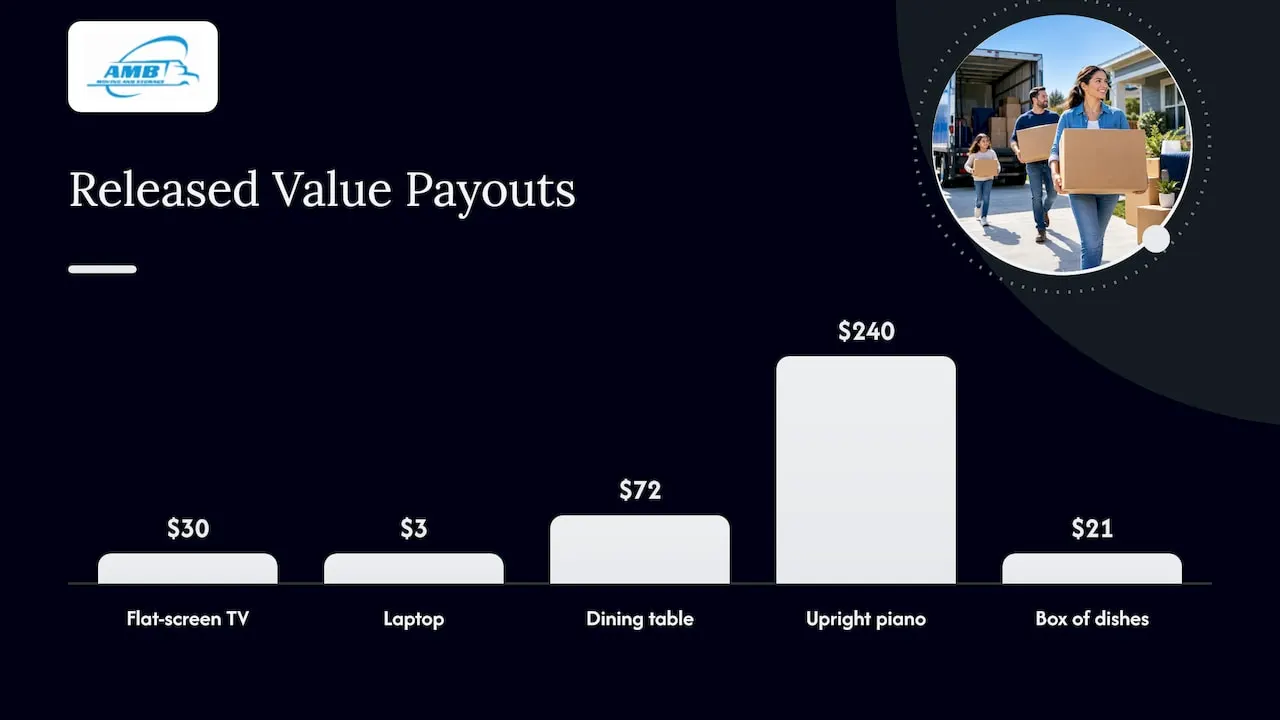
The formula is simple: weight of the damaged or lost article, in pounds, times $0.60. The mover’s maximum payout is set by that formula, not by the item’s value, according to the FMCSA booklet.
Here is what that looks like with ordinary household items:
| Item | Approx. weight | Released value payout at $0.60/lb | What replacing it may cost |
|---|---|---|---|
| Flat-screen TV | 50 lb | $30 | Several hundred dollars or more |
| Laptop in a padded bag | 5 lb | $3 | Often $800 or more |
| Dining table (solid wood) | 120 lb | $72 | Often well above that |
| Upright piano | 400 lb | $240 | Typically much higher |
| Box of dishes | 35 lb | $21 | Depends on the set |
The weights are rough estimates for illustration, and the replacement ranges are general expectations, not quotes. The pattern is what matters: light, expensive things (electronics, jewelry, art) are the worst fit for a weight-based formula, and heavy, cheap things look better than they are.
A worked example
Say a family moves from Chicago to Phoenix. A crew member drops a 45-pound flat-screen while loading, and the screen cracks. Under released value the claim is worth 45 × $0.60 = $27. The family bought the set for $450. The mover is not being stingy. It is paying exactly what the contract and the federal liability level provide.
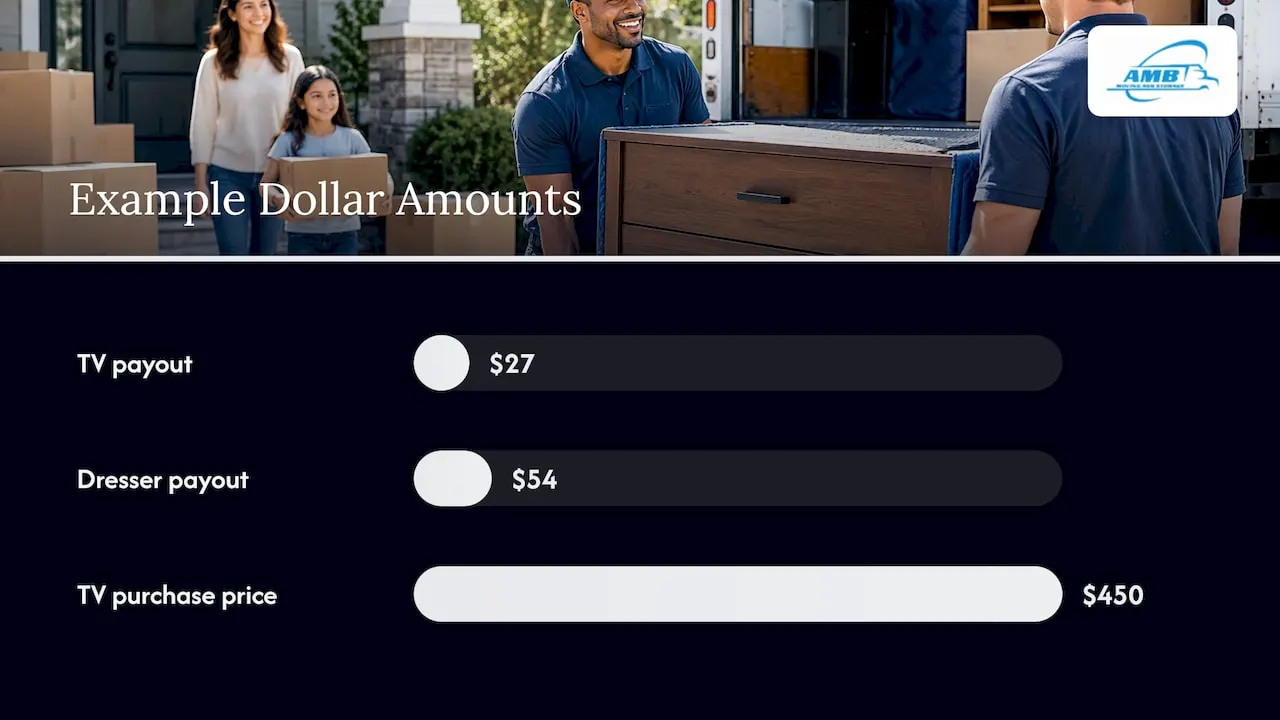
Now take a different loss: a 90-pound dresser with a split side panel. Released value pays $54. The repair might cost more than that alone.
“Per article” is stricter than it sounds
A box counts as one article, even if it holds twenty items. If a carton of 30 pounds of glassware is crushed, the claim is 30 × $0.60 = $18, however many pieces were inside. That is one reason packing quality and inventory detail matter, which we cover below.
We break the same trap down further in Avoid a $30 TV Payout: Full Value Protection for U.S. Interstate Moves.
Released value vs. full value protection
The main alternative is full value protection. Instead of a weight-based cap, the mover is responsible for the replacement value of lost or damaged goods. In practice that means repair, replacement or a cash settlement, depending on what the contract allows.
The FMCSA booklet says full value protection is generally priced using a minimum shipment valuation of at least $6.00 per pound of the total shipment weight. That is a figure for the whole shipment, not each item. A 8,000-pound move would carry a minimum declared valuation of $48,000 under that rule. The charge for the coverage is set by the mover’s tariff, so it varies by company and by deductible, and you should get it in writing.
| Released value | Full value protection | |
|---|---|---|
| Extra cost | None | Yes, set by the mover |
| Basis of payout | $0.60 per pound, per article | Repair, replacement or cash value, within the declared valuation |
| Best for | Low-value goods you could replace easily | Furniture, electronics, art and anything you could not shrug off losing |
| Biggest risk | Payouts far below real value | Higher cost; limits on items of extraordinary value |
The extraordinary value rule
Even full value protection has an exception worth knowing. Per the FMCSA booklet, movers may limit liability for items of extraordinary value, defined as items valued over $100 per pound, unless those items are specifically listed on the shipping documents. Jewelry, small antiques, collectible watches and similar items can fall into this category. List them by name on the paperwork, or carry them yourself.
Are movers liable for damage under released value?
Yes. Released value does not mean the mover owes you nothing. It means the mover owes you a capped amount: $0.60 per pound, per article. The cap is the part most customers miss when they sign a stack of documents quickly.
If you are shopping for interstate movers or a nationwide moving company, compare how each one presents the coverage choice. A clear estimate shows which valuation level is in the quote, what upgrading costs and whether the choice is recorded on the contract.
When released value is enough, and when it is not
No single answer fits every household. A few honest rules of thumb:
Released value can be reasonable when:
- You are moving mostly inexpensive, replaceable goods
- You are willing to self-insure the risk of a few broken items
- You are carrying valuables, documents and electronics yourself
Upgrade to full value protection when:
- You own furniture, appliances or electronics that would be costly to replace
- You are moving a whole household across the country, where the shipment passes through more handling and more miles
- A single loss, such as a broken heirloom, would hurt more than the price of the coverage
- You are relocating for work and cannot easily absorb replacement costs
The comparison to make is simple. Add up what you would have to spend if the worst realistic item broke, then weigh that against the extra cost of coverage on your quote. If the first number is bigger, the coverage pays for itself in peace of mind even if you never file a claim.
Separate insurance as a third option
There is a layer beyond valuation: a separate policy from an insurance company. Some people buy it for items that the mover’s valuation will not fully cover, or because they want a different claims process. Know that the policy has its own terms, exclusions and claim steps, and that it does not replace a good inventory.
If you want to see how outside carriers think about goods in transit, this explanation of insurance for moving goods in transit shows how business transport cover is structured. For household moves in the U.S., our guide to third party moving insurance for interstate moves covers where it helps and where it overlaps. Your homeowners or renters policy may also respond in limited ways, so read Homeowners Insurance and Moving: What Covers You and When before you assume either way.
Protect your belongings before a claim ever happens
Coverage decides how much you can recover. Preparation decides how often you need to.
Pack and crate fragile pieces properly
Because payouts are weight-based, a damaged lightweight, high-value item is a poor trade. Professional packing reduces the chance of damage. Our professional packing services are priced at $1 to $2 per cubic foot. For glass-top tables, large mirrors, art and similar pieces, custom crating adds rigid protection; see Custom Crating: Avoid Released Value Payouts on Interstate Moves for how it works. Specialty handling for items like pianos and safes starts at $200, as listed in our moving cost guide.
Build an inventory you can rely on
- Photograph each room and each valuable item from several angles before pickup.
- Record serial numbers for electronics and appliances.
- Keep receipts or screenshots of purchase prices for anything over a few hundred dollars.
- Note existing scratches and dents so they are not blamed on the move.
- Read the mover’s inventory sheet and confirm that your valuable items are described individually, not lumped into “misc.”
Keep what matters out of the truck
Carry medications, passports, jewelry, laptops, hard drives and legal documents with you. They are the items where a weight-based payout is least useful and where loss is hardest to undo. Our checklist of items movers won’t move is a good start for deciding what travels with you.
How to handle a damage claim
If something arrives broken or missing, the steps are the same whichever coverage you chose.
- Inspect at delivery. Walk through with the crew and compare items against the inventory before you sign anything.
- Note damage on the paperwork. Write it on the inventory or delivery document, in the specific, with the item’s name. Do not sign a clean receipt if there is visible damage.
- Photograph everything. Take pictures of the item, the box and any packing materials before you discard them.
- File a written claim. Contact your mover for its claim form and submit it with photos, the inventory line and proof of value. Your contract states the filing deadline, so check it on day one rather than month eight.
- Keep copies and follow up. Save every email and form, and note dates of calls.
- Know your escalation path. If a claim stalls, the FMCSA’s consumer resources and your state’s consumer protection office are the places to turn.
Under released value your payout will follow the weight formula, so documentation mainly proves what was damaged and how heavy it was. Under full value protection, documentation of the item’s value matters much more.
Our perspective
We move households and offices across state lines, and we see the same moment repeat. A customer has compared three moving cost estimates, chosen the lowest, and only later learns that the “coverage” in the quote was the $0.60-per-pound default. By then they have signed.
We think the coverage choice should be made on purpose, in plain language, before the move is booked. That means telling a family what released value pays on their heaviest furniture and their lightest electronics, showing what full value protection looks like for their shipment weight, and letting them decide. We are a licensed and insured nationwide mover, and our approach is structured planning, clear communication and transparent pricing.
Our practical advice: if you cannot comfortably replace it out of pocket, do not leave it on released value. Crate what is fragile, list what is valuable, carry what is irreplaceable.
— AMB
Plan your long-distance move with the coverage question answered
If you are planning a cross country move in the next 30 to 60 days, ask every company for the same three things in writing: which valuation level is in the quote, what the upgrade costs for your shipment weight, and how claims are filed. We will walk you through all three on a long distance moving estimate, including packing, storage and specialty items, so the number you see is the number you plan around.
Ready for a quote that spells out your coverage? Request your free moving estimate.
What to check before you sign
Before you commit to any mover, run through this short list:
- The valuation level is written on the estimate and on the contract, not assumed.
- You know the dollar cost of upgrading to full value protection.
- High-value and extraordinary-value items are listed by name.
- Fragile items are packed or crated by professionals.
- You have photos, serial numbers and receipts saved somewhere other than the moving truck.
- You know where your mover’s claim form lives and how long you have to file.
Released value coverage is fine for what it is: a free floor. Just do not mistake it for a safety net.
FAQ
Is released value coverage the same as insurance?
No. It is a limit on the mover’s liability, built into the contract, not a policy sold by an insurer. Per the FMCSA booklet, movers are not required to provide insurance, though they may offer separate third-party liability insurance for sale.
How much does released value coverage pay?
It pays up to $0.60 per pound, per article, according to the FMCSA booklet. A 50-pound television would be worth $30 on a claim, regardless of what you paid. The formula applies to each article separately.
What is the difference between full value and released value?
Released value caps payouts by weight and costs nothing extra. Full value protection makes the mover responsible for the replacement value of lost or damaged goods and is a paid upgrade. It is generally priced from a minimum shipment valuation of at least $6.00 per pound of total shipment weight, per the FMCSA booklet.
Are my most valuable items covered at their full worth?
Not automatically. Movers may limit liability for items valued over $100 per pound unless you list them specifically on the shipping documents. List jewelry, small antiques and similar pieces by name, or carry them with you.
Can I change my coverage after the move starts?
Do not count on it. Choose your valuation level before you sign, and make sure it is written on the contract. If you want to change it, ask your mover how and by when, and get any change in writing.
Sources
- Your Rights and Responsibilities When You Move, FMCSA (2022 update)
- Transportverzekering verhuizing bedrijf: zo doe je het goed