


TL;DR:
- Florida’s top cities for 2026 offer a balance of affordability, strong job markets, and quality schools suited to diverse priorities. Families, professionals, and retirees should evaluate neighborhood-level factors such as housing costs, school ratings, and commute times alongside city rankings to make informed relocation decisions. Customized planning, including visits and full monthly cost modeling, ensures a successful move tailored to individual lifestyles and career needs.
The best places to move in Florida are cities and towns that deliver a working balance of affordability, strong job markets, quality schools, and a lifestyle worth waking up for. Florida attracted over 300,000 net new residents in recent years, and the competition among cities for that talent is real. Whether you are a family chasing good school districts, a professional targeting Tampa’s tech sector, or a retiree drawn to Sarasota’s Gulf Coast culture, the right city depends on your specific priorities. This guide ranks the top Florida cities for 2026 using data from U.S. News, RelocateRight, and Houzeo, then shows you how to match those rankings to your actual life.
Which cities top the 2026 Florida relocation rankings?
Florida’s top-ranked cities for relocation cover a wide spectrum from wealthy suburban enclaves to affordable mid-size metros. Parkland ranks #1 among Florida cities to live in for 2026, with a median household income of $223,200 and an unemployment rate of just 2.53%. That combination places it 14th nationally in the U.S. News rankings, which means Parkland competes with cities across the entire country, not just within Florida.

Tampa Bay holds the title of best overall city for working professionals in Florida, balancing job market depth, Gulf Coast access, and a cost of living that does not require a six-figure salary to manage. Jacksonville earns its place as the most affordable major Florida city, with a median home price around $310,000 and a job market that has diversified well beyond its military and logistics roots. Sarasota consistently ranks among the top destinations for retirees and remote workers, driven by walkable neighborhoods, Sarasota Memorial Health Care System, and direct beach access.
| City | Median Home Price | Key Strength | Best For |
|---|---|---|---|
| Parkland | $650,000+ | Top-ranked schools, safety | Affluent families |
| Tampa Bay | $380,000 | Jobs, lifestyle, Gulf Coast | Working professionals |
| Jacksonville | $310,000 | Affordability, job growth | Budget-conscious movers |
| Sarasota | $450,000 | Culture, healthcare, beaches | Retirees, remote workers |
| Lake City | $215,000 | Lowest cost of living | First-time buyers |
| Gainesville | $285,000 | University economy, amenities | Young professionals |
Orlando and Fort Lauderdale round out the upper tier. Orlando’s tourism economy masks a surprisingly deep technology and healthcare job market, while Fort Lauderdale offers proximity to Miami’s financial sector without Miami’s price tag. Naples sits at the luxury end of the spectrum, attracting high-net-worth retirees with its low crime rates and premium healthcare infrastructure.
How does affordability vary across Florida’s best places to move?
Affordability in Florida is not a single number. It is a calculation that combines home prices, rent, property taxes, homeowner’s insurance, and the cost of everyday goods. Lake City is the most affordable city in Florida for 2026, with a median home price of $215,000 and a cost of living 18% below the national average. That gap translates directly into more purchasing power for families relocating from high-cost states like New York or California.
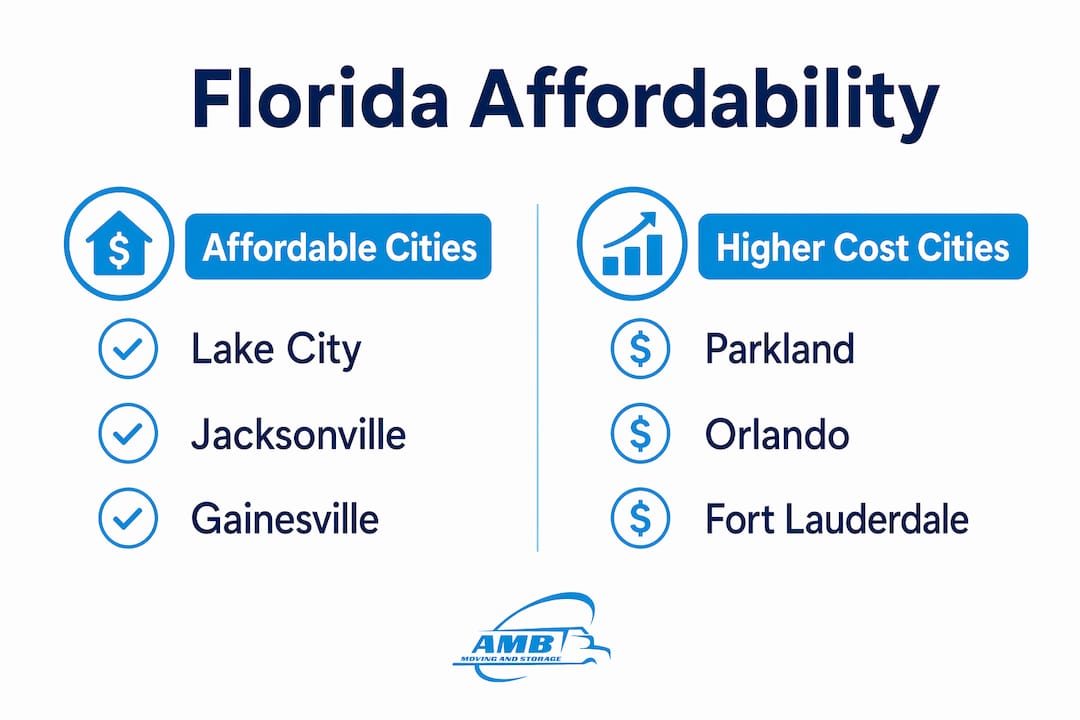
The statewide picture is more complex. Median gross rent in Florida sits at $1,487 per month, while buying a median-priced home costs between $2,400 and $2,800 monthly depending on location and financing terms. That spread matters because two families buying homes at the same price in Jacksonville versus Naples can face monthly costs that differ by hundreds of dollars once insurance and local tax rates are factored in.
Jacksonville, Lakeland, and Gainesville offer the most accessible entry points for buyers, with median prices under $325,000 and solid amenity profiles. Gainesville comes in around $285,000 and benefits from the University of Florida’s economic stabilizing effect. Lakeland sits at approximately $305,000 and has seen strong job growth in logistics and distribution, partly driven by its position between Tampa and Orlando on I-4.
Home affordability decisions must account for financing variables, taxes, and insurance beyond the median price. Florida’s property insurance market has tightened significantly, and annual premiums in coastal areas can add $3,000 to $8,000 to your yearly housing costs. Inland cities like Gainesville and Lake City carry lower insurance exposure, which is a real financial advantage that rarely appears in headline affordability rankings.
Pro Tip: Before committing to a city, model your full monthly housing cost using a mortgage calculator that includes property tax, homeowner’s insurance, and HOA fees. A $310,000 home in Jacksonville and a $310,000 home in Fort Myers can produce monthly costs that differ by $400 or more once insurance is included.
What should families consider about schools and community quality?
School quality is the single most cited reason families choose one Florida city over another, yet most parents rely on a single number from a rating website without understanding what drives it. GreatSchools ratings combine test scores, growth metrics, and college readiness, but sponsored placements can affect which schools appear most prominently in search results. A school with a high headline score may rank well on test performance but poorly on student growth, which is often the more meaningful indicator for families moving into a district mid-year.
Families should analyze the components driving a school’s rating rather than relying on the overall score. The student growth metric measures how much individual students improve over time, regardless of their starting point. A school in an Orlando suburb like Winter Park or Lake Mary may show strong growth scores even if its overall rating is not the highest in the county.
Here is what to evaluate beyond the headline rating:
- Student growth percentile: Measures year-over-year academic improvement, not just absolute performance
- College readiness scores: AP enrollment, dual enrollment, and SAT/ACT participation rates signal real preparation
- Teacher retention rates: High turnover in a school district is a warning sign that rarely shows up in ratings
- District funding per pupil: Florida’s school funding varies significantly by county, affecting class sizes and program availability
- Extracurricular and arts programs: Often the first cut in underfunded districts, these matter for family quality of life
Cape Coral and the surrounding Lee County school district have improved measurably over the past five years, making it a stronger family option than its historical reputation suggests. Seminole County, which covers suburbs northeast of Orlando, consistently ranks among Florida’s top school districts and offers a more affordable entry point than Parkland or Boca Raton.
Pro Tip: Visit the Florida Department of Education’s school accountability reports at fldoe.org to pull raw grade data for specific schools. A school’s letter grade from the state is calculated differently from GreatSchools ratings and often tells a different story.
What job markets and lifestyle factors make Florida cities attractive?
Florida’s job market is not monolithic. Each major metro has a distinct economic engine, and matching your career to the right city is as important as matching your budget.
-
Tampa Bay leads Florida for working professionals in 2026. The metro hosts major employers in financial services (Raymond James, Citigroup), healthcare (Tampa General Hospital, BayCare), and a growing technology sector anchored by companies like ReliaQuest and Syniverse. The Tampa Bay job market offers the strongest combination of salary levels, industry diversity, and cost-adjusted quality of life in the state.
-
Orlando runs on tourism and hospitality at the surface, but its deeper economy includes a significant defense and simulation technology cluster around UCF’s Research Park, plus one of Florida’s largest healthcare networks through AdventHealth and Orlando Health. Remote workers benefit from Orlando’s infrastructure without needing to tap the tourism economy at all.
-
Jacksonville offers the most affordable major metro entry point in Florida with a growing diverse economy that includes banking (Fidelity National Information Services, Bank of America operations), logistics, and a substantial military presence at Naval Station Mayport and Naval Air Station Jacksonville. Commute times average under 25 minutes, which is a genuine lifestyle advantage over Tampa or Miami.
-
Sarasota and St. Petersburg attract remote workers and retirees for different reasons. Sarasota is highly ranked for its cultural infrastructure, including the Ringling Museum, a strong performing arts scene, and Sarasota Memorial Health Care System. St. Petersburg has transformed its downtown into one of Florida’s most walkable urban cores, with a craft brewery scene, the Salvador Dali Museum, and direct waterfront access.
-
Miami and Fort Lauderdale serve professionals in finance, international trade, and real estate. Miami’s Brickell district functions as a Latin American financial hub, attracting multinational firms and high-earning professionals. The tradeoff is a cost of living that rivals New York in some neighborhoods.
How to create a personalized shortlist for your Florida move
Effective Florida relocation planning begins with selecting metro areas that match your job type, commute preferences, and school district requirements before you evaluate affordability in depth. Skipping this step leads to the common mistake of choosing a city based on price alone, then discovering the commute or school situation does not work.
Follow this framework to build your shortlist:
-
Define your non-negotiables first. List your top three criteria in order of priority. For most families, this is job access, school district quality, and housing budget. For retirees, it shifts to healthcare access, climate, and community amenities.
-
Match metro areas to your career sector. If you work in finance, Tampa Bay and Miami are your primary targets. Healthcare professionals have strong options in Orlando, Jacksonville, and Sarasota. Remote workers have the most flexibility and should weight lifestyle and cost most heavily.
-
Model the full monthly cost. Use a mortgage calculator that includes property tax, insurance, and HOA fees. Compare that number against your take-home pay using Florida’s 0% state income tax as a real advantage in your calculation.
-
Check housing inventory in your target neighborhoods. A city can rank highly on paper but have extremely low inventory in the school district or zip code you actually want. Use Zillow or Redfin to check active listings before committing to a city.
-
Visit before you sign. Validate editorial top-city claims by visiting local markets personally to assess commute realism, amenities access, and current housing supply. A Saturday morning drive through your target neighborhood tells you more than any ranking.
Pro Tip: When planning a scouting trip, use a service like Opulent Transport for airport transfers in the Fort Lauderdale area so you can focus on evaluating neighborhoods rather than managing logistics.
Key takeaways
The best Florida city for your relocation is the one that scores highest on your specific combination of job access, school quality, housing cost, and lifestyle, not the one that tops a generic national ranking.
| Point | Details |
|---|---|
| Parkland leads Florida rankings | Median income of $223,200 and 2.53% unemployment make it the top-ranked city for 2026. |
| Affordability varies sharply | Lake City costs 18% below the national average; coastal cities add thousands in annual insurance costs. |
| School ratings need deeper review | Student growth and teacher retention matter more than headline scores from GreatSchools. |
| Tampa Bay wins for professionals | Strong job market across finance, healthcare, and tech with manageable cost of living. |
| Visit before you decide | Local scouting trips reveal commute realities and housing inventory that rankings cannot capture. |
What we have learned from helping families move to Florida
After coordinating hundreds of interstate moves to Florida, the pattern we see most often is this: families do thorough research on city rankings and almost none on the actual neighborhood they are moving into. A city can rank in the top five statewide while having specific zip codes with poor school performance, long commutes, or limited housing inventory in the price range that matters.
The other consistent mistake is treating median home price as the full affordability story. Real affordability hinges on financing, tax, and insurance details, and two families moving to the same city can face monthly budgets that differ by $500 or more. We have seen clients choose Jacksonville over Tampa based on price, then discover their specific employer is in a Tampa suburb that adds 45 minutes to the daily commute. The math changes fast.
The families who relocate most successfully are the ones who treat city selection and neighborhood selection as two separate decisions. Pick the metro that fits your career and school requirements. Then spend serious time on the specific neighborhood, school zone, and commute corridor before you sign anything.
— AMB
Plan your Florida move with Ambmovingservices
Planning a long-distance move to Florida involves more than choosing the right city. It requires coordinating timing, protecting your belongings, and working with movers who understand interstate regulations and Florida’s specific logistics.
Ambmovingservices specializes in long-distance moving to Florida’s top cities, including Tampa, Jacksonville, Orlando, Sarasota, and beyond. As a licensed and insured nationwide moving company, AMB Moving & Storage handles everything from packing and loading to secure storage and final delivery. Families relocating from the Northeast, Midwest, or West Coast trust AMB for moves that arrive on time and on budget. Get your free moving cost estimate and start your Florida relocation with a plan that actually works.
Get a free quote today and let Ambmovingservices handle the logistics while you focus on choosing the right neighborhood.
FAQ
What is the most affordable city to move to in Florida?
Lake City is the most affordable city in Florida for 2026, with a median home price of $215,000 and a cost of living 18% below the national average. Jacksonville is the most affordable major metro, with a median home price around $310,000 and a strong job market.
Which Florida city is best for families with children?
Parkland ranks first in Florida for families based on school quality, safety, and median income, though its home prices exceed $650,000. Seminole County suburbs near Orlando and Cape Coral offer strong school districts at more accessible price points.
Is Tampa or Orlando better for job seekers moving to Florida?
Tampa Bay leads for working professionals due to its depth in financial services, healthcare, and technology. Orlando is stronger for healthcare and defense-adjacent technology roles, and its lower housing costs give it an edge for mid-career professionals.
How much does it cost to buy a home in Florida’s top cities?
Median home prices range from $215,000 in Lake City to over $650,000 in Parkland. Monthly ownership costs run between $2,400 and $2,800 depending on location, financing, and insurance, which varies significantly between coastal and inland cities.
What should I do before finalizing my Florida relocation decision?
Visit your target city and neighborhood in person to assess commute times, housing inventory, and local amenities. Cross-reference school ratings with Florida Department of Education grade data and model your full monthly housing cost including insurance and property taxes before committing.