


A long carry fee is an accessorial charge movers add when your truck can’t park within the carrier’s standard walking distance, commonly 75 feet from your door. It applies at pickup, delivery, or both, and it should show up as a line item on your written estimate. If your driveway is long, your building has no loading zone, or your street is blocked on move day, measure the distance now and get it disclosed before the truck ever shows up.
TL;DR:
- Most long carry fees are triggered if the truck cannot park within 75 feet of your entry point, especially in urban, gated, or rural properties.
- Measurements should be taken from legal parking spots to your door, using tools like a tape measure or Google Maps, with photos of obstacles to prevent surprises.
- Longer carries beyond about 250 feet are often billed as multiple increments or a shuttle fee, adding potentially hundreds of dollars to the move costs.
- A thorough pre-move survey that documents distances and obstacles and lists accessorials in writing can prevent unexpected charges on move day.
- If a long carry fee appears without prior disclosure, you can dispute it by providing evidence and filing a complaint through the FMCSA or FTC.
Table of Contents
- What a Long Carry Fee Is, in Plain Terms
- Typical Distance Thresholds That Trigger the Charge
- How Movers Measure the Carry, and How You Can Too
- Properties and Situations Most Likely to Trigger a Fee
- Why a Pre-Move Survey Prevents the Surprise Entirely
- What Long Carry Fees Actually Cost
- How to Estimate and Avoid the Fee Before Move Day
- How AMB Handles Long-Carry Situations
- Our Take on When to Pay the Fee vs. Fight the Access Problem
- Get a Measured, Written Estimate Before You Book
- Where to Verify the Rules Yourself
- Sources
- FAQ
What a Long Carry Fee Is, in Plain Terms
A long carry fee is an accessorial, which is industry shorthand for any charge added on top of your base transportation cost. Interstate moves are typically priced by weight times mileage, called linehaul; local moves usually run on an hourly crew rate. Long carry sits outside both. It compensates the crew for extra labor when they can’t get the truck within normal walking range of your entrance.
It’s easy to confuse with two cousins. A stair fee applies to vertical effort, carrying items up or down flights, regardless of horizontal distance. A shuttle fee applies when the main truck can’t access the property at all and a smaller vehicle has to ferry items back and forth. The FMCSA’s consumer guidance requires interstate carriers to operate under published tariffs, meaning accessorial charges like these have to be disclosed, not sprung on you at the curb.
Typical Distance Thresholds That Trigger the Charge
Seventy-five feet is the number you’ll see most often. Many carriers include a set distance free, often around 75 feet, then bill per foot or per increment beyond it. Some companies have a slightly larger free allowance, and others charge in blocks rather than per foot, so longer carries may be billed as multiple increments instead of a straight per-foot rate.
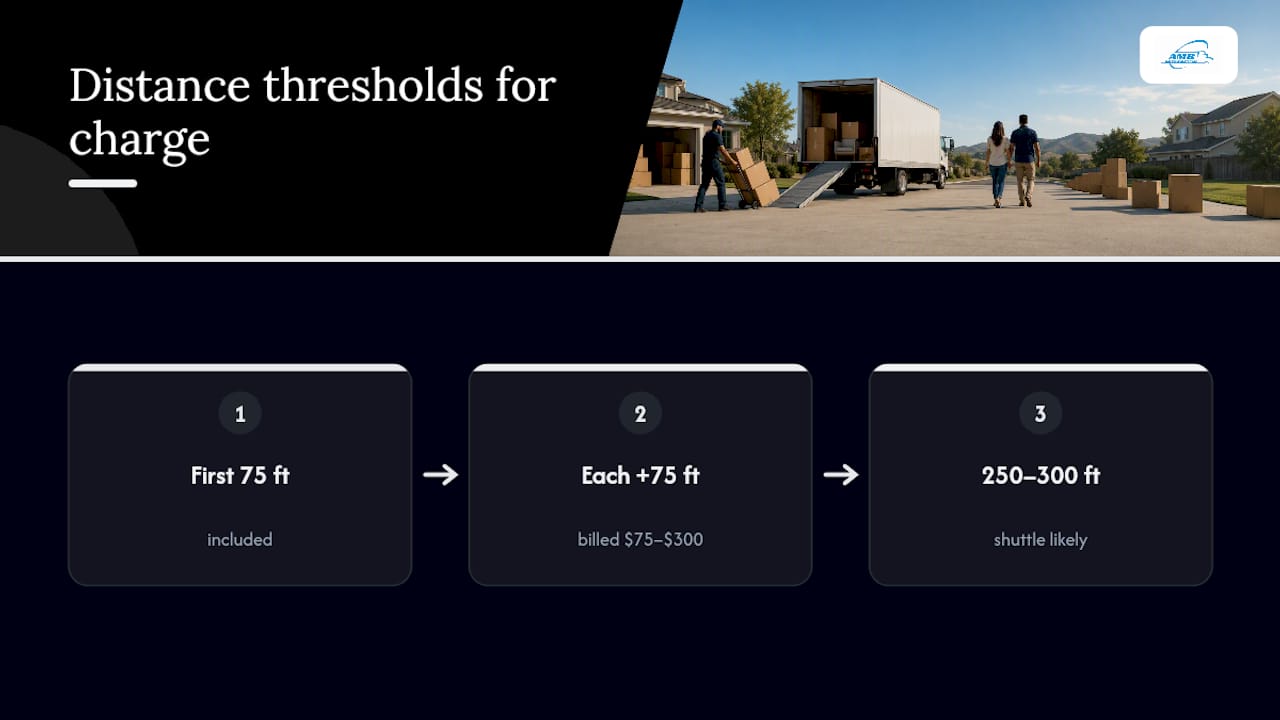
Once the walk stretches past roughly 250 to 300 feet, many movers switch strategies entirely and bring in a shuttle truck instead of paying a crew to hand-carry furniture that far. Look for language on your estimate like “first 75 ft included” or “each additional 75 ft: $X.” If you don’t see that phrase anywhere, ask for it directly.
How Movers Measure the Carry, and How You Can Too
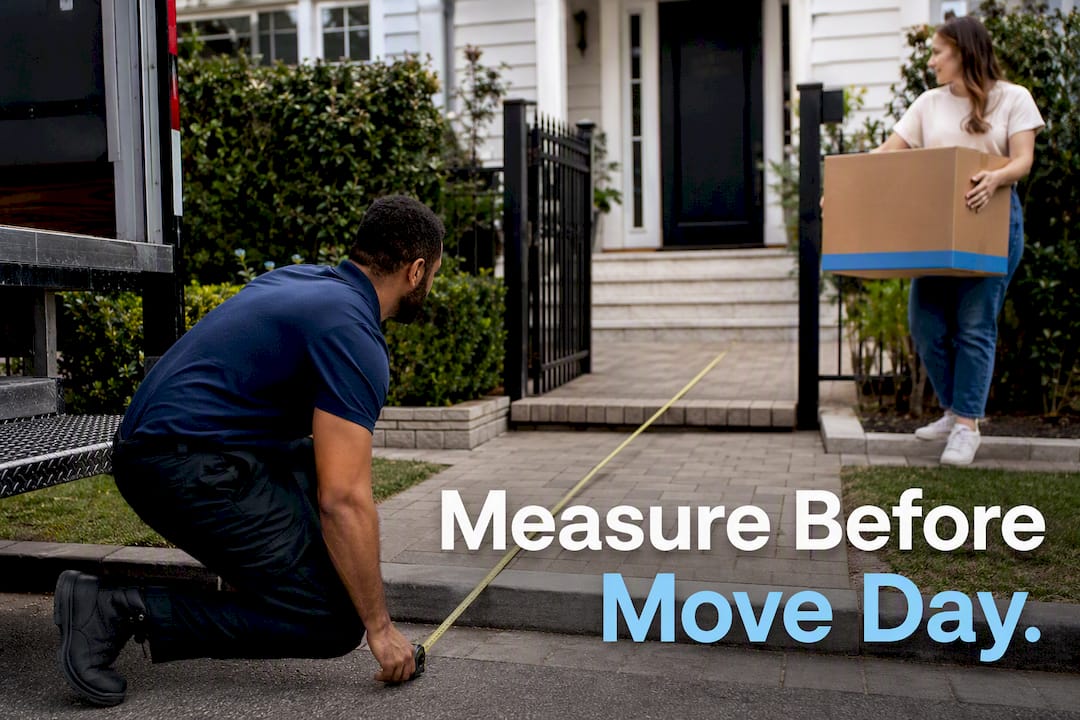
Movers measure from where the truck can legally and safely park to the entry point the crew will actually use, not the shortest theoretical path. That distinction matters because a blocked driveway or an angled parking spot can turn a 60-foot walk into a 130-foot one.
You can do the same measurement yourself before your estimator ever arrives. A tape measure works for short distances. For longer stretches, the distance tool in Google Maps gives a reasonably accurate read from curb to door. Take a photo standing at the likely truck position, looking toward your entrance, and note any obstacles: stairs, gates, gravel, mud that would block a hand truck. If you live on a numbered street with marked curb segments, note the exact spot where legal parking starts. That single photo, sent with your quote request, does more to prevent a move-day surprise than almost anything else you can do.
Properties and Situations Most Likely to Trigger a Fee
Some living situations almost guarantee a long carry conversation before move day. Watch for:
- Urban walkups where the truck has to park on a busy street half a block away
- Gated communities with restricted access points or guard-controlled entries
- Long private driveways, common in rural and exurban properties
- HOA rules that ban trucks from parking directly in front of units
- Construction, events, or street closures that push parking further out on the actual day
Pickup and delivery conditions often differ. You might load out of a downtown apartment with no loading zone, then deliver to a suburban house with a normal driveway and no fee at all. Flag both addresses separately when you request quotes, because a clean delivery address doesn’t offset a difficult pickup.
Why a Pre-Move Survey Prevents the Surprise Entirely
A proper pre-move survey, in person or filmed, should capture the measured truck-to-door distance, photos of the access route, and any parking constraints, with every accessorial written into the estimate before you sign anything. The FTC’s guidance on hiring movers specifically recommends getting estimates in writing and documenting anything that could affect price.
If your survey is virtual, walk the estimator through the route with your phone camera, not just the rooms. Ask them to state out loud what they’re noting for distance and obstacles, then get that in the written summary. Know which kind of estimate you’re signing: a binding not-to-exceed estimate caps your total, but only for the conditions disclosed at the time. Undisclosed obstacles found on move day can still add accessorials on top, even under a binding quote.
What Long Carry Fees Actually Cost
Pricing follows a few common models. Some carriers charge a flat per-foot rate, often $1 to $3 per foot beyond the included allowance. Others bill per increment, commonly $75 to $300 for each additional 75-foot block. A smaller number charge per item carried long distance rather than by footage.
Here’s what that looks like in practice. A 100-foot carry, 25 feet past a 75-foot allowance, might add one increment fee, somewhere in the $75 to $150 range. A 250-foot carry could mean two or three full increments, or a shuttle charge instead, often several hundred dollars. On an interstate move, these accessorials stack on top of your weight-times-mile linehaul cost, and industry estimates put the combined effect of accessorials like long carry, stairs, and shuttle service at roughly 20% to 35% above the base linehaul quote for households with tricky access.
How to Estimate and Avoid the Fee Before Move Day
- Measure and photograph your access points at both pickup and delivery addresses, then send those measurements with your initial quote request.
- Ask for line-item accessorials in writing, or confirm the long-carry charge is already folded into a flat, binding quote based on the access you disclosed.
- Reserve parking in advance where possible: guest spots, a permit, or a neighbor’s driveway that puts the truck closer to your door.
Pro Tip: Keep every email, photo, and text about your quoted access conditions in one folder. If a charge appears that contradicts what you disclosed, that paper trail is what gets it removed or reduced.
Undisclosed obstacles are one of the most common reasons quotes jump on moving day, and proactive measurement and disclosure meaningfully cut down on that risk. If a fee still shows up unexpectedly, ask for the tariff line item in writing before you pay it.
How AMB Handles Long-Carry Situations
A licensed, insured nationwide mover typically starts every quote with a pre-move survey designed to catch access issues before they become invoice surprises. Estimators document measured distances and photograph parking and entry points, then list any long-carry, stair, or shuttle charges as clear accessorial line items rather than folding them into a vague total.
That transparency matters most on interstate moves, where linehaul pricing already involves weight and mileage calculations. Readers planning a long-distance move can request a measured assessment that accounts for both ends of the trip.
Our Take on When to Pay the Fee vs. Fight the Access Problem
If your inventory is light and the carry is short, paying the accessorial usually beats hours spent hunting for closer parking or a permit. For heavier loads or carries past 200 feet, arranging better truck access almost always costs less than the fee, and it’s easier on the crew’s schedule and your furniture. Tip crews an extra $10 to $20 per person on carries that ran long through no fault of your disclosure. If a charge appears that wasn’t on your written estimate, document it and escalate through FMCSA’s dispute process before you pay.
— AMB
Get a Measured, Written Estimate Before You Book
This moving company provides an alternative to guesswork pricing by offering a documented pre-move survey that measures your actual truck-to-door distance and lists every accessorial in writing, so a 150-foot driveway or a walkup with no loading zone gets priced before move day, not during it.
That same survey process covers packing needs and, when a move requires a storage gap between addresses, temporary storage options as well. Whether you’re planning a cross-country relocation or a state-to-state move for a growing family, request your free, itemized quote today and get the measured numbers in writing before you commit to a date.
Where to Verify the Rules Yourself
- FMCSA’s Protect Your Move covers interstate tariff rules and how to file a complaint against a carrier.
- The FTC’s mover-scam guidance explains how to spot red flags and demand written estimates.
- MovingRated’s cost guide breaks down accessorial pricing ranges used across the industry.
Sources
- Protect Your Move — FMCSA
- Avoid scams when you hire a moving company — FTC
- Long-distance moving guide — MovingRated
- The stair tax and other hidden moving fees — MoveSmart
FAQ
What Is a Long Carry Fee?
It’s an accessorial charge for carrying belongings farther than a mover’s standard walking allowance, usually 75 feet, from where the truck parks to your door.
How Much Does It Cost to Move 200 Miles Away?
Cost depends heavily on weight, crew size, and accessorials like long carry, but a 200-mile move for an average household commonly lands in the low thousands once linehaul and standard fees are combined; getting a measured quote is the only way to get an accurate number for your specific inventory.
What Is the Cheapest Way to Move Across the Country?
Booking during off-peak months, decluttering before the survey, and disclosing access conditions upfront to avoid accessorial surprises are the most reliable ways to keep a cross-country move affordable; consolidated or shared-load options can also cut costs versus a dedicated truck.
Can I Dispute a Long Carry Fee After the Move?
Yes. If the charge wasn’t disclosed on your written estimate, keep your photos and correspondence and file a complaint through FMCSA’s consumer process; documentation from your pre-move survey is usually the deciding factor.