


Federal employee relocations are governed by the Federal Travel Regulation (41 CFR 302), which sets the mandatory baseline every agency must follow while leaving room for agency discretion on extras. Agencies decide which discretionary allowances to authorize, and the U.S. Office of Personnel Management (OPM) sets the rules for relocation incentives. Before anything else, check your offer letter and call your agency’s relocation office to confirm exactly what’s been authorized in writing.
TL;DR:
- Agencies are not required to pay for discretionary benefits such as house-hunting trips or POV shipment unless explicitly confirmed in writing before the move.
- Relocation incentives are limited to 25% of annual pay per year of service, and require a signed service agreement to be enforceable.
- Procurement channels like CHAMP and SIN 531 are used for move management and home sale services, but employees must confirm which applies before planning.
- Reimbursement rates for household goods depend on distance and weight, with GSA updates annually and tax allowances like RITA and WTA often making reimbursements taxable.
- Early paperwork, clear documentation, and confirmed authorizations prevent most disputes and unexpected costs during federal relocations.
Table of Contents
- What Is a Government Relocation Guide Actually Covering?
- Mandatory vs. Discretionary Allowances Under the FTR
- Relocation Incentives and Service Agreements: What You Need to Know
- How Agencies Procure Relocation Services
- What Are Realistic Rates and Reimbursement Numbers?
- Step-by-Step Checklist and Timeline for a Federal Relocation
- How Professional Movers Coordinate With Government Task Orders
- An Editorial Take on Government Relocation Programs
- Get a Quote for Your Federal Relocation
- Sources
What Is a Government Relocation Guide Actually Covering?
A government relocation guide has to account for several move types that carry different rules and paperwork. A permanent change of station (PCS) moves an employee to a new official duty station indefinitely, while a temporary change of station (TCS) covers assignments expected to last one to three years. Add to that the CONUS/OCONUS distinction (moves within the continental United States versus outside it, including Alaska, Hawaii, and overseas posts), and you can see why so many employees get tripped up on entitlements.
For authoritative answers, three sources matter most:
- The Federal Travel Regulation (FTR), 41 CFR 302, which is the controlling legal text for allowances.
- OPM’s relocation incentives fact sheet, covering pay-related benefits separate from moving allowances.
- GSA’s Employee Relocation Resource Center (ERRC), which agencies use for procurement and policy guidance.
Start with your agency’s Relocation Resource Center or HR office, and loop in the contracting officer if a move involves procured relocation services rather than a straight reimbursement.
Mandatory vs. Discretionary Allowances Under the FTR
The FTR draws a hard line between what an agency must pay and what it may choose to offer, and that line trips up more employees than any other part of the process. Mandatory items generally include transportation and per diem for the employee and immediate family, shipment and temporary storage of household goods (HHG), and certain reimbursements tied to selling or buying a home under an authorized move.
Discretionary items sit in a different bucket:
- House-hunting trip expenses
- Temporary quarters subsistence expense (TQSE)
- Shipment of a privately owned vehicle (POV), which many agencies don’t authorize domestically
Pro Tip: Never assume a benefit applies just because a coworker received it. Agencies have latitude on discretionary items, and one bureau’s policy can differ sharply from another’s inside the same department.
Here’s a scenario that plays out often: an employee accepts a position 1,800 miles away, expecting house-hunting trip reimbursement because a colleague got one two years earlier. The agency’s current policy no longer authorizes it. The fix is simple but easy to skip: get every discretionary benefit confirmed in writing in the offer package, not verbally, before you commit to moving dates or sign a lease.
Relocation Incentives and Service Agreements: What You Need to Know
Relocation incentives are separate from moving expense reimbursements. They’re recruitment tools OPM permits for hard-to-fill positions, paid as a lump sum or in installments, and they come with strings attached.
To qualify, the position generally must be difficult to fill without the incentive, and the employee must maintain acceptable performance throughout a required service period. Before any payment goes out, the employee signs a service agreement specifying:
- The length of the service period (commonly one to four years)
- When that period officially begins
- Repayment terms if the employee leaves government service or the agency early, voluntarily, before completing it
On caps, OPM’s relocation incentives fact sheet sets a standard limit of 25% of annual basic pay, multiplied by the years in the service agreement, though agencies can request a waiver for a higher limit in specific cases. Documentation matters here as much as eligibility. An incentive without a signed service agreement on file isn’t something an employee should count on, no matter what a hiring manager promised during recruitment.
How Agencies Procure Relocation Services
Agencies rarely handle relocation logistics alone. GSA’s Employee Relocation Resource Center gives contracting officers and program managers governmentwide tools, sample documents, and policy guidance for buying relocation services rather than building a program from scratch.
Two procurement channels come up constantly:
- CHAMP centralizes household goods transportation procurement and runs on the Transportation Management Services Solution (TMSS) for move management and carrier assignment.
- SIN 531 on the GSA schedule covers homesale assistance, move management, and property management services, with contractors required to meet quality-control and fee-structure requirements.
One detail agencies often overlook: under SIN 531 rules, an employee generally can’t use both homesale assistance and property management services on the same move. Eligibility calls are agency-specific and binding once made, so program managers should confirm which service applies before an employee starts planning around the wrong one. Procurement typically runs through blanket purchase agreements or task orders, with industrial funding fees built into contractor pricing.
What Are Realistic Rates and Reimbursement Numbers?
Commuted rate tables price household goods transportation by “cost per hundredweight” (CWT) across mileage bands, and GSA updates them annually, with rates effective November 1 each cycle. A rough illustration: an employee shipping 8,000 pounds (80 CWT) roughly 1,200 miles pays a materially different commuted rate than one moving the same weight 400 miles, since the per-CWT rate scales with distance.
| Item | What it covers | Where to verify |
|---|---|---|
| Commuted rate (CWT) | HHG transportation reimbursement by weight and distance | GSA reimbursable relocation rates |
| POV mileage | Reimbursement when driving a personal vehicle to the new station | Current IRS standard mileage rate plus agency travel guidance |
| RITA/WTA | Tax reimbursement allowances for taxable relocation payments | FTR procedures and agency payroll office |
The Relocation Income Tax Allowance (RITA) and Withholding Tax Allowance (WTA) exist because many relocation reimbursements count as taxable income. The FTR lays out the procedure agencies follow to calculate and pay RITA the year after the move, once the employee’s actual tax liability is known. Readers planning a household goods move can compare typical relocation expense examples for long-distance moves to get a realistic sense of scale before requesting an official estimate.
Step-by-Step Checklist and Timeline for a Federal Relocation
A federal move rewards early paperwork and punishes procrastination. Use this sequence as a working timeline:
- At offer stage: Get every authorized benefit, mandatory and discretionary, in writing. Confirm whether a service agreement applies and read its repayment terms before signing.
- 60 to 90 days out: Schedule entitlement counseling with your agency’s relocation coordinator. Decide between homesale assistance or property management (not both) if SIN 531 services apply, and select an authorized mover or vendor from the approved list.
- 30 to 45 days out: Confirm HHG weight estimates, storage-in-transit needs, and any TQSE authorization dates so temporary housing lines up with the shipment schedule.
- Move week: Coordinate the shipment date with the carrier, document the household goods inventory carefully, and keep every receipt tied to reimbursable expenses.
- Post-move: File final accounting paperwork, submit any claims for loss or damage promptly, and expect RITA processing the following tax year.
Pro Tip: Build a simple folder, physical or digital, that holds the offer letter, service agreement, weight estimates, and every authorization memo. When a reimbursement gets questioned months later, that folder is the difference between a quick resolution and a drawn-out appeal.
For a broader template on sequencing a multi-state move, our guide to relocation logistics covers timing considerations that apply whether or not the move involves agency procurement.
How Professional Movers Coordinate With Government Task Orders
Licensed interstate movers who’ve handled federal relocations know the paperwork is as important as the truck. Before scheduling, they typically request the signed service agreement, the agency’s authorized weight estimate, and any storage authorization tied to a delayed report date. That documentation determines what the mover can bill and what falls back on the employee.
A few operational risks come up often on government-compliant moves:
- Accessorial charges (long carries, stair fees, shuttle service) that aren’t automatically covered under standard entitlements
- Prohibited or restricted items that differ slightly from a typical residential move
- Valuation coverage choices that need to match what the agency’s authorization actually reimburses
Pro Tip: Ask your mover for a written breakdown of accessorial charges before move day. Surprises here are the most common reason employees end up paying out of pocket on an otherwise fully authorized relocation.
Movers familiar with federal regulations that apply to interstate carriers can flag mismatches between an agency’s authorization and standard commercial practice before they become billing disputes.
An Editorial Take on Government Relocation Programs
Most guidance on federal relocation treats the FTR like a rulebook to memorize. It’s better understood as a floor, not a ceiling, and that distinction gets lost constantly. Agencies are required to pay certain things and permitted to pay others, and the gap between those two categories is where most employee frustration lives. The employees who navigate this well aren’t the ones who read 41 CFR 302 cover to cover. They’re the ones who get every discretionary benefit confirmed in writing before they pack a single box.
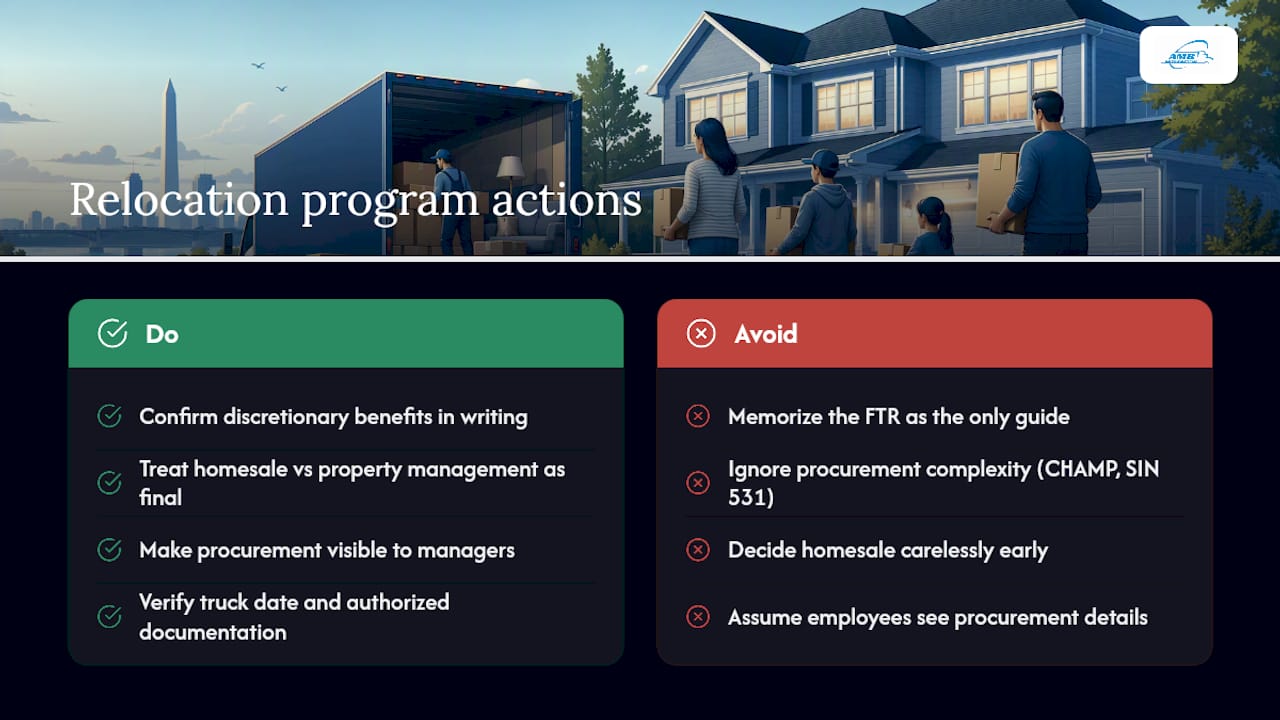
The other pattern worth naming: procurement complexity (CHAMP, SIN 531, task orders, IFF fees) is largely invisible to the relocating employee, and that’s by design. It shouldn’t be invisible to program managers running the show, because a homesale-versus-property-management decision made carelessly early in a move can’t be undone later. Treat that choice with the weight it deserves.
Where AMB sees the most value we can add isn’t in the regulatory interpretation, agencies and OPM own that, but in the execution layer: making sure the truck shows up on the date the service agreement specifies, with documentation that matches what was authorized.
— AMB
Get a Quote for Your Federal Relocation
AMB Moving & Storage handles the execution side of federal relocations: long-distance moving, secure short- and long-term storage, and move management that lines up with the documentation your agency requires. As a licensed and insured nationwide moving company, we coordinate shipment scheduling, weight estimates, and storage-in-transit around the paperwork your relocation coordinator hands you, so the operational details of your interstate move don’t stall on missing forms.
When you request a quote, have your authorized weight estimate, move dates, and any service agreement or storage authorization on hand. That’s the minimum we need to price a long-distance move accurately and avoid accessorial surprises later. Whether you’re relocating under a PCS, a hardship transfer, or a hiring incentive tied to a service agreement, get your government move quote started today, and we’ll build a moving plan around the entitlements your agency has already authorized.
This article is general information, not a substitute for advice from a qualified lawyer. Consult a qualified legal professional about your own circumstances before acting on anything here.
Sources
- 41 CFR 302 — Federal Travel Regulation (FTR) — Relocation allowances
- Fact Sheet: Relocation Incentives — U.S. Office of Personnel Management
- Employee Relocation Resource Center — GSA
- Reimbursable relocation expenses and rates — GSA