
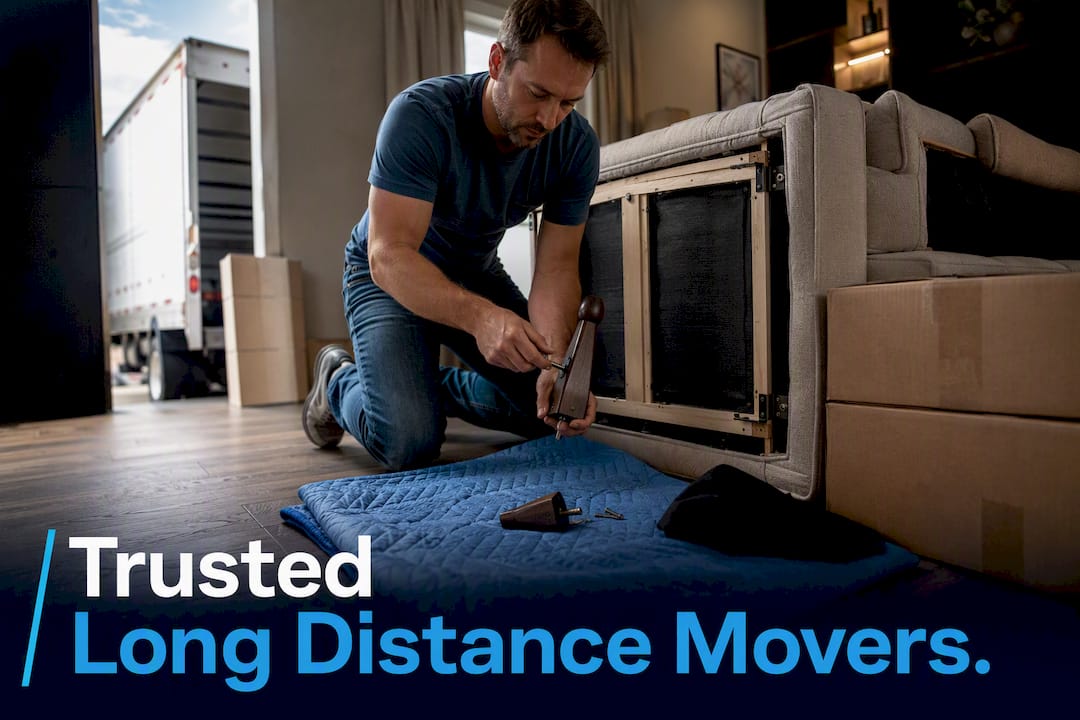

Yes, most couches can be broken down enough to clear a tight doorway, stairwell, or elevator. Remove the cushions, unscrew the legs, pull off any slipcover, and separate modular sections where they connect. If you’re dealing with a power recliner, a sleeper sofa mechanism, a glued antique frame, or a couch worth more than the cost of professional help, that’s your cue to call a specialist instead of a screwdriver.
TL;DR:
- Disassembling couches involves removing cushions, legs, and modular parts, but complex pieces like power recliners or antiques are better handled by professionals.
- Measure your couch and all passageways at least twice, and photograph all fasteners before disassembly to ensure easier reassembly.
- Use the proper tools, including socket sets, screwdrivers, and Allen keys, avoiding improvised fixes that risk damaging upholstery or frame parts.
- For sectional, sleeper, or recliner sofas, specific disassembly steps or electrical disconnection protocols are necessary to prevent damage and ensure safe transport.
- Hire a professional disassembly service when dealing with complex mechanisms, high-value pieces, or limited access to avoid damage and costly delays.
Table of Contents
- How Do You Prepare for Couch Disassembly for Moving?
- What Tools Do You Need to Take Apart a Sofa?
- How Do You Disassemble a Couch Step by Step?
- What Changes for Sectionals, Sleepers, and Recliners?
- When Should You Hire a Professional Disassembly Specialist?
- How Do You Coordinate Disassembly With Your Moving Crew?
- AMB’s Take: When DIY Ends and Professional Help Begins
- Get a Custom Quote for Your Move and Couch Disassembly
- Sources
- FAQ
How Do You Prepare for Couch Disassembly for Moving?
Before you touch a single screw, walk your exit path with a tape measure. Couch disassembly for moving fails most often not because someone skipped a step, but because nobody measured the hallway turn or the elevator door until the sofa was already stuck in it.
Here’s the sequence that actually prevents a stuck-couch disaster:
- Measure the couch in three dimensions (height, width, depth) including the arms, then measure every doorway, hallway turn, stairwell landing, and elevator interior it has to pass through.
- Check what actually detaches. Flip the couch over or tilt it back and look for leg screws, sectional connector clips, or zippered cushion covers.
- Photograph every joint and fastener before you remove anything. This step alone saves more reassembly headaches than any other on this list.
- Clear the route. Remove interior doors from their hinges if the couch won’t clear the frame otherwise. Interior door removal is generally straightforward with basic tools, and it often buys you the extra two or three inches a couch needs.
- Protect your floors. Lay down a runner or moving blankets along the path, especially over hardwood or tile where a dragged couch leg can gouge a permanent scar. Our guide on how to protect floors during a move covers materials that hold up under heavy furniture.
- Decide DIY versus professional based on what you find. A couch with four bolt-on legs and a zip-off cushion set is a weekend project. A reclining sectional with wiring harnesses is not.
Pro Tip: Take the width measurement of your narrowest pinch point (usually a stairwell turn or an interior door) and subtract two inches for safety margin. If your intact couch beats that number, you may not need to disassemble at all.
What Tools Do You Need to Take Apart a Sofa?
Half of couch disassembly for moving goes wrong because someone shows up with a single flathead screwdriver and improvises the rest. Don’t improvise. Gather these before you start:
- Socket set with metric and standard sizes (most couch legs use hex bolts, not screws)
- Phillips and flathead screwdrivers
- Allen keys (Ikea-style flat-pack couches almost always use these)
- Pliers and an adjustable wrench for stubborn brackets
- Staple remover and needle-nose pliers for upholstery held with staples rather than screws
- A small pry bar, used sparingly and only where fabric won’t tear
- Moving blankets, ratchet straps, a furniture dolly, and plastic or felt furniture sliders
- Small labeled bags or a divided parts box for screws, bolts, and brackets
- Packing tape and a permanent marker
- Work gloves, safety glasses, and at least one other person to help lift
Stop using metal tools the moment you hit upholstery you can’t identify. If you can’t tell whether a seam is stitched or stapled, cutting into it risks tearing fabric you can’t repair on moving day. Expert disassembly guidance consistently points to this as the line between a couch that survives the move and one that arrives with a torn arm panel.
How Do You Disassemble a Couch Step by Step?
This sequence works for the vast majority of standard sofas: two- and three-seaters with bolt-on legs, removable backs, or clip-together arms. Sectionals, sleepers, and recliners need extra care, which we’ll cover next.
1. Strip it down to the frame’s starting point.
Pull every cushion, throw pillow, and slipcover off first. Photograph the couch from three angles before you remove anything else. This becomes your reassembly map later, and it’s the single habit step-by-step disassembly guides recommend most consistently.
2. Remove the legs.
Tip the couch onto its back or side. Most legs thread into a metal plate or wood block with a single bolt; some use a hex screw accessible through a hole in the base fabric. Once each leg comes off, tape it directly to the underside of the couch or drop it into a labeled bag. Never toss loose hardware into a moving box with fifty other items. You will not find it again in the new house.
3. Access the hidden fasteners.
Many couches hide their major bolts and brackets under a dust skirt, a strip of black fabric stapled along the base. Peel back or carefully cut this skirt (it’s rarely worth preserving) to expose the frame connections between the seat deck and the back or arm units.
4. Remove the arms and back panel.
Look for L-brackets, cam locks, or long bolts connecting the arms to the seat frame. Avoid cutting factory staples unless you’re prepared to restaple the upholstery yourself or have a repair plan at the destination. Fold loose fabric inward and pin or tape it in place so it doesn’t snag or tear during transport.
5. Handle exposed springs and raw frame edges.
Once panels come off, you may expose sinuous springs, raw wood corners, or metal brackets. Wrap these in moving blankets and secure with stretch wrap. A wood corner poking through blanket padding is one of the more common ways couches, walls, and doorframes get damaged during a move, which is exactly the kind of risk a damage guarantee from a professional service is designed to cover.

Pro Tip: Number every part with painter’s tape as you remove it, in the order you removed it. Reassembly goes twice as fast when part “3” clearly connects to bracket “3,” rather than guessing which bolt goes where three weeks later.
6. Test-fit before you load the truck.
Loosely reconnect one or two of the smaller joints (a leg to its plate, for example) to confirm you’ve kept the matching hardware together. This five-minute check prevents the frustrating discovery, at the new place, that a bolt got left behind three states ago.
What Changes for Sectionals, Sleepers, and Recliners?
Not every couch follows the standard playbook above. A few categories need their own approach, and getting this wrong risks more than a scuffed wall.
- Sectionals usually separate along rail or clip systems designed for exactly this purpose. Identify which piece is the anchor (often the corner unit) and work outward. Individual sections are lighter and easier to carry, though a large chaise piece can still be too bulky for a narrow stairwell without leg removal.
- Sleeper sofas hide a fold-out metal mechanism under the seat cushions. Secure the mechanism in its closed position with a strap or zip tie before you remove any surrounding brackets. If the couch came with manufacturer paperwork, check it. Sleeper mechanisms vary enough between brands that a step that works on one model can jam another.
- Recliners and power sofas add wiring into the mix. Disconnect and label any power cords or control wiring before removing panels, and treat any hardwired electrical connection (rather than a simple plug) as a job for a certified technician rather than a DIY afternoon.
- Antiques and glued-frame pieces are the one category where disassembly itself is the risk. A frame held together with old glue joints instead of bolts can crack or separate permanently if you try to take it apart. For pieces like this, moving it whole, even if that means a tighter squeeze through a doorway, is often the safer route than disassembly.
When Should You Hire a Professional Disassembly Specialist?
Call in help when the math stops favoring DIY. A few signals make that call easy:
- The couch has real replacement value, whether that’s sentimental or a four-figure price tag.
- You’re looking at a complex frame, a sleeper mechanism, or a power recliner with wiring.
- You don’t own the right tools, or you don’t have a second set of hands to help lift.
- Your building has a tight walk-up, a narrow stairwell, or an elevator with strict reservation windows.
A specialist’s service typically covers disassembly, protective wrapping, navigating the piece through tight spots, full reassembly at the destination, and in many cases a damage guarantee that a general moving crew won’t offer. Commercial disassembly providers build their entire pitch around solving exactly the tight-door, awkward-frame problems that stall DIY attempts.
Cost tends to move with three factors: the couch’s complexity, how difficult the access is (walk-up floors and elevator reservations both add time), and whether you need rush or same-day service.
Pro Tip: Book the specialist before your movers, not after. Give them photos and exact measurements up front. It shrinks the estimate call to a few minutes and avoids a surprise on move day if the piece turns out more complex than described over the phone.
How Do You Coordinate Disassembly With Your Moving Crew?
Timing decides whether disassembly saves you money or costs you extra. Book the disassembly specialist to work before or alongside your moving crew, and confirm arrival windows and any elevator or loading dock reservations for both teams in advance.
On move day, the sequence should run: floor runners down first, disassembly completed, then the moving crew loads the components, with reassembly happening only after everything arrives at the destination. Share your measurements and photos with both the disassembly team and the moving crew so nobody is improvising a plan on the sidewalk. Confirm parking and loading logistics ahead of time too. Before anyone leaves, sign off on the paperwork, photograph the couch’s condition both before and after, and keep the bag of hardware with you rather than letting it ride separately in the truck. Getting this sequence wrong is a common reason movers can’t complete a couch delivery on the spot, leaving the owner stuck arranging a rush specialist visit after the truck has already left.

AMB’s Take: When DIY Ends and Professional Help Begins
DIY disassembly works fine for a straightforward sofa with bolt-on legs and a roomy hallway. It stops working the moment you’re dealing with a sleeper mechanism, a power recliner, or a building with a tight walk-up and no margin for error. Professional moving companies coordinate disassembly directly with long-distance and interstate move scheduling, which is where most DIY plans actually fall apart. Not in the living room, but in the gap between “the couch is in pieces” and “the truck showed up on time.” Booking disassembly alongside your move, rather than scrambling for it separately, can be the difference between a smooth moving day and a same-day rush fee.
— AMB
Get a Custom Quote for Your Move and Couch Disassembly
Ambmovingservices handles the parts of a long-distance move that go beyond just loading boxes: couch disassembly, protective packing for fragile or bulky pieces, nationwide interstate transport, reassembly at your destination, and short- or long-term storage if your timeline needs it.

To get an accurate quote fast, have your couch’s measurements ready, along with photos of the access path from curb to living room, and note whether the piece has a sleeper mechanism or power components. Whether you’re planning a full cross-country move or a state-to-state relocation with a few tricky furniture pieces, our teams handle long distance moving and interstate moving as coordinated services, not separate line items you have to schedule yourself. If you need storage between disassembly and delivery, that is built into our nationwide moving options as well. Request a moving quote today and ask about scheduling disassembly alongside your booked move date to avoid the same-day scramble entirely.
Sources
For hands-on procedural detail beyond this guide, see the Instructables couch disassembly walkthrough and TaskRabbit’s furniture disassembly tips. Always check manufacturer instructions first when your couch model provides them.
- How to Move a Couch Through a Tight Door: AKA How to Dissassemble a Couch.
- DIY Furniture Disassembly 101: Expert Tips for Taking Apart Furniture When Moving
- Sofa Disassembly Cost NYC: What to Expect in 2026 | Sofa Era
- Sofa Disassembly Services Near Me
FAQ
Can You Take a Sofa Apart to Move It?
Yes. Most sofas allow you to remove the legs, cushions, and slipcovers, and many also let you separate the arms and back from the seat frame using hidden bolts or brackets.
What Is the Best Way to Dismantle a Sofa?
Work in order: remove cushions and slipcovers first, then legs, then peel back the dust skirt to reach frame bolts, then separate the arms and back panel while protecting any exposed wood or springs with moving blankets.
How Can I Disassemble a Couch Without Tools I Don’t Have?
If you’re missing a socket set, Allen keys, or a staple remover, you’re better off booking a professional disassembly specialist rather than forcing a fastener with the wrong tool and risking frame or upholstery damage.
How Do I Dismantle a Three-Seater Sofa?
A standard three-seater follows the same sequence as smaller sofas: cushions off, legs unbolted, dust skirt peeled back for hidden fasteners, then arms and back separated at the bracket connections, just with more weight to manage with a second person helping.
When Should I Book Professional Help Instead of Doing It Myself?
Book professional help when you’re facing a sleeper mechanism, a power recliner, an antique frame, or a tight walk-up or elevator move, especially if the disassembly is happening alongside a long-distance or interstate relocation.