


Full Value Protection makes your mover financially responsible for repairing, replacing, or paying the replacement cost of lost or damaged items, up to the value you declared on the shipment. Released Value, the alternative, pays only $0.60 per pound per item, regardless of what that item actually cost. For most interstate moves involving furniture, electronics, or anything you’d hate to lose, Full Value Protection is the smarter pick. Declare an honest value and list your expensive items separately.
TL;DR:
- Declaring a realistic value that reflects current replacement costs is crucial, as it caps the mover’s liability under Full Value Protection.
- Items over 100 dollars per pound must be listed on a high-value inventory form before the move to ensure full coverage eligibility.
- The cost of Full Value Protection generally ranges from 1% to 2% of the declared shipment value, with higher deductibles lowering premiums.
- Proper documentation, including photos and detailed inventories of high-value items, significantly improves claim success chances.
- PBO packing and undervaluing your shipment can lead to denied claims, making professional packing and accurate valuation essential.
Table of Contents
- What Is Full Value Protection Under FMCSA Rules?
- Full Value Protection Vs. Released Value: What the Numbers Actually Show
- What Does Full Value Protection Cost?
- What FVP Actually Covers, and Where It Stops
- How to Elect Full Value Protection and File a Claim
- Is Full Value Protection Worth It for Your Move?
- How AMB Moving Services Handles Valuation and Claims Support
- Why the Standard FVP Advice Misses the Real Risk
- Move With a Company That Treats Valuation Seriously
- Sources
What Is Full Value Protection Under FMCSA Rules?
Full Value Protection isn’t a marketing term dreamed up by movers. It’s a regulatory category defined by the Federal Motor Carrier Safety Administration, and interstate carriers are legally required to offer it. The FMCSA requires movers to present both valuation options before your shipment loads, and if you don’t sign a written waiver choosing Released Value instead, Full Value Protection becomes the default coverage on your move.
Under this coverage, the mover has to do one of three things for a lost or damaged item:
- Repair the item so it’s restored to the condition it was in before the move.
- Replace it with an item of like kind and quality.
- Pay you a cash settlement equal to the current replacement cost.
The catch is the declared value you set at booking. That number caps the mover’s total liability for the entire shipment, so it needs to reflect what your belongings would actually cost to replace today, not what you paid for them five years ago. This figure, along with your valuation choice, has to appear on the written estimate, the mover’s tariff, and the bill of lading, the contract you sign at pickup. If it’s missing or vague on any of those documents, that’s a paperwork problem worth flagging before the truck leaves your driveway.
Full Value Protection Vs. Released Value: What the Numbers Actually Show
Numbers make this decision easier than any explanation. Say your 50 pound flat screen TV, worth $600 today, gets crushed in transit.
- Under Released Value, the mover owes you $0.60 times 50 pounds, which comes out to $30. That’s the entire payout for a TV that cost twenty times that amount.
- Under Full Value Protection, the mover has to repair the TV, replace it with a comparable model, or cut you a check for its current replacement cost, up to your declared shipment value.
The gap in real terms: A 50 pound television destroyed in transit nets $30 under Released Value but is eligible for full replacement cost under FVP.
The same math applies to a washing machine, a dining set, or a home office setup. Weight-based payouts almost never match what modern goods are worth, because heavy items aren’t necessarily expensive and light items, like a laptop, can be worth far more than their pound-for-pound liability limit.
Released Value can make sense in narrow cases, like shipping a few boxes of used textbooks or dorm furniture with no real resale value. Outside of that, it shifts nearly all the financial risk of loss or damage onto you, the customer, which is the opposite of what insurance is supposed to do.
What Does Full Value Protection Cost?

Pricing follows a fairly predictable formula across the industry. Carriers commonly charge roughly 1% to 2% of your declared shipment value for Full Value Protection. Declare $80,000 in household goods, and expect a valuation charge somewhere in the $800 to $1,600 range, depending on the carrier and your deductible.
A few pricing mechanics matter here:
- Minimum declared value. Movers often set a floor tied to your shipment’s estimated weight, so even a light shipment can’t be declared at an artificially low value. This protects the carrier from being on the hook for expensive items with a token declared value attached.
- Deductible options. Just like auto insurance, choosing a higher deductible, say $500 instead of $0, lowers your premium. If you’re moving a modest household with few breakables, a higher deductible plus a slightly lower valuation charge can be the more economical route.
- Break-even thinking. Compare the premium difference between deductible tiers against the odds of filing a claim above that threshold. For a full truckload cross-country move, most families come out ahead paying a bit more for a low or zero deductible.
Our guide on moving insurance for interstate moves breaks down how declared value interacts with these charges in more detail.
What FVP Actually Covers, and Where It Stops
Full Value Protection is generous, but it isn’t unlimited. Certain categories fall outside standard coverage, and knowing them upfront prevents an unpleasant surprise at claim time.
Standard exclusions include:
- Boxes packed by the owner (PBO). If you packed it yourself and the box arrives with no external damage, the mover typically isn’t liable for what’s broken inside.
- Normal wear and tear. Scuffed furniture legs or a worn couch arm from years of use won’t qualify.
- Inherent vice. Damage caused by a pre-existing defect in the item itself, not by the move.
- Mechanical or electrical derangement without visible damage. If your TV stops working but the box shows no dents or cracks, proving the damage happened in transit gets much harder.
There’s also a hard rule around expensive items: anything valued at more than $100 per pound, think jewelry, fine art, or a rare instrument, needs to be listed on a high value inventory form before the move. Skip that step, and the mover’s liability on that specific item can be sharply limited, no matter what your overall declared value says.
Pro Tip: Photograph every high-value item and any existing damage before the movers arrive, and keep those photos with your copy of the bill of lading. If you ever need to file a claim, dated photos are the single strongest piece of evidence you can produce.
How to Elect Full Value Protection and File a Claim
Electing coverage correctly, and documenting your shipment properly, is what turns Full Value Protection from a legal promise into money in your pocket if something goes wrong.
- Confirm your choice in writing. Check the valuation section on your estimate and bill of lading before signing. It should clearly state Full Value Protection, your declared value, and your chosen deductible, not a blank field or a default you didn’t discuss.
- Complete the high-value inventory before loading. List anything over the $100 per pound threshold by name and estimated value, and hand the form to the crew before the truck is packed.
- Document condition as items are loaded. Photograph furniture, electronics, and anything fragile. Note existing scratches or dents on the inventory sheet the crew prepares at pickup.
- Inspect at delivery before signing. Don’t sign the delivery receipt until you’ve checked major items. Once you sign, disputing damage gets harder.
- File the claim promptly. Notify the mover in writing, usually within nine months per federal rules, and expect an adjuster to review your documentation. Movers generally have 120 days to acknowledge a claim and issue a decision, with settlement paid as a repair, replacement, or cash payment.
Is Full Value Protection Worth It for Your Move?
Run through a short checklist before you decide:
- Replacement cost. Add up what it would actually cost to replace your furniture, electronics, and appliances today. If that number is in the thousands, Released Value’s per-pound formula won’t come close.
- High-value items. Own jewelry, art, or collectibles? They need separate listing regardless of which valuation you choose.
- Who’s packing. If you’re packing your own boxes, remember PBO exclusions apply, and third-party insurance might fill that gap better than mover valuation.
- Distance and duration. Longer interstate hauls mean more handling, more transfers, and statistically more opportunity for something to shift or break.
For expensive electronics or antiques, or if you’re packing boxes yourself, third-party moving insurance is worth pricing out separately since policy terms are often broader than standard mover valuation, even though it adds a second claims process.
Pro Tip: If a mover pushes hard for Released Value, hands you a bill of lading with the valuation section left blank, or can’t clearly explain their FVP pricing on the spot, treat that as a warning sign and get a second estimate.
How AMB Moving Services Handles Valuation and Claims Support
Valuation coverage is typically discussed at the estimate stage rather than buried in paperwork signed last minute. Customers are guided through declared value, deductible choices, and high-value inventory requirements before the moving crew arrives to avoid surprises.
Some practices are included in the process to reduce claim risk, such as professional packing for fragile and high-value items, inventory documentation support including serial numbers, condition notes, and photos from pickup through delivery, and secure short- and long-term storage with consistent documentation standards.
You can see how this fits into a broader move on our inter state moving services page, which covers how valuation coverage applies specifically to state-to-state relocations.
Why the Standard FVP Advice Misses the Real Risk
Most articles on this topic treat Full Value Protection like a checkbox: pick it, pay a little extra, move on. That undersells the part that actually determines whether coverage works when you need it, your declared value and your documentation.
An accurate declared value matters more than which valuation type you pick. Underdeclare your shipment to save a hundred dollars on premium, and you’ve capped your own payout below what your belongings are worth, even with Full Value Protection in place. That’s the failure mode nobody warns you about clearly enough.
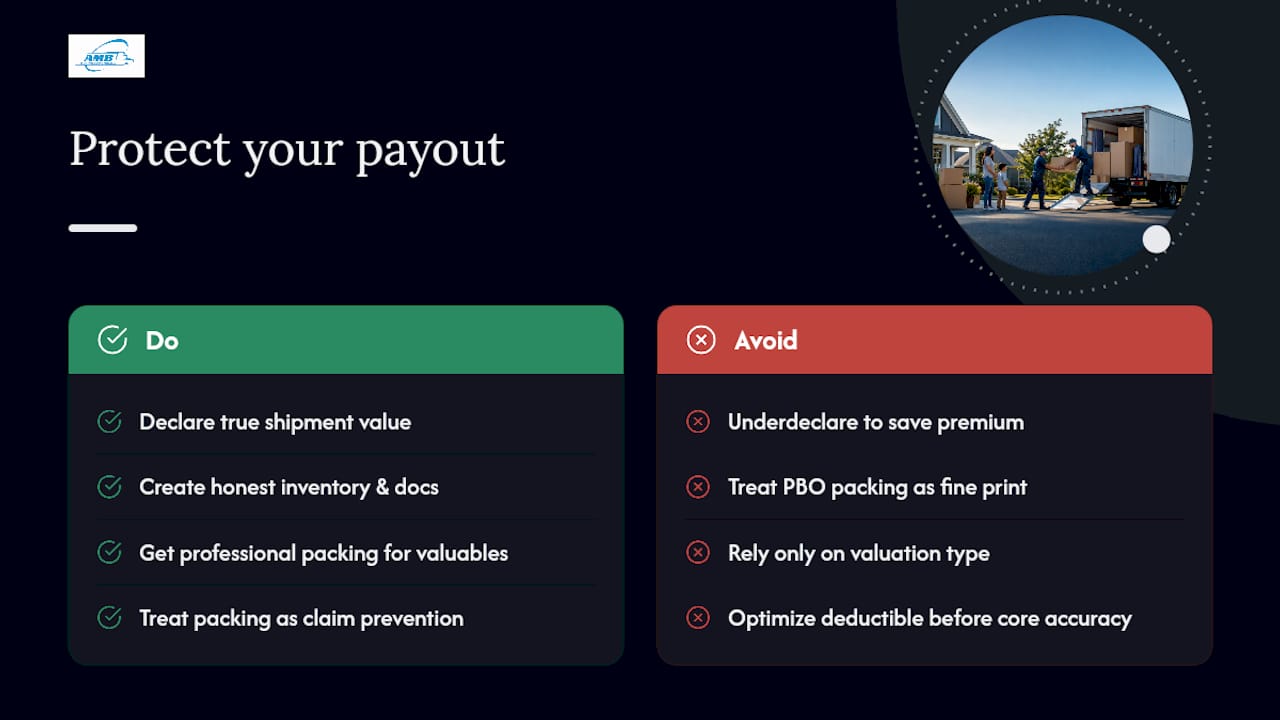
The other blind spot is packing. Conventional wisdom frames PBO exclusions as fine print. In practice, it’s one of the most common reasons claims get denied on electronics and fragile goods. If you’re serious about protecting a shipment, professional packing on your valuables does more for your claim odds than any deductible choice.
Prioritize an honest inventory and accurate declared value first. Everything else, deductible tier, packing decisions, third-party insurance, is a secondary optimization once that foundation is right.
— AMB
Move With a Company That Treats Valuation Seriously
Ambmovingservices is built for exactly the scenario this article covers: interstate and long distance moving, where getting valuation coverage right actually matters. We handle declared value conversations upfront, support high-value inventory documentation, and offer professional packing that keeps your Full Value Protection claim intact if something goes wrong.
Whether you’re relocating across two states or coast to coast, our long distance moving services are built around the same federal compliance standards this guide walks through, licensed, insured, and transparent about what your coverage actually pays. If you’re planning a cross-country move and want a mover that explains valuation clearly instead of rushing you through the bill of lading, request your quote today and get a straight answer on coverage before you book.
Sources
- How do I insure my belongings during a move? | FMCSA
- Moving Valuation: Released vs Full Value Protection | Mover Scorecard


