


Start a room-by-room, box-numbered inventory with a photo for every box, and keep a copy off the moving truck. That single habit protects you more than any other step in the entire relocation process. A useful household inventory moving record needs just five things per entry: a box number, the room it came from, a three to five word contents summary, a fragile or open-first flag, and a linked photo.
This is your personal record, separate from the mover’s own paperwork. Interstate carriers are required to prepare a written descriptive inventory under 49 CFR § 375.503, noting the condition of every carton and loose item, with the shipper signing off at pickup and delivery. Your list and their list serve different purposes, and you need both.
Before you tape a single box shut, do this:
- Pick your format: a spreadsheet, a printable checklist, or an app with photo storage.
- Photograph every high-value item individually, from more than one angle.
- Set up one shared folder or cloud account so the inventory survives even if your phone doesn’t.
Key Takeaways
A household inventory works because it pairs a fast, photo-backed personal record with the mover’s legally required descriptive inventory, giving you proof at every stage of the move.
| Point | Details |
|---|---|
| Start six weeks out | Begin with storage areas and low-use rooms before tackling the kitchen and bedrooms. |
| Use the 3–5 word rule | Pair a short box label with one photo instead of cataloging every item individually. |
| Tier your documentation | Photograph items over $100, keep receipts for items over $500, and appraise anything over $2,500. |
| Reconcile at pickup and delivery | Compare your list against the mover’s descriptive inventory before signing either document. |
| Choose a mover that respects your system | Ambmovingservices coordinates packing crews and delivery documentation around interstate compliance and your existing box-numbering setup. |
Table of Contents
- Building Your Household Goods Inventory List Step by Step
- What to Photograph and Record for Each Item
- Should You Use a Spreadsheet, App, or Printable List?
- Handling Valuables, Fragile Items, and Exceptions
- Reconciling Your Inventory With the Mover’s Official Record
- How AMB Moving Services Supports an Inventory-Ready Move
- Coordinating Your Inventory With a Reliable Interstate Mover
- Why the Standard Moving Checklist Advice Misses the Point
- Sources
Building Your Household Goods Inventory List Step by Step
Most families wait too long to start. The right window is six to two weeks before moving day, and the order matters almost as much as the timing.
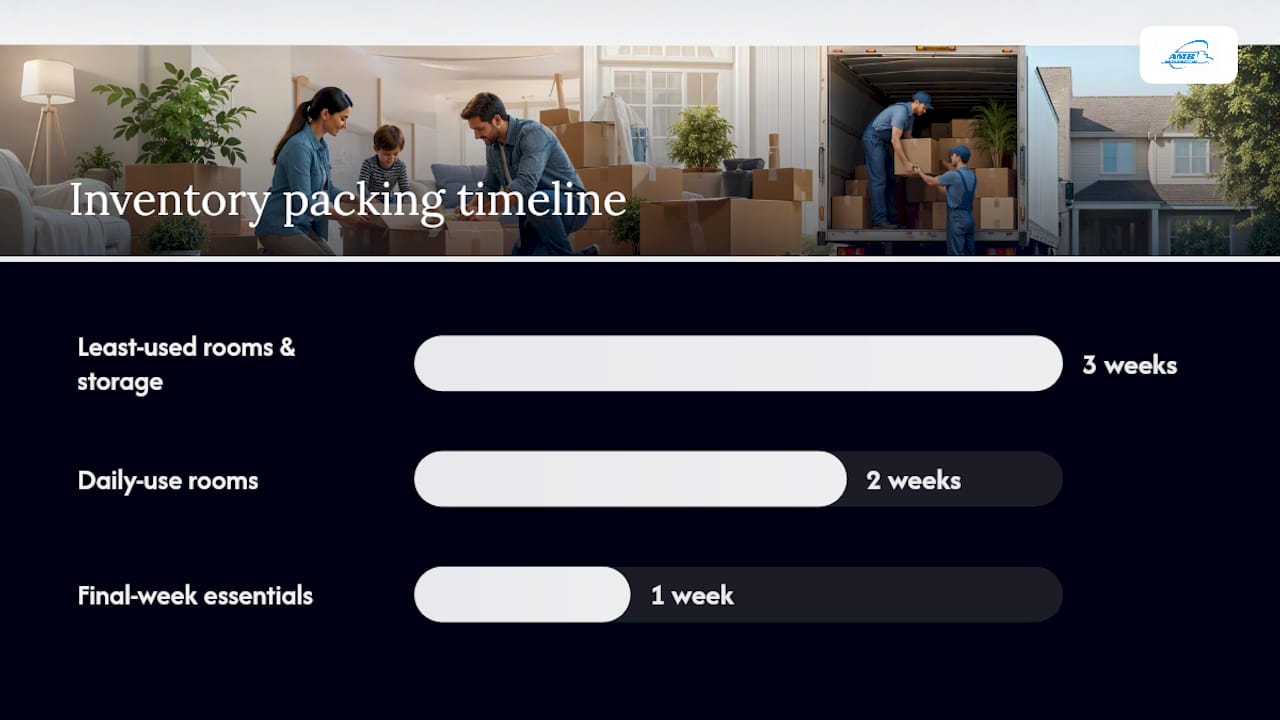
Weeks 6 to 4: Begin with rooms you use least: storage areas, guest rooms, the garage. This is also when you inventory anything going into short-term or long-term storage rather than onto the truck, which is worth tracking separately using a storage solutions checklist.

Weeks 3 to 2: Move into daily-use spaces: kitchen, bedrooms, home office. These rooms generate the most boxes and the most confusion later, so give them the most careful labeling.
Final week: Everyday essentials, last-minute items, and anything you’ll unpack within the first 24 hours at your new address.
- Assign a room-prefix numbering scheme. Use codes like K for kitchen, BR1 for bedroom one, and OFF for office, followed by a sequence number: K-01, K-02, BR1-01. This isn’t busywork. When a box goes missing or a mover asks “where does this go,” a code beats a guess every time.
- Label each box with the 3–5 word rule. “Kitchen: pots, pans, lids” tells you enough without turning packing into a cataloging project. This short-description-plus-photo approach is the industry sweet spot between speed and usefulness, and it’s the same logic behind QR-code label systems.
- Photograph the inside of each box before sealing it. One shot, timestamped, linked to the box number in your spreadsheet or app.
- Flag fragile and open-first boxes clearly, on at least two sides, with a marker or bright sticker the movers can spot from across the room.
- Update your master list daily, not at the end of packing week. A shared spreadsheet or app lets a spouse or helper add entries without a group text spiral.
Following a residential moving checklist alongside your inventory keeps the packing timeline and the documentation timeline moving in sync, instead of one lagging behind the other.
Pro Tip: Print a one-page “master index” listing only box numbers and rooms, and tape it inside your front door on moving day. It turns a chaotic loading process into a checklist you can cross off in real time.
On moving day itself, cross-check every box against your list as it goes onto the truck. If a mover’s crew notes pre-existing damage on their inventory before loading, read that note before you sign anything. That signature is your acknowledgment, not a formality.
What to Photograph and Record for Each Item
Photos do more legal work than most people realize. An independent, self-conducted inventory with photographic evidence is what insurance regulators recommend specifically because it holds up when a claim gets disputed.
For every room, take four kinds of photos:
- A wide shot of the full room before packing starts, showing furniture placement and general condition.
- A contents photo of each box, taken right before you seal it.
- Close-up shots of any pre-existing scratch, dent, stain, or crack. Photograph it even if you think it’s minor.
- Close-ups of serial numbers and model tags on electronics, appliances, and anything with a warranty.
Match your documentation effort to value. Items of higher value should be documented with photos, receipts, serial numbers, and where appropriate, formal appraisals. Very high-value items such as art, jewelry, and instruments are often best kept with you rather than on the truck.
Movers use standardized condition codes on their own paperwork; your photos are the plain-language backup that makes those codes meaningful later. If their inventory says “PE” for a pre-existing scratch on your dresser, your photo from three weeks earlier proves exactly what that scratch looked like before anyone touched it.
Name your files consistently: BR1-01_dresser_scratch_2026-03-14, for example. Store everything in one cloud folder shared with a spouse or family member, never only on the truck and never only on one phone.
Should You Use a Spreadsheet, App, or Printable List?
The right tool depends on where you are in the process, not personal preference. Planning favors paper. Execution favors digital.
A printable room-by-room checklist works well in the early weeks when you’re deciding what to keep, sell, or store. It’s fast to scribble on and doesn’t require charging a device. Once you start actually filling boxes, a digital tracker becomes worth the setup time because you can search it, share it, and attach photos directly to each entry.
Your template needs these fields at minimum, based on the structure most consumer moving guides recommend:
| Field | Why it matters |
|---|---|
| Box number | Ties every physical box to a record |
| Room | Groups boxes for loading and unpacking order |
| Contents (3–5 words) | Fast to write, fast to read |
| Fragile flag | Alerts movers and future you |
| Open-first flag | Speeds up day-one unpacking |
| Photo link | Backs up the description visually |
| Approximate value | Flags what needs extra care or insurance |
| Packed date | Useful for claims and troubleshooting |
Apps make the most sense when multiple people are packing, when you want QR labels for instant retrieval, or when cloud backup matters more than a familiar spreadsheet layout. A basic spreadsheet is perfectly sufficient for a smaller household. Start with a printed room checklist for planning, then switch to a digital box tracker once packing actually begins.
Handling Valuables, Fragile Items, and Exceptions
Not everything belongs on a standard checklist the same way. Some items need heavier documentation; others shouldn’t be on the truck at all.
- High-value items (jewelry, collectibles, electronics over $500) get their own separate list with receipts, serial numbers, and photos, apart from the general box inventory.
- Documents, medications, and perishables don’t belong in numbered boxes. Note “carrying personally” in your inventory so nothing appears to be missing later.
- Hazardous materials like propane tanks, paint, or aerosols are typically excluded from shipments entirely; note their disposal or separate transport in your records.
- Climate-sensitive items (instruments, art, wine) need labeled boxes specifying “climate sensitive” so movers handle storage and truck placement accordingly.
- Detailed photo and serial-number documentation directly strengthens any later insurance claim, since adjusters weigh evidence quality heavily. Understanding how moving insurance actually works before you pack helps you decide what needs extra protection.
Reconciling Your Inventory With the Mover’s Official Record
Your household inventory and your carrier’s inventory aren’t competing documents. They’re meant to overlap, and knowing where they overlap prevents most disputes before they start.
Federal rules require interstate carriers to prepare a written, itemized descriptive inventory covering every carton and loose item in the shipment. That inventory uses standardized condition codes, and both the shipper and the carrier sign it at pickup and again at delivery, under 49 CFR § 375.503.
At pickup:
- Walk the truck with the crew lead and compare box counts against your own numbered list.
- Read every condition note before signing. If something looks wrong or incomplete, say so on the spot.
- Don’t sign a blank or vague inventory just to speed things along.
Most disputes over moving damage trace back to one moment: a rushed signature at pickup or delivery, given before either side actually compared notes. Reading the mover’s inventory line by line against your own record, before you sign, resolves nearly every disagreement before it becomes a claim.
At delivery, photograph anything damaged before you sign the delivery paperwork, not after. Most moving contracts specify a notice window for filing damage claims, often measured in days, so check your contract terms and don’t let that window close. For more on how your own tracking complements a carrier’s paperwork, see this breakdown of moving inventory management.
Keep signed copies of both inventories, plus your photos, for at least a year after delivery. Claims sometimes surface late, especially for items that weren’t unpacked immediately.
How AMB Moving Services Supports an Inventory-Ready Move
An inventory is only as strong as the move built around it, and that’s where a licensed, insured carrier changes the outcome. Ambmovingservices builds inventory-aware practices directly into its process for long-distance and interstate relocations.
- Pre-move planning calls that walk through box counts, high-value items, and storage needs before the truck arrives.
- Professional packing teams trained to coordinate box numbering and labeling with your existing system, not against it.
- Condition documentation at pickup and delivery, consistent with federal descriptive inventory requirements.
- Secure short-term and long-term storage options for items that don’t travel with the rest of the shipment.
Pro Tip: Hand your packing crew a printed copy of your box-numbering key before they start loading. It takes two minutes and saves hours of confusion at delivery.
For nationwide moving company handling cross country movers and state to state relocations, aligning your personal inventory with the crew’s process from day one is what keeps a long-distance move from turning into a paperwork headache. If you’re planning an interstate move and want a team that treats your inventory as part of the job, not an afterthought, request a quote through Ambmovingservices’ quote page.
Coordinating Your Inventory With a Reliable Interstate Mover
Ambmovingservices is the practical next step for anyone who has just built a household inventory and now needs a crew that will actually respect it. A DIY move or a rental truck puts the entire loading, driving, and unloading burden on you, exactly when your energy should be going toward tracking boxes and checking off your list. A licensed interstate carrier removes that burden while working directly from your numbering system.
Ambmovingservices handles long distance moving, interstate movers’ coordination, and full state-to-state logistics, backed by licensing and insurance compliance that matters for cross country movers specifically. The team’s packing crews and drivers are set up to cross-reference your box labels against their own descriptive inventory at pickup and delivery, so your documentation and their paperwork tell the same story.
Explore long-distance moving services or review interstate moving options to see how a nationwide moving company structures a multi-state relocation. If storage fits into your plan, the nationwide moving network covers that too. For readers weighing specialized shipping needs, furniture shipping services from logistics partner USI Ship cover large or unusual items outside a standard household shipment. Ready to see moving cost estimates for your specific inventory and timeline? Request a quote and get a plan built around the boxes you’ve already numbered.
Why the Standard Moving Checklist Advice Misses the Point
Most moving advice treats the inventory and the mover’s paperwork as separate chores, one for you, one for them. That’s backwards. The research on this is clear: the two documents are supposed to talk to each other, and disputes happen almost entirely in the gap between them.
The conventional wisdom oversells exhaustive item-by-item cataloging. Nobody sustains a habit of listing forty individual items per box for six weeks straight; that’s how inventories get abandoned by week three. The short-description-plus-photo method wins because people actually finish it.
What gets underrated is the signature moment itself, at pickup and at delivery. That’s the real decision point, not the packing week. A detailed inventory means nothing if you sign a vague condition report without reading it. Prioritize building the habit of reading before signing over building the perfect spreadsheet. A good-enough list checked carefully beats a flawless list checked carelessly, every time.
— AMB
Sources
- 49 CFR § 375.503 — Inventory of household goods
- NAIC — Home inventory (consumer guidance)
- Inventory sheets: legally keep you from losing your stuff on a move — HireAHelper
- The Ultimate Moving Inventory Checklist (BoxBuddy)