


TL;DR:
- Choosing a licensed, insured direct carrier with a clear, itemized estimate prevents surprises and costly headaches during long-distance moves.
- Verify the carrier’s USDOT/MC number and confirm it owns trucks and crews to ensure accountability and transparency.
Pick a licensed, insured direct carrier that gives you a written, itemized estimate and explains your valuation options before you sign anything. That single decision eliminates most of the surprises that turn long-distance moves into expensive headaches.
TL;DR: Verify the mover’s USDOT/MC number on FMCSA, insist on a binding or itemized non-binding estimate, and confirm the company is the actual carrier, not a broker. For a vetted direct carrier, request a quote from AMB Moving Services before your moving date fills up.
- Choose a direct carrier over a broker for cleaner accountability and faster claims resolution.
- Get every fee in writing: long-carry, stair, shuttle, and storage-in-transit charges add up fast.
- Confirm USDOT/MC registration before signing any contract.
- Ask whether the estimate is binding or non-binding and what the 110% rule means for your final bill.
Table of Contents
- Why a direct carrier beats a broker for interstate moves
- How to evaluate and compare nationwide moving companies
- What red flags look like and what questions to ask
- What interstate moves actually cost and how long they take
- How AMB Moving Services handles your interstate move
- Key Takeaways
- Why transparent interstate moving is the only model worth trusting
- Get a written estimate from AMB Moving Services
- Authoritative sources for verifying mover credentials
Why a direct carrier beats a broker for interstate moves
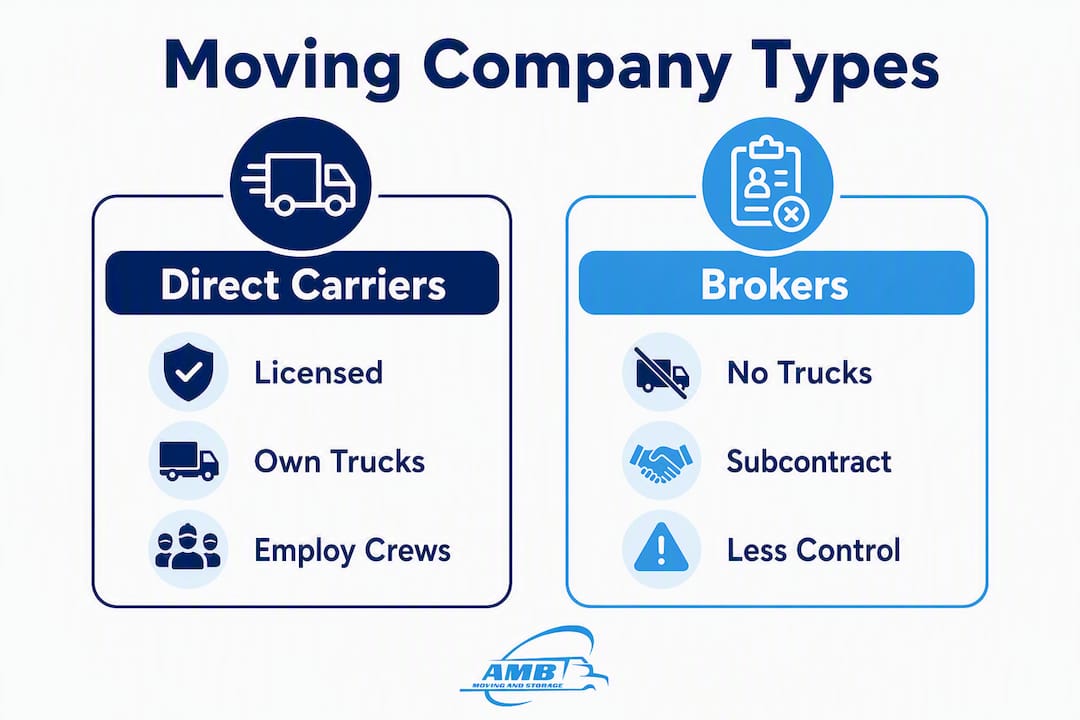
The difference between a direct carrier and a broker is simple: a direct carrier owns the truck, employs the crew, and signs your bill of lading. A broker takes your deposit and hands the job to a subcontractor you never vetted.
Direct carriers own trucks and crews and manage logistics themselves, which means fewer handoffs between your origin and destination. When something goes wrong, there is one company responsible. With a broker arrangement, the paper trail can fragment across multiple parties, and the performing carrier’s name may not even match the company you signed with. Insist that the bill of lading names the company actually doing the work.
Brokers are not illegal, but they introduce risk that most homeowners and businesses do not anticipate. A subcontracted crew may have different equipment, different training, and a different claims process than the company you researched. FMCSA distinguishes movers from brokers explicitly and requires both to register, but only the carrier is directly accountable for your goods in transit.
- Ask this first: “Are you the carrier or a broker?” Get the answer in writing.
- Verify the USDOT/MC number at FMCSA’s company search before signing.
- Confirm the performing carrier’s name appears on your bill of lading.
- Check complaint history in the FMCSA database, not just star ratings.
Pro Tip: If a company hesitates or deflects when you ask “Are you a carrier or a broker?”, treat that as a red flag. A legitimate direct carrier answers immediately.
How to evaluate and compare nationwide moving companies
A fair comparison requires the same checklist applied to every candidate. Use this during quote calls and in-person or virtual surveys.
The 10-point vetting checklist
- Verify USDOT/MC registration at FMCSA before any other step.
- Confirm carrier vs. broker status and get it in writing.
- Request an itemized estimate that lists base transportation, labor, packing, and all access fees separately.
- Clarify estimate type: binding (cost-certain) or non-binding (subject to the 110% rule at delivery under FMCSA rules).
- Ask about valuation options: Released Value Protection covers roughly $0.60 per pound per article, which rarely matches replacement cost. Full Value Protection costs more but pays actual repair or replacement.
- Confirm service scope: packing, specialty item handling, storage-in-transit, and guaranteed pickup/delivery windows.
- Test communication quality: a mover who proactively explains inventory needs, elevator access, and narrow-street constraints during the quote phase predicts better service during transit.
- Check extra fees explicitly: long-carry, stair, shuttle, and elevator charges should appear in the written estimate, not surface at delivery.
- Review complaint patterns on FMCSA, not just aggregate review scores.
- Compare written contracts, not advertised prices.
Getting reliable moving company quotes for long-distance moves means applying this list to every candidate, including quote-comparison platforms that route requests to multiple carriers. Those platforms save time, but they do not replace vetting each carrier individually.
What red flags look like and what questions to ask
The most expensive moving mistake is choosing on price alone. Industry professionals consistently report that low-ball estimates correlate with missed delivery windows, mishandled goods, and hidden fees that appear only at delivery.
Red flags to watch for
- Refusal or inability to provide a USDOT/MC number.
- No in-person or virtual survey before quoting (a price without seeing your inventory is a guess, not an estimate).
- Vague or evasive answers about extra fees.
- Demands for a large cash deposit upfront.
- No written bill of lading or contract before pickup.
- Pressure to sign immediately with no time to review terms.
The exact questions to ask every mover
- Are you a carrier or a broker?
- Can I see your USDOT/MC number?
- Is this estimate binding or non-binding?
- What extra fees could apply at delivery, and are they in this written estimate?
- How do you handle damage claims, what is the deductible, and what is the typical resolution timeline?
Hidden fees like long-carry, stair, and shuttle charges can materially inflate a final bill when they are not defined upfront. Movers with nothing to hide put every fee in the estimate. Those who do not are telling you something. For a practical look at what clear fee disclosure looks like, see no hidden fees movers.
What interstate moves actually cost and how long they take
Price depends on four variables: weight, distance, labor, and access conditions at both ends. Add valuation coverage and packing services and the number moves further.
| Cost component | What to ask |
|---|---|
| Base transportation | Quoted by weight and mileage — confirm both figures |
| Labor (load/unload) | Hourly or flat rate? How many crew members? |
| Packing materials and services | Itemized per box type or flat fee? |
| Long-carry, stair, shuttle fees | Are these in the written estimate? |
| Storage-in-transit | Daily or weekly rate? Minimum duration? |
| Valuation/insurance | Released Value vs. Full Value Protection? |
For a data-driven breakdown of costs by route, the 2026 interstate moving cost report covers real route data across common long-distance lanes.
Under FMCSA rules, a mover collecting on a non-binding estimate can charge no more than 110% of the original estimate at delivery. The remaining balance is collectible later. Binding estimates lock the price regardless of actual weight, provided your inventory does not change.
Transit timelines vary by distance and season. A cross-country move from the East Coast to California typically takes about one to two weeks in transit. Shorter interstate lanes generally run a few days. It is advisable to book several weeks ahead during the busy summer season, as last-minute bookings then often face higher rates and tighter scheduling.
Statistic to know: Released Value Protection, the default coverage, pays approximately $0.60 per pound per item. A 50-pound television damaged in transit would yield about $30 in compensation. Full Value Protection pays actual repair or replacement cost.
How AMB Moving Services handles your interstate move
AMB Moving Services operates as a direct carrier for long-distance and interstate relocations across the United States, which means the company owns the equipment, employs the crews, and holds direct accountability for your shipment from pickup to delivery.
- Written, itemized estimates with all fees disclosed before you sign.
- USDOT/MC registration and full FMCSA compliance for interstate moves.
- Valuation options explained at the estimate stage, not after loading.
- Packing services and materials available as part of the move package.
- Short- and long-term storage for moves requiring staged delivery.
- Specialty handling for senior, student, military, government, and commercial relocations.
- Commercial relocation support for businesses moving offices across state lines.
For nationwide moving needs, AMB coordinates logistics across multiple states with a consistent crew model that reduces the handoffs a broker arrangement introduces.
Pro Tip: When you contact AMB for a quote, prepare a room-by-room inventory, note any access constraints (narrow driveway, stairs, elevator), and identify specialty items like pianos or artwork. The more detail you provide, the more accurate your written estimate.

Key Takeaways
Choosing a licensed direct carrier with transparent, itemized pricing is the single most reliable way to protect your budget and your belongings on an interstate move.
| Point | Details |
|---|---|
| Verify USDOT/MC first | Check every mover’s registration and complaint history on FMCSA before signing anything. |
| Direct carrier vs. broker | Direct carriers own trucks and crews, reducing handoffs and keeping claims accountability clear. |
| Binding vs. non-binding estimates | Non-binding estimates are capped at 110% at delivery under FMCSA rules; binding estimates lock the price. |
| Released Value Protection limits | Default coverage pays about $0.60 per pound per item — request Full Value Protection for real replacement cost. |
| Ambmovingservices recommendation | AMB Moving Services is a licensed direct carrier offering itemized estimates, packing, storage, and specialty handling for interstate moves nationwide. |
Why transparent interstate moving is the only model worth trusting
Most moving complaints trace back to one failure: the mover never clearly explained what the final bill would include. The customer signed a non-binding estimate without understanding the 110% rule. The broker never disclosed the subcontractor. The claims process turned out to require documentation nobody mentioned at booking.
The direct-carrier model with written, itemized estimates is not a premium feature. It is the baseline standard every interstate mover should meet. When a company cannot or will not meet it, the price they quote is irrelevant because the final number will be different anyway. For homeowners and businesses planning complex multi-state moves, the interstate moving step-by-step guide lays out exactly what a well-run move looks like from first contact to delivery.
Get a written estimate from AMB Moving Services
AMB Moving Services gives you a concrete price before your belongings leave the driveway, not a surprise at delivery.
Here is what the process looks like:
- Prepare your inventory — room by room, with specialty items flagged.
- Request an in-person or virtual survey so the estimate reflects your actual load.
- Review the itemized written estimate — every fee listed, nothing deferred to delivery day.
- Choose your valuation coverage — AMB explains both options before you sign.
- Confirm your pickup window and schedule early, especially for summer moves.
Request your quote directly, or explore AMB’s full long-distance moving services to see what is included. For corporate clients, the commercial moving page covers office and business relocation logistics in detail.
Authoritative sources for verifying mover credentials
Before you sign with any interstate mover, these are the primary tools to use.
| Resource | What it gives you |
|---|---|
| FMCSA Protect Your Move | Five-step guide to selecting a mover; explains movers vs. brokers |
| FMCSA Company Search | Registration status, complaint counts, carrier vs. broker classification |
| FMCSA Select a Mover | Explains binding vs. non-binding estimates and the 110% rule |
| FMCSA Regulations and Enforcement | Full regulatory framework governing interstate household goods moves |
| FMCSA General Requirements | Consumer rights and carrier obligations under federal law |
How to use FMCSA’s company search: enter the mover’s legal name or USDOT number, then check the “Operating Authority” field (carrier, broker, or both), the complaint count relative to shipment volume, and whether the authority is active. A high complaint ratio relative to shipment volume is a stronger signal than star ratings on review platforms, which can be curated. Cross-check FMCSA complaint patterns against independent review platforms for a complete picture, but never let a clean review profile substitute for a verified USDOT/MC number and a written contract.
For executive and corporate relocations, relocation services for executives covers how stair, elevator, and shuttle fees affect total cost in high-access-constraint scenarios.