


TL;DR:
- A business relocation requires detailed planning to avoid operational disruptions and budget overruns. Starting 6 to 12 months in advance for lease review, vendor selection, and infrastructure setup is essential for a smooth move. Staggering employee moves over 60 to 90 days and performing a tech dry run beforehand minimizes operational risks and maintains productivity.
A business relocation timeline guide is a phased scheduling and task framework that maps every critical action from lease review to post-move stabilization, giving your team a clear path to execute an office move without losing productivity or budget control. Most businesses underestimate how far in advance planning must begin. Operational disruption during active move and stabilization phases runs 25–30%, a figure that drops sharply when cross-functional teams, including legal, IT, HR, and facilities, coordinate from the start. This guide walks you through the full relocation strategy timeline, from the first lease conversation to the 90-day post-move review, with specific tasks, timing, and tools to keep your business running throughout.
What is a realistic business relocation timeline guide?
A well-structured office relocation runs across five overlapping phases, each with distinct deliverables and dependencies. Compressing any phase creates downstream risk, and the most common failures trace back to starting too late.

| Phase | Timeframe | Core Tasks |
|---|---|---|
| Strategic planning | 6–12 months out | Lease review, budget scoping, site selection |
| Vendor selection | 3–6 months out | Movers, IT vendors, internet ordering, lease signing |
| Operational prep | 1–3 months out | IT setup, packing, employee communication |
| Final countdown | 2 weeks out | Tech dry run, confirmations, move day logistics |
| Post-move stabilization | 60–90 days after | Adjustments, workspace optimization, feedback |
The 6–12 month window is where most businesses lose ground. Lease decommissioning clauses, restoration obligations, and vendor lead times all require decisions made well before a single box is packed. Skipping this phase forces reactive spending later.
The 3–6 month window is the most logistically dense. This is when you sign the new lease, select your commercial mover, and, critically, order internet service. Internet provisioning for new office spaces takes 60–90 days for on-net buildings and 60–120 days or more for off-net buildings requiring infrastructure upgrades. That timeline starts the day you sign, not the day you remember to call your carrier.
The 1–3 month window shifts focus inward. IT teams configure systems, employees receive communication about the move schedule, and department leads begin coordinating packing. The business moving schedule for this phase should include weekly status reviews with all department owners.
Pro Tip: Build a two-week buffer into every phase boundary. Dependencies between phases are rarely clean, and a single vendor delay can cascade across your entire step-by-step business move guide.
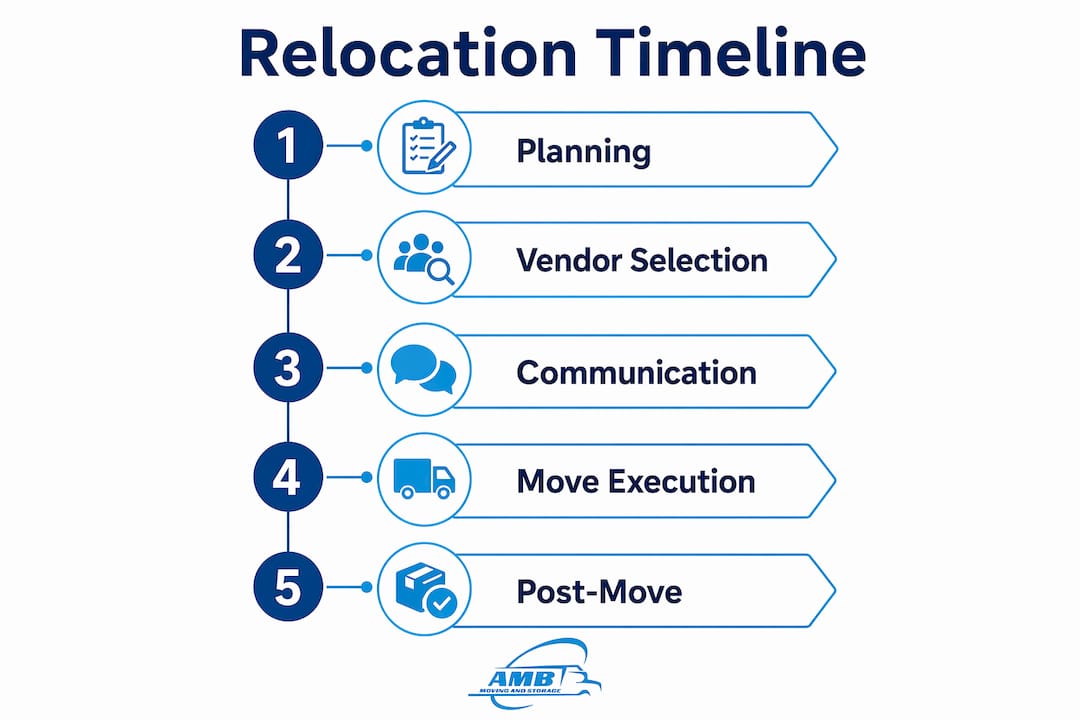
The post-move stabilization phase is the one most businesses forget to plan for. Expect 60–90 days of adjustment before productivity fully returns to baseline. Budget for it, schedule for it, and assign someone to own it.
How do you coordinate internet, leases, and vendors on time?
Logistics coordination is where office moves fail most visibly. The tasks below have hard lead times that cannot be shortened by throwing money at them.
The lease is the foundation of your entire relocation logistics plan. Before you sign anything, your legal team must review restoration clauses. Commercial leases often require tenants to restore the space to its original condition at move-out, and that remediation cost can exceed the cost of the physical move itself. Budget for this in month one of planning, not month eleven.
Internet ordering is the single most time-sensitive task in the entire process. Order internet the same day you sign the lease. Dedicated internet access (DIA) and fiber circuits require permitting, infrastructure work, and carrier scheduling that routinely takes 60–120 days. Movers can arrive on time, furniture can be placed perfectly, and your team can still sit idle for weeks because circuits were ordered late.
Critical logistics checklist with timing
- 6–12 months out: Engage a tenant-side real estate advisor, review existing lease exit clauses, scope restoration costs, and set the total relocation budget.
- 3–6 months out: Sign new lease, order internet immediately, select and contract commercial movers, engage IT vendors, and confirm workspace software needs.
- 1–3 months out: Begin IT infrastructure setup at the new site, finalize packing schedules by department, and send the first employee communication.
- 2–4 weeks out: Conduct a full tech dry run, confirm all vendor arrival windows, and brief department leads on move day logistics.
- Move day: Activate the move day command center, assign floor leads, and keep IT support on site.
Vendor selection deserves the same rigor as lease negotiation. The most successful office moves align closely with lease strategy, vendor selection, and operational goals, not just furniture transport. Select your commercial mover based on experience with interstate and long-distance commercial work, not just proximity.
Pro Tip: Negotiate vendor contracts before you need them. Carriers, IT integrators, and commercial movers all have capacity constraints. Locking in contracts 4–6 months out gives you better pricing and guaranteed availability.
Staggering employee moves across 60–90 days rather than executing a single cutover day reduces logistical pressure and protects operational continuity. Plan wave schedules by department, starting with teams that have the lowest client-facing dependencies.
What steps ensure minimal operational disruption during the move?
Operational continuity is the real measure of a successful relocation. Physical logistics are manageable. Keeping the business running while they happen is the harder problem.
Phased employee moves across 60–90 days outperform single cutover days on every operational metric. Move your back-office and support teams first, then client-facing departments, then leadership. Each wave gives you a chance to fix problems before they affect revenue-generating teams.
A tech dry run 1–2 weeks before move day identifies connectivity failures, VPN issues, and hardware conflicts while there is still time to fix them without disrupting operations. Skipping this step is the most expensive shortcut in any office move.
A tech dry run 1–2 weeks before move day is non-negotiable. Run every system your teams depend on: VoIP phones, video conferencing, file servers, cloud access, and security systems. Document every failure and assign a fix owner with a 48-hour deadline. Problems found during a dry run cost hours to fix. The same problems found on move day cost days.
Employee communication is a force multiplier. Teams that understand the move schedule, know their move date, and have a channel to ask questions transition faster and with less friction. Send a move FAQ to all staff 8 weeks out, hold department briefings at 4 weeks, and publish a move day guide 1 week out. Assign an HR lead to manage questions and concerns throughout.
Overlap rent is a cost most businesses resist budgeting for and then pay anyway. Running two leases simultaneously for 30–60 days gives your IT team time to set up the new space before anyone moves in. It also gives you a fallback if move day complications arise. Build this into your financial model from the start.
Set up a move day command center at the new location. Staff it with your facilities lead, an IT technician, and an HR representative. Give every employee a direct contact number. Most move day problems are small and fixable in minutes if someone is empowered to act immediately.
Pro Tip: Install occupancy sensors in the new space before the first wave of employees arrives. The utilization data from the first 90 days will tell you whether your floor plan matches how your teams actually work, and you can adjust before habits calcify.
How do you build an effective office moving checklist?
A checklist without owners and deadlines is just a list. The difference between a functional office moving checklist and a document that gets ignored is accountability structure.
Every row in your checklist needs four fields: the task, the owner, the due date, and the current status. That structure forces clarity. When a task slips, you know immediately who is responsible and how far behind the schedule has fallen.
Building your checklist by department
- Legal: Lease exit review, restoration cost estimate, new lease execution, vendor contract review.
- IT: Internet order confirmation, network infrastructure setup, hardware inventory, dry run scheduling, move day support plan.
- HR: Employee communication calendar, wave schedule by department, FAQ document, feedback channel setup, post-move survey.
- Facilities: Vendor coordination, packing supply procurement, floor plan finalization, move day logistics, post-move punch list.
- Finance: Relocation budget approval, overlap rent provision, restoration cost reserve, vendor payment schedule.
Tailor the checklist depth to your business size. A 50-person team needs a simpler checklist than a 400-person organization with multiple departments and a long-distance moving component across state lines. The structure stays the same; the number of rows scales with complexity.
Review the checklist in a weekly cross-functional meeting from the moment planning begins. The cadence matters as much as the content. Teams that review progress weekly catch slipping tasks before they become crises. Teams that review monthly discover problems too late to fix without cost.
| Checklist element | Why it matters |
|---|---|
| Assigned task owner | Prevents tasks from falling between departments |
| Fixed due date | Creates accountability and enables early warning |
| Status tracking | Gives leadership real-time visibility into move readiness |
| Cross-departmental scope | Catches dependencies that single-team lists miss |
A detailed relocation checklist with assigned owners, due dates, and status tracking reduces missed tasks and improves cross-team coordination, particularly for organizations managing 200–500 hybrid employees across multiple locations. The checklist is also your post-move audit tool. After stabilization, review every row to identify what took longer than planned and why. That data makes your next relocation faster and cheaper.
What I’ve learned from watching office moves succeed and fail
The pattern is consistent. Businesses that treat relocation as a cross-functional change program rather than a facilities project execute better moves. The ones that assign it to one person in operations, skip the cross-departmental checklist, and start planning six months late pay for it in downtime, employee frustration, and budget overruns.
The two costs that blindside businesses most often are internet provisioning delays and lease restoration fees. Both are entirely predictable and entirely avoidable with early action. Order internet the day you sign the lease. Read the restoration clause before you sign anything. These are not complex tasks. They just require doing them at the right time.
Phased moves feel slower but perform better. Every business I have seen attempt a single cutover day for more than 100 employees has experienced significant disruption. Waves give you control. They give your IT team time to fix problems between groups. They give your employees a sense of order rather than chaos.
Employee trust is the hidden variable in relocation success. Teams that receive clear, early, and honest communication about the move timeline stay engaged. Teams that find out about the move late, or receive vague answers to direct questions, start updating their resumes. The communication plan is not a soft deliverable. It is a retention tool.
Post-move data is underused. Occupancy sensors, workspace utilization software, and a simple 30-day employee survey will tell you whether the new space is working. Act on that data in the first 90 days, while adjustments are still cheap and easy.
— AMB
Ambmovingservices supports your business relocation from day one
Planning a commercial move across state lines requires more than a truck and a timeline. Ambmovingservices specializes in interstate and commercial moves for businesses of all sizes, with experience coordinating phased relocations, long-distance logistics, and multi-state moves that keep operations running throughout the transition.
From the first planning call to the final delivery at your new location, Ambmovingservices provides the coordination and expertise your move requires. Whether your business is relocating across town or across the country, the team at Ambmovingservices builds a move plan around your operational schedule, not the other way around. Request a detailed moving quote today and get a timeline built specifically for your business.
Key takeaways
A successful business relocation requires phased planning starting 6–12 months out, with internet ordered on lease-signing day and employee moves staggered across 60–90 days to protect operational continuity.
| Point | Details |
|---|---|
| Start planning 6–12 months out | Lease review, restoration budgeting, and vendor selection all require this lead time. |
| Order internet on lease day | Provisioning takes 60–120 days; late orders cause move-in delays regardless of other logistics. |
| Phase employee moves over 60–90 days | Staggered waves reduce disruption and give IT time to fix problems between groups. |
| Run a tech dry run 1–2 weeks before move day | Connectivity and system failures found early cost hours to fix; found on move day, they cost days. |
| Build a checklist with owners and due dates | Accountability structure prevents tasks from falling between departments and keeps the timeline on track. |
FAQ
How far in advance should a business start planning a relocation?
Start planning 6–12 months before your target move date. This window covers lease review, vendor selection, internet ordering, and budget scoping, all of which have lead times that cannot be compressed.
Why does internet provisioning take so long for office moves?
Internet provisioning for dedicated circuits takes 60–90 days for on-net buildings and 60–120 days or more for off-net buildings. Permitting, infrastructure work, and carrier scheduling drive these timelines, not administrative delays.
What is a tech dry run and when should it happen?
A tech dry run is a full test of all office systems at the new location, run 1–2 weeks before move day. It identifies connectivity failures, hardware conflicts, and VPN issues while there is still time to fix them without disrupting operations.
How do staggered employee moves reduce operational disruption?
Moving employees in waves over 60–90 days, rather than all at once, reduces logistical pressure and gives IT teams time to resolve issues between groups. This approach consistently outperforms single cutover days for organizations with more than 50 employees.
What does a commercial lease restoration clause mean for relocation costs?
A restoration clause requires tenants to return the space to its original condition at move-out. Remediation costs can exceed the cost of the physical move itself, so budget for this expense at the start of planning, not at the end of the lease term.