


TL;DR:
- Business relocation involves carefully planning the transfer of a company’s operations to improve costs, market access, or growth over a period of six to twelve months. It requires synchronized management of logistics, IT infrastructure, compliance, and personnel, with early and thorough planning essential for success. Proper execution includes detailed site selection, comprehensive budgeting, strategic IT sequencing, and clear communication to ensure minimal disruption and optimal outcomes.
Business relocation is defined as the planned transfer of a company’s operations, assets, workforce, and legal registrations from one facility to another, with the goal of improving cost structure, market access, or growth capacity. Far from a simple logistics exercise, a well-executed corporate move requires coordinated planning across facilities management, IT infrastructure, HR, finance, and legal compliance. Blue Cape Economic Advisors, Hughes Marino, and The Tradable all confirm that businesses treating relocation as a strategic program rather than a moving project achieve significantly better outcomes. The difference between a smooth transition and a costly disruption almost always comes down to how early and how thoroughly the planning begins.
What does understanding business relocation really involve?
Business relocation, also called corporate relocation or commercial moving, is a multi-phase operational program that typically spans 6 to 12 months from initial strategic planning through post-move stabilization. That timeline is not conservative padding. It reflects the real lead times required for lease negotiation, IT infrastructure setup, regulatory compliance updates, and workforce communication. Businesses that compress this window consistently face higher costs, extended downtime, and employee attrition.
The core insight every decision-maker needs upfront: relocation impacts cost structure, compliance exposure, customer experience, and talent access simultaneously. A move to a lower-rent market may save on occupancy costs while increasing labor costs if the talent pool is thinner. A move across state lines triggers new tax registrations, business licenses, and potentially Corporate Transparency Act reporting obligations. None of these factors can be evaluated in isolation.
The business relocation guide that actually works treats the project as three parallel programs running at once: a logistics program, a technology program, and a change management program. Each has its own workstreams, owners, and milestones. Collapsing them into a single moving checklist is the most common planning failure.
What are the key phases and timeline of a business relocation?
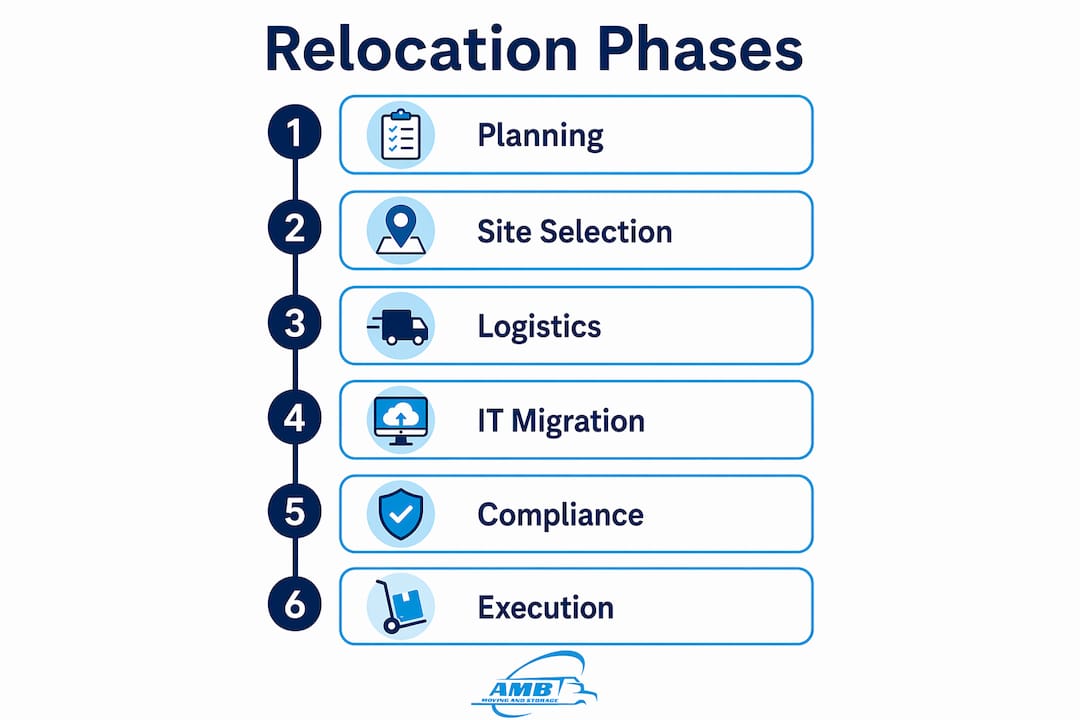
A phased relocation timeline with defined milestones is the single most effective tool for reducing risk. Here is how the phases break down in practice:
- Strategic planning (months 6 to 12 before move day): Define the business case, establish a relocation committee, appoint a relocation lead, and conduct site selection. This phase ends with a signed lease and an approved budget.
- Preparation (months 3 to 4 before move day): Engage movers, IT vendors, and telecom providers. Begin fit-out design, notify employees and key customers, and initiate compliance updates including new business registrations and tax filings.
- Pre-move execution (weeks 2 to 8 before move day): Complete IT infrastructure installation at the new site, begin device imaging and data pre-copy, pack non-essential items, and confirm vendor schedules.
- Move execution: Schedule the physical move on weekends or holidays to limit operational disruption. Use phased moves for larger operations so critical functions remain live throughout.
- Post-move stabilization (weeks 1 to 4 after move day): Complete IT system testing, conduct damage surveys, collect employee feedback, and resolve open issues before declaring the move complete.
Workstreams across facilities, IT, HR, and finance must run in parallel, not sequentially. Waiting for the lease to be signed before contacting IT vendors, for example, can push circuit installation lead times past your move date.
Pro Tip: Appoint a dedicated relocation lead with authority to make decisions across departments. Committees without a single accountable owner consistently miss milestones and generate conflicting priorities.

How do you evaluate and select the right location for your business?
Site selection is the decision that determines whether the relocation delivers on its strategic promise. Most businesses focus on rent per square foot and miss the variables that drive total occupancy cost. Effective site selection incorporates rent, taxes, common area maintenance charges, tenant improvement allowances, insurance, fit-out costs, and lease duration into a weighted scoring model.
Beyond the numbers, location affects your business in ways that compound over time. Proximity to your existing customer base, access to the talent pools your roles require, and alignment with your brand positioning all belong in the evaluation. A professional services firm relocating from a central business district to a suburban office park may save 20% on rent while losing credibility with enterprise clients who judge address quality.
The table below shows the key factors to score when comparing candidate sites:
| Evaluation factor | What to assess |
|---|---|
| Total occupancy cost | Rent plus CAM, taxes, insurance, and fit-out amortized over lease term |
| Lease flexibility | Break clauses, renewal options, and expansion rights |
| Talent access | Commute times, transit access, and proximity to target labor markets |
| Customer proximity | Distance from key accounts and trade area demographics |
| Compliance fit | Zoning, permits, and state-specific regulatory requirements |
Pro Tip: Request a full lease abstract from your attorney before signing. Landlords routinely include clauses on permitted use, subletting, and restoration obligations that create significant financial exposure if missed during negotiation.
What are the comprehensive costs involved in a business relocation?
Business relocation costs extend well beyond the moving company invoice. Decision-makers who budget only for physical moving consistently face a 30% to 50% cost overrun once all categories are accounted for. A realistic budget must include:
- Physical moving: Professional commercial movers, packing materials, specialty equipment handling, and insurance coverage for assets in transit
- IT and telecom: Circuit installations, structured cabling, device imaging, server migration, and new hardware procurement
- Facility fit-out: Signage, furniture, partitioning, electrical upgrades, and any tenant improvement work not covered by the landlord’s allowance
- Lease overlap: Dual rent during the transition period, which can run two to four months depending on notice periods and fit-out timelines
- Productivity loss: Reduced output during packing, the move itself, and the stabilization period. For a 50-person office, even two weeks of 20% reduced productivity represents a material cost
- Compliance and legal: New state business registrations, tax registrations, updated licenses, attorney fees, and any Corporate Transparency Act filings
- Employee support: Relocation assistance packages for key staff, recruitment costs if employees choose not to follow the business, and temporary workspace costs
A cost-benefit analysis comparing total relocation costs against the projected savings or revenue gains over a three-year horizon is the standard framework for justifying the investment to a board or ownership group. Engage a finance professional and a tax advisor before finalizing the budget. State-to-state moves in particular carry tax implications that vary significantly by destination.
For a detailed breakdown of what long-distance commercial moves actually cost, the moving cost guide from Ambmovingservices provides current benchmarks across move sizes and distances.
How do you plan IT, data migration, and operational continuity during a move?
IT failure is the most common cause of extended downtime during a business relocation. The reason is almost always sequencing. Circuit installations and structured cabling can require 30 to 90 working days of lead time after lease signing. Businesses that start this process late have no recovery option except expensive temporary solutions.
The steps for relocating a business’s IT infrastructure follow a specific sequence:
- Immediately after lease signing: Order circuits, engage your telecom provider, and schedule structured cabling installation. Do not wait for fit-out design to finalize.
- Eight weeks before move day: Begin bulk pre-copy of data to the new environment. This reduces the volume of data requiring migration during the final cutover window.
- Two to four weeks before move day: Complete infrastructure installation and begin parallel testing of network, phone, and internet systems at the new site.
- Move weekend: Execute the final incremental data sync and cutover. IT cutover plans must include pre-defined rollback triggers and validation checkpoints so teams can revert to the old environment if critical systems fail validation.
- Weeks one to four post-move: Test all systems under live load, resolve connectivity issues, and confirm backup and recovery processes are functioning at the new site.
Locking IT cutover sequencing from infrastructure to user access reduces chaos and isolates issues faster than an unstructured approach. Treat the cutover like a software release with a defined go/no-go decision point, not a moving day task that gets handled as it comes up.
Pro Tip: Assign a dedicated IT lead who owns the cutover plan independently from the facilities lead. When one person tries to manage both, IT tasks consistently get deprioritized until it is too late to recover the timeline.
What are best practices for managing people, compliance, and communication?
The human and regulatory dimensions of a business relocation are where most plans have the least detail and the most risk. Clear, early, and honest communication with employees is not a courtesy. It is a retention strategy. Employees who learn about a relocation from rumor rather than leadership are significantly more likely to begin job searching before the move is announced.
A strong people and compliance plan covers:
- Employee communication: Announce the move as early as operationally possible. Provide a clear timeline, address commute and compensation impacts directly, and offer a formal Q&A process.
- Relocation support: For key employees whose commute increases materially, consider relocation assistance packages, flexible work arrangements, or compensation adjustments to reduce attrition risk.
- Compliance updates: Corporate Transparency Act reporting, state business registrations, tax registrations, professional licenses, and data protection compliance must all be updated to reflect the new address. These are not post-move tasks. Begin them during the preparation phase.
- Customer and partner communication: Notify key accounts, update your Google Business Profile, website, contracts, and marketing materials before move day. A customer who cannot reach you because your phone number or address is wrong loses confidence quickly.
- Post-move feedback: Collect structured feedback from employees in the first two weeks after the move. Early issue identification accelerates the return to full productivity and surfaces problems before they become embedded operational friction.
An office moving checklist that integrates compliance tasks alongside physical move milestones is the most practical tool for keeping all workstreams on track.
Key takeaways
Successful business relocation requires parallel execution across logistics, IT, compliance, and people management, with governance structures in place at least six months before move day.
| Point | Details |
|---|---|
| Start planning 6 to 12 months out | Strategic planning, site selection, and governance must begin well before the physical move. |
| Budget beyond rent and movers | Include IT, fit-out, lease overlap, productivity loss, and compliance costs for an accurate financial picture. |
| Sequence IT work immediately | Order circuits and cabling the day the lease is signed. Lead times of 30 to 90 days leave no margin for delay. |
| Treat compliance as a parallel workstream | Business registrations, tax updates, and licensing must run alongside physical move preparation, not after it. |
| Communicate early and directly | Employees and key customers told early and honestly are far more likely to remain engaged through the transition. |
What most relocation guides get wrong
After working with businesses across dozens of interstate and long-distance commercial moves, the pattern is consistent: companies underestimate the timeline, overestimate their internal capacity to manage the project, and treat IT as a moving day task rather than a six-month program.
The businesses that relocate smoothly share one characteristic. They appoint a relocation lead with real authority and a cross-functional committee that meets weekly from the moment the lease is signed. They do not wait for the fit-out to finish before calling the telecom provider. They do not announce the move to employees the week before it happens.
The other mistake I see repeatedly is treating the cost-benefit analysis as a formality rather than a genuine decision tool. A move that saves $80,000 per year in rent but costs $200,000 in productivity loss, IT delays, and employee turnover is not a good move. Run the numbers honestly, including the costs that are hard to quantify, before committing.
One more thing: the physical moving company you choose matters more than most decision-makers realize. An experienced commercial moving partner who understands phased moves, sensitive equipment handling, and interstate logistics coordination reduces your risk exposure on move day significantly. Verifying licensing and insurance before signing a contract is not optional. It is the minimum standard.
— AMB
Move your business with confidence using Ambmovingservices
Ambmovingservices specializes in commercial relocations across state lines, with experience managing the logistics complexity that interstate business moves demand. From coordinating phased move schedules to handling sensitive IT equipment and office furniture with care, the team at Ambmovingservices brings the operational discipline your relocation requires. Every commercial move is backed by full licensing, insurance, and federal compliance, so you are protected throughout the process. Whether you are relocating a single office or a multi-site operation, get a customized moving quote and find out how Ambmovingservices can reduce your downtime and protect your assets from day one.
FAQ
What is business relocation?
Business relocation is the planned transfer of a company’s operations, workforce, and assets to a new facility, typically spanning 6 to 12 months and requiring coordination across logistics, IT, HR, finance, and legal compliance.
How far in advance should you plan a business move?
Most expert sources recommend beginning strategic planning 6 to 12 months before move day, with site selection, governance structures, and IT vendor engagement completed at least four to six months out.
What does a business relocation checklist need to include?
A complete business relocation checklist covers site selection, lease review, budget development, IT infrastructure planning, compliance updates, employee communication, vendor coordination, move execution scheduling, and post-move stabilization tasks.
What are the biggest costs in a business relocation?
Beyond the moving company fee, the largest cost categories are IT rewiring and infrastructure, facility fit-out, lease overlap during transition, productivity loss, compliance and legal fees, and employee retention or relocation support.
How do you minimize downtime during a business relocation?
Schedule the physical move on weekends or holidays, use phased move strategies so critical functions remain operational, complete IT infrastructure installation and testing at the new site before move day, and have a defined rollback plan for IT cutover events.